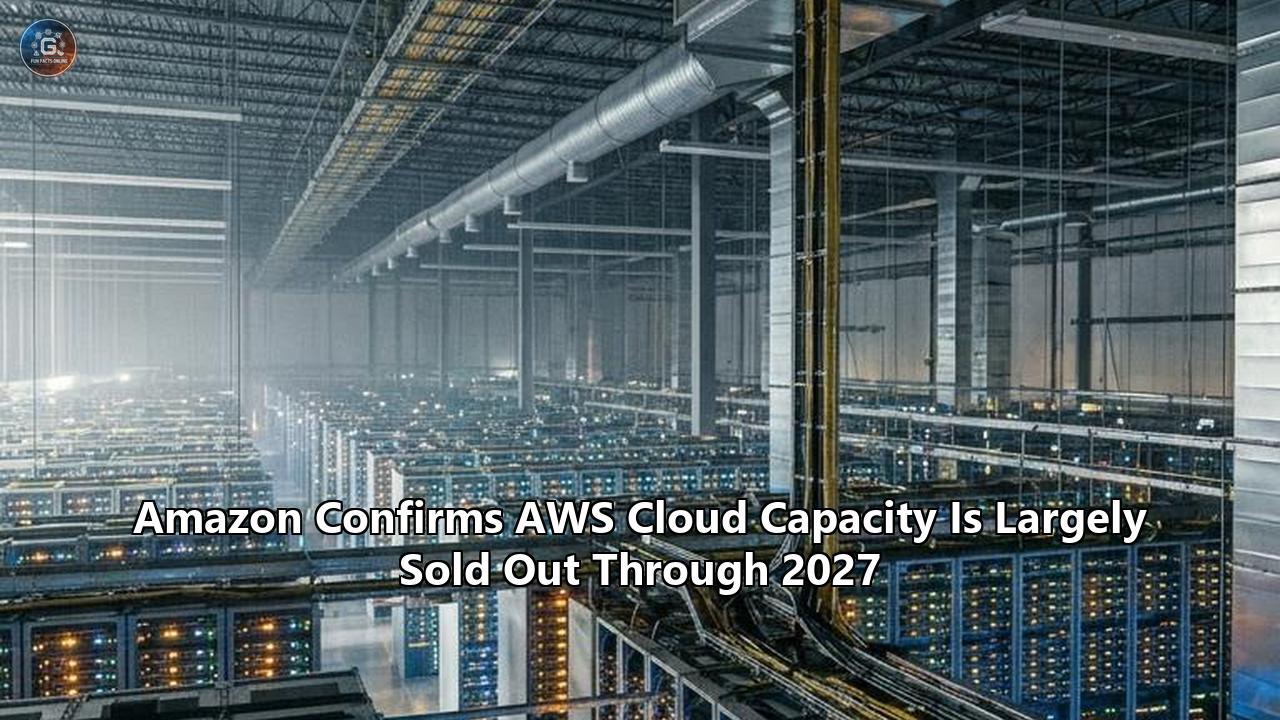
Amazon Web Services has reached an inflection point in the history of enterprise computing: its dedicated data center inventory is nearly depleted for the foreseeable future. Speaking on an Andreessen Horowitz video podcast with venture capitalists Ben Horowitz and Erik Torenberg, Amazon Chief Executive Officer Andy Jassy revealed that large commitments for AWS cloud capacity are sold out through 2027, with substantial portions of 2028 already reserved.
Even with Amazon spending roughly $220 billion in capital expenditures in 2026 alone—and analysts projecting capital budgets to exceed $280 billion in 2027—the company cannot build infrastructure fast enough to satisfy enterprise appetite. "Even spending $220 billion this year, we’re leaving a meaningful amount of demand on the table," Jassy stated. "Obviously, at this point ’26 is sold out. We always leave a certain amount for On Demand, and our inference service Bedrock or EC2, but ’27 is largely sold out. A good chunk of ’28 is sold out".
The disclosure exposes the severe physical friction that now dictates digital computing. For two decades, public cloud computing operated under the assumption of infinite elasticity: an engineer with a corporate credit card could spin up thousands of virtual machines in seconds and spin them down an hour later, paying only for the compute cycles consumed. Today, generative artificial intelligence model training and large-scale agentic inference have reversed that model. Large capacity allocations now behave like industrial commodities, secured years in advance through multi-billion-dollar take-or-pay forward contracts.
The ramifications extend across the entire technology sector. Hyperscale competitors Microsoft Azure and Google Cloud Platform are confronting their own severe capacity constraints, specialized "neocloud" providers such as Lambda and CoreWeave are aggressively angling to capture unserved enterprise demand, and chief technology officers are being forced to rethink their entire infrastructure roadmaps. By contrasting Amazon’s technical and economic responses with those of its peers, the broader industry reveals a stark divide in how the race for compute is fought across silicon, energy, and business models.
Elasticity Inverted: The New Economics of Pre-Committed Cloud Capacity
To understand the operational gravity of Jassy’s announcement, one must dissect the structural difference between consumer-facing on-demand services and the massive compute blocks required to train and run modern frontier models. Cloud computing historically thrived on statistical multiplexing: because enterprise software workloads have varying peaks and valleys, a provider could oversubscribe underlying physical hardware, assuming that not every customer would demand peak compute simultaneously.
Generative artificial intelligence shatters statistical multiplexing. A training cluster of 50,000 graphics processing units (GPUs) or application-specific integrated circuits (ASICs) running an active training loop must operate at sustained, continuous load—drawing maximum wattage and saturating non-blocking network fabrics 24 hours a day for months at a stretch. These workloads cannot be quietly throttled, paused, or co-located on shared nodes without catastrophic performance degradation caused by inter-node synchronization latency.
Consequently, Amazon sells capacity assurance through two distinct mechanisms:
- On-Demand Capacity Reservations (ODCR): Allows enterprise clients to reserve compute capacity for specific Amazon Elastic Compute Cloud (EC2) instance types within a designated Availability Zone, ensuring workloads do not fail due to capacity exceptions during traffic spikes.
- EC2 Capacity Blocks for ML: Fixed-duration, future-dated reservations specifically engineered for high-performance machine learning workloads, guaranteeing access to contiguous clusters connected via high-bandwidth interconnects (such as AWS’s Elastic Fabric Adapter) for a defined window.
Jassy emphasized that standard on-demand services—including baseline EC2 instances and managed inference API endpoints like Amazon Bedrock—retain a dedicated buffer. However, the foundational blocks of high-density clusters are gone through 2027.
Traditional Cloud Delivery (2006–2022)
[Data Center Pool] ---> [Dynamic Multiplexing] ---> [Instant On-Demand Elasticity]
                                                    (Billed by the Second)

Frontier AI Cloud Delivery (2024–Present)
[Power & Silicon Pipeline] ---> [Multi-Year Forward Allocation] ---> [Locked Capacity Blocks]
                                                                     (Multi-Year Take-or-Pay)
Cloud analyst David Linthicum observed that while public reactions framed the news as an immediate shutdown of cloud access, the operational reality is more nuanced. Linthicum pointed out that enterprises can still log into the AWS Management Console to provision compute for ordinary tasks. The absolute shortage lies in hyperscale, contiguous, multi-megawatt allocations—the exact infrastructure foundation enterprise teams and frontier labs require to compete in the current technology cycle.
This dynamic is reflected directly on Amazon's balance sheet. Amazon’s remaining performance obligations (RPO)—an accounting metric that tallies contracted future revenue from long-term commitments that have not yet been recognized—approached $500 billion in mid-2026. The company is no longer operating an on-demand infrastructure utility; it is operating a pre-sold backlog pipeline.
Silicon Architecture: Trainium and Inferentia Against the Nvidia Monopoly
The supply squeeze is fundamentally a hardware allocation problem. AWS, Microsoft Azure, and Google Cloud have approached this limitation through starkly contrasting hardware and packaging methodologies.
Silicon Ecosystem Approaches

Vendor           Primary In-House Silicon    External Silicon Reliance    Interconnect / Fabric
-----------------------------------------------------------------------------------------------
Amazon AWS       Trainium2, Inferentia2      Nvidia Blackwell / H200      NeuronLink-v2 / EFA
Microsoft Azure  Maia 100, Cobalt 100        Nvidia Blackwell (Heavy)     Infiniband / Ultra Ethernet
Google Cloud     TPU v5p, TPU v6 (Trillium)  Nvidia Blackwell (Moderate)  Optical Circuit Switching
AWS has leaned heavily on Annapurna Labs, the chip design firm it acquired in 2015. Rather than relying exclusively on Nvidia’s merchant silicon, Amazon has bet its margin profile on its custom Trainium and Inferentia chip families. The company’s flagship machine learning cluster, the EC2 UltraCluster, deploys its second-generation Trainium2 chips in interconnected fabrics scaling up to 100,000 chips linked by NeuronLink-v2, delivering high-throughput non-blocking petabit-scale networking.
The technical and commercial tradeoffs of this approach are pronounced:
1. Cost and Supply Isolation vs. The CUDA Software Moat
By designing Trainium2, AWS reduces its exposure to Nvidia’s gross margins (which hover near 75%) and bypasses portions of Nvidia’s constrained distribution queues. AWS can price Trainium2 clusters at an estimated 30% to 40% discount compared to equivalent Nvidia Hopper or Blackwell instances on a price-to-performance basis.
The tradeoff is the software layer. Nvidia’s CUDA platform represents twenty years of deep optimization across libraries, compilers, and algorithmic frameworks. While AWS provides the Neuron SDK—enabling PyTorch and JAX codebases to compile down to Trainium architecture—developers frequently encounter missing operator kernels, subtle numerical instability, and higher debugging overhead. For companies racing to release models, paying a cash premium for Nvidia silicon to avoid engineering delays often outweighs theoretical cloud savings.
2. High-Bandwidth Memory (HBM) and Advanced Packaging Dependencies
Custom ASICs do not entirely insulate cloud providers from supply constraints. Both Nvidia’s Blackwell GPUs and Amazon’s Trainium2 processors depend on the same underlying manufacturing bottlenecks: TSMC’s 3-nanometer and 4-nanometer foundry nodes, TSMC’s Chip-on-Wafer-on-Substrate (CoWoS) advanced packaging, and global allocations of High-Bandwidth Memory (HBM3e and HBM4) produced by SK Hynix, Samsung, and Micron.
Jassy confirmed that raw component supply remains deeply constrained: "I wish I could tell you that I thought the supply constraints would be just a 2027 issue. I think we'll see them in different components for several years". A shortage of HBM or advanced packaging substrates throttles custom ASIC production as severely as it throttles merchant GPU boards.
3. Competitor Silicon Strategies Compared
Google Cloud presents the starkest contrast to Amazon’s hardware approach. Google began its Tensor Processing Unit (TPU) journey more than a decade ago. Its sixth-generation TPU, codenamed Trillium, runs on a software platform deeply integrated with Google DeepMind’s toolchains, leveraging proprietary Optical Circuit Switches (OCS) that dynamically reconfigure cluster topology at the optical layer without electrical-to-optical conversion. This allows Google to run training jobs across tens of thousands of TPU cores with industry-leading network reliability.
Microsoft Azure has taken a more bifurcated stance. While it develops its custom Maia 100 accelerator and Cobalt CPU, Microsoft has prioritized being the primary commercial deployment ground for Nvidia’s bleeding-edge clusters, buying Nvidia systems by the hundreds of thousands to satisfy the infrastructural appetite of OpenAI. Azure’s approach reduces software friction for customers at the expense of steep capital expenditures and thinner operational margins.
Power, Heat, and the Industrial Realities of the Grid
Even if TSMC and memory manufacturers could instantly multiply chip output tenfold, AWS, Azure, and Google Cloud would remain constrained by a more stubborn reality: the physical electrical grid. The modern data center bottleneck has shifted from server procurement to utility interconnection queues.
A decade ago, a standard enterprise hyperscale data center required 20 to 40 megawatts (MW) of power. Modern generative AI computing campuses routinely demand between 500 MW and 1 gigawatt (GW)—the electrical consumption of a medium-sized metropolitan city. Securing utility agreements, constructing high-voltage substations, and navigating regional transmission organizations (RTOs) like PJM Interconnection in the mid-Atlantic United States now requires four to seven years.
Data Center Development Timeline Mismatch

Component Fabrication (Chips, Optics, Servers)
[====== 6–12 Months ======]

Data Center Shell Construction
[============ 18–24 Months ============]

Substation & Utility Power Interconnection
[==================================== 48–84 Months ====================================]
This structural timing mismatch explains why Amazon confirms its large-scale capacity is spoken for through 2027: the physical structures set to go live in that timeframe began development years prior. As Jassy noted during an earlier earnings briefing, investments in data center real estate and electrical design must be deployed roughly two years before physical servers are bolted into racks.
To mitigate grid stagnation, hyperscalers are adopting radically divergent energy strategies:
AWS: Behind-the-Meter Nuclear and On-Site Generation
Amazon shocked both the technology and utility sectors by purchasing the Cumulus data center campus from Talen Energy for $650 million. The facility connects directly "behind the meter" to the 2.5 GW Susquehanna nuclear power plant in Pennsylvania. By siphoning clean nuclear energy directly before it reaches the public transmission grid, AWS attempted to bypass regional transmission queues and secure reliable baseload power.
This model encountered regulatory scrutiny. The Federal Energy Regulatory Commission (FERC) and regional utilities raised fundamental objections over transmission cost allocation, questioning whether hyperscalers should be permitted to co-opt existing baseload energy without funding broad grid improvements. Amazon has simultaneously invested hundreds of millions of dollars into small modular reactors (SMRs) through agreements with X-energy to build private nuclear capacity by the 2030s.
Microsoft: Merchant Nuclear Plant Restarts
Microsoft chose a different regulatory vector. Instead of a behind-the-meter co-location, Microsoft partnered with Constellation Energy to revive the retired Unit 1 reactor at Three Mile Island (renamed the Crane Clean Energy Center). Under a 20-year power purchase agreement, Microsoft will purchase 100% of the facility’s 835 MW output, which will be injected directly onto the public grid to offset Azure’s regional draw. This front-of-the-meter structure sidesteps certain interconnection disputes but requires navigating the technical, regulatory, and mechanical restart of a nuclear facility decommissioned years ago.
Google: Advanced Geothermal and SMR Fleets
Google has focused its energy investments on next-generation clean power. In addition to a landmark agreement with Kairos Power to construct a 500 MW fleet of small modular reactors across seven sites by 2035, Google has deployed commercial enhanced geothermal projects with Fervo Energy in Nevada. Geothermal offers 24/7 firm power with a much smaller physical surface footprint than solar or wind, though its capacity cannot yet scale to the multi-gigawatt levels demanded by next-generation frontier training clusters.
Neoclouds and the Shifting Landscape of Cloud Arbitrage
The inability of hyperscalers to satisfy immediate demand has created a thriving secondary market. Specialized GPU clouds—frequently termed "neoclouds"—such as Lambda, CoreWeave, Together AI, and Crusoe have raised billions in debt and equity to exploit the shortfall.
When AWS announces that dedicated clusters are sold out through 2027, enterprise purchasing teams do not simply pause their AI roadmaps; they look elsewhere.
Enterprise Allocation Dilemma

                      [Enterprise AI Workload]
                                 |
         +-----------------------+-----------------------+
         |                                               |
         v                                               v
[Hyperscaler: AWS/Azure]                       [Neocloud: Lambda/CoreWeave]
  - Massive auxiliary services (S3/IAM)          - Rapid node availability
  - Multi-year backlog for massive clusters      - Pure bare-metal performance
  - Heavy governance & compliance frameworks     - Lacks mature enterprise ecosystem
  - High egress fees & infrastructure lock-in    - Debt-leveraged, hardware asset-heavy
The executive perspective from the neocloud tier reveals this dynamic clearly. Dave Ward, Head of Cloud Services at Lambda and an 18-year AWS veteran who spent a year as Andy Jassy’s technical assistant, highlighted the operational opening: "Right now, large hyperscalers and others are turning away large enterprises. And so it's an opportunity to win that business".
However, Ward acknowledged the strategic tension facing every specialized compute provider: "Winning that business is one thing, but keeping it will take more than GPUs... Then the question is why would they stay with a neocloud in the long term? Why wouldn't they just go back to a hyperscaler?"
The differences between hyperscalers and neoclouds illustrate profound architectural and operational tradeoffs:
Infrastructure Architecture: Bare Metal vs. Hypervisor Overhead
Hyperscalers build their systems for multi-tenancy, security isolation, and enterprise compliance. Amazon deploys its proprietary AWS Nitro System, offloading networking, storage virtualization, and security monitoring to dedicated ASIC cards so that guest instances can consume nearly 100% of host CPU power. Even with Nitro, enterprise cloud stacks carry complex identity access management (IAM), audit logging, and network gateway overhead.
Neoclouds bypass standard enterprise virtualization layers. They provision bare-metal GPU nodes running optimized Linux kernels directly linked over Nvidia Quantum-2 InfiniBand fabrics. For pure machine learning training runs, this architectural simplicity eliminates virtualization tax and minimizes jitter, delivering marginally faster training times for identical cluster sizes.
The Broader Ecosystem Moat
Where neoclouds struggle is in the surrounding software infrastructure. An enterprise does not run an artificial intelligence application solely on raw compute. The workflow requires data lakes (Amazon S3), transactional databases (Amazon Aurora), secure operational boundaries (AWS PrivateLink), managed vector databases, streaming ingest pipelines (Amazon Kinesis), and stringent regulatory compliance certifications (SOC 2 Type II, FedRAMP High, HIPAA).
When an enterprise trains a model on a neocloud, it must either migrate petabytes of sensitive internal data outside its established hyperscaler security perimeter—incurring steep data egress charges and regulatory scrutiny—or maintain a fragile multicloud bridge.
Financial Viability and Capital Structures
The capital structures of these competing platforms are fundamentally distinct. Amazon, Alphabet, and Microsoft generate tens of billions of dollars per quarter in operational cash flow from their core e-commerce, cloud software, enterprise licensing, and advertising operations, allowing them to fund data center construction internally, even when free cash flow temporarily turns negative due to peak capital expenditure cycles.
Neoclouds rely heavily on debt financing, frequently borrowing against their physical GPU assets as collateral. Because AI accelerators depreciate rapidly as new architectures debut every 12 to 18 months, neoclouds carry substantial refinancing risk. If hyperscalers successfully bring massive new megawatt facilities online in 2027 and 2028, a sudden influx of hyperscale compute capacity could spark a price war, compressing neocloud operating margins while their debt obligations remain fixed.
Strategic Repercussions for Enterprise IT
With large allocations of AWS cloud capacity committed for the next several years, chief information officers and engineering leaders are adapting their operations. The era of treating compute as a frictionless, infinitely expandable operational expense has ended.
Organizations are adjusting to this prolonged capacity crunch through four primary technical and strategic adaptations:
1. Workload Bifurcation: Training Remotely, Inferencing Locally
Companies are fundamentally separating training clusters from inference deployments. Frontier model training—requiring tens of thousands of tightly coupled accelerators—is consigned to multi-year forward reservations wherever power and chips exist, often in rural data centers geographically distant from the enterprise’s core operational regions.
Inference, however, is being decentralized. Unlike training, inference requests can be distributed across smaller, geographically diverse clusters. By optimizing inference to run on smaller footprints, enterprises can take advantage of AWS’s distributed on-demand buffers and edge Availability Zones without requiring massive contiguous blocks.
2. Algorithmic and Structural Efficiency
Software engineers are turning to model efficiency techniques to circumvent hardware shortages:
- Quantization: Compressing 16-bit floating-point (FP16) model weights into 8-bit (FP8) or 4-bit (INT4) representations drastically reduces memory bandwidth requirements, allowing larger models to run on smaller, readily available server instances.
- Speculative Decoding: A architectural method where a small, fast draft model generates token candidates that are verified in parallel by a larger model, significantly reducing inference latency and chip utilization per request.
- Small Language Models (SLMs): Rather than routing routine corporate queries to massive 400-billion-parameter foundation models, enterprises are distilling task-specific intelligence into 3-billion to 8-billion-parameter models that can run locally on standard enterprise compute instances or consumer-tier enterprise servers.
3. Price Adjustments and Capacity Governance
Scarcity has directly driven price inflation for high-end compute. AWS quietly raised its rates for EC2 Capacity Blocks for ML by roughly 15% across all global regions. The price increase covered both Nvidia systems (P5, P5e, P4d) and Amazon’s in-house silicon instances (Trn1, Trn2).
Enterprise Resource Management Evolution

Dimension           Legacy Cloud Model (Pre-2023)    Scarcity-Era Cloud Model (2024–2028)
-----------------------------------------------------------------------------------------
Procurement Cycle   Minutes (Self-service console)   12 to 36 Months (Executive sign-off)
Financial Model     Operational Expense (OpEx)       Mixed OpEx / Heavy CapEx Commitments
Cluster Access      Shared multi-tenant pools        Isolated, dedicated hardware blocks
Architecture Goal   Maximum developer velocity       Maximum token/watt/dollar efficiency
Hardware Diversity  Homogeneous standard x86        Heterogeneous (Nvidia, ASICs, SLMs)
Within engineering organizations, capacity governance has moved from an internal DevOps detail to a boardroom-level metric. Platform teams are introducing strict internal quotas, enforcing automated shutdowns on idle instances, and mandating that any workload requiring more than 64 dedicated accelerators receive vice-presidential approval.
4. Selective Repatriation and Colocation
A notable subset of mature enterprises is stepping back from public hyperscalers entirely for their baseline workloads. By leasing physical wholesale cage space from colocation providers such as Equinix, Digital Realty, or CyrusOne, enterprises are purchasing their own server racks outright.
While on-premises deployments reintroduce the operational friction of hardware maintenance, rack-level power distribution, and physical network engineering, they provide two critical advantages: immunity from cloud provider capacity allocations and the elimination of ongoing cloud platform margins for predictable, steady-state workloads.
Market Dynamics: Hyperscaler Comparison
The current capacity crunch reveals how each major cloud titan is navigating compute shortages, financial strain, and capital allocation:
| Provider | Forward Capacity Status | Primary Strategy | Primary Hardware Bottleneck | Energy Strategy |
|---|---|---|---|---|
| Amazon Web Services | Sold out through 2027; large chunks of 2028 booked | Custom silicon scale (Trainium2), behind-the-meter nuclear, massive $220B CapEx | HBM allocations, physical land/substation development, memory packaging | Direct nuclear plant purchase (Talen/Susquehanna), long-term SMR partnerships |
| Microsoft Azure | Severely constrained; prioritizing core partner commitments | Deep alignment with Nvidia, massive OpenAI cluster scale, custom Maia deployments | Advanced liquid cooling retrofits, multi-gigawatt single-campus power allocations | Merchant nuclear power restarts (Constellation/Three Mile Island) |
| Google Cloud | Heavily booked; internal DeepMind demand competing with external customers | Vertical hardware-software co-design, sixth-generation TPU deployment, OCS fabrics | Foundry wafer allocation at TSMC, advanced packaging capacity | Enhanced geothermal systems (Fervo Energy), fleet SMR deals (Kairos Power) |
Financially, this era is testing Wall Street’s patience. During recent quarters, both Alphabet and Meta saw free cash flows swing into negative territory due to enormous infrastructure expenditures. Amazon’s cash flow after capital expenditures over a trailing twelve-month period similarly flipped from an $18.2 billion surplus to a $7.6 billion deficit, underscoring the massive financial drain of pre-funding multi-year data center construction.
Yet, as Jassy made clear on the a16z podcast, tech leadership views under-investing as a far more dangerous hazard than over-investing: "We’re spending $220bn this year, and we could spend a lot more, and it wouldn’t be a bad use of capital in both medium- to long-term, and I think we still probably wouldn’t satisfy all the demand. There is just an incredible demand right now".
The Road Ahead: Catalysts and Unresolved Questions Through 2028
The revelation that large AWS cloud capacity is essentially unavailable for new large-scale reservations until 2028 sets up several critical technical, market, and regulatory developments to monitor over the next two years.
1. The Inference Transition and Capital Efficiency
The current capacity deficit is partially driven by frontier foundational model training. However, industry economics dictate that training expenditures must eventually yield sustainable revenue via inference. If model architectures stabilize and inference efficiency improves significantly faster than context windows expand, enterprise compute demand could level off before the massive wave of data centers under construction in 2026 and 2027 comes online.
Hyperscalers risk finding themselves over-provisioned with high-cost infrastructure if synthetic reasoning models decouple performance improvements from brute-force parameter scaling. Conversely, if fully autonomous, multi-step agentic systems become mainstream enterprise workflows, token generation volumes could explode exponentially, extending the capacity shortage well into the 2030s.
2. High-Bandwidth Memory (HBM4) Transitions
The memory industry’s transition from HBM3e to HBM4 in 2026 and 2027 represents a critical technological milestone. HBM4 moves to a 2048-bit interface, requiring advanced logic process foundations for the base die.
How successfully foundries like TSMC, Intel Foundry Services, and Samsung execute these advanced packaging nodes will determine whether Amazon and its competitors can actually hit the compute densities promised to customers who have pre-booked capacity years in advance. Any yield complications in advanced memory packaging will directly delay delivery timelines for cloud capacity blocks.
3. Grid Regulatory Interventions and Municipal Pushback
As data centers increasingly strain local utility jurisdictions, regulatory resistance will intensify. Municipalities in Northern Virginia, Silicon Valley, and Dublin, Ireland, have already begun placing caps on data center energy draws or demanding heavy community concessions.
Whether AWS, Azure, and Google can successfully negotiate municipal energy frameworks—and whether projects like behind-the-meter nuclear co-location can survive legal challenges at the federal level—will dictate whether physical capacity delivers on schedule.
The cloud computing market has evolved into a high-stakes, forward-committed commodity sector. Amazon’s acknowledgment that its compute blocks are booked through 2027 confirms that the primary constraint on digital intelligence is no longer software ingenuity or algorithm design. It is the physical rate at which human beings can pour concrete, weave transmission lines, enrich fuel, and fabricate precision silicon at atomic scale. For the next several years, access to the high-performance computing required to build the future will belong almost entirely to those who had the foresight—and the capital—to reserve their place in line years ahead of time.
Reference:
- https://www.fierce-network.com/cloud/aws-sold-out-capacity-thats-good-news-lambda
- https://shattered.io/aws-capacity-largely-sold-out-2027-jassy-220b-2026/
- https://www.chosun.com/english/industry-en/2026/10/25/OGZ47U2LKNEH5AI7NMGIQRNDVI/
- https://www.infoq.com/news/2026/11/aws-capacity-sold-out/
- https://qz.com/amazon-earnings-aws-capacity-cash-flow-ai-spending-102926
- https://www.datacenterdynamics.com/en/news/aws-capacity-largely-sold-out-in-2027-amazon-ceo-claims/
- https://www.techzine.eu/news/infrastructure/145261/aws-has-sold-nearly-all-of-its-cloud-capacity-through-the-end-of-2027/
- https://www.cloudcomputing-news.net/news/aws-capacity-ai-demand-2028/
- https://www.investing.com/news/company-news/amazons-aws-cloud-capacity-largely-sold-out-through-2027-ceo-says-4970563