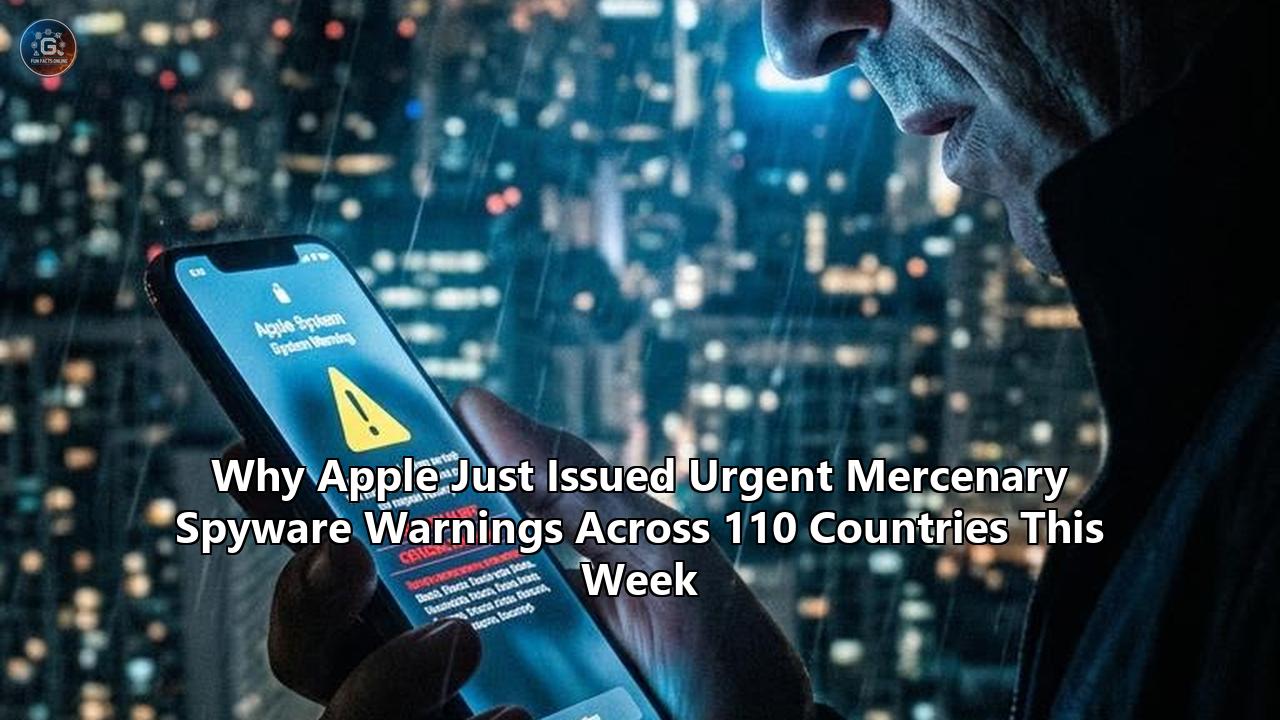
Apple deployed high-confidence threat notifications to targeted iPhone, iPad, and Mac users across 110 countries on Thursday, alerting them that sophisticated commercial surveillance operators had attempted to breach their devices. Unlike routine security advisories that accompany software patches, this coordinated push delivered direct, urgent alerts to individuals singled out by multi-million-dollar cyber weapons.
The latest round represents one of the broadest single-day notification campaigns Apple has ever conducted. Since late 2021, the company has periodically alerted users in more than 150 countries to state-aligned surveillance activity. However, this week’s deployment incorporates an expanded, high-visibility alerting pipeline designed to bypass notification fatigue and break through device siloing. Targets received red alert banners directly on their lock screens and inside their Settings apps, alongside authenticated emails from [email protected] and web banners on their Apple Account dashboard.
┌─────────────────────────────────────────────────────────────┐
│                   APPLE THREAT NOTIFICATION                 │
│                                                             │
│  Apple detected a mercenary spyware attack targeted at     │
│  your iPhone. There are actions you can take now to help   │
│  protect your data and device.                              │
└─────────────────────────────────────────────────────────────┘
The stark message warns recipients that they were personally singled out by advanced mercenary spyware tools. For high-risk individuals, an official Apple spyware warning is often the sole operational indicator that a nation-state or private intelligence vendor is intercepting their encrypted calls, extracting message archives, logging GPS coordinates, and remotely activating their microphones.
The scale of this coordinated release underscores the industrialization of commercial mobile hacking. While the alerts do not disclose specific threat actors or victim identities to protect detection telemetry, the distribution across 110 territories highlights how deeply commercial offensive operations have penetrated global communications networks.
The Target Profile: Precision Surveillance Versus Mass Cybercrime
Mercenary surveillance campaigns operate on an entirely different economic and technical tier than conventional cybercrime. Typical malicious actors rely on opportunistic phishing campaigns, mass password credential stuffing, or broad ransomware droppers that cast wide nets to capture financial credentials. Mercenary spyware campaigns, by contrast, focus on microscopic victim pools.
+-------------------------------------------------------------------------+
|                  COMMERCIAL SPYWARE TARGET TAXONOMY                     |
+-------------------------------------------------------------------------+
|  Civil Society          | Investigative journalists, human rights       |
|                         | attorneys, NGO leads, anti-corruption monitors|
+-------------------------+-----------------------------------------------+
|  Political Infrastructure| Parliamentary opposition, election officials,  |
|                         | campaign strategists, dissident leaders       |
+-------------------------+-----------------------------------------------+
|  Statecraft & Policy    | Foreign service diplomats, trade negotiators,  |
|                         | national security advisors, defense planners  |
+-------------------------+-----------------------------------------------+
|  Enterprise & Legal     | High-profile litigators, cross-border M&A     |
|                         | advisors, investigative audit teams           |
+-------------------------------------------------------------------------+
Surveillance contractors sell their platforms directly to government agencies, security ministries, and intelligence bodies. Because individual zero-click exploit chains cost anywhere between $2 million and $8 million on the private exploit broker market, deploying an attack incurs substantial operational risk and expense. The moment a vendor uses a zero-day exploit against an individual, they risk the vulnerability being captured, analyzed, and permanently patched by the platform vendor.
"Mercenary spyware is precision tooling, meaning that people are targeted because of who they are, what they know, and who they talk to," explained Adam Boynton, Senior Enterprise Strategy Manager at Jamf.
The geographic breadth of this week’s wave—spanning mature democracies, autocratic states, and non-aligned developing nations alike—demonstrates that mercenary surveillance is no longer restricted to isolated domestic crackdowns. It is an instrument of transnational repression and covert statecraft.
Technical Architecture: Zero-Clicks, Blastdoor, and Detection Telemetry
Mercenary spyware vendors such as Israel's NSO Group (creators of Pegasus), the Intellexa consortium (distributors of Predator), Candiru, and Variston rely predominantly on "zero-click" remote code execution vectors. These exploits require zero interaction from the victim: no malicious links clicked, no files downloaded, and no prompts accepted.
                     ZERO-CLICK ATTACK LIFECYCLE

  [ Attacker ]
       │
       ▼ (Sends invisible iMessage/MMS/HomeKit packet)
  [ iPhone ] ──► [ Parsing Service (ImageIO / CoreGraphics / WebKit) ]
                       │
                       ▼ (Triggers memory corruption / Out-of-Bounds Write)
                 [ Blastdoor Sandbox Escape ]
                       │
                       ▼ (Kernel Privilege Escalation)
                 [ Full Device Compromise ]
                       │
                       ├── Real-time Microphone / Camera Surveillance
                       ├── Signal, WhatsApp, iMessage Decryption
                       └── Live GPS Tracking & File System Exfiltration
Historically, vendors deliver zero-clicks through complex data-parsing engines built into default operating system services:
- Media Parsing Engines: Complex file formats (such as crafted PDFs, WebP images, or JBIG2 compression streams) processed by frameworks like ImageIO or CoreGraphics.
- Encrypted Messaging Protocols: Exploits targeting how iMessage, FaceTime, or Apple Wallet parse metadata payloads before the user even opens the notification.
- Font and Web Engines: WebKit and font renderers that contain logic flaws permitting out-of-bounds memory writes.
When Apple detects these attacks, the finding stems from internal security intelligence, forensic analysis of anomalous crash logs, and telemetry gathered across Apple Cloud services. Once Apple’s Security Engineering and Architecture (SEAR) team confirms an exploit pattern with high confidence, the company triggers its threat notification pipeline.
Apple deliberately keeps the specific forensic indicators behind each alert confidential. Disclosing the exact file signature, protocol anomaly, or memory offset that triggered an Apple spyware warning would hand surveillance developers the exact blueprint needed to adjust their operational security, patch their evasion routines, and evade future detection.
The Threat Notification System: What Changes for the User
The August wave showcases Apple’s expanded alert delivery pipeline. Previously, threat notifications relied on email alerts paired with banner notices visible only when logging into the Apple ID web portal. This workflow left a critical security gap: high-risk users frequently overlooked external emails or dismissed them as phishing attempts.
                 TRIPLE-TIER THREAT NOTIFICATION SYSTEM

  1. On-Device Lock Screen & Settings
     ├── High-priority push banner on Lock Screen
     └── Persistent red badge under Settings > [User Name] > Threat Notifications

  2. Cryptographic Email Notification
     ├── Sender: [email protected]
     └── Plaintext advisory with zero clickable links or login prompts

  3. Web-Based Portal Validation
     └── Authenticated red banner at the root of account.apple.com
To eliminate ambiguity, Apple’s expanded model integrates directly with the device's operating system. When a device receives a threat payload signal from Apple, a persistent alert appears inside the primary Settings menu.
Settings
├── [User Profile]
│   └── Apple Threat Notifications (1 Alert)  ◄── [Direct OS Level Verification]
│       ├── Status: Mercenary Spyware Attack Detected
│       ├── Recommended Action: Enable Lockdown Mode
│       └── External Resource: Access Now Helpline
Apple adheres to strict communication safeguards to prevent threat notifications from being weaponized by phishing operations:
- Zero Clickable Links: Legitimate Apple threat notifications never contain hyperlinks.
- Zero Attachment Downloads: Apple never attaches execution files, configuration profiles, or system tools.
- No Credential Demands: The notice will never ask users to enter an Apple Account password or verification code to "clear" the alert.
- Hardware-Level Verification: If a notification is genuine, signing directly into account.apple.com via a separate browser session will display a matching alert banner across the top of the interface.
Short-Term Impact: Incident Response and Forensic Mobilization
For an organization or individual receiving a notification, the short-term impact is an immediate shift into emergency digital triage. When an alert lands, the target must assume that their operational perimeter is fundamentally compromised.
"Notifications create a critical signal that a community is being targeted," noted John Scott-Railton, Senior Researcher at The Citizen Lab at the University of Toronto’s Munk School. "People get an alert, and then some of them reach out and seek help. Often this kicks off an investigation that reveals many, many more cases."
                       EMERGENCY INCIDENT RESPONSE PROTOCOL

     [ RECEIVE APPLE SPYWARE ALERT ]
                   │
                   ▼
     ┌───────────────────────────────────────────────┐
     │ 1. Device Hardening                           │
     │    ├── Immediately enable Lockdown Mode       │
     │    ├── Update OS to latest version            │
     │    └── Power-cycle device daily               │
     └──────────────────────┬────────────────────────┘
                            │
                            ▼
     ┌───────────────────────────────────────────────┐
     │ 2. Forensic Preservation                      │
     │    ├── Generate full sysdiagnose archive      │
     │    ├── Do not wipe or factory reset device    │
     │    └── Isolate hardware from internal LAN     │
     └──────────────────────┬────────────────────────┘
                            │
                            ▼
     ┌───────────────────────────────────────────────┐
     │ 3. Specialized Triage                         │
     │    ├── Contact Access Now Digital Helpline    │
     │    ├── Submit telemetry to Citizen Lab/Amnesty│
     │    └── Revoke high-value session tokens       │
     └───────────────────────────────────────────────┘
The immediate operational playbook recommended by security researchers and Apple’s threat intelligence unit involves three distinct phases:
1. Activating Lockdown Mode
Apple introduced Lockdown Mode in iOS 16 as an extreme hardening mechanism specifically engineered to counter commercial mercenary software. When enabled, Lockdown Mode imposes severe functional constraints across the operating system:
- Message Processing: Blocks the vast majority of message attachments other than simple images. Disables complex parsing, link previews, and shared album handshakes.
- Web Browsing: Disables Just-In-Time (JIT) JavaScript compilation, complex font rendering, and WebGL by default unless explicitly whitelisted.
- Apple Services: Blocks incoming FaceTime calls and invitations from unknown initiators.
- Wired Connections: Blocks USB connections to computers and accessories when the iPhone is locked, preventing hardware-based extraction forensics.
- Configuration Profiles: Prevents the installation of Mobile Device Management (MDM) profiles that rogue actors often use to establish device persistence.
Apple has confirmed that to date, there is no documented case of a successful mercenary spyware compromise against a device operating with Lockdown Mode actively enabled.
2. Contacting Rapid-Response Helplines
Apple explicitly refers targeted individuals to independent forensic bodies, most notably the Digital Security Helpline run by the nonprofit Access Now. The helpline provides 24/7 emergency response for journalists, activists, and human rights defenders.
Forensic teams at Access Now and The Citizen Lab analyze device system logs (sysdiagnose), track outbound network connections, and cross-reference indicators of compromise (IoCs) with known signatures from Pegasus, Predator, or Subzero.
3. Identity and Credential Isolation
Because modern mobile spyware extracts keychain data, session cookies, and authentication tokens, targets must immediately assume all cloud accounts accessed via that device are exposed. Incident response mandates logging out of all active web sessions, revoking OAuth tokens, and transitioning to hardware-based FIDO2 security keys (such as YubiKeys) for all critical accounts.
Market Dynamics: The Resilience of the Commercial Spyware Industry
The timing and scale of this 110-country alert highlight the structural resilience of the commercial spyware trade. Despite aggressive regulatory measures from Western democracies, export bans, and direct litigation, the market for sovereign-grade surveillance continues to expand.
+--------------------------------------------------------------------------+
|                 MERCENARY SPYWARE MARKET EVOLUTION                       |
+--------------------------------------------------------------------------+
|  Tier-1 Monoliths       | NSO Group (Pegasus), Candiru                   |
|                         | Focus: Deep-pocket state defense contracts     |
+-------------------------+------------------------------------------------+
|  Corporate Alliances    | Intellexa Consortium (Predator, Cytrox, WiSpear|
|                         | Focus: Multi-jurisdiction shell operations     |
+-------------------------+------------------------------------------------+
|  Emerging Challengers   | Paragon Solutions (Graphite), Variston, QuaDream|
|                         | Focus: Modular zero-day delivery frameworks    |
+-------------------------+------------------------------------------------+
|  Gray-Market Brokers    | Crowdfense, Zerodium, Operation Zero           |
|                         | Focus: Purchasing iOS zero-days ($2M - $8M)    |
+--------------------------------------------------------------------------+
When one vendor faces sanctions or financial strain, new entities rapidly absorb its engineering talent and exploit inventory. Following the United States Department of Commerce placing NSO Group and Candiru on the Entity List in late 2021, the Intellexa Alliance quickly scaled its operations across Greece, North Macedonia, Cyprus, and Ireland to service clients in Europe, Africa, and Southeast Asia.
Surveillance contractors have adapted by decentralizing their operational footprint:
- Jurisdictional Arbitrage: Companies establish corporate holding structures across multiple lax regulatory jurisdictions, insulating development teams from single-country export controls.
- Modular Exploitation Frameworks: Instead of selling monolithic malware suites, vendors increasingly package their offerings as modular platforms, leasing individual zero-day exploit stages separately from command-and-control infrastructure.
- Exploit Brokering Hubs: Bidding wars on the gray market have driven exploit payouts to historic highs, incentivizing independent security researchers to sell critical iOS zero-days to private surveillance brokers rather than submitting them through Apple’s official Security Bounty program.
Policy and Geopolitical Consequences
The deployment of an Apple spyware warning across 110 countries invariably sparks diplomatic and domestic political crises. Unlike technical research papers that discuss vulnerabilities in the abstract, an Apple threat notification delivers concrete, attributable proof of surveillance directly into the hands of political actors.
                 DOWNSTREAM GEOPOLITICAL IMPACT CHAIN

  [ Apple Threat Notification Deployed ]
                    │
                    ▼
  [ High-Profile Target Identifies Alert (Politician/Journalist) ]
                    │
                    ▼
  [ Independent Forensic Verification (Citizen Lab / Access Now) ]
                    │
                    ▼
  ┌─────────────────────────────────────────────────────────────┐
  │ Downstream Political & Legal Ramifications                  │
  ├─────────────────────────────────────────────────────────────┤
  │ • Parliamentary Inquiries & Resignations                    │
  │ • Diplomatic Friction (State-on-State Espionage Exposed)   │
  │ • Expansion of US/EU Commerce Sanctions & Export Controls  │
  │ • Judicial Challenges over Unlawful Evidence Admissibility │
  └─────────────────────────────────────────────────────────────┘
Historical precedents demonstrate how these alerts reshape political landscapes:
- Domestic Espionage Scandals: In Greece, Spain (the "CatalanGate" affair), and Poland, forensic confirmations of commercial spyware infections revealed that state intelligence agencies were systematically monitoring political opposition leaders, cabinet members, and investigative journalists. These disclosures forced parliamentary inquiries, intelligence chief resignations, and ongoing judicial investigations.
- Cross-Border Friction: When diplomats, cross-border trade negotiators, and foreign ministry staff discover mercenary malware on their hardware, the findings complicate bilateral state relations, exposing covert collection campaigns between nominal allies.
- Legal Challenges: Evidence obtained through unlawful mercenary surveillance has contaminated domestic judicial proceedings across several jurisdictions, prompting courts to throw out prosecutions built on tainted digital intercepts.
Regulatory bodies have struggled to keep pace with the market’s velocity. While the United States enacted Executive Order 14093—prohibiting executive branch operational use of commercial spyware that poses counterintelligence risks—and the European Parliament’s PEGA Committee published sweeping recommendations, enforcement remains fragmented across national boundaries.
Long-Term Defensive Engineering: Apple’s Shifting Security Posture
Apple’s security engineering team has fundamentally shifted its architectural strategy. The company has recognized that patching individual bugs as they are discovered is structurally insufficient against an industry that spends tens of millions of dollars annually engineering new zero-day chains.
+--------------------------------------------------------------------------+
|                  CORE PLATFORM HARDENING INITIATIVES                     |
+--------------------------------------------------------------------------+
|  Blastdoor Architecture | Isolated, sandboxed Swift environment for all  |
|                         | untrusted iMessage payload parsing             |
+-------------------------+------------------------------------------------+
|  Memory Tagging & PAC   | Hardware-level Pointer Authentication Codes and|
|                         | Memory Tagging Extensions to break exploit flow|
+-------------------------+------------------------------------------------+
|  Swift Migration        | Rewriting legacy C/C++ parsing daemons into    |
|                         | memory-safe Swift across iOS system services   |
+-------------------------+------------------------------------------------+
|  Lockdown Mode          | Radical attack-surface reduction disabling JIT,|
|                         | complex web renderers, and accessory handshakes|
+--------------------------------------------------------------------------+
Apple is systematically redesigning iOS around structural mitigation principles:
- Memory-Safe Transition: Apple is accelerating the migration of legacy C and Objective-C codebase components—particularly parsing engines handling images, fonts, and network packets—into Swift. Memory safety eliminates buffer overflows and use-after-free conditions, which account for the vast majority of zero-click vulnerabilities.
- Hardware-Level Protections: Modern Apple silicon includes advanced Pointer Authentication Codes (PAC) and Memory Tagging Extensions (MTE) designed to detect and invalidate memory corruption before an attacker can divert code execution flow.
- Isolation Containment (Blastdoor): The Blastdoor framework acts as an isolated, Mach-message-based sandbox for untrusted payloads. Even if an attacker achieves arbitrary code execution within the parsing engine, Blastdoor prevents privilege escalation into the root operating system.
What to Watch Next
As the fallout from this week’s global notification wave continues to develop, several key milestones will define the trajectory of mobile security and digital surveillance governance:
- Forensic Publications from Civil Society: Independent research groups, including The Citizen Lab and Amnesty International’s Security Lab, will likely publish detailed technical post-mortems over the coming weeks, identifying the specific exploit vectors, malware families, and state actors responsible for this campaign wave.
- Emergency Rapid-Response Security Updates: Apple is expected to deploy follow-up iOS and macOS security patches addressing the specific vulnerabilities uncovered during this intelligence cycle.
- Expansion of Export Controls: Western regulatory agencies are tracking new corporate entities emerging in the Middle East and Eastern Europe, with potential additions to international trade sanctions and Entity Lists.
- Targeted Retaliation and Litigative Pressure: Apple’s ongoing civil lawsuits against commercial vendors, combined with government-backed enforcement actions, continue to challenge the legal viability of the private zero-day surveillance industry.
The deployment of an Apple spyware warning to 110 countries confirms that the border between state-grade intelligence operations and commercial consumer technology has permanently dissolved. The defense of global mobile infrastructure is no longer simply an engineering challenge—it is an ongoing operational conflict played out across millions of lines of code, real-time threat telemetry, and high-stakes forensic analysis.
Reference:
- https://dailyvoice.com/article/rare-iphone-security-warning-reaches-users-in-110-countries-what-to-check/
- https://petapixel.com/2026/08/14/apple-threat-notifcation-sent-to-users-in-110-countries/
- https://thehackernews.com/2026/08/apple-warns-users-in-110-countries-they.html
- https://mashable.com/tech/iphone-spyware-alert-what-to-do
- https://www.malwarebytes.com/blog/news/2026/08/apple-now-uses-iphone-alerts-for-targets-of-mercenary-spyware
- https://www.cnet.com/tech/apples-warnings-about-spyware-are-real-dont-ignore-them/
- https://www.facebook.com/heraldtribune/posts/apple-sent-threat-notifications-to-users-in-110-countries-on-aug-13-the-reason-w/1679171964215877/
- https://www.pcmag.com/news/apple-sends-mercenary-spyware-warnings-to-users-in-110-countries
- https://www.forbes.com/sites/kateoflahertyuk/2026/08/14/apple-issues-new-spyware-warning-to-iphone-users-in-110-countries/
- https://9to5mac.com/2026/08/13/apple-sends-fresh-wave-of-mercenary-spyware-warnings-worldwide/