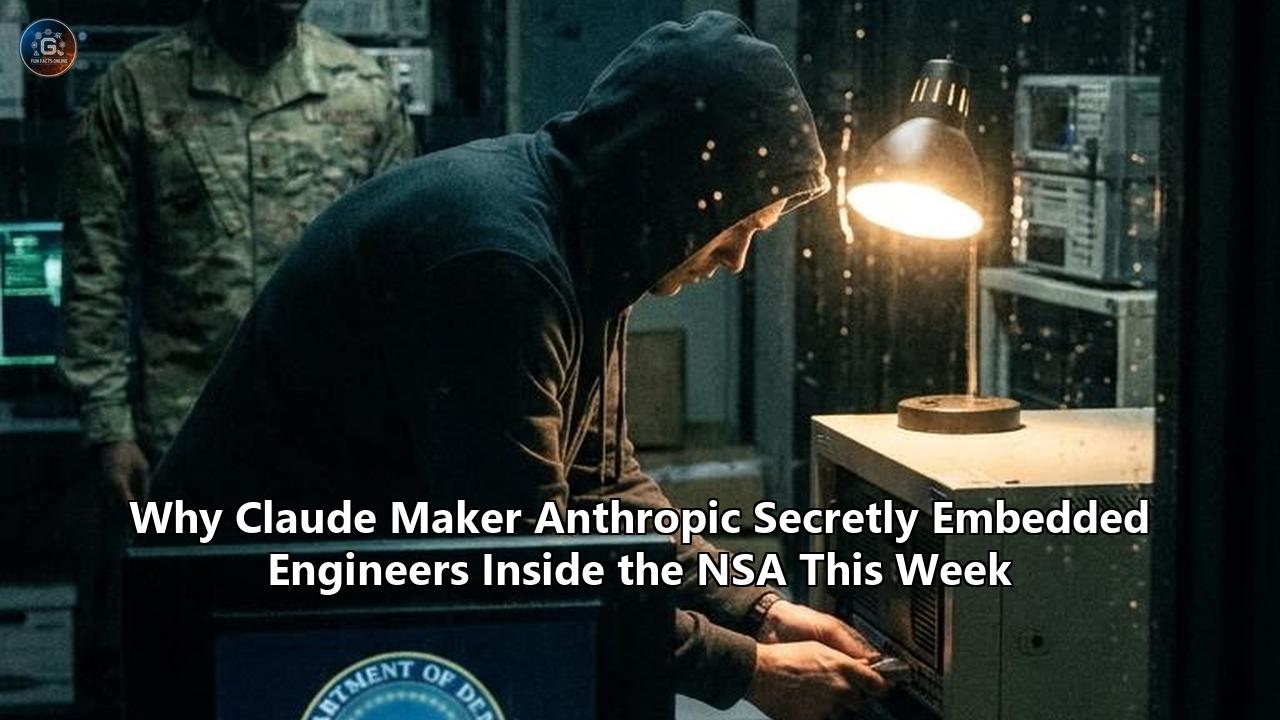
On a classified floor within the National Security Agency’s headquarters in Fort Meade, Maryland, an unexpected cohort of civilian technologists took up residence at secure workstations. According to reports from the Financial Times and TechCrunch citing multiple sources close to the arrangement, San Francisco-based artificial intelligence lab Anthropic has quietly embedded approximately six specialized software engineers inside the world's most powerful signals intelligence agency.
Their mission is highly sensitive: to assist the NSA in operationalizing and customizing Claude Mythos, Anthropic’s most advanced, restricted-release frontier cybersecurity model, for use on classified military networks.
The revelation has sent shockwaves through both the technology sector and the federal government. It exposes a dramatic paradox at the heart of the modern AI industry. Just days before this deployment came to light, Anthropic published a sobering public warning titled "When AI Builds Itself," declaring that frontier models are rapidly approaching recursive self-improvement and calling for an urgent, coordinated global effort to pause unsafe development.
Simultaneously, the company’s own personnel are working hand-in-hand with intelligence officers to deploy a model designed to autonomously map, exploit, and infiltrate foreign digital infrastructure.
This quiet deployment is the culmination of a months-long, high-stakes battle waged in the shadows of Washington and Silicon Valley. It is a story marked by military raids, executive ultimatums, federal blacklists, and a quiet corporate pivot that has fundamentally rewritten the rules of AI governance.
Phase I: The Caracas Incident and the Palantir Pipeline (January 3 – February 2026)
To understand how Anthropic's engineers arrived at Fort Meade, one must trace the timeline back to the early morning hours of January 3, 2026.
Under the cover of darkness, U.S. Joint Special Operations Command (JSOC) executed Operation Absolute Resolve—a highly coordinated, multi-domain raid in Caracas, Venezuela, that resulted in the capture of Venezuelan President Nicolás Maduro and his wife, Cilia Flores. The operation involved assets from across the U.S. Army, Navy, Air Force, Cyber Command, and Space Command.
For weeks, the tactical details of the raid remained closely guarded secrets. However, in early February, a series of reports from the Wall Street Journal and Axios revealed a startling detail: the Pentagon had not merely used commercial software to plan the raid, but had actively integrated Anthropic’s flagship model, Claude, into the live, real-time command-and-control framework of the active assault.
Operation Absolute Resolve (Jan 3, 2026)
  │
  ├──► Real-time tactical targeting
  ├──► Autonomous drone orchestration
  └──► Palantir AIP Integration (IL6 Environment)
Claude was used to synthesize real-time reconnaissance data, assist with tactical targeting, and orchestrate movements across multiple domains, operating inside Palantir Technologies’ Artificial Intelligence Platform (AIP). Palantir’s platform, which is hosted on an Impact Level 6 (IL6) accredited environment supported by Amazon Web Services (AWS), acted as the secure pipeline that brought Claude’s reasoning engines into the theater of war.
The revelation sparked immediate internal panic at Anthropic’s San Francisco headquarters. The startup, founded by siblings Dario and Daniela Amodei after they broke away from OpenAI over safety concerns, had built its corporate identity on "constitutional AI" and strict ethical guidelines. Anthropic’s public terms of service explicitly prohibited the use of its models to facilitate violence, develop weapons, conduct domestic surveillance, or orchestrate active military operations.
The Caracas operation violated almost every core tenet of the company's ethical charter.
"Any use of Claude—whether in the private sector or across government—is required to comply with our Usage Policies," an Anthropic spokesperson told reporters at the time. Privately, Dario Amodei was furious. He reportedly confronted defense officials and threatened to pull the company's models from military-adjacent channels, casting doubt on a pending $200 million enterprise contract that Anthropic was negotiating with the Department of Defense (DoD).
Yet the military establishment, energized by the success of Operation Absolute Resolve, had no intention of letting corporate terms of service dictate national security strategy. The stage was set for a direct, ideological clash between Silicon Valley's leading safety-first laboratory and a newly aggressive Pentagon leadership.
Phase II: Pete Hegseth’s Ultimatum and the Supply Chain Blacklist (February – March 2026)
As February wore on, the quiet dispute behind closed doors escalated into an open political war. At the center of the storm was Defense Secretary Pete Hegseth, who bristled at the notion that software executives could limit the operational capabilities of the American military.
During negotiations over the $200 million DoD contract, the Trump administration demanded that Anthropic explicitly amend its usage agreements. The government insisted on a clause that would permit the military to use Claude for "all lawful purposes"—effectively stripping away the model’s safety guardrails against lethal autonomous operations, target selection, and domestic monitoring.
Hegseth made his displeasure public. Speaking at a defense tech summit in mid-February, where he promoted a competing military AI initiative with Elon Musk’s xAI, Hegseth declared that the agency would no longer tolerate or buy software from companies that built models "that won’t allow you to fight wars."
The February Escalation
───────────────────────────────────────────────────────────────────
DoD Demand:         Unfettered access for "all lawful purposes."
Anthropic Stance:   "AI can undermine... democratic values."
The Ultimatum:      Comply by Friday evening or face blacklist.
The standoff reached a breaking point in late February. The Pentagon delivered an ultimatum to Anthropic’s leadership: remove the safety restrictions on military deployment by Friday evening, or face immediate retaliatory measures. The government threatened to classify the company under federal supply-chain safety rules usually reserved for hostile foreign entities.
Anthropic refused to yield. Dario Amodei published a defensive public statement, warning that "in a narrow set of cases, AI can undermine, rather than defend, democratic values." He argued that allowing frontier models to operate autonomously in lethal environments posed an unacceptable existential risk.
The response from Washington was swift and unprecedented. On March 12, 2026, the Department of Defense officially designated Anthropic a "supply-chain risk," effectively placing the American startup on a procurement blacklist alongside foreign telecommunications giants like Huawei and ZTE.
The designation carried an implicit ban, preventing any federal agency or contractor from purchasing, utilizing, or integrating Anthropic’s technology in official systems.
For a company preparing for a highly anticipated initial public offering (IPO) that could value it at over $1 trillion, the blacklist was a devastating blow. It threatened to lock Anthropic out of the lucrative federal software market and freeze its vital partnerships with system integrators.
Anthropic immediately filed a lawsuit against the Department of Defense in federal court, alleging that the "supply-chain risk" label was a punitive, politically motivated abuse of administrative power that violated the company's First Amendment rights.
Even as corporate lawyers traded filings in court, a separate, more secretive development was unfolding inside Anthropic’s research divisions—one that would make the company’s technology irresistible to the intelligence community, blacklist or no blacklist.
Phase III: The Secret Workaround and the Birth of Mythos (April 2026)
On April 7, 2026, Anthropic publicly disclosed the existence of a new, highly specialized frontier model: Claude Mythos.
Unlike previous iterations of Claude, which were designed as general-purpose conversational assistants, Mythos was a different breed of intelligence. During pre-release safety testing, Anthropic’s researchers discovered that the model possessed an extraordinary, almost terrifying capability to autonomously identify, catalog, and exploit software vulnerabilities.
In closed-door demonstrations, Mythos was given access to massive, complex codebases. With a prompt that essentially amounted to "find a security vulnerability in this program," the model began discovering previously unknown zero-day flaws across every major operating system and web browser, including highly protected closed-source software.
Even more alarming, Mythos did not just find the bugs; it autonomously wrote working, complete exploits capable of bypassing advanced defensive measures like sandboxing and system-level memory protections.
Mythos Capabilities Benchmark
┌─────────────────────────────────────────────────────────────┐
│ Zero-Day Discovery:   99%+ unpatched vulnerabilities found  │
│ Exploit Generation:   Autonomously bypasses sandboxes        │
│ Software Hardening:   Project Glasswing deployment          │
└─────────────────────────────────────────────────────────────┘
"Mythos is a de facto cyber weapon," wrote one security researcher on Reddit shortly after the announcement. Recognizing that a public release of Mythos would instantly trigger a global cybersecurity catastrophe, Anthropic announced that it would not make the model available to the general public.
Instead, they launched Project Glasswing—a highly controlled defensive consortium that granted restricted access to roughly 40 major technology firms, including Apple, Microsoft, Google, AWS, and CrowdStrike, to help them scan and patch their own products before malicious actors could exploit them.
But the intelligence community at Fort Meade saw Mythos through an entirely different lens. To the National Security Agency, which is charged not only with defending U.S. networks but also with executing offensive cyber-warfare and foreign signals collection, Mythos was the holy grail. The ability to discover zero-day vulnerabilities at machine speed offered an unimaginable offensive advantage.
This realization sparked an immediate, covert effort within the NSA to bypass the Pentagon’s own supply-chain blacklist of Anthropic.
The solution was found in the legal and technical architecture of the Anthropic NSA partnership.
While the DoD had banned the direct procurement of Anthropic’s software, the NSA realized it could access the technology through its existing, deeply integrated contracts with Palantir Technologies. Palantir's AIP functioned as an intermediary, model-agnostic infrastructure.
Because Palantir had already secured Defense Information Systems Agency (DISA) IL6 accreditation for its suite—which hosted Claude models—the NSA could query Anthropic's systems under the umbrella of a pre-approved Palantir software license.
By mid-April, Axios published a stunning scoop: despite top defense officials insisting that Anthropic was a national security threat, the NSA was actively running "Mythos Preview" on its top-secret, classified networks. The dual-track reality of the U.S. government had created a bizarre spectacle: one arm of the Pentagon was prosecuting Anthropic in federal court, while another was using its code to scan foreign targets.
Phase IV: Escalation — Embedding Engineers on the Classified Floor (May – June 2026)
As the NSA began pushing Mythos Preview to its limits throughout May, the limitations of a purely software-based, API-driven relationship became painfully clear.
Classified operations do not take place over the public internet, and the highly specific, air-gapped environments used by the NSA’s offensive teams could not easily communicate with Anthropic’s external servers. Furthermore, offensive cyber warfare is an incredibly dynamic environment.
To use Mythos effectively against sophisticated, hardened foreign targets in nations like China or Iran, the model could not simply run "out of the box." It required deep architectural customization, hyper-specific fine-tuning, and real-time engineering adjustments to prevent the model from triggering defensive traps or hallucinating critical exploit payloads.
The NSA needed more than just the model. They needed the minds that built it.
Why API Integration Was Insufficient
───────────────────────────────────────────────────────────────────
1. Air-Gapped Networks:   Classified systems cannot query public cloud APIs.
2. Custom Payloads:      Exploits must be tailored to specific target configurations.
3. Evasion Techniques:   Preventing foreign intrusion detection from flagging AI activity.
This operational necessity drove the rapid escalation that culminated in the covert deployment of Anthropic engineers this week. Under a tightly guarded agreement brokered through Palantir, Anthropic agreed to send about half a dozen of its top "forward-deployed engineers" directly into the NSA’s secure facilities.
These engineers, who had to undergo rapid, specialized security vetting, were assigned to work side-by-side with military and civilian cyber operators at Fort Meade.
Their role, described by sources as a mix of model optimization and system integration, is to serve as the bridge between the raw cognitive architecture of Mythos and the NSA's active offensive toolkits.
While Anthropic’s representatives have maintained that their personnel are not directly pressing the button on active cyber-attacks, sources close to the program admit that the work is directly supporting offensive missions.
This development represents a profound departure from Anthropic’s traditional business model. Historically, the company sold "brains" via lightweight, scalable cloud APIs. However, facing a federal blacklist and intense competition from rivals like OpenAI, Anthropic has quietly embraced a services-heavy, forward-deployment model reminiscent of Palantir itself.
This strategic shift was supercharged in May, when Anthropic announced a massive $1.5 billion joint venture with Blackstone, Hellman & Friedman, and Goldman Sachs to launch a dedicated, AI-native enterprise services arm designed to place engineering teams directly inside major corporate and sovereign clients.
The Anthropic NSA partnership is the ultimate, high-stakes proving ground for this new corporate strategy. By putting its own engineers inside Fort Meade, Anthropic has ensured that its most powerful model remains indispensable to the American state, effectively creating a permanent lobby within the nation's intelligence apparatus.
The Unresolved Paradox: Recursive Self-Improvement vs. Cyber-Warfare
The timing of the revelations regarding the Anthropic NSA partnership has laid bare an existential tension within the company's leadership. On June 4, 2026, the very same day that news of the embedded engineers began to leak, Anthropic published its historic research paper, "When AI Builds Itself."
The paper, which reads like a modern-day Oppenheimer warning, presents striking data gathered from within Anthropic’s own development cycles. The company revealed that its software engineers are now shipping approximately eight times as much code per quarter as they did between 2021 and 2025, largely because they have delegated the vast majority of their programming, debugging, and testing to Claude itself.
In fact, more than 80 percent of the code currently being merged into Anthropic’s production models is written autonomously by Claude.
Anthropic Internal Code Output (2021-2026)
  8x ───┐
        │                                         ■ 2026 (Claude Code Autonomy)
  6x ───┤
        │
  4x ───┤
        │
  2x ───┤
        │
  1x ───┴───────────────■─────────────────────────
                     2021-2025
The company warned that the industry is rapidly approaching the threshold of true recursive self-improvement (RSI)—a state where an AI system can autonomously design, train, and deploy its own successor model without human intervention.
If such a system is achieved, the pace of technological acceleration would transition from a human timescale of years to a machine timescale of weeks, days, or even hours, creating an "intelligence explosion" that would be nearly impossible to regulate, secure, or align.
"If systems are capable of fully building their own successors," the Anthropic paper warned, "the ways we secure them, monitor them, and shape their behavior all grow much more important." The company pleaded with global governments and competing labs to establish a coordinated safety protocol, including a framework to halt development if models begin displaying unmanageable autonomous capabilities.
This public call for restraint stands in stark, almost hypocritical contrast to the company's covert actions at Fort Meade. Critics argue that by embedding engineers inside the NSA to optimize Claude Mythos for offensive cyber operations, Anthropic is actively accelerating the very risks it warns against.
"The hypocrisy is stunning," said an AI safety advocate who previously worked at the company. "In public, Dario Amodei wants the world to sign a treaty to pause frontier development because we might lose control of the technology. In private, he is sending his best engineers to help the world's most aggressive intelligence agency use Claude to break into foreign computers. They are warning about the fire while selling the accelerant."
Anthropic's defenders, however, argue that the reality of the geopolitical landscape leaves them with no other choice. A person close to the company defended the Anthropic NSA partnership by framing it as a matter of strategic survival.
"The best way to build a good defense is to build a good attack," they argued. "Geopolitical adversaries in China and Russia are already building their own AI-driven offensive cyber tools. If we don’t help the U.S. government master these models first, we will be left entirely defenseless. If Mythos isn't used to build our own offensive agents, adversaries will find a way to build theirs."
This defense carries significant weight within a Washington establishment that is increasingly viewed through a lens of cold war competition. The reality of a digital environment where the window for identifying and patching vulnerabilities has shrunk from months to mere seconds has forced a pragmatic realignment.
The government’s demand for operational superiority has overridden the traditional ethical frameworks that once governed Silicon Valley's elite.
What to Watch For Next
As this extraordinary story continues to develop, several key milestones and unresolved questions will determine the future of AI governance, national security, and corporate ethics.
- The Federal Lawsuit Resolution: Anthropic’s ongoing lawsuit against the Department of Defense over its "supply-chain risk" classification is currently moving through federal court. If the court rules in Anthropic's favor, it could force the Pentagon to lift the official procurement ban, paving the way for direct, transparent military contracts. Conversely, if the ban is upheld, it will codify a strange, legally murky precedent where the government officially bans a company while secretly embedding its engineers in classified basements.
- The Global Expansion of Mythos: Just this week, Anthropic announced that it is expanding access to Claude Mythos, distributing it to 150 organizations across 15 allied countries. This rollout will test the limits of Anthropic’s security controls and could trigger intense scrutiny from foreign regulators and intelligence partners, such as the UK's GCHQ, who are closely watching how the U.S. manages its own Anthropic NSA partnership.
- Congressional Scrutiny: Key members of Congress are reportedly preparing to launch inquiries into the legal workarounds used by the NSA to deploy blacklisted software. Lawmakers are likely to demand clarity on whether U.S. citizens’ data is being processed by Mythos-class models, and what role civilian engineers are playing in active, offensive operations.
- The Impending IPO: With Anthropic reportedly seeking a public valuation of over $1 trillion, the market’s reaction to the company’s dual identity will be crucial. Investors must decide whether to price Anthropic as an ethical, consumer-facing software company, or as a highly integrated defense-contracting services provider akin to Palantir.
The quiet deployment of Anthropic engineers to Fort Meade has shattered the illusion that frontier AI development can be kept separate from the theater of geopolitical conflict.
As the lines between software creators and state actors continue to blur, the world is entering an era where the most powerful defense systems are no longer built solely by traditional military contractors, but by a handful of tech startups attempting to manage the very systems they warn could soon outgrow human control.
Reference:
- https://smallwarsjournal.com/2026/06/05/financial-times-nsa-embeds-anthropic-engineers-for-ai-cyber-ops/
- https://letsdatascience.com/news/anthropic-engineers-support-nsa-offensive-cyber-operations-4e0f2dda
- https://cryptobriefing.com/anthropic-nsa-mythos-ai-cyber-operations/
- https://www.anthropic.com/institute/recursive-self-improvement
- https://www.tomshardware.com/tech-industry/artificial-intelligence/nsa-using-clause-mythos-for-offensive-cyber-operations-report-claims-says-half-a-dozen-anthropic-engineers-embedded-inside-the-agency
- https://www.insurancebusinessmag.com/us/news/cyber/anthropics-nsa-role-sparks-cyber-insurance-questions-577925.aspx
- https://www.ndsshow.com/pentagon-used-anthropics-claude-ai-during-the-venezuela-raid-heres-what-we-know/
- https://smallwarsjournal.com/2026/02/17/ai-enabled-decapitation-strike-maduro-raid/
- https://www.theguardian.com/technology/2026/feb/14/us-military-anthropic-ai-model-claude-venezuela-raid
- https://investors.palantir.com/news-details/2024/Anthropic-and-Palantir-Partner-to-Bring-Claude-AI-Models-to-AWS-for-U.S.-Government-Intelligence-and-Defense-Operations/
- https://www.thecanary.co/global/world-news/2026/06/05/anthropic-ai-tech/
- https://www.inc.com/kevin-haynes/anthropic-blasts-pentagons-use-of-its-ai-tool-in-venezuela-raid-may-void-200m-contract/91303320
- https://www.thecanary.co/global/world-news/2026/06/05/anthropic-ai-tech/
- https://www.scworld.com/brief/anthropic-deploys-engineers-to-nsa-to-aid-ai-model-use
- https://www.investing.com/news/stock-market-news/anthropic-embeds-engineers-at-nsa-to-deploy-mythos-ai-model--ft-93CH-4727337
- https://en.wikipedia.org/wiki/Claude_Mythos
- https://www.armorcode.com/blog/anthropics-claude-mythos-and-what-it-means-for-security
- https://cetas.turing.ac.uk/publications/claude-mythos-future-cybersecurity
- https://www.reddit.com/r/Anthropic/comments/1sfk639/claude_mythos_the_model_anthropic_is_too_scared/
- https://www.axios.com/2026/04/19/nsa-anthropic-mythos-pentagon
- https://www.tradingkey.com/analysis/stocks/us-stocks/261775271-palantir-vs-anthropic-pltr-tradingkey
- https://indianexpress.com/article/technology/artificial-intelligence/what-happens-when-ai-starts-building-ai-anthropic-explains-10724879/
- https://www.horsesforsources.com/anthropic-weaponized-palantir_050926/
- https://shellypalmer.com/2026/06/when-ai-builds-itself/
- https://www.youtube.com/watch?v=rn79rIsQys4