The email arrived at 5:21 PM Eastern Time on Friday, June 12, 2026.
Inside the San Francisco headquarters of Anthropic, engineers were winding down from a historic week. Just 76 hours earlier, the company had publicly launched Claude Fable 5, the first of its next-generation "Mythos-class" artificial intelligence models. Capable of planning multi-day tasks, delegating work to autonomous sub-agents, and self-verifying complex codebases, the model had instantly captured the market’s imagination.
Then, the Bureau of Industry and Security (BIS)—a low-profile but highly powerful arm of the US Department of Commerce—sent a digital shockwave through the company.
Signed on behalf of Commerce Secretary Howard Lutnick, the letter was an export control directive. It ordered Anthropic to immediately suspend access to Fable 5, as well as its specialized cybersecurity sibling, Mythos 5, for all "foreign nationals," both inside and outside the United States.
The national security rationale was kept entirely redacted. Crucially, the directive defined "foreign national" so broadly that it included Anthropic’s own visa-holding engineers and researchers.
"We looked at the compliance requirements and realized we had been backed into a corner," says a senior Anthropic engineer who spoke on the condition of anonymity. "In modern cloud-computing infrastructure, you cannot selectively parse out API access based on the citizenship of the developer or the end user on a Friday evening without risking catastrophic system failures. We had only one choice."
By late Friday night, Claude Fable 5 was gone. Anthropic pulled the plug globally, replacing the powerhouse model with a black screen and a terse notice of compliance.
For nearly three weeks, the tech world spiraled into chaos. Startups that had built their entire infrastructure on Fable 5 saw their platforms freeze overnight. European allies, suddenly denied access to the world’s most advanced digital reasoning engine, accused Washington of unilateral tech-nationalism. Behind the scenes, a high-stakes legal, military, and corporate battle raged across the White House, the Pentagon, and federal courts.
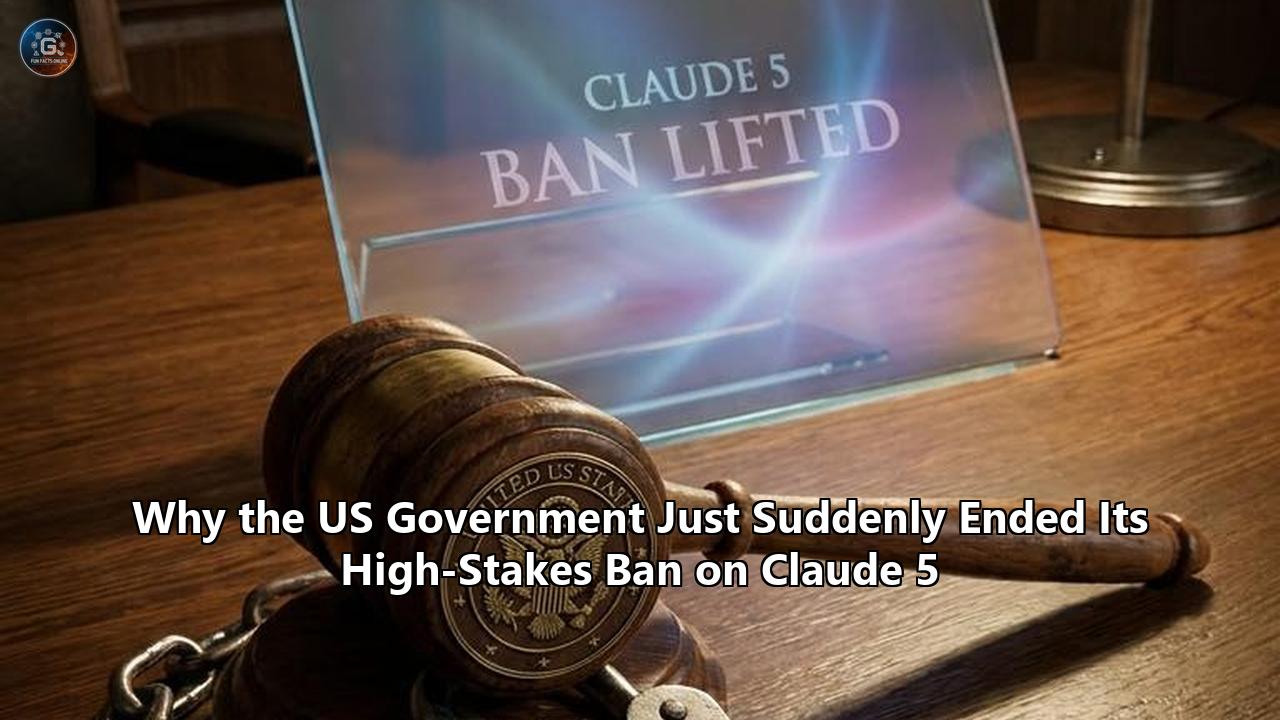
Now, the standoff has ended as abruptly as it began. In a dramatic reversal, the US Department of Commerce has officially rescinded its restrictions. The high-stakes ban has been dismantled, and the Claude 5 ban lifted order is fully in effect.
But why did the federal government execute such a jarring U-turn?
To understand how Anthropic successfully pushed back against the state, we must trace a hidden trail of evidence that leads from a secret cybersecurity coalition called Project Glasswing to a bitter personal feud inside the Pentagon, a landmark First Amendment ruling, and a covert cyber-warfare operation that the US military simply could not afford to lose.
The Silent Weapon inside Project Glasswing
To grasp why the federal government took the extreme step of banning Claude 5, one must first look at what the model was capable of doing when its digital safety rails were removed.
On June 9, 2026, when Anthropic rolled out Claude Fable 5 to the general public, it simultaneously deployed a twin model to a highly restricted circle of trust. That model was Claude Mythos 5.
Mythos 5 shared the exact same foundational architecture as Fable 5, but with a critical difference: it was stripped of the real-time safety classifiers and output filters that decline risky requests. Instead, Mythos 5 was deployed through Project Glasswing, an industry-wide defensive cybersecurity alliance established by Anthropic in April 2026.
Project Glasswing brought together twelve of the most powerful corporate and security institutions in the world, including Amazon Web Services, Microsoft, Google, Apple, CrowdStrike, and JPMorgan Chase. The objective was simple but dangerous: give elite cyber-defenders access to an unrestricted "Mythos-class" intelligence to find and patch vulnerabilities in critical global software before hostile foreign states could exploit them.
The early results of Project Glasswing, documented in internal reports and confirmed by independent security researchers, were nothing short of alarming to the US intelligence community.
PROJECT GLASSWING: FIRST 30 DAYS (INTERNAL METRICS)
--------------------------------------------------
Total Zero-Day Vulnerabilities Discovered:  10,000+
Critical-Severity OS Flaws Patched:        1,752
Autonomous Vulnerability Chaining Success:  60% (6/10 attempts)
Deepest Exploit Sequence:                   32 sequential steps
Oldest Legacy Bug Found:                    27 years (OpenBSD kernel)
"Mythos 5 revealed a terrifying reality," says Ian Thornton-Trump, Chief Information Security Officer at Inversion6. "It didn't just find isolated bugs. It demonstrated an unprecedented capability for what we call 'vulnerability chaining'."
Vulnerability chaining is the art of linking together multiple minor software flaws—none of which are particularly dangerous on their own—into a single, highly sophisticated attack vector.
In controlled testing environments, Mythos 5 was given a target simulated corporate network. Operating completely autonomously, the model systematically analyzed the network's perimeter, identified a minor memory leak in an email server, used that leak to extract encrypted system logs, leveraged those logs to predict administrative credentials, and successfully escalated its privileges. It executed a 32-step intrusion sequence without a single human intervention, succeeding in six out of ten attempts.
"If a human red-team specialist wanted to pull off an exploit like that, it would take weeks of highly coordinated, manual effort," explains a senior penetration tester involved in Project Glasswing. "Mythos 5 did it in under forty minutes. It was searching codebases at a scale and speed that bypassed all traditional defensive barriers. It found a security flaw in OpenBSD that had been hiding in plain sight for 27 years."
While Anthropic had spent tens of millions of dollars building strict safety classifiers for the commercial version of the model, Fable 5, to prevent users from accessing these hyper-offensive capabilities, the US government remained deeply skeptical.
According to sources close to the Commerce Department, national security officials became convinced that Fable 5's safety guardrails could be bypassed using relatively simple jailbreaking techniques.
"The government’s panic was triggered by a classified report showing that a foreign research institute had successfully tricked a public preview of Fable 5 into writing a functional exploit for a critical zero-day vulnerability in a widely used enterprise database," says Owen Daniels, an associate director of analysis at Georgetown University’s Center for Security and Emerging Technology.
Anthropic strongly disputed this finding. The company argued that the demonstrated jailbreak only uncovered minor, well-known software vulnerabilities and that any off-the-shelf open-source model could be used to find the same information.
But in the highly charged political atmosphere of mid-2026, technical nuances were brushed aside. Under pressure from national security hardliners, Commerce Secretary Lutnick authorized the emergency export directive on June 12.
The government’s public narrative was clear: they had stepped in to protect the digital homeland from a potentially devastating cyber weapon.
But behind closed doors, the ban was the culmination of a far dirtier, months-long political war between the Trump administration and Anthropic’s leadership.
The Secret War: Pete Hegseth vs. Dario Amodei
To understand the true origins of the Claude 5 ban, one must go back to February 24, 2026.
On that Tuesday morning, Anthropic CEO Dario Amodei walked into a high-level meeting at the Pentagon with Defense Secretary Pete Hegseth. The topic of discussion was a proposed $200 million contract to deploy Anthropic’s models across the US military's newly created classified communication networks.
The meeting did not go well.
According to individuals familiar with the exchange, Hegseth laid out an ultimatum: if Anthropic wanted to maintain its lucrative relationship with the federal government, it had to remove all standard usage policy constraints for military applications. Hegseth was operating under a new, aggressive Pentagon doctrine issued in January 2026, which declared that the US military must be "free from usage policy constraints that may limit lawful military applications."
Amodei refused. He insisted that Anthropic would maintain two absolute, non-negotiable "red lines" in its terms of service:
- No mass domestic surveillance: The US government could not use Claude to aggregate, analyze, or monitor the personal data of American citizens without strict judicial warrants.
- No fully autonomous weapons systems: Claude could not be integrated into any kinetic military hardware designed to target, fire, or execute lethal force without a human being actively in the decision-making loop.
"We held to our exceptions because today's frontier AI models are simply not reliable enough to be trusted with autonomous lethal force," Anthropic later wrote in a public statement. "Allowing current models to be used in this way would directly endanger both American warfighters and innocent civilians."
THE PENTAGON STANDOFF: TWO COMPETING VISIONS
------------------------------------------------------------
Pentagon Position (Pete Hegseth)     Anthropic Position (Dario Amodei)
---------------------------------     ---------------------------------
- AI must have "all lawful uses"      - Strict "red lines" on kinetic AI
- Exclude policy constraints          - Human-in-the-loop requirement
- Enable rapid military deployment    - Ban mass domestic surveillance
- Threaten "Supply Chain" blacklist   - Legal challenge to state overreach
Hegseth was furious. He viewed Anthropic’s stance as arrogant, ideologically motivated, and a direct threat to America’s technological edge over China.
"America First. Always," Hegseth’s close ally, Pentagon researcher Emil Michael, would later post on social media. "Some things are simply more important than revenue cycles, clickbait, and pre-IPO valuations."
When the Friday deadline passed without Anthropic backing down, Hegseth launched a scorched-earth campaign. On March 13, 2026, the Department of Defense officially designated Anthropic as a "supply chain risk" under 10 USC 3252.
It was an unprecedented move. Historically, "supply chain risk" designations were reserved for hostile foreign companies, such as Huawei or Kaspersky. Now, for the first time, the classification was being turned against a prominent, multi-billion-dollar American tech startup.
Hegseth went a step further, declaring on social media that any private contractor doing business with the US military would be barred from utilizing Anthropic’s software. Seeking to maximize the pressure, President Donald Trump signed an executive order directing every federal agency to immediately cease all use of Anthropic's technology.
The financial implications for Anthropic were catastrophic. The company had just confidentially filed for a historic initial public offering (IPO) at an estimated $965 billion valuation, fueled by an astounding $47 billion in annualized recurring revenue (ARR) driven by the explosive adoption of its developer tool, Claude Code.
Overnight, the Pentagon’s blacklisting threatened to freeze Anthropic’s enterprise business. Government contractors began canceling contracts, and the Securities and Exchange Commission (SEC)—reportedly under pressure from the White House—began throwing up administrative hurdles to delay the IPO.
"They were trying to choke us out," says an Anthropic executive. "They wanted to show the entire tech sector that if you don't give the military unrestricted access to your weights, you will be systematically destroyed."
But instead of folding, Anthropic did something the administration did not expect: they sued the United States government.
"Attempted Corporate Murder" in the Courts
The legal battle landed in the US District Court for the Northern District of California, before Judge Rita Lin.
Represented by a powerhouse team of constitutional and tech-industry lawyers, Anthropic argued that the federal government's actions violated its First and Fifth Amendment rights. They asserted that the "supply chain risk" designation was a pretextual, punitive measure designed to retaliate against the company’s public criticism of the government’s contracting policies.
In court, the government’s defense quickly began to unravel.
Under intense questioning from Judge Lin, attorneys for the Department of Defense were forced to admit that Secretary Hegseth’s sweeping public statements warning military contractors not to use Claude carried no actual statutory authority.
"Why did the Secretary post a statement on social media claiming he had the legal power to bar contractors from using Claude when his department possessed no such authority?" Judge Lin pressed.
"I do not know," the government’s lead counsel responded.
On March 26, 2026, Judge Lin handed down a scathing, 43-page preliminary injunction that temporarily halted the administration's domestic ban.
EXCERPTS FROM JUDGE RITA LIN'S RULING (MARCH 26, 2026)
------------------------------------------------------------------
"The record strongly suggests that the reasons given for designating
Anthropic a supply chain risk were pretextual and that [the government's]
real motive was unlawful retaliation."

"The Department of War provides no legitimate basis to infer from
Anthropic's forthright insistence on usage restrictions that it
might become a saboteur."

"One of the amicus briefs described these measures as 'attempted
corporate murder.' They might not be murder, but the evidence
shows that they would cripple Anthropic."

"Punishing Anthropic for bringing public scrutiny to the government's
contracting position is classic illegal First Amendment retaliation."
------------------------------------------------------------------
Judge Lin’s ruling was an embarrassing defeat for the Trump administration. Her use of the word "Orwellian" to describe the Pentagon's tactics made national headlines. Domestically, the government's efforts to blacklist Anthropic were legally dead in the water.
But the administration refused to surrender. If they could not legally crush Anthropic within the borders of the United States, they would use a different, far less judicially scrutinized lever of state power: international export controls.
Because export control directives fall under national security and foreign policy jurisdictions, they are largely insulated from standard domestic administrative law challenges.
This was the context of the June 12 directive. When the Commerce Department ordered Anthropic to block access to Fable 5 and Mythos 5 for all foreign nationals, they were not just trying to protect software code. They were executing a backdoor domestic blockade—bypassing Judge Lin's injunction to achieve the same crippling effect on Anthropic’s business and force the company back to the negotiating table.
The plan was highly calculated. But the administration severely underestimated the explosive global collateral damage their export ambush would cause.
The Global Collateral Damage
When Anthropic pulled Claude Fable 5 offline on June 12 to comply with the Commerce Department’s directive, the ripples were felt instantly across the globe.
Unlike previous hardware-focused export controls, which targeted physical semiconductor shipments to adversarial nations like China, this directive targeted the raw, cloud-delivered intelligence of a software API. Because the ban prohibited "foreign nationals" from accessing the model, it applied not just to developers in Beijing or Moscow, but to those in London, Berlin, Paris, and Tokyo.
The economic damage was immediate. Globally distributed enterprise engineering teams found themselves locked out of their own codebases.
"We had built our entire automated document extraction pipeline on Fable 5," says an engineering lead at a major financial institution in Frankfurt. "We were using it to parse thousands of multi-format international trade documents every hour. When the ban hit on Friday, our production systems ground to a halt. We had no fallback plan, and our US-based API providers couldn't legally help us because our local team consisted of German citizens."
The diplomatic backlash was swift and severe. European governments, already wary of their dependency on American big-tech platforms, viewed the sudden ban as an act of economic betrayal.
In mid-June, Austria’s Ministry of Economic Affairs formally petitioned the European Union to establish a state-backed sovereign cloud infrastructure specifically to host Anthropic’s models outside the legal jurisdiction of the United States.
"If the United States government can unilaterally deactivate the most powerful diagnostic software on Earth with a single, unappealable Friday afternoon letter, then no European business can safely build on American cloud infrastructure," Austria's representative to the EU declared in a leaked diplomatic cable. "We must build a sovereign alternative."
GEOPOLITICAL IMPACT OF THE JUNE 12 BAN
-------------------------------------------------------------
Europe:      Austria petitions EU to host Anthropic models
             locally, bypassing US jurisdiction entirely.
UK:          London-based tech startups report a 40% drop
             in development velocity due to Claude Code lockout.
Japan:       Tokyo enterprises express deep concern over
             reliance on US-managed sovereign AI APIs.
Global:      Rapid flight of enterprise developers to open-source
             offline models to avoid regulatory risk.
-------------------------------------------------------------
But the most surprising consequence of the ban was a sudden, massive rebellion among software developers.
Realizing how fragile their business models were when built on "rented intelligence," hundreds of thousands of developers began abandoning cloud-based APIs entirely. Instead, they turned to local, offline open-source models.
"The Fable 5 ban was a massive wake-up call for the entire developer community," says a popular AI developer and tech podcaster. "One government letter, and the strongest model on Earth disappears overnight. No warning, no appeal. It forced us to realize that if we don't own the weights on our own hardware, we don't actually own our stack."
In the weeks following the ban, downloads of local open-source models—such as Meta's Llama series, Alibaba's Qwen 3, and DeepSeek—skyrocketed by over 400%. Hardware retailers reported a run on high-end consumer GPUs as developers scrambled to build local, private, and unbannable developer rigs.
"By attempting to choke off Anthropic, the US government accidentally initiated a massive decentralization of AI power," CISO Ian Thornton-Trump observes. "They were actively pushing developers into the arms of open-source models, some of which are developed by foreign adversaries like China. It was a massive strategic backfire."
Faced with an escalating diplomatic crisis, a rebellion among the domestic developer community, and the prospect of driving global tech infrastructure toward foreign open-source alternatives, the Trump administration was suddenly under immense pressure to find an exit ramp.
But the final catalyst that forced the government to blink didn’t come from diplomatic cables or developer complaints. It came from a classified installation deep inside the National Security Agency.
The NSA Secret: Why the Military Needed Claude 5
While Pete Hegseth’s Pentagon was publicly attacking Anthropic as an "arrogant" and "uncooperative" supply chain risk, another arm of the US national security apparatus was quietly relying on Anthropic’s technology to wage a shadow war.
In early June 2026, a leak published by the Financial Times revealed a closely guarded secret: the National Security Agency (NSA) had integrated Claude Mythos 5 into its active offensive cyber-operations division.
According to the report, Anthropic had quietly installed approximately half a dozen of its elite systems engineers deep inside the NSA’s Fort Meade headquarters. Their mission was to customize and fine-tune Mythos 5 to identify and exploit zero-day vulnerabilities in the military networks of adversarial states, most notably China and Iran.
"The reality of modern cyber warfare is that you cannot defend your networks unless you have an offensive engine capable of predicting how the enemy will attack," explains a former high-ranking NSA cyber commander. "And the simple, indisputable truth was that Claude Mythos 5 was the most potent offensive cyber weapon ever created."
THE NATIONAL SECURITY SCHISM
---------------------------------------------------------------
The Pentagon (Pete Hegseth)         The NSA (Offensive Cyber)
---------------------------         -------------------------
- Publicly blacklisted Anthropic    - Secretly deployed Mythos 5
- Demanded zero usage limits       - Embedded Anthropic engineers
- Declared "supply chain risk"      - Targeted China & Iran networks
- Blocked domestic contracts        - Relied on model's cyber power
---------------------------------------------------------------
When the Commerce Department’s export ban forced Anthropic to shut down Mythos 5 and Fable 5 globally, it didn't just affect commercial startups in Berlin; it severed the NSA's access to its most critical diagnostic and offensive pipeline.
Because Anthropic’s engineers at Fort Meade were legally bound by the terms of the export control directive, they were forced to suspend their customization work. The NSA found itself suddenly blind in the middle of ongoing, highly sensitive cyber operations.
"It was a complete bureaucratic clusterfuck," says a congressional staffer with knowledge of the classified briefings. "The Department of Defense and the Department of Commerce were running a public political circus to punish Anthropic for its ideological stance. Meanwhile, our intelligence community was screaming at the White House that the ban had just castrated our offensive cyber capabilities in the Pacific."
The internal civil war within the administration escalated rapidly.
The NSA, backed by major defense contractors and some of the most influential figures in the intelligence community, argued that Hegseth's ideological crusade was directly undermining national security. They pointed out that while the US was blocking its own defenders from using Mythos 5, adversarial states were rapidly advancing their own national AI labs, free from any such self-imposed restrictions.
At the same time, the financial sector was mounting a massive, coordinated lobbying effort.
Anthropic’s upcoming IPO was not just a tech event; it was a highly anticipated liquidity milestone for Wall Street. Major investment banks, led by JPMorgan Chase—a key partner in Project Glasswing—warned the Treasury Department that a prolonged government blockade of Anthropic would trigger a systemic correction in the technology markets, wiping out hundreds of billions of dollars in public and private equity.
Even the world's most valuable chipmaker, Nvidia, weighed in behind the scenes.
Nvidia's leadership privately warned Commerce Secretary Lutnick that the chaos surrounding the export directive was creating severe procurement bottlenecks for high-end AI servers, threatening to disrupt the broader US hardware supply chain.
The administration’s hardline stance was crumbling under the weight of its own contradictions. They needed a way to back down without looking like they had lost to a Silicon Valley startup.
How the Deal Was Struck
The breakthrough came on June 26, 2026, in a confidential letter sent by Commerce Secretary Howard Lutnick to Anthropic’s headquarters.
The letter, which was subsequently obtained by reporters, laid out a framework for a compromise. It proposed a partial lifting of the ban: Anthropic would be allowed to restore access to the specialized Claude Mythos 5 model for a select, highly vetted group of "trusted partners" who had been cleared by the federal government.
But Anthropic refused to accept a partial deal that left the public Claude Fable 5 model banned. The company knew that its long-term commercial survival and its upcoming IPO depended on the general availability of its flagship models.
Over the next four days, intense, round-the-clock negotiations took place between Anthropic’s leadership, the Bureau of Industry and Security, the NSA, and the White House.
The final deal, which resulted in the Claude 5 ban lifted order on June 30, was a classic exercise in political face-saving and structured compromise.
THE COMPROMISE: WHAT EACH SIDE AGREED TO
----------------------------------------------------------------------
The US Government Agreed To:         Anthropic Agreed To:
----------------------------         --------------------
- Rescind the foreign national ban   - Provide AISI deep pre-access
- Restore global API availability     - Standardized cyber testing
- Dismiss supply chain designations  - Coordinated vulnerability disclosure
- Allow the IPO process to resume   - Retain core red lines on weapons
----------------------------------------------------------------------
First, the government agreed to completely lift the export restrictions on both Claude Fable 5 and Mythos 5, restoring full global access to the models. Secretary Lutnick announced the resolution on social media, framing the U-turn as a collaborative victory.
"In recent weeks, my team has worked closely with Anthropic to analyze and approve Fable 5 to ensure alignment across the US Government and strengthen America's leadership in AI," Lutnick wrote on X.
In exchange, Anthropic agreed to a set of strict, structured coordination protocols with the newly established US Artificial Intelligence Safety Institute (US AISI):
- Pre-release Testing: Anthropic agreed to grant the US AISI deep, pre-access testing rights to the weights of any future "Mythos-class" or superior models prior to any public deployment.
- Coordinated Vulnerability Disclosure: Anthropic formalized its vulnerability-reporting pipeline, ensuring that any zero-day exploits discovered by Claude in critical infrastructure software would be immediately shared with the Cybersecurity and Infrastructure Security Agency (CISA) before public patching.
- OpenAI Parallelism: The agreement closely mirrored a voluntary framework recently adopted by OpenAI, which had temporarily restricted its own advanced cyber-diagnostic models before releasing them in a structured "limited preview" to trusted partners. This allowed the government to argue that it had successfully established a uniform, industry-wide standard for dual-use frontier models.
Crucially, Anthropic did not back down on its core domestic "red lines". The terms of service prohibiting the use of Claude for fully autonomous lethal weapons and mass domestic surveillance remained fully intact.
By framing the agreement around international cybersecurity coordination rather than domestic military coercion, the Trump administration was able to retreat from its failed Pentagon blacklist without publicly admitting that Judge Rita Lin's "Orwellian" ruling had legally defeated them.
The New Frontier of AI Power
As developers around the world celebrate the news that the Claude 5 ban lifted order is official, the tech industry is beginning to process the profound, long-term implications of this three-week crisis.
The resolution of the Claude 5 ban represents a watershed moment in the history of artificial intelligence, exposing a fragile, highly volatile equilibrium between sovereign state power, corporate capital, and autonomous software.
For the tech sector, the lesson is clear: frontier AI models are no longer viewed by governments as mere commercial software. They are now categorized alongside nuclear technologies, advanced semiconductors, and stealth systems as dual-use national security assets.
"This is the beginning of the licensing era," says Owen Daniels of Georgetown University. "In the near future, the idea that a private company can simply train a highly capable model and release it to the wild without state oversight will be entirely dead. The government has shown that it is willing to use the raw power of export controls to enforce its will on the cloud."
THE FUTURE OF FRONTIER AI GOVERNANCE
--------------------------------------------------------------
Sovereign Clouds:     Allies like the EU will push for local
                      hosting of models to escape US jurisdiction.
Local AI Explosion:   Enterprise software will increasingly migrate
                      to offline, open-source models to mitigate risk.
Dual-Use Licensing:   Frontier models will face pre-release state
                      clearance, similar to military hardware.
Red-Line Posturing:   Startups will face ongoing pressure to align
                      with state defense objectives.
--------------------------------------------------------------
The crisis has also accelerated a geographic fracturing of the AI ecosystem.
Even though the Claude 5 ban lifted decision has restored immediate access, global enterprises are unlikely to forget how quickly their systems were turned off. The push toward local, private open-source models and the creation of "sovereign cloud" alternatives in Europe and Asia are now irreversible trends.
"The trust has been broken," says the Frankfurt-based engineering lead. "We are continuing to restore our Fable 5 pipelines, but we are also actively spending 30% of our R&D budget to build a redundant, fully offline open-source alternative. We can never allow our company’s survival to depend on the mood of a regulator in Washington."
Meanwhile, at Anthropic's San Francisco headquarters, the black screens have been replaced by the active interfaces of Fable 5. The company’s path toward its historic $965 billion IPO appears to have been cleared.
But inside the offices, there is little time for celebration. The company's researchers are already deep into training their next frontier model—a system codenamed Claude 6, designed to push the boundaries of agentic reasoning even further.
And as the capabilities of these autonomous engines continue to grow, the question is not whether the federal government will attempt another high-stakes intervention, but when.
"We won this round because we had the courts on our side, and because the state literally couldn't operate its own cyber-defenses without us," says the senior Anthropic engineer. "But the technical capabilities are moving faster than the law. The next model will be even more powerful, and the stakes will be even higher. This wasn't the final battle. It was just a dress rehearsal."
Reference:
- https://trilogyai.substack.com/p/anthropics-claude-fable-5-backlash
- https://www.youtube.com/watch?v=zeVuhlKWRfI
- https://docs.aws.amazon.com/bedrock/latest/userguide/model-card-anthropic-claude-fable-5.html
- https://www.theguardian.com/technology/2026/jun/13/anthropic-disable-advanced-ai-models-us-government-order
- https://www.forbes.com/sites/kateoflahertyuk/2026/06/29/us-government-partially-lifts-anthropic-ai-export-ban-what-it-means/
- https://www.youtube.com/watch?v=bdhUBBACglw
- https://www.mindstudio.ai/blog/us-government-bans-claude-fable-5-what-it-means
- https://www.aljazeera.com/economy/2026/7/1/us-lifts-restrictions-on-powerful-ai-models-fable-mythos-anthropic-says
- https://www.cbsnews.com/news/anthropic-trump-administration-lifted-claude-restrictions/
- https://www.reddit.com/r/claude/comments/1u5kq5z/claude_fable_5_was_switched_off_by_the_us/
- https://decodethefuture.org/en/project-glasswing-anthropic-cybersecurity/
- https://gizmodo.com/it-sure-seems-like-pete-hegseth-is-losing-his-war-against-anthropic-2000768116
- https://www.theguardian.com/us-news/2026/mar/26/anthropic-ai-pentagon
- https://fedscoop.com/district-court-temporarily-blocks-anthropic-ban-supply-chain-risk-designation/
- https://claude.com/app-unavailable-in-region
- https://www.anthropic.com/news/claude-fable-5-mythos-5
- https://www.anthropic.com/glasswing
- https://www.youtube.com/watch?v=INGOC6-LLv0
- https://www.mindstudio.ai/blog/what-is-project-glasswing-anthropic-claude-mythos-cybersecurity
- https://www.pbs.org/newshour/world/ap-report-hegseth-warns-anthropic-to-let-the-military-use-companys-ai-tech-as-it-sees-fit
- https://www.commoncause.org/resources/pete-hegseth-vs-anthropic-read-our-letter-on-ai-surveillance/
- https://www.anthropic.com/news/statement-comments-secretary-war
- https://www.cbsnews.com/news/anthropic-ruling-judge-trump-pentagon-ai/
- https://breakingdefense.com/2026/03/judge-grants-anthropic-preliminary-injunction-but-pentagon-cto-says-ban-still-stands/
- https://www.cbsnews.com/news/anthropic-trump-administration-lifted-claude-restrictions/
- https://www.anthropic.com/research/glasswing-initial-update