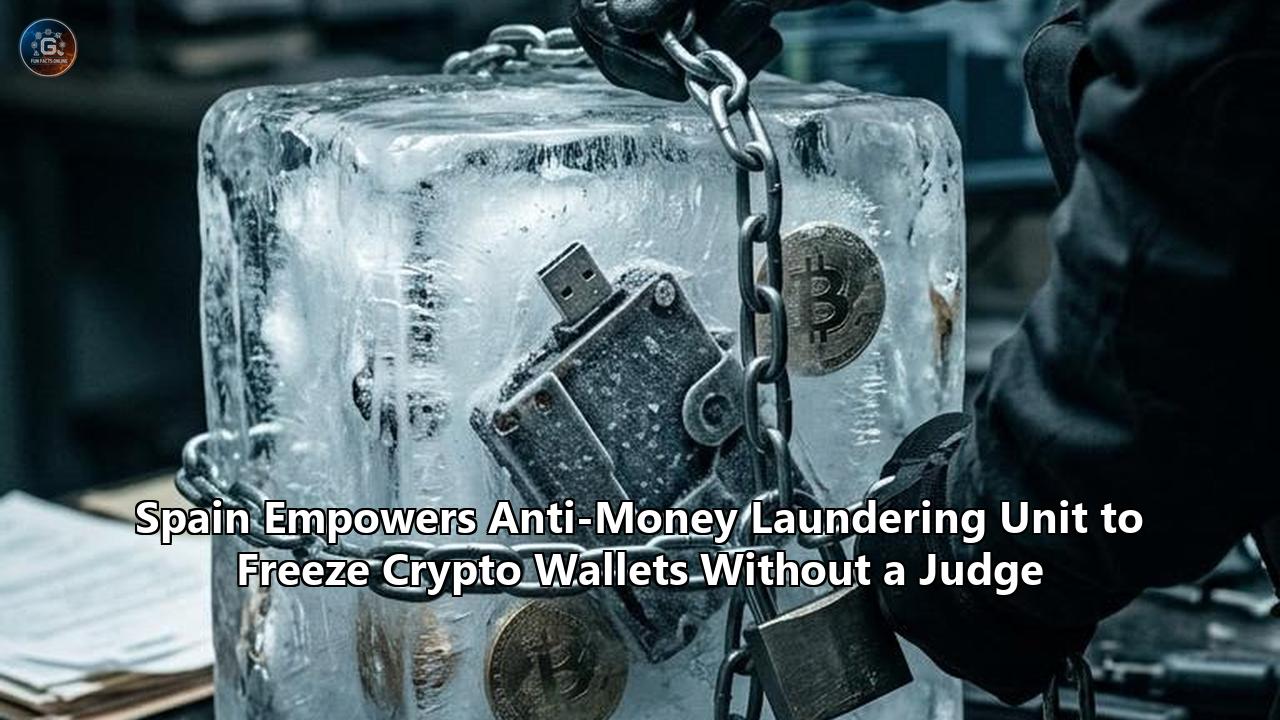
On November 25, 2026, the Spanish government published a legislative measure tucked into the depths of a broader financial decree that dismantled a longstanding pillar of digital property rights in Spain. Under Royal Decree-Law 44/2026, published in the Boletín Oficial del Estado (BOE), Spain granted its financial intelligence unit the authority to unilaterally freeze cryptocurrency accounts and seize control of digital transactions without prior judicial review or a magistrate’s warrant.
The mandate targets digital asset platforms, payment processors, and traditional credit institutions. By inserting a newly drafted Article 46 bis into the nation’s foundational anti-money laundering statute—Law 10/2010—the Spanish executive branch empowered the Executive Service of the Commission for the Prevention of Money Laundering and Monetary Offences (SEPBLAC) to act as an administrative judge, jury, and executioner for financial halts. Under the statute, SEPBLAC can lock an individual’s or entity’s crypto-asset account for up to five business days. If an asset is already in motion across a blockchain, the agency can unilaterally halt the pending transaction for up to ten business days.
No judge examines the evidence before the freeze order lands on an exchange’s compliance desk. No courtroom hearing takes place, and no formal criminal indictment is required. Instead, the standard for intervention rests on an administrative assessment: the existence of mere "indications" that a digital wallet, account, or transfer could be linked to money laundering, illicit financing, or organized crime.
The measure takes effect on January 25, 2027, subject to a mandatory 30-day ratification vote in Spain’s Congress of Deputies. For digital asset custodians, Virtual Asset Service Providers (VASPs), and domestic crypto holders, the decree marks a structural turning point. Regulated platforms operating within Spanish jurisdiction face ruinous consequences if they hesitate to carry out an order. Under Spain’s administrative sanctioning regime, failure to freeze a customer's wallet instantly constitutes a very serious infraction, triggering mandatory minimum fines starting at €150,000 and escalating into millions of euros, alongside potential license revocations.
The path to this decree was neither sudden nor accidental. It represents the culmination of a decade-long struggle between Spanish law enforcement, judicial magistrates, tax collectors, and an elusive digital asset economy that moves at the speed of block confirmations. Tracing how Spain moved from treating cryptocurrency as a novelty to equipping an intelligence agency with warrantless asset-freezing powers reveals a steady escalation of institutional frustration, legal friction, and deliberate regulatory encroachment.
2014–2019: The Judicial Vacuum and the Latency Dilemma
The origins of Spain’s aggressive enforcement posture trace back to the early days of decentralized digital assets, when Spanish courts and regulators found themselves completely unequipped to handle on-chain transactions.
Throughout the mid-2010s, the Spanish legal apparatus viewed Bitcoin through the lens of traditional property and contract law. When the Audiencia Nacional and provincial criminal courts first encountered cases involving digital currencies—primarily ransoms demanded via early ransomware strains or illicit commerce on darknet platforms—judges lacked statutory definitions to seize or liquidate the underlying tokens.
A defining moment in this early phase came in 2015, when the Directorate-General for Taxes (Dirección General de Tributos) issued administrative rulings clarifying that digital currencies were exempt from Value Added Tax (VAT), falling under the financial services exemption outlined in European Court of Justice case law. Yet, while tax authorities took an early administrative view, the criminal justice system fell dangerously behind.
Under Spain’s Criminal Procedure Act (Ley de Enjuiciamiento Criminal, or LECrim), the provisional seizure of assets has always required strict judicial intervention. Rooted in Article 24 of the 1978 Spanish Constitution, which guarantees fundamental rights to effective judicial protection and due process, any asset freeze required a judge of instruction (juez de instrucción) to review evidence, determine proportionality, and issue a formal warrant.
This procedural framework quickly proved disastrous for detectives within the National Police (Policía Nacional) and the Civil Guard’s Central Operational Unit (Unidad Central Operativa, UCO). In several early drug trafficking and cybercrime probes, investigators tracked cryptocurrency transactions originating in Madrid and Barcelona to mixer services and foreign OTC desks. By the time law enforcement compiled an evidentiary dossier, drafted a formal request, submitted it to a public prosecutor, and secured a judge’s signature, the digital assets were long gone.
Traditional Spanish Asset Freezing Process (Pre-Reform):
Suspicious Alert -> Law Enforcement Probe -> Public Prosecutor Review -> Judicial Hearing -> Judge Issues Freeze Warrant -> VASP Freezes Asset
[Typical Latency: Days to Weeks — High Asset Flight Risk]
The friction reached the highest levels of the judiciary in June 2019. In a milestone ruling (Sentencia 326/2019), the Spanish Supreme Court (Tribunal Supremo) ruled on a major fraud case where victims were swindled out of hundreds of Bitcoins. The high court explicitly held that Bitcoin cannot be considered money or legal tender under Spanish law, classifying it instead as an intangible asset or financial unit of account. Crucially, the Supreme Court ruled that victims could not receive restitution in Bitcoin itself; instead, the court ordered the perpetrator to indemnify victims in fiat euros based on the asset's value at the time the contracts expired.
The ruling sent shockwaves through Spanish law enforcement. It laid bare a glaring reality: the legal system did not possess the mechanics to treat digital assets as liquid sovereign instruments, yet criminals were using them precisely for that purpose. To freeze crypto, police had to jump through judicial hoops designed for land registries and brick-and-mortar bank accounts. Investigators warned the Ministry of Justice that blockchain latency was asymmetric—criminals moved illicit capital in six seconds, while the judiciary operated on a calendar of weeks.
2020–2022: Royal Decree-Law 7/2021 and the VASP Register
As illicit crypto flows gained visibility across Europe, the European Union pressured member states to implement the Fifth Anti-Money Laundering Directive (5AMLD). Spain had lagged behind its transposition deadlines, inviting infringement proceedings from the European Commission. The Spanish executive branch responded with urgency, turning to a fast-track legislative mechanism that would become its preferred weapon: the Royal Decree-Law.
In April 2021, the government enacted Real Decreto-ley 7/2021, transposing 5AMLD and overhauling Spain’s core Anti-Money Laundering statute, Law 10/2010. This moment marked the end of digital asset informalism in Spain and established the first deep operational bridge between crypto firms and state surveillance.
The 2021 reform introduced two structural mechanisms:
- *The Expansion of Obliged Entities (Sujetos Obligados): Crypto-fiat exchange platforms and custodian wallet providers operating in Spain were formally added to the list of entities bound by strict anti-money laundering and counter-terrorist financing rules, placing them in the same legal category as commercial banks, notaries, and casinos.
- The Bank of Spain VASP Registry: Under the updated law, all crypto exchanges and custody services offering operations in Spain were mandated to register with the Bank of Spain (Banco de España). Registration was not a light administrative check; it required firms to prove the commercial honorability of their executives and submit their internal AML compliance manuals directly to SEPBLAC for scrutiny.
Between late 2021 and 2022, global and domestic exchanges lined up to gain entry into the Bank of Spain's registry. Entities like Bit2Me, Binance, Bitstamp, and Coinbase submitted their operations to the central bank's supervision. Through this register, the state constructed a direct gateway into the transaction ledgers of every custodial crypto user in the country.
Yet, an operational bottleneck remained. Real Decreto-ley 7/2021 gave SEPBLAC visibility, but it did not give it unilateral enforcement teeth. When an exchange flagged a red-flag transaction and filed a Suspicious Activity Report (comunicación por indicio) with SEPBLAC, the intelligence agency could only aggregate the data, draft a financial intelligence dossier, and dispatch it to the Fiscalía Anticorrupción (Anti-Corruption Prosecutor’s Office) or the police.
If SEPBLAC wanted an account blocked immediately, it had no domestic power to do so. Under Article 46 of Law 10/2010, SEPBLAC could only order the suspension of a transaction if it received a formal, urgent petition from an equivalent Financial Intelligence Unit (FIU) in another European Union member state. Domestically, the agency remained entirely subordinate to the judiciary. If a Spanish citizen was laundering funds through a Madrid-based exchange, SEPBLAC had to watch the funds leave the platform unless an investigative judge happened to issue a provisional freeze order.
Behind closed doors in Madrid’s Ministry of Economy and Ministry of the Interior, this limitation was viewed as a critical flaw. The state had built an extensive monitoring network, but it still lacked the unilateral power to sever the wire.
2023–2024: The Fiscal Enclosure and the Shadow of DAC8
By early 2023, the Spanish government’s strategy expanded from anti-money laundering prevention to fiscal control. The Ministry of Finance (Ministerio de Hacienda), steered by the State Tax Administration Agency (AEAT), initiated a campaign to eliminate anonymity for domestic crypto holders.
The primary manifestation of this campaign was the rollout of Modelo 721, an aggressive tax reporting declaration implemented for the 2023 fiscal year. Under Modelo 721, Spanish tax residents holding digital assets on platforms located outside Spanish territory were legally required to declare every token, public key, and fractional balance exceeding a total aggregate value of €50,000. Failure to submit this detailed ledger carried heavy monetary penalties, pushing Spanish taxpayers to either pull their assets onto domestic, Bank of Spain-registered exchanges or declare their foreign holdings down to the last decimal place.
Simultaneously, the tax agency implemented Modelos 172 and 173, obligating domestic exchanges to provide automatic, periodic reports containing customer names, tax identification numbers, wallet balances, and comprehensive transaction histories.
Spain's Multi-Pronged Surveillance Net (2021–2024):
├── Financial Oversight: Bank of Spain VASP Registry (AML Compliance via SEPBLAC)
├── Fiscal Reporting: Modelo 721 (Foreign Holdings) & Modelos 172/173 (Domestic Operations)
├── Advertising Restrictions: CNMV Circular 1/2022 (Mandatory Risk Warnings & Pre-Clearance)
└── European Integration: MiCA (Regulation EU 2023/1114) & DAC8 Implementation Phase
During this phase, spain crypto regulations matured into one of the most comprehensive monitoring frameworks anywhere in Western Europe. The National Securities Market Commission (CNMV) enacted Circular 1/2022, asserting control over crypto promotions, requiring mass-market campaigns to obtain regulatory pre-clearance, and demanding warning labels declaring digital assets high-risk investments.
Yet, fiscal authorities hit a major constitutional wall in late 2024 and 2025. The Spanish executive had drafted a sweeping reform to the General Tax Law (Ley General Tributaria) designed to transpose the European Union’s DAC8 directive—the eighth iteration of the Directive on Administrative Cooperation. Tucked within this draft bill was a clause granting the Spanish Tax Agency the explicit, direct authority to execute administrative embargoes and seizures on cryptocurrency accounts belonging to delinquent taxpayers, mimicking the way the state freezes traditional bank accounts for unpaid taxes.
However, political instability intervened. In October 2026, the dissolution of the Spanish Parliament (Cortes Generales) triggered by political fragmentation caused all pending legislative business to lapse under the Standing Orders of Congress. The direct tax seizure bill disappeared into the legislative wastebasket.
For civil liberties groups, crypto defense attorneys, and digital property advocates, the lapse of the DAC8 bill felt like a reprieve. It appeared that any statutory mechanism allowing the administrative state to seize digital wallets without prior judicial process had been stalled. That optimism was short-lived.
2025: The €16.1 Million Bottleneck and AMLD6
While the tax agency’s direct-seizure ambitions stalled in parliament, pressure was mounting on the criminal enforcement front. In early 2026, judicial reports revealed that Spanish criminal courts had assigned over €16.1 million (approximately $17.7 million) in seized crypto assets to the Asset Recovery and Management Office (Oficina de Recuperación y Gestión de Activos, ORGA) during the 2025 calendar year.
On paper, €16.1 million represented an enforcement milestone for the Ministry of Justice. In reality, law enforcement leadership viewed that sum as a small fraction of the capital slipping through their fingers. The UCO, the National Police’s Economic and Fiscal Crime Unit (UDEF), and the Anti-Drug Prosecutor’s Office pointed out that in several operations targeting transnational cartels, millions of euros in stablecoins had been shifted off custodial platforms in the final hours before a duty magistrate signed an asset freeze warrant.
The delay was not caused by police inactivity; it was an inevitable feature of Spanish criminal procedure:
- Step 1: An exchange flags an anomalous, rapid transfer of Tether (USDT) or Bitcoin and sends an expedited notice to SEPBLAC.
- Step 2: SEPBLAC analysts examine the ledger and trace the digital hops across non-custodial wallets and high-risk mixers.
- Step 3: Finding red flags, SEPBLAC routes the intelligence to the specialized public prosecutor (Fiscalía).
- Step 4: The prosecutor files an emergency petition before the central instruction judge (juzgado central de instrucción) at the Audiencia Nacional.
- Step 5: The judge assesses criminal jurisdiction, necessity, and proportionality before issuing a formal court order to the exchange.
In the fast-moving digital asset ecosystem, that five-step administrative chain proved fatal to enforcement. By the time Step 5 was executed, the recipient address on the exchange had already emptied the account via automated API calls, dispatching the funds to private, self-hosted hardware wallets or decentralized liquidity pools beyond administrative reach.
At the same time, the European Union had passed its new Anti-Money Laundering package: Regulation (EU) 2024/1624 and Directive (EU) 2024/1640, commonly known as the Sixth Anti-Money Laundering Directive (AMLD6).
Article 24 of AMLD6 contained a requirement that would change the enforcement landscape. It mandated that member states must equip their national Financial Intelligence Units with the legal capacity to suspend or withhold consent to transactions in progress, or temporarily suspend accounts, whenever money laundering or terrorist financing is suspected.
Crucially, the European directive did not explicitly demand that FIUs bypass judicial oversight; it left the procedural architecture to individual national capitals. Some European states, such as Germany, advanced aggressive models through the Bundestag, passing measures allowing the prolonged seizure of unexplained digital wealth exceeding €100,000 for up to 180 days while the owner's financial origins were probed. Poland's parliament followed suit, voting 240-202 to authorize administrative freezes on crypto assets held by individuals on national sanctions lists before judicial review.
In Madrid, the executive saw an opening. The government determined that attempting to push a standalone law through an unpredictable, fractured Congress of Deputies to grant police or intelligence services warrantless freeze powers would trigger fierce pushback from opposition parties, privacy groups, and constitutional purists.
Instead, the executive turned to an omnibus legislative instrument: the urgent Royal Decree-Law.
November 2026: The Administrative Strike — Royal Decree-Law 44/2026
On Tuesday, November 24, 2026, the Spanish Cabinet (Consejo de Ministros) approved Real Decreto-ley 44/2026. When it appeared the following morning in the official state gazette (BOE-A-2026-24702), the public and the financial press initially overlooked its regulatory implications. The decree’s formal title focused on entirely unrelated economic matters: consumer credit contracts, mortgage protections, and the regulation of servicers acquiring non-performing loan (NPL) portfolios from banking institutions.
Buried deep within the decree’s miscellaneous sections—specifically within its Sixth Final Provision (Disposición final sexta)—lay the amendment to Spain’s core money-laundering statute: the insertion of Article 46 bis into Law 10/2010.
With a few paragraphs of legislative text, the government removed the requirement of judicial pre-approval for digital asset account freezes.
Article 46 bis directly empowers SEPBLAC to freeze crypto accounts, suspend banking relationships, and abort digital transactions through pure administrative authority. The text establishes two distinct statutory timeframes:
- Account Freezes (Up to 5 Business Days): SEPBLAC can unilaterally issue a binding order to any regulated platform to suspend the use of a cryptocurrency account, digital asset wallet, bank account, or general business relationship for up to five business days.
- Transaction In-Flight Blocks (Up to 10 Business Days): Where an asset transfer is already initiated or pending execution, SEPBLAC has the direct authority to order the firm to refuse or halt the transaction for a maximum of ten business days.
The Fast-Track Administrative Freeze (Royal Decree-Law 44/2026):
Indications of Suspicion -> SEPBLAC Unilateral Administrative Order -> Immediate Freeze by VASP (Within Same Day)
                                  │
                   ┌──────────────┴──────────────┐
                   ▼                             ▼
       Account Freeze: 5 Days        Transaction Halt: 10 Days
                   │                             │
                   └──────────────┬──────────────┘
                                  ▼
      Public Prosecutor (Ministerio Fiscal) Must File in Court
                                  │
             ┌────────────────────┴────────────────────┐
             ▼                                         ▼
     Judge Ratifies / Extends                   Statutory Clock Lapses:
     (Under Criminal Procedure)                 Freeze Drops Automatically
The trigger threshold is extraordinarily low compared to criminal evidentiary requirements. The agency does not need to show "probable cause" or meet the strict criminal standards required to open a preliminary investigation under Spanish procedural law (indicios racionales de criminalidad). The statute requires only that SEPBLAC determine there are mere "indications" (indicios) that an account, business relationship, or transaction could be tied to money laundering, terrorism financing, or underlying illicit activity.
The decree outlines clear procedural mechanics for how this power must be wielded:
- The Origin of the Action: SEPBLAC can initiate these freezes through two vectors. First, from its own autonomous data analytics—meaning the agency’s internal algorithms and blockchain intelligence tools can trigger a freeze without any external complaint. Second, upon receiving a Suspicious Activity Report (SAR) from an obliged entity. When acting on an external SAR, SEPBLAC is bound to issue the freeze order within three business days of receiving the report.
- Third-Party Petitions: The unit can also deploy this unilateral freeze mechanism at the direct request of the Spanish National Police, the Civil Guard, the National Intelligence Centre (CNI), or financial intelligence counterparts within the EU and international FATF jurisdictions.
- The Judicial Checkpoint (The Exit Ramp): To preserve formal constitutional appearances, the decree establishes that an administrative freeze cannot continue indefinitely. Once the five-day (for accounts) or ten-day (for transactions) statutory window expires, the freeze lapses automatically, and the assets must be released back to the user. The hold can only be maintained beyond these limits if the Public Prosecutor’s Office (Ministerio Fiscal) petitions a competent court to ratify or extend the measure as part of a formal criminal proceeding before the administrative clock runs out.
- Complete Administrative and Civil Immunity: To ensure that private crypto exchanges and custodial banks do not hesitate out of fear of lawsuits from high-net-worth clients, the decree shields SEPBLAC, its staff, and the executives of the complying crypto platforms from civil or contractual liability for damages resulting from executing the emergency freeze.
This procedural shift represents a major change for spain crypto regulations. By transforming what was once an intelligence shop into an operational executioner, Spain established an administrative fast lane that operates entirely outside the judiciary's gatekeeping role.
The Legal and Constitutional Collision
The publication of Real Decreto-ley 44/2026 provoked pushback across Spain’s legal, academic, and constitutional sectors. The primary battleground centers on Article 24 of the Spanish Constitution of 1978, which guarantees tutela judicial efectiva—the fundamental right to effective judicial protection, due process, and a fair hearing before an independent magistrate prior to the deprivation of property rights.
Under centuries-old legal doctrine inherited from Roman-civil law traditions, administrative agencies in Spain possess powers of self-enforcement (autotutela administrativa). The state can fine drivers, freeze bank balances for delinquent municipal taxes, or temporarily impound commercial vehicles without going to court first.
However, constitutional jurists contend that extending this administrative power to the warrantless freezing of intangible financial assets on mere suspicion crosses an impermissible constitutional line.
Critiques focus on three operational vulnerabilities:
- The Presumption of Guilt and the Reversal of Proof: By allowing SEPBLAC to freeze accounts for five to ten days on simple "indications," the decree effectively forces the crypto user into financial paralysis without an initial right of reply. If an algorithmic false positive flags a legitimate business owner moving payroll via stablecoins or an investor reallocating assets across platforms, the capital remains impounded while the agency conducts its internal review. In volatile crypto markets, a ten-day transaction freeze during an asset crash or liquidity crunch could result in complete capital liquidation before a judge ever sees the case file.
- Abuse of the Royal Decree-Law Instrument: Article 86 of the Spanish Constitution allows the government to issue Royal Decree-Laws only in cases of "extraordinary and urgent necessity" (extraordinaria y urgente necesidad). Jurists argue that shoehorning an anti-money laundering structural power into an omnibus decree largely dealing with non-performing consumer debt portfolios represents legislative maneuvering designed to sidestep parliamentary debate and committee scrutiny.
- The Asymmetry of Remedies: If an instruction judge orders an asset frozen under Spain’s Criminal Procedure Act, the affected party has immediate procedural rights: the right to an attorney, access to the judicial docket (vista del expediente), and the immediate ability to file an appeal for reform (recurso de reforma) or an appeal to the provincial court (recurso de apelación). Under the new administrative freeze, because the measure exists purely within the administrative walls of SEPBLAC for the first five to ten days, the affected user has no open judicial forum to challenge the freeze until after the intelligence unit has already wrapped up its review or handed the case over to the public prosecutor.
Legal defense groups and digital rights organizations in Madrid, including the Spanish Association of Fintech and Insurtech (AEFI) and various constitutional litigation foundations, have hinted at preparing appeals before the Constitutional Court (Tribunal Constitucional). They argue that the measure violates not only Article 24, but also Article 18 (guaranteeing personal privacy and secrecy of communications) and Article 33 (the constitutional right to private property).
Operational Reality: The VASP Compliance Shockwave
While constitutional lawyers debate due process, the operational burden of the decree lands on the desks of compliance officers, risk managers, and chief legal counsels at cryptocurrency exchanges operating within the country.
Under Law 10/2010, the penalties for an obliged entity that fails to comply with a direct order from SEPBLAC are catastrophic. Article 46 bis removes any margin of discretion for the platform. If an exchange receives a freeze order from SEPBLAC and delays its implementation, the action is classified as a "very serious infringement" (infracción muy grave).
The statutory consequences under Spanish anti-money laundering law include:
- Minimum administrative fines starting at €150,000, which can scale up to €10 million or 10% of the institution's total annual turnover.
- Public sanctions and reputational censure published in the official state gazette.
- The direct withdrawal of authorization or revocation of the exchange’s Bank of Spain registration, effectively barring the platform from operating in the Spanish market.
- Direct personal liability, sanctions, and temporary disqualification of board members and compliance officers from holding management positions across the European financial sector.
Nikolai Timofejev, a legal and regulatory affairs consultant who specializes in financial compliance for digital asset institutions, underscored the operational shift confronting the sector. He noted that the decree forces crypto firms into treating regulatory freeze requests not as bureaucratic mail to be processed within days, but as an instantaneous technical response. Timofejev emphasized that platforms must assign an operational workstream with a designated legal liaison equipped with the authority to immediately execute same-day freezes on client withdrawals and transactions to insulate the firm from six-figure baseline fines.
The mechanical burden this imposes on crypto platforms is immense. Unlike traditional commercial banks, which operate during standard business hours and execute settlement batches overnight or over business days, cryptocurrency exchanges operate 24 hours a day, seven days a week, 365 days a year.
To comply with SEPBLAC’s new powers without falling foul of the three-day and same-day operational windows, exchanges operating in Spain must re-engineer their infrastructure:
+---------------------------------------------------------------------------------------+
|                              NEW VASP OPERATIONAL PIPELINE                            |
+---------------------------------------------------------------------------------------+
|  1. 24/7 API-Driven Freeze Infrastructure                                             |
|     Exchanges must build programmatic kill-switches into account ledgers to           |
|     immediately halt outbound RPC calls and withdrawal endpoints upon receiving       |
|     an authenticated administrative order.                                            |
|                                                                                       |
|  2. Real-Time Account Quarantine Protocols                                            |
|     Distinguishing between transaction-level holds (10-day cap) and global            |
|     account suspensions (5-day cap), preventing automatic collateral liquidations     |
|     in leveraged positions during an active freeze.                                   |
|                                                                                       |
|  3. Designated 24/7 Regulatory Liaison Officers                                        |
|     Ensuring compliance personnel are authorized to carry out asset blocks            |
|     outside normal judicial hours, holidays, and weekends.                            |
|                                                                                       |
|  4. Immutable Administrative Audit Logging                                            |
|     Documenting down-to-the-millisecond execution times to defend against             |
|     SEPBLAC non-compliance fines while preparing evidence packages for prosecutors.   |
+---------------------------------------------------------------------------------------+
For smaller, homegrown Spanish exchanges, these requirements create a heavy compliance drag. The cost of maintaining round-the-clock compliance teams and specialized API infrastructure to respond instantly to warrantless state freeze orders increases the barriers to entry across the domestic tech ecosystem.
The European Crossfire: A Blueprint for AMLA?
Spain does not exist in an institutional vacuum. The emergence of Article 46 bis represents an early battleground for a broader, coordinated transformation taking place across the entire European Union.
The European Union is currently deep into the construction of its new centralized regulatory regime, dominated by the Anti-Money Laundering Authority (AMLA), headquartered in Frankfurt. AMLA is tasked with harmonizing financial crime enforcement across all 27 member states, directly supervising high-risk cross-border financial entities, and setting unified standards for Financial Intelligence Units across the bloc.
For years, the European Commission has looked with deep suspicion at the patchwork of national FIU capabilities. While an FIU in one country could unilaterally suspend a transaction, an FIU in another had to wait for an investigative judge, giving criminal syndicates an easy roadmap for regulatory arbitrage.
| Country | Administrative Freeze Power | Time Limit (No Court Order) | Asset Classes Targeted | Judicial Extension Requirement |
|---|---|---|---|---|
| Spain | Direct FIU (SEPBLAC) Action | 5 days (accounts) / 10 days (txs) | Crypto assets, bank accounts, payment accounts | Mandatory petition by Public Prosecutor before deadline |
| Germany | Asset Recovery Authorities | Up to 180 days (Unexplained Wealth) | Crypto assets over €100,000 | Judicial oversight applied during retention phase |
| Poland | Administrative / Sanction Units | Variable preliminary freeze | Bitcoin, crypto tokens, bank funds | Ex-post judicial review following sanctions designation |
| France | TRACFIN (Intelligence Unit) | 48 to 72 hours (Oppositional power) | Bank transfers, financial assets | Requires court referral for extension beyond administrative window |
By advancing this measure through Royal Decree-Law 44/2026, Spain has aligned itself with the most interventionist bloc within the European Union. Spain’s move provides a live regulatory sandbox for how the European Union’s broader Sixth Anti-Money Laundering Directive will reshape domestic enforcement.
The decree's preamble directly admits this motive, noting that SEPBLAC’s preventive power had historically been restricted to cross-border requests originating from foreign FIUs, rendering domestic enforcement sluggish and uncompetitive. The reform seeks to close that gap completely, positioning Madrid not as a regulatory follower, but as an aggressive testing ground for administrative powers.
Yet, this rapid march toward pre-emptive administrative control highlights a growing philosophical divergence within the European financial landscape. While the European Union prides itself on offering the world’s most robust regulatory clarity through the Markets in Crypto-Assets (MiCA) regulation, the aggressive expansion of warrantless freezing mechanisms risks casting a chilling effect over institutional capital deployment. When sovereign entities grant intelligence units the unilateral authority to immobilize capital without a judicial warrant, foreign institutional investors must incorporate operational and sovereign seizure risks into their European custody models.
Market Repercussions: The Self-Custody Flight
A basic law of digital asset markets states that whenever the regulatory perimeter tightens around custodial gateways, on-chain activity alters its trajectory. The introduction of warrantless administrative freezes into spain crypto regulations is already accelerating structural shifts across the domestic market.
The first and most immediate consequence is the deepening divide between custodial and non-custodial operations.
For users who store their digital assets with centralized, Bank of Spain-registered exchanges, the risk profile has changed completely. Users on custodial platforms no longer face legal exposure solely in the event of formal criminal proceedings or tax audits. Under Article 46 bis, their funds can be impounded simply because their deposit passed through an unhosted wallet that was flagged by SEPBLAC’s automated heuristic tracking software.
The Institutional Bifurcation:
┌────────────────────────────────────────────────────────┐
│               Regulated Custodial Path                 │
│  • Subject to Bank of Spain VASP Registration          │
│  • Vulnerable to 5-10 day warrantless SEPBLAC freezes  │
│  • Automated reporting under Modelos 172/173           │
│  • Real-time KYC and Travel Rule transaction scrutiny  │
└────────────────────────────────────────────────────────┘
                           VS.
┌────────────────────────────────────────────────────────┐
│             Non-Custodial / Sovereign Path             │
│  • Hardware Wallets & Cold Storage (Ledger, Trezor)   │
│  • Immune to direct administrative API kill-switches   │
│  • Self-hosted cryptographic key control               │
│  • Dependent on decentralized P2P and offshore rails   │
└────────────────────────────────────────────────────────┘
Predictably, the decree is driving Spanish market participants toward self-custody. Hardware wallet manufacturers, decentralized finance (DeFi) protocols, and peer-to-peer transaction networks are seeing an uptick in interest from domestic users seeking to insulate their private wealth from sudden administrative halts.
However, escaping the administrative dragnet via self-custody carries its own legal minefield under the broader umbrella of spain crypto regulations. A resident who shifts funds onto a non-custodial wallet remains legally bound by Modelo 721 and personal income tax reporting obligations. If that resident subsequently seeks to off-ramp those funds back into fiat currency to purchase real estate or invest in traditional markets, they face intense scrutiny from the very same compliance departments that are now terrified of SEPBLAC’s €150,000 baseline fines.
When a user attempts to deposit crypto that originated from an unhosted wallet into a Spanish exchange, the exchange’s transaction-monitoring software flags the deposit. Under the new decree, SEPBLAC now holds the power to freeze that transaction for up to ten days while it inspects the entire historical transaction graph of the unhosted wallet. Thus, the administrative perimeter does not merely police the exchange; it serves as a digital checkpoint for capital attempting to return to the real economy.
What Comes Next: The Ratification Cliff and Unresolved Questions
Spain’s transition to warrantless administrative crypto freezes faces significant upcoming hurdles. The policy trajectory between now and late January 2027 will determine whether this mechanism becomes permanent law or faces an unprecedented constitutional collapse.
Milestone 1: The Parliamentary Ratification Vote (December 2026)
Under Article 86.2 of the Spanish Constitution, every Royal Decree-Law promulgated by the executive branch must be submitted to an immediate debate and vote in the full Congress of Deputies within thirty days of its publication.
The Pedro Sánchez-led administration operates in a heavily fractured legislative chamber, relying on a volatile coalition of regional nationalist and pro-independence parties. Royal Decree-Law 44/2026 contains a massive array of consumer credit measures alongside the crypto freeze provisions. Lawmakers face a stark binary choice: validate the decree in its entirety, or strike down consumer mortgage and credit protections to kill the administrative money-laundering powers.
If opposition parties manage to unbundle the decree or vote it down, the controversial Article 46 bis will fall with it. If the coalition holds, the measure will be codified permanently into Spanish law.
Milestone 2: Technical Integration by January 25, 2027
The official effective date set by the decree is January 25, 2027. This window gives crypto exchanges, payment processors, and banking institutions less than two months to overhaul their compliance departments, appoint designated liaisons, and deploy technical systems capable of halting transactions instantly.
The operational friction points will surface during this period:
- How will SEPBLAC transmit its freeze notifications to offshore VASPs registered with the Bank of Spain?
- What cryptographic protocols will authenticate that a freeze order actually originated from SEPBLAC, rather than a sophisticated social-engineering cyberattack targeting an exchange's legal desk?
- How will exchanges manage the risk of leveraged positions or automatic stop-losses held by clients whose accounts are frozen for five days, only for SEPBLAC to later release the hold after finding no wrongdoing?
Milestone 3: The Constitutional Court Challenge
If validated by Congress, legal defense foundations and industry trade groups plan to lodge formal appeals of unconstitutionality (recurso de inconstitucionalidad*) before the Constitutional Court. The central argument will target the bypassing of judicial pre-clearance under Article 24 of the Constitution.
The high court's eventual ruling will resonate far beyond Spain. If the Constitutional Court upholds the administrative freeze, it will establish a precedent across Europe that intangible digital assets can be administratively impounded on mere regulatory suspicion without offending fundamental constitutional property protections. If the court strikes it down, it will force the European Union to reconsider how far its member states can go in accelerating AMLD6 directives at the expense of procedural due process.
A New Baseline for Financial Oversight
The quiet publication of Royal Decree-Law 44/2026 marks the end of an era for digital finance in Spain. For over a decade, the core appeal of decentralized assets—and their biggest headache for state authorities—was the mathematical principle that funds could only be immobilized through the possession of a private key, or through a deliberate judicial order served upon a regulated intermediary after proving probable cause to a magistrate.
That legal firewall has been dismantled. By vesting SEPBLAC with the unilateral authority to halt on-chain transfers for ten business days and shut down accounts for five business days without a judge’s signature, Spain has redefined the boundary between administrative intelligence and judicial enforcement.
The message sent by the Spanish state to the global crypto industry is clear: digital assets may move at the speed of internet packets, but the administrative apparatus will re-engineer statutory law to match that velocity. In the ongoing tug-of-war between decentralized protocols and state control, Spain has officially deployed the nuclear option of administrative finance. Whether this power succeeds in neutralizing organized financial crime or simply drives legitimate digital enterprise into foreign jurisdictions and unhosted shadows is the defining question that will play out across the courts, the markets, and the blockchain ledgers throughout 2027 and beyond.
Reference:
- https://bitcoinmagazine.com/news/spain-sepblac-freeze-crypto-accounts
- https://mlq.ai/news/spain-lets-its-anti-laundering-unit-freeze-crypto-accounts-without-a-judge/
- https://news.bitcoin.com/regulation-and-legal/spain-moves-freeze-crypto-accounts-without-court-approval/
- https://cryptobriefing.com/regulation/
- https://cointelegraph.com/news/spain-moves-grant-financial-watchdog-power-freeze-crypto-accounts
- https://www.bitkub.com/en/blog/spain-gives-anti-laundering-unit-power-to-freeze-crypto-B0aXMew7mbTWLSaHFSm0mD
- https://finance.biggo.com/news/f43564a5-85fa-4b89-850c-9143a3a0fc22
- https://thedefiant.io/news/regulation/spain-issues-decree-to-allow-temporary-crypto-account-freezes