At 16,800 miles per hour, the margin for error in low Earth orbit (LEO) is exactly zero. As of late 2025, aerospace tracking platforms cataloged 15,965 satellites circling the Earth. Of those, 13,026 were active—a staggering 23% year-over-year increase driven primarily by the rapid deployment of commercial megaconstellations. Yet, this orbital infrastructure shares a fatal flaw: finite chemical propulsion. A multi-hundred-million-dollar communications satellite inevitably transforms into dead weight the moment its 500-kilogram hydrazine tank runs dry, forcing operators to write off perfectly functional solar arrays, transponders, and optical sensors.
The financial arithmetic of this limitation is punishing. Every decommissioned satellite requires a replacement launch, adding to a compounding orbital traffic crisis that currently includes over 31,019 tracked objects and an estimated 1.2 million debris fragments larger than one centimeter. To halt this capital bleed, aerospace engineers have spent two decades pursuing on-orbit servicing (OOS). However, early attempts relied on rigid robotic limbs—analogous to the industrial arms used on automotive assembly lines—which perform poorly when tasked with delicately manipulating non-cooperative, uncrewed targets in a microgravity vacuum.
A mathematically distinct solution emerged in March 2026. Data from recent orbital tests confirm that soft, bio-inspired continuum manipulators—engineered to mimic the fluid, multi-jointed reach of an octopus tentacle—can successfully navigate the complex kinematics of space. By executing compliance control and fluid transfer at orbital velocities, these cable-driven appendages offer a scalable mechanism for extending the life of space assets.
The Physics of Orbital Servicing and the Rigid Arm Deficit
To understand the necessity of continuum robotics in space, one must first quantify the kinematic hostility of orbital docking. Traditional space manipulators, such as the Canadarm series, utilize a series of discrete rigid links connected by motorized rotary joints. In terrestrial environments, heavy cast-aluminum arms leverage a fixed base and the constant downward vector of gravity to achieve sub-millimeter precision.
In a microgravity environment, Newtonian mechanics present a severe operational barrier. When a rigid robotic arm makes contact with a target satellite, any residual momentum or slight misalignment generates an immediate transfer of kinetic energy. Because the target satellite is free-floating, a docking force applied at an imperfect angle will induce a torque, sending the dead satellite into an uncontrolled spin. Space agencies characterize this as the "threading a needle in space" problem. At 27,000 kilometers per hour, a 2-millimeter spatial deviation during fuel nozzle insertion can fracture a propellant valve, immediately creating a cloud of hypergolic fuel and shrapnel.
Historical missions highlight the constraints of rigid architecture. DARPA’s 2007 Orbital Express mission and later commercial life-extension vehicles relied on massive, purpose-built mechanical capture mechanisms designed strictly for cooperative targets. These systems required the target satellite to possess specific grappling fixtures. Because the vast majority of the 13,026 active satellites currently in orbit were launched without standardized docking rings or refueling ports, rigid capture mechanisms cannot service them.
Architecture of the Cable-Driven Continuum Manipulator
To bypass the limitations of rigid joints, aerospace engineers turned to continuum kinematics. Instead of isolating movement to distinct elbows and wrists, a continuum arm bends continuously along its entire length.
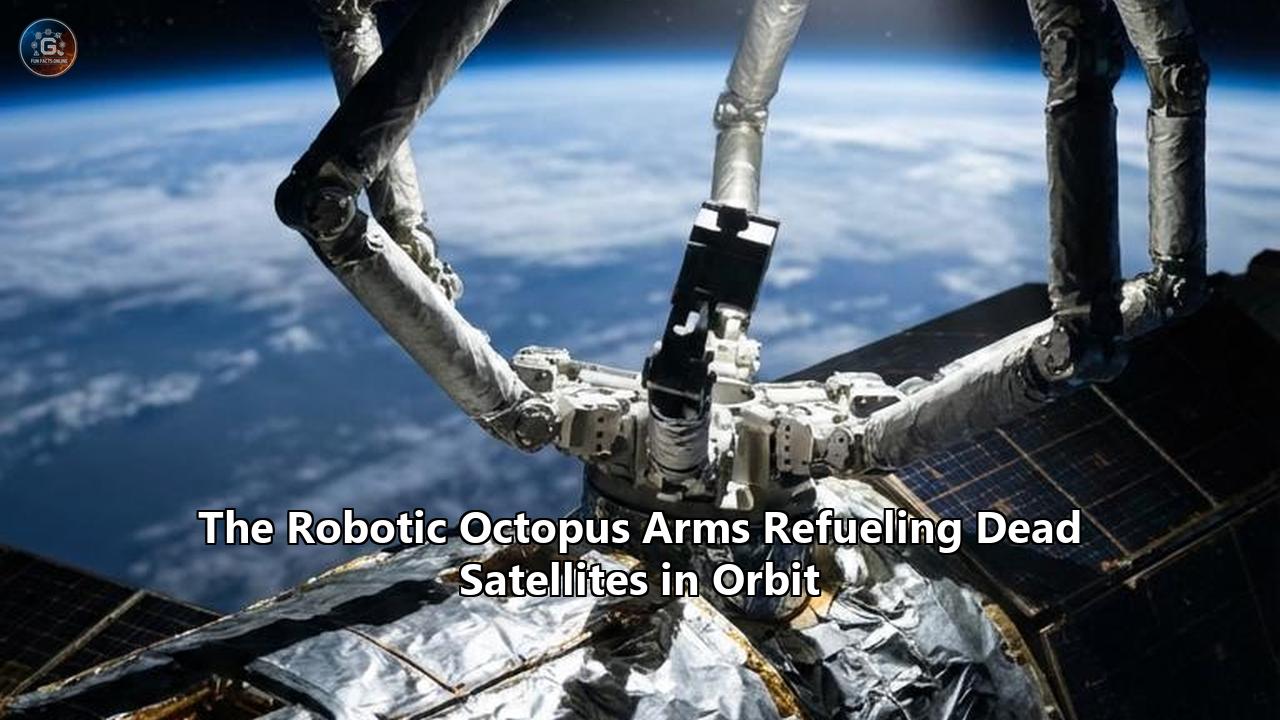
On March 16, 2026, a Kuaizhou-11 rocket launched from the Jiuquan Satellite Launch Center carrying the Yuxing 3-06 (also designated Hukeda-2 or Xiyuan-0) technology demonstration satellite. Built by Shenzhen Mofang Satellite Technology Co., Ltd., the platform housed a primary payload developed by Tsinghua University's Shenzhen International Graduate School and Suzhou Sanyuan Aerospace Technology: a flexible, cable-driven robotic arm.
The mechanical design of the Hukeda-2 arm directly mirrors the muscular hydrostats found in cephalopods. The arm lacks an internal rigid skeleton. Instead, it utilizes an assemblage of linked, spring-loaded tubes and a leaf spring-tendon system. High-tensile cables run the length of the appendage. By precisely tensioning and relaxing individual cables via basal motors located safely inside the satellite chassis, the entire arm can curl, twist, and snake through complex spatial geometries.
This electromechanical separation provides three quantifiable advantages for space operations:
- Mass Reduction: Moving the heavy drive motors out of the arm and into the satellite base drastically lowers the arm’s inertia. A lower mass appendage exerts exponentially less force upon contact, protecting delicate target structures.
- Infinite Degrees of Freedom (DOF): While a standard rigid robotic arm may possess 6 or 7 DOF, a continuum arm possesses theoretically infinite points of bending, allowing it to reach around solar panels or navigate deep into a satellite's chassis to reach recessed fuel fill-and-drain valves.
- Inherent Compliance: If the arm inadvertently bumps a target satellite, the spring-laden tubes naturally deform, absorbing the kinetic energy rather than transferring it to the target spacecraft.
The Four Modes of Orbital Validation
During its late-March and early-April 2026 testing phases, the Hukeda-2 continuum arm successfully executed a series of demonstrations that provided hard telemetry on its operational viability. Engineers evaluated the system across four distinct parameters:
- Autonomous Programmed Refueling: The arm utilized onboard motion planning algorithms to navigate from a stowed safe position to a simulated docking port without ground intervention. It successfully inserted a nozzled tip into a dummy fuel receptacle, validating the spatial coordinates required for fluid transfer.
- Human-in-the-Loop Remote Control: Ground operators guided the appendage utilizing real-time visual feedback. Telemetry data confirmed stable communication and minimal latency despite the 16,800 mph orbital velocity, proving that operators can manually intervene if an autonomous sequence fails.
- Visual Servo Docking: The satellite utilized camera imagery to continuously calculate the relative position of the arm's end-effector and the target. The closed-loop control system automatically adjusted cable tension to maintain a precise trajectory, countering the natural drift inherent in LEO.
- Force-Compliant Manipulation: Utilizing integrated torque and force sensors, the arm applied specific, measured pressure against a surface. This verified the hardware’s ability to apply the exact mechanical force required to open a fuel valve without exceeding structural limits.
Material Science and the Thermodynamics of LEO
Deploying soft robotics in the vacuum of space requires overcoming extreme environmental degradation. LEO exposes materials to severe atomic oxygen erosion, high doses of ionizing radiation, and brutal thermal cycling. A satellite passing in and out of Earth's shadow experiences temperature swings from -170°C to +120°C every 90 minutes.
For a rigid metal arm, thermal expansion is a known variable that can be mitigated with specific alloys and thermal blanketing. For a continuum arm relying on the precise tension of internal cables, microscopic thermal expansion can cause catastrophic navigation failures.
Data from the Tsinghua University development team reveals the severity of this challenge. During pre-launch thermal vacuum testing, which simulated the extreme temperature gradients of orbit, the microscopic heat-driven expansion and contraction of the arm’s structural materials triggered a feedback loop in the tensioning cables. This caused the entire appendage to experience "uncontrolled shaking" inside the vacuum chamber. The engineering team required three days of continuous algorithmic adjustments to the compliance control software to stabilize the arm, proving that the software managing a continuum robot must dynamically recalculate cable tension based on real-time temperature fluctuations.
Global Market Economics and the European Response
The successful demonstration of the Hukeda-2 system signals an imminent shift in orbital infrastructure management, opening a market that quantitative analysts project will reach $9.5 billion by 2035. The compound annual growth rate (CAGR) of 11.7% in the on-orbit servicing sector is largely predicated on the maturation of active debris removal and robotic satellite refueling.
The financial incentives for operators are highly asymmetric. Launching a replacement for a 4,000-kilogram geostationary communications satellite can cost upwards of $250 million when factoring in manufacturing, launch vehicle procurement, and insurance. Conversely, an orbital servicing mission that dispatches a 500-kilogram refueling drone equipped with a continuum arm to deliver 50 kilograms of propellant could theoretically be executed for under $30 million. Extending the revenue-generating life of the target asset by just three years yields an exceptional return on investment.
European and American aerospace contractors are aggressively pursuing parallel technologies. The European Space Agency (ESA), in a subcontract with Airbus Defence & Space, funded the Parallel Continuum Manipulator (PACOMA) project. Unlike the single-tentacle approach of the Chinese system, PACOMA utilizes a Revolute-Universal-Spherical (RUS) kinematic chain featuring six flexible links driven by a leaf spring-tendon system.
Extensive laboratory testing of the PACOMA prototype demonstrated its specific utility in addressing the misalignment problem during space docking. By leveraging parallel continuum mechanics, the ESA system provides high payload capacity and significant mechanical damping, ensuring that kinetic energy from an imperfect docking alignment is safely absorbed by the manipulator rather than the target rover or satellite. Market projections specifically note that by 2035, Europe’s satellite servicing sector will heavily rely on these types of robotic satellite refueling platforms, integrated with AI-powered autonomous rendezvous and docking (ARD) systems.
In the United States, parallel efforts include the Defense Advanced Research Projects Agency (DARPA) Robotic Servicing of Geosynchronous Satellites (RSGS) program and commercial ventures like Orbit Fab, which focuses on deploying standardized orbital propellant depots. However, the successful LEO test of a bio-inspired continuum arm places international competitors under strict timelines to finalize their own compliance-based capture mechanisms.
Debris Mitigation and the Active Payload Density Threat
Beyond direct financial savings, the imperative for robotic satellite refueling is driven by raw spatial density. The 2025 ESA Space Environment Report highlighted a critical threshold: within specific, highly populated altitude bands in LEO, the spatial density of active payloads is now on the same order of magnitude as the density of space debris.
When a satellite runs out of fuel, it loses the ability to perform collision avoidance maneuvers. With 1.2 million pieces of debris larger than 1 centimeter currently in orbit—each traveling fast enough to detonate a satellite upon impact—an uncontrolled, out-of-fuel satellite becomes a massive liability. If a dead satellite is struck, it shatters, adding thousands of new fragments to the environment and escalating the probability of a Kessler Syndrome cascade.
By employing continuum arms to interface with these aging assets, operators gain two distinct options. The primary option is fluid transfer—pumping propellant into the satellite so it can resume station-keeping and active collision avoidance. The secondary option, should the satellite's internal systems fail entirely, involves using the flexible arm to grapple the dead satellite firmly and apply a controlled retrograde burn, safely plunging the asset into the Earth's atmosphere for destruction.
Strategic Dual-Use Implications
The data surrounding continuum robotic arms also necessitates an analysis of orbital security. Space is a heavily contested operational domain. Any technology capable of matching orbits with a non-cooperative satellite, autonomously calculating a docking trajectory, and reaching inside its chassis with millimeter precision is inherently dual-use.
China's rapid expansion of its space infrastructure includes the deployment of megaconstellations such as the QianFan network (90 active satellites in late 2025) and the GuoWang network (57 active satellites). Protecting, maintaining, and refueling these assets provides a distinct strategic advantage. A robotic arm that can delicately connect a fuel hose to a friendly satellite can just as easily sever a power conduit or blind an optical sensor on a foreign adversary's surveillance platform.
The fluid, unpredictable movement of a continuum arm complicates defensive space situational awareness. A rigid arm extends in predictable geometric angles, allowing observing radar and optical sensors to calculate its exact reach and trajectory. A cable-driven tentacle can snake along the hull of a spacecraft, utilizing infinite degrees of freedom to bypass physical defensive baffles, making its final target point nearly impossible to predict until the moment of contact.
Moving Toward a Modular Orbital Economy
The validation of the Hukeda-2 flexible manipulator proves that the mechanical limitations of microgravity docking are resolvable through biological mimicry. The data—from the 11.7% market growth projections to the successful stabilization of cable-tension algorithms in thermal vacuum chambers—indicates a permanent shift in how satellites will be engineered and managed.
The era of designing monolithic, single-use spacecraft is ending. The integration of continuum robotics effectively converts satellites from disposable assets into maintainable nodes within a broader logistical network. As these flexible arms scale into commercial production, the metrics defining orbital operations will shift from strict fuel mass limitations to the efficiency of automated refueling logistics, establishing a resilient and replenishable architecture above the Earth.
Reference:
- https://aeromorning.com/en/orbital-traffic-surges-13026-ac8ve-satellites-as-of-october-1-2025/
- https://www.tradeandindustrydev.com/industry/aerospace-defense/survey-says-orbital-traffic-surges-13026-active-35036
- https://www.esa.int/Space_Safety/Space_Debris/ESA_Space_Environment_Report_2025
- https://sdup.esoc.esa.int/discosweb/statistics/
- https://pmc.ncbi.nlm.nih.gov/articles/PMC11496037/
- https://www.scmp.com/news/china/science/article/3347888/chinese-satellite-performs-landmark-refuelling-test-low-earth-orbit
- https://ua.news/en/technologies/kitaiskii-suputnik-proviv-dozapravku-na-nizkii-navkolozemnii-orbiti
- https://sixdegreesofrobotics.com/robot-news/chinas-octopus-arm-in-orbit-could-change-who-owns-the-sky
- https://futurism.com/space/satellite-china-fuel-arm
- https://www.electronicsforu.com/news/china-tests-flexible-robotic-arm-for-on-orbit-servicing
- https://www.youtube.com/watch?v=AOfAs0d0vhw
- https://pmc.ncbi.nlm.nih.gov/articles/PMC9966035/
- https://www.livescience.com/space/space-exploration/chinese-satellite-with-robotic-octopus-arm-passes-key-refueling-test-in-orbit-making-longer-lived-space-assets-more-likely
- https://spaceindustrydatabase.com/reports
- https://www.globenewswire.com/news-release/2025/03/20/3046358/28124/en/Europe-Satellite-Docking-System-Refueling-Market-Report-2025-2035-Focus-on-Satellite-Docking-Systems-In-Orbit-Refueling-In-Orbit-Propellant-Tanks-and-Country-Level-Analysis.html
- https://www.fastcompany.com/90979324/next-big-things-tech-space-telecom-2023