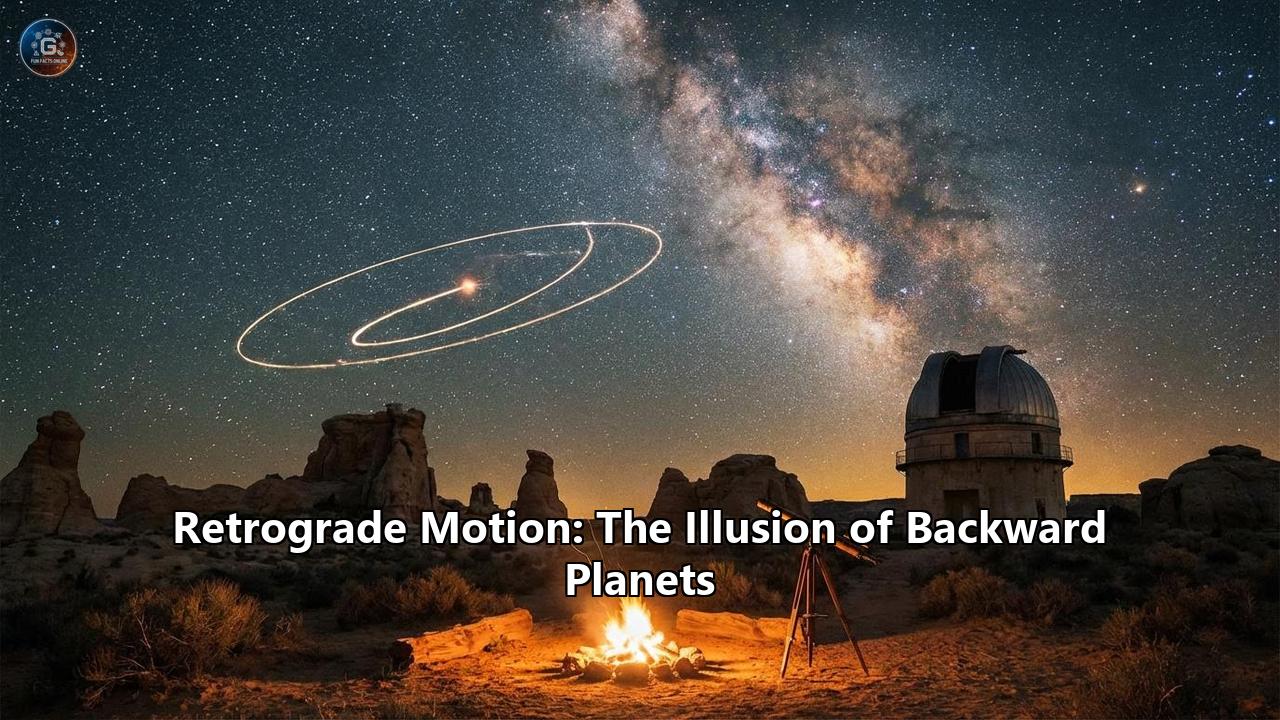
Imagine standing beneath the vast, unpolluted canopy of the night sky a few thousand years ago. Without smartphones, light pollution, or modern distractions, the heavens were humanity’s first television screen, clock, and compass all rolled into one. Night after night, ancient astronomers and shepherds alike watched the stars wheel overhead in perfect, predictable harmony. They mapped the constellations and trusted the steadfast rotation of the cosmos.
But hiding among these reliable, twinkling pinpricks of light were the rebels of the solar system: the "wandering stars," or as the ancient Greeks called them, planētai. Most of the time, these planets drifted eastward against the backdrop of fixed stars, following the cosmic speed limit. But every once in a while, they would do something entirely baffling. They would slow down, stop, and seemingly travel backward for weeks or months at a time before stopping again and resuming their forward march.
This bizarre, gravity-defying cosmic dance is known as retrograde motion.
For millennia, this illusion of backward planets drove philosophers mad, inspired entirely new branches of mathematics, and eventually became the key to unlocking the true architecture of our solar system. Today, it fuels modern pop-culture astrology and provides backyard astronomers with some of the most fascinating observational targets in the sky. To truly understand retrograde motion is to understand the very nature of perspective.
The Anatomy of a Cosmic Illusion
To demystify retrograde motion, we must first accept a fundamental truth: no planet in our solar system ever actually stops in its orbit and throws it in reverse. The laws of celestial mechanics and the immense momentum of planetary bodies make such a U-turn physically impossible. Retrograde motion is, in its purest form, an optical illusion born of relative speed and orbital geometry.
The easiest way to visualize this phenomenon is to imagine yourself driving on a multi-lane highway. You are in a swift sports car in the inside lane, representing Earth. In the outside lane is a large, slower-moving transport truck, representing an outer planet like Mars or Jupiter.
As you approach the truck from behind, everything makes sense. But as your faster car overtakes the truck, something interesting happens to your perspective. If you fix your gaze on the truck while keeping the distant mountains (representing the background stars) in your field of view, the truck appears to move backward relative to those mountains during the brief window that you are passing it. The truck hasn't stopped, nor has it thrown its engine into reverse. It is still moving forward at highway speeds. But because you are moving faster on a tighter, inner track, your relative vantage point creates the illusion of backward motion.
This is exactly what happens in the solar system. Earth, orbiting closer to the Sun, moves faster than the superior planets (Mars, Jupiter, Saturn, Uranus, and Neptune). When Earth catches up to and “laps” one of these outer planets, the line of sight from Earth, through the outer planet, and toward the distant stars shifts. For a period of a few weeks or months, the outer planet appears to trace a loop or a zigzag pattern in the night sky.
The mechanics work slightly differently for the inner, or inferior, planets—Mercury and Venus. Because their orbits are tighter and faster than Earth's, they are the ones lapping us. When Mercury or Venus passes between Earth and the Sun, they appear to dart backward against the starry background before resuming their forward (direct) motion as they swing around the far side of the Sun.
A Brief History of Cosmic Confusion
Before the optical illusion of retrograde motion was understood, it was the ultimate headache for ancient scientists. The prevailing belief of antiquity was the geocentric model, heavily championed by the Greek astronomer Ptolemy in the 2nd century CE. In this model, Earth was the stationary center of the universe, and everything—the Sun, the Moon, and the planets—revolved around us in perfect, divine circles.
But the backward loops of the planets directly contradicted this elegant theory. If Mars was orbiting Earth in a perfect circle, why did it occasionally stop, backtrack, and loop around?
To save the Earth-centered model, Ptolemy and his contemporaries developed a mathematical workaround called epicycles. They proposed that while planets orbited Earth on a large circle (the deferent), they were simultaneously spinning on a smaller circle (the epicycle). Imagine a teacup ride at an amusement park: the entire platform rotates, but each individual teacup is also spinning on its own axis. This "wheels within wheels" system successfully predicted planetary positions, but it was incredibly clunky, mathematically exhausting, and required constant adjustments to match real-world observations.
It wasn't until the 16th century that Polish astronomer Nicolaus Copernicus proposed a far more elegant solution: the heliocentric (Sun-centered) model. By simply placing the Sun at the center of the solar system and acknowledging that the planets orbit it at different speeds, the need for complex epicycles vanished instantly. Retrograde motion wasn't a physical reality of complex loops; it was merely an illusion caused by a moving Earth passing a moving planet.
Later, Johannes Kepler refined this model by proving that planets orbit in ellipses rather than perfect circles, definitively solving the mathematics of the solar system. In a very real way, the baffling illusion of retrograde planets was the catalyst that pushed humanity out of the center of the universe and into the modern scientific era.
The "Mercury Retrograde" Phenomenon
You cannot discuss retrograde motion in the modern era without addressing the cultural juggernaut that is "Mercury Retrograde." Even people who have never looked through a telescope know to blame the messenger planet for missed alarms, broken laptops, lost emails, and ex-lovers returning from the digital ether.
In astrological traditions, Mercury is the planet that governs communication, travel, commerce, and technology. The theory goes that when the planet appears to move backward, the domains it rules are thrown into chaos. Because Mercury is the closest planet to the Sun and possesses the fastest orbit (completing a year in just 88 Earth days), it laps us frequently. As a result, Mercury goes into apparent retrograde three to four times every single Earth year, for about three weeks at a time.
The cultural explosion of Mercury retrograde as a scapegoat for daily frustrations is a fascinating study in human psychology. In our hyper-connected, fast-paced modern world, we are under immense pressure for everything to work perfectly all the time. When a server crashes, a flight is delayed, or a contract falls through, it feels deeply personal. Pointing to the sky and blaming an optical illusion provides a comforting sense of release. It tells us: It's not your fault; the universe is just acting up right now.
But beyond the memes and the dread, even modern astrologers suggest a different approach to these periods. Instead of viewing them as curses, they can be seen as built-in cosmic pauses. The prefix "re-" becomes the theme: review, reassess, repair, reconnect, and reflect. It is an invitation to slow down in a world that demands we constantly speed up.
To ground this in the present moment, as of this writing in early March 2026, we are actively experiencing one of these periods. Mercury entered retrograde in the intuitive water sign of Pisces on February 26, 2026, and will remain in its backward dance until March 20, 2026. During this time, the skies practically invite a slower, more deliberate approach to our daily communications and creative pursuits.
Touring the Solar System in Reverse
While Mercury gets all the press, every single planet in our solar system experiences apparent retrograde motion from Earth's vantage point. Each planet's retrograde cycle has its own unique rhythm and visual signature.
Venus: The Rare Backward Dance
Venus is Earth's closest planetary neighbor and shines brighter than anything in the night sky besides the Moon. Because its orbit is so similar in size to ours, Venus goes retrograde the least frequently of any planet—only once every 18 months, for about 40 days. In astrological terms, Venus retrogrades are often associated with reassessing relationships, values, and finances. Astronomically, watching Venus transition from an "Evening Star" in the west to a "Morning Star" in the east during its retrograde phase is a spectacular transition that has fascinated skywatchers since the days of the ancient Mayans.
Mars: The Fiery Loop
The retrograde of Mars is perhaps the most visually dramatic. Because Mars orbits just outside of Earth, it is the planet we lap the most intimately. Mars goes retrograde roughly every 26 months, lasting for about two to two-and-a-half months. When Earth catches up to Mars, the distance between the two planets shrinks drastically. Consequently, Mars grows fiercely bright and distinctly red in our night sky.
When you track Mars during this time, it traces a massive, unmistakable "Z" or loop shape against the background stars. Astrologically, the "warrior planet" going backward is often viewed as a time of internalizing anger, reassessing ambitions, or feeling like your drive is stalling. The next time humanity will witness this fiery backward loop will be from January 10 to April 1, 2027.
Jupiter and Saturn: The Slow Wanderers
The gas giants are located much farther from the Sun. Because their orbits are vast and they move so slowly, Earth laps them quite regularly—about once a year. Consequently, Jupiter and Saturn spend a large portion of the year (several months) in retrograde motion.
Because they move so slowly against the starry background, their backward motion isn't as visually abrupt as Mars or Mercury, but it is deeply satisfying to track with a telescope. In a beautiful piece of celestial timing, Jupiter's most recent retrograde period in the constellation of Gemini literally comes to an end today, March 10, 2026, returning the gas giant to its direct forward motion.
Uranus, Neptune, and Pluto: The Long Reversals
The ice giants and the dwarf planet Pluto are so incredibly distant that their movement across our sky is agonizingly slow. Because Earth zips around the Sun so much faster, we spend nearly half of our year overtaking them. Therefore, Uranus, Neptune, and Pluto are in apparent retrograde motion for roughly five to six months out of every year.
Apparent Retrograde vs. True Retrograde
Thus far, we have discussed apparent retrograde motion—the optical illusion caused by orbital passing. However, the universe is full of genuine weirdness. There are instances in astrophysics where things truly are moving backward. This is known as true retrograde motion.
- True Retrograde Rotation (Planetary Spin): Most planets in our solar system, including Earth, spin on their axes in a counter-clockwise direction (if viewed from above the North Pole). However, Venus is a spectacular rebel. Venus has a true retrograde rotation, meaning it spins backward (clockwise). If you were to stand on the surface of Venus (and survive the crushing, acidic atmosphere), you would see the Sun rise in the west and set in the east. Uranus also experiences a form of true retrograde rotation, though its axis is tilted a staggering 98 degrees, meaning it essentially rolls around the Sun on its side like a bowling ball.
- True Retrograde Orbits (Moons): While all the major planets orbit the Sun in the same direction, some moons orbit their host planets backward. The most famous example is Neptune's largest moon, Triton. Triton orbits in the opposite direction of Neptune's rotation. Astrophysicists believe Triton was not formed alongside Neptune but is actually a captured dwarf planet from the Kuiper Belt. Because of its backward orbit, tidal forces are slowly degrading Triton's trajectory. Millions of years from now, Triton will drift too close to Neptune and be torn apart by gravity, forming a spectacular ring system.
How to Observe Retrograde Motion for Yourself
You don't need a multi-million-dollar observatory or a degree in astrophysics to witness retrograde motion. You simply need a clear sky, your naked eyes (or a good pair of binoculars), and patience. Retrograde motion is not a real-time event you can watch unfold over a cup of coffee; it is a long-exposure photograph of celestial mechanics that takes weeks to reveal itself.
Here is how you can observe it:
- Pick a Target: Mars is the easiest and most dramatic, but Jupiter or Saturn will also work wonderfully during their respective retrograde seasons.
- Find a Reference Point: Note the planet's position relative to a bright, easily identifiable "fixed" star or constellation.
- Keep a Log: Once a week, go out at the exact same time of night and sketch or photograph the planet's position relative to your fixed background stars.
- Watch the Loop: Over the course of a few months, your sketches or photographs will reveal the planet slowing its eastward drift, stopping, moving westward for several weeks, stopping again, and finally resuming its eastward journey.
For modern astrophotographers, taking a photograph of the planet every few nights and compositing them into a single image yields a stunning visual representation of the retrograde loop—a cosmic signature written across the dark canvas of space.
The Philosophy of Backward Motion
There is a profound, almost poetic lesson hidden within the mechanics of retrograde motion. For thousands of years, humans looked up at the night sky and assumed the universe was broken, confusing, or acting chaotically because a planet appeared to be moving backward. We built convoluted, anxiety-inducing models of reality just to try and make sense of it.
But the planets were never moving backward. They were simply following their natural, perfectly designed paths. The illusion of chaos was created entirely by our own perspective. We were judging the speed and direction of the universe based solely on the fact that we were speeding past it.
When we experience periods in our own lives where things seem to be stalling, reversing, or falling apart—whether we jokingly blame Mercury, Mars, or simply bad luck—it is worth remembering the astrophysics of the night sky. Sometimes, what looks like backward motion is merely an optical illusion caused by a shift in vantage point. Sometimes, to realize that everything is actually moving forward exactly as it should, we just need to change our perspective, slow down, and enjoy the view.
Reference:
- https://www.lifestyleasia.com/hk/astrology/upcoming-retrogrades-of-2026-dates-and-significance/
- https://www.almanac.com/content/mercury-retrograde-dates
- https://www.almanac.com/mars-retrograde-when-mars-retrograde
- https://cafeastrology.com/retrogrades.html
- https://wyldemoon.co.uk/the-moon/2026-retrograde-planetary-forecast/
- https://www.reddit.com/r/astrology/comments/1qu8hxh/february_2026_astrology_overview_eclipses/
- https://pandoraastrology.com/transits-this-year/planetary-retrogrades-stations/mars-station-retrograde/
- https://whenthecurveslineup.com/2026/03/01/2026-march-10-jupiters-retrograde-ends/