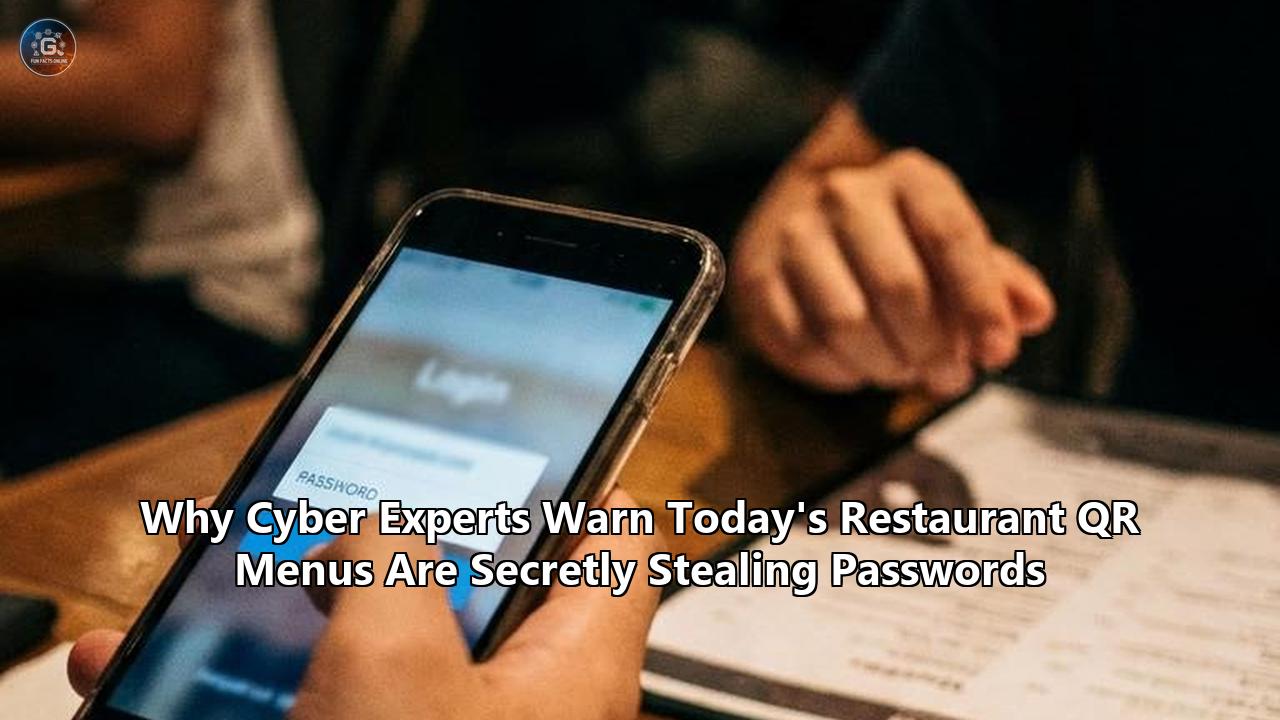
Cybersecurity researchers from Microsoft and federal law enforcement agencies have issued urgent warnings this week regarding a massive, highly coordinated wave of credential-theft attacks hiding in plain sight: the restaurant dining table.
According to intelligence reports released in May 2026, an estimated 35,000 users across 13,000 organizations have recently had their sensitive personal data, corporate login credentials, and financial accounts compromised through a remarkably low-tech delivery system. Threat actors are physically invading public spaces—specifically restaurants, cafes, and parking facilities—and placing fraudulent QR code stickers over legitimate digital menus and payment portals.
When unsuspecting patrons scan the code to order an appetizer or pay for their meal, they are seamlessly routed to meticulously crafted, fake login screens designed to harvest their passwords, intercept multi-factor authentication tokens, and directly drain their bank accounts.
This tactic, known in the threat intelligence community as "quishing" (QR phishing), has escalated from a fringe annoyance into a primary vector for cyber warfare. Attack volume has surged nearly fivefold over the past year, with malicious QR codes now accounting for roughly 11% of all reported cyberattacks. Federal authorities are now treating the hospitality industry as an active frontline in the battle for data security, forcing both corporate IT leaders and restaurant owners to fundamentally rethink how physical and digital spaces intersect.
The Anatomy of a Tabletop Hijack
The mechanics of a physical quishing attack are alarmingly simple, requiring no advanced hacking skills to initiate. A threat actor simply generates a malicious URL using free online tools, converts that URL into a standard black-and-white QR code, prints it onto sheets of adhesive stickers, and walks into a busy restaurant.
During the lunchtime rush, the attacker places these fraudulent stickers perfectly over the restaurant’s legitimate tabletop QR codes. To the average diner sitting down minutes later, nothing appears out of the ordinary.
When the customer points their smartphone camera at the code, the device prompts them to open a link. Because the destination URL is often masked, shortened, or visually similar to a legitimate domain (such as restaurant-menu-order.net instead of the restaurant's actual website), the victim taps it without a second thought.
From there, the attack branches into several distinct, high-impact scenarios:
The Fake Verification Trap
Instead of bringing up a menu, the malicious site prompts the user to verify their identity or connect to the restaurant's "free Wi-Fi" by logging in via Google, Apple, or Microsoft 365. The page is a perfect visual clone of a legitimate tech giant's login portal. When the diner types in their username and password, the threat actor captures those keystrokes in real-time. In highly sophisticated operations, the attacker's server also proxies the victim's multi-factor authentication (MFA) code, generating a live session token that grants the hacker immediate access to the victim's corporate email or cloud storage.
The Payment Portal Skim
In environments where QR codes are used to settle the bill, the scanned code directs the user to an independent, attacker-controlled payment gateway. The interface requests standard credit card details, complete with a realistic-looking checkout button. The diner inputs their financial information, believing they are paying for their meal. The attacker captures the credit card data and often pushes a small, secondary charge to verify the card's validity before selling the numbers on the dark web.
The Silent Malware Drop
Though slightly less common due to modern mobile operating system protections, some malicious QR codes bypass user input entirely. Upon scanning, the code triggers a background download of spyware or a malicious application. If the user’s device lacks the latest security patches, this payload can execute, granting the attacker access to the phone's contacts, text messages, and mobile banking applications.
The Blind Spots in Modern Threat Detection
The explosive success of these restaurant-based attacks highlights a severe vulnerability in how both humans and security software process visual data.
For the past two decades, cybersecurity defense has been heavily text-oriented. Secure Email Gateways (SEGs) and network firewalls are highly efficient at analyzing text-based URLs, identifying suspicious misspellings, and blocking known malicious domains. But a QR code is not text; it is an image.
When an attacker embeds a malicious QR code into an email disguised as an HR compliance update or a digital receipt from a recent restaurant visit, legacy security filters only see a harmless .png or .jpg file. The lack of readable text allows the payload to slip past perimeter defenses and land directly in the target's inbox or, in the case of a physical sticker, bypass digital perimeter defenses entirely.
Furthermore, attackers are employing active evasion techniques to keep their malicious domains off security blacklists. When automated security web-crawlers attempt to scan the URL hidden inside a reported QR code, the attacker's server detects the bot and displays a benign, error-free page. But when a human victim scans the exact same code from a mobile device, the server recognizes the smartphone's user-agent and routes them to the credential-harvesting page. Some attackers even place a fake CAPTCHA screen immediately after the QR scan. Because security bots cannot solve the visual puzzle, they cannot see the malicious login page hidden behind it, classifying the link as safe.
The Psychology of the Scan
The technical failures are compounded by a deep-rooted psychological vulnerability. During the global pandemic, the hospitality industry universally adopted QR codes as a touchless safety measure. Diners were aggressively conditioned to pull out their phones and scan before even speaking to a server.
This created a dangerous muscle memory. Consumers learned to view QR codes as inherently safe, frictionless shortcuts. Unlike clicking a random link in an unsolicited text message—a behavior most digital citizens now recognize as dangerous—scanning a physical object inside a trusted physical space feels secure. The cognitive dissonance is profound: a patron sitting in a high-end, reputable steakhouse extends the trust they have in the establishment directly to the sticker on the table.
Cybercriminals are aggressively exploiting this specific blind spot. They recognize that evaluating qr code security risks requires a pause—a moment of critical thinking to inspect a URL string—that completely contradicts the rapid, automatic behavior the hospitality industry has trained consumers to exhibit.
The Ripple Effects Across the Corporate Landscape
While the initial point of compromise occurs at a restaurant table, the blast radius of a successful quishing attack routinely extends into the corporate sector.
The widespread adoption of Bring Your Own Device (BYOD) policies means the smartphone a victim uses to scan a dinner menu is often the exact same device they use to access their company’s proprietary data, Slack channels, and internal networks. When a diner inputs their Microsoft 365 credentials into a fake restaurant Wi-Fi portal, they are handing over the keys to their employer's kingdom.
Microsoft’s latest threat intelligence indicates that hackers are specifically timing these attacks during peak lunch hours in business districts. They know corporate employees are leaving their offices, walking into nearby cafes, and using their work phones to scan menus. A single compromised password at a corner deli can result in a massive data breach for a Fortune 500 company hours later.
The financial liability surrounding these breaches remains legally ambiguous. If an executive's credentials are stolen via a tampered code inside a restaurant, resulting in a multi-million-dollar corporate ransomware attack, the legal responsibility is difficult to assign. Can a restaurant be held liable for failing to secure its tables against physical tampering? As legal teams begin to heavily scrutinize consumer protection laws in 2026, the hospitality industry is bracing for a wave of negligence lawsuits related to unmonitored digital infrastructure.
Strategies for Detection and Remediation
As the severity of these attacks becomes clear, cybersecurity leaders and technology vendors are deploying an aggressive array of countermeasures. The response requires a synthesis of artificial intelligence, physical security protocols, and a fundamental restructuring of employee security awareness.
Post-Perimeter AI Analysis
Because traditional filters fail to read images, security firms are heavily investing in Computer Vision and advanced optical character recognition (OCR). Platforms developed by industry leaders like Cofense now utilize AI to actively hunt for QR codes within digital environments.
When an email containing a QR code enters a corporate network, these specialized detection engines extract the image, visually decode the matrix, and unspool the underlying URL. Crucially, the systems are designed to follow the entire redirect chain, solving fake CAPTCHAs and analyzing the final landing page for credential-harvesting forms. If a threat is detected, the Phishing Defense Center (PDC) automatically quarantines the message and rips the threat out of all employee inboxes simultaneously, neutralizing the attack before a user can ever pull out their phone.
Real-Time Browser Interception
For physical attacks occurring outside the corporate network—such as the restaurant sticker scenario—the defense relies on the mobile device itself. Security companies are pushing browser extensions and mobile protection suites that operate precisely at the moment of the scan.
When a user scans a physical code, applications like Guardio intercept the URL sequence before the page fully renders on the screen. The software cross-references the domain against real-time intelligence databases, specifically looking for newly registered domains and lookalike URLs (e.g., parking-pay-verify.com). If the destination is flagged, the user receives an aggressive, full-screen warning blocking the fake login portal.
The Hospitality Industry's Tactical Pivot
Restaurant owners and hospitality managers are realizing that mitigating qr code security risks is no longer solely an IT problem; it is a physical security imperative. Industry associations are issuing new operational guidelines to combat the epidemic of physical tampering.
Many establishments are abandoning static stickers entirely. Instead, they are integrating dynamic QR codes into digital displays, point-of-sale tablets, or waitstaff handheld devices. Because the code is rendered on a digital screen, it is physically impossible for an attacker to place a sticker over it. Furthermore, dynamic codes can be programmed to expire and regenerate every few minutes, rendering any photographed or copied versions useless to off-site scammers.
Other establishments are taking a decidedly low-tech route: returning to the paper menu. After evaluating the ongoing costs of mitigating cyber fraud, some high-volume restaurant groups have concluded that the operational convenience of digital ordering is vastly outweighed by the reputational damage of a data breach originating at their tables.
For restaurants continuing to use static tabletop codes, management is implementing strict physical auditing procedures. Waitstaff and busboys are now trained to physically run their fingers over table codes between seatings, checking for peeling edges, mismatched colors, or suspicious layers that indicate an attacker has placed a rogue sticker over the legitimate code.
Hardening the Human Firewall
Technology and physical audits can only catch a fraction of the threats. The final line of defense remains the consumer, prompting a massive overhaul in how organizations conduct security awareness training.
Corporate security teams are moving away from theoretical warnings and deploying live, simulated quishing campaigns. Employees are sent harmless but deceptive QR codes embedded in realistic-looking emails—such as fake HR benefit updates or missed package deliveries. If the employee scans the code and attempts to enter their credentials, they are immediately redirected to a customized, real-time education module explaining how they were deceived and what visual cues they missed.
Security educators are pushing a new core directive for all mobile users: preview, verify, and pause.
Modern smartphone operating systems, including iOS and Android, have been updated to display a yellow or gray text box containing the destination URL immediately after a QR code is recognized by the camera. The primary training objective is to stop users from blindly tapping that box. Users are being trained to scrutinize the previewed URL just as they would an email link. If they are sitting in a local diner but the URL preview reads an obscure series of letters or a generic cloud-hosting address, they are instructed to close the camera and ask for a physical menu.
Furthermore, IT departments are heavily enforcing multi-factor authentication protocols that do not rely on easily interceptable text messages or one-time passcodes. By shifting toward hardware security keys (like YubiKeys) or biometric passkeys tied directly to the physical device, organizations ensure that even if an employee is tricked into typing their password into a fake restaurant portal, the attacker cannot complete the login sequence without physical possession of the hardware token.
The Regulatory and Compliance Horizon
The explosion of quishing has caught the attention of federal regulators, who are moving rapidly to establish new compliance standards for public-facing digital interfaces.
The Federal Trade Commission (FTC) and the FBI's Internet Crime Complaint Center (IC3) have drastically escalated their public service campaigns regarding physical-digital scams. Moving into late 2026, there is intense lobbying from consumer protection groups to hold businesses financially accountable if they fail to actively monitor and secure the digital gateways they require customers to use.
Auditors assessing qr code security risks for corporate compliance frameworks (such as SOC 2 or ISO 27001) are expanding their scope. Companies that issue corporate mobile devices are increasingly required to demonstrate that they have deployed mobile threat defense (MTD) solutions capable of intercepting malicious image-based routing. The days of treating mobile phones as secondary, lightly managed endpoints are completely over.
Financial institutions and credit card issuers are also tightening their fraud detection algorithms. Because quishing often leads to immediate, unauthorized transactions through fake payment portals, banks are heavily scrutinizing sudden geographical anomalies. If a user's phone geolocation places them in Chicago, but a QR-initiated payment attempts to process through a merchant ID registered in Eastern Europe, advanced payment gateways are automatically severing the connection.
Looking Ahead: The Future of Frictionless Interaction
The ongoing war against malicious QR codes represents a critical inflection point in the broader evolution of frictionless commerce.
The core vulnerability of the QR code is its static, unauthenticated nature. Anyone can create one, and anyone can scan one. To survive this current wave of fraud, the underlying technology must evolve. Researchers are currently prototyping cryptographic visual codes—QR variants that contain embedded digital signatures. When scanned, the smartphone's operating system would cryptographically verify the signature against a trusted certificate authority before rendering the destination link, effectively destroying the viability of rogue stickers.
Simultaneously, we are tracking a subtle but significant shift in consumer behavior. The blind trust generated during the pandemic is fracturing. As news of drained bank accounts and compromised corporate networks continues to dominate the May 2026 news cycle, diners are increasingly viewing the tabletop black-and-white square not as a convenience, but as a liability.
In the immediate future, vigilance must become a permanent fixture of our daily routines. The digital threat landscape is no longer confined to the inbox or the corporate network. It has bled directly into the physical world, sitting quietly on a restaurant table, waiting for the next camera to open.
Reference:
- https://patnapress.com/qr-code-scam-online-data-theft/
- https://guard.io/blog/qr-code-scam-quishing-2026
- https://trinware.com/cybersecurity/careful-with-that-qr-code-how-scammers-are-turning-convenience-into-crime/
- https://www.hbs.net/blog/quishing
- https://ebuildersecurity.com/articles/qr-phishing-attacks-safety-guide/
- https://qrcodekit.com/news/qr-codes-and-cyber-security/
- https://dpss.lacounty.gov/en/resources/awareness/cybersecurity-awareness/qr-code-security.html
- https://cofense.com/getmedia/b0ef0a8d-1700-4ae3-a951-74f1f64b9524/Cofense-QR-Code-Phishing-Datasheet.pdf
- https://cofense.com/customer-stories/managing-phishing-reports-and-creating-a-culture-of-cybersecurity
- https://cofense.com/getmedia/c809590d-87b2-4418-ad11-15062cd2430e/Cofense-Case_Study_PDC.pdf
- https://www.iwins.com/blog/think-twice-before-scanning-that-qr-code/
- https://www.bartonesq.com/news-article/take-the-paper-menu-avoiding-qr-code-security-risks/