The ambient hum of the servers in the financial sector of Frankfurt, Germany, was the only sound in the office when the notification popped up. It was a standard Tuesday afternoon. On the screen of a senior treasury manager, an email arrived. The subject line read: “Updated Q2 Liquidity Projections.”
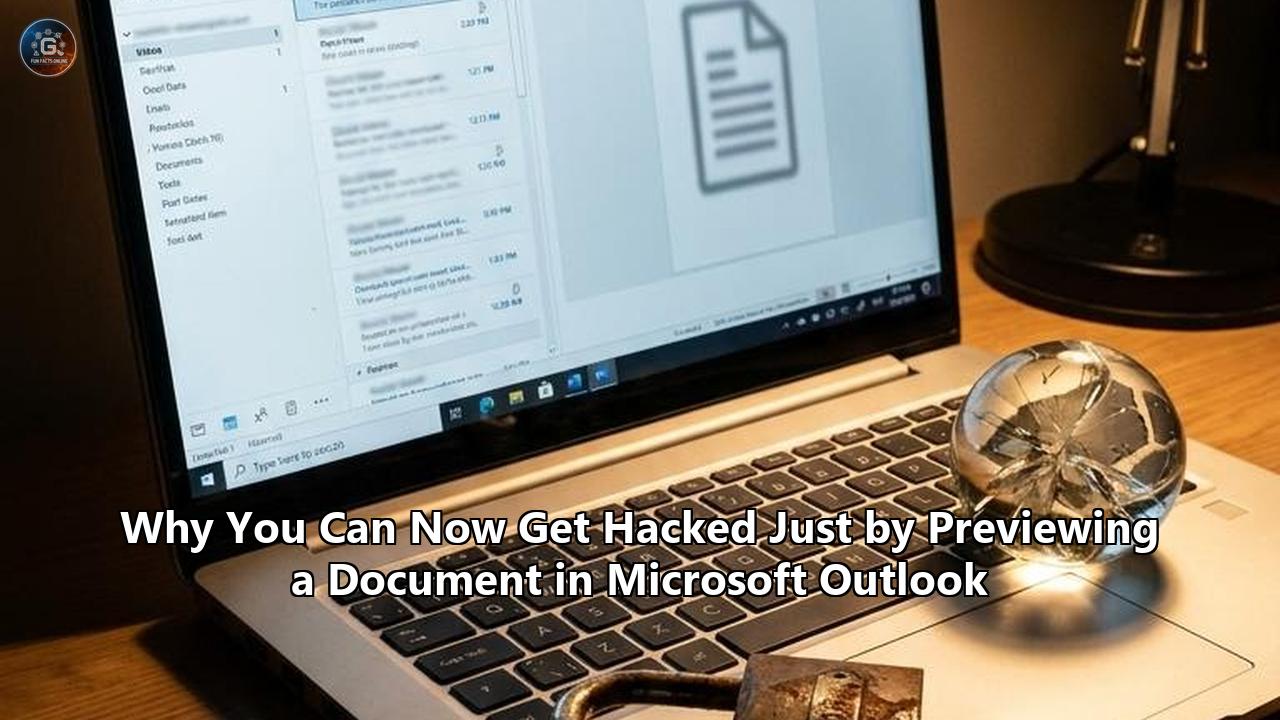
The manager did not double-click the attachment. They did not click any hyperlinked text, nor did they download a hosted image. They simply clicked on the email in their inbox list, allowing the Microsoft Outlook Preview Pane to display the top three lines of the message.
Behind the glass of the monitor, a silent chain reaction began.
Within milliseconds, the application called upon a decades-old shared dynamic link library (DLL) to render the formatted layout. As the library processed the message, it encountered a specifically misaligned sequence of memory pointers. The software attempted to read from a memory address that had already been freed and reallocated to another system process.
The application did not crash. Instead, the instruction pointer shifted. A obfuscated command executed, launching a background process that silently connected to an external server in Eastern Europe, downloading an encrypted payload.
By the time the manager decided the email was irrelevant and clicked away, the attacker possessed complete, unprivileged user access to the workstation. From there, the lateral movement across the internal corporate network began.
This scenario is no longer a hypothetical exercise. A flurry of critical zero-click remote code execution (RCE) flaws has laid bare a fundamental, uncomfortable truth about enterprise email security: the mere act of previewing an email has become a viable vector for a full system compromise.
The Architecture of Convenience: Why the Preview Pane is a Sandbox Nightmare
To understand how an email client can be exploited without any user interaction, one must look closely at how Microsoft Outlook was constructed. Outlook was never designed to be just a simple text reader. Over its thirty-year history, it evolved into an operating system within an operating system—handling calendars, scheduling, contacts, task lists, and heavily formatted corporate communication.
When HTML email became the industry standard in the late 1990s and early 2000s, Microsoft faced a design choice. Rendering rich text and HTML safely requires a browser engine. Initially, Outlook utilized the Internet Explorer rendering engine (MSHTML.dll). However, as Internet Explorer became notorious for security exploits, Microsoft made a significant architectural pivot.
Beginning with Office 2007, Microsoft decided that Outlook would use Microsoft Word as its default email editor and viewer. If you received a Rich Text Format (RTF) or HTML email, Outlook did not spin up a web browser; it spun up a subset of Word's rendering engine in the background.
+-------------------------------------------------------------+
|                     Microsoft Outlook                       |
|  +-------------------------------------------------------+  |
|  |                     Inbox Pane                        |  |
|  +-------------------------------------------------------+  |
|  |                    Preview Pane                       |  |
|  |  +-------------------------------------------------+  |  |
|  |  |                 wwlib.dll                       |  |  |
|  |  |  (Word Rendering Engine handles RTF, Fonts, etc)|  |  |
|  |  +-------------------------------------------------+  |  |
|  |  |                 ole32.dll                       |  |  |
|  |  |  (Handles Embedded Objects, Tables, Diagrams)   |  |  |
|  |  +-------------------------------------------------+  |  |
|  +-------------------------------------------------------+  |
+-------------------------------------------------------------+
This decision linked the security of Outlook directly to the codebase of Microsoft Word. At the heart of this integration is wwlib.dll, a massive, historically complex library responsible for parsing, formatting, and laying out text, tables, fonts, and document structures.
When you click an email and the Preview Pane is active, Outlook immediately feeds the raw content of that message—including complex nested structures—to wwlib.dll and associated Windows system libraries like ole32.dll.
"The fundamental issue is that the Preview Pane acts as an automatic parser," says Johnathan Vance, a veteran binary exploitation researcher who analyzed the recent flaws. "We tell users not to click links and not to download attachments. But the Preview Pane takes that choice away. The moment the bytes hit the preview window, the code to parse them has already executed. If there is a parsing vulnerability, you are compromised before you even realize who sent the email."
This structural layout creates a playground for zero-day exploit developers. By targeting memory management flaws within these legacy document-parsing libraries, attackers can bypass the typical visual cues of a phishing attack. The email does not need to look suspicious; it only needs to contain a structured payload that exploits how Outlook processes document components.
In early 2026, this latest outlook security vulnerability was triggered by memory misalignment, bringing the security community to a sudden realization: the legacy libraries that have powered Office for decades are buckling under the weight of modern, automated exploitation techniques.
The 2025 Breach: Under the Hood of Windows OLE
The lineage of modern zero-click Outlook exploits can be traced back to a critical vulnerability disclosed in January 2025: CVE-2025-21298. Carrying a near-maximum CVSS severity rating of 9.8, this flaw highlighted the extreme danger of Windows Object Linking and Embedding (OLE) technology when combined with email preview mechanisms.
OLE is a legacy Windows technology that allows one application to embed or link to documents and objects created in another application. For example, when you see an Excel spreadsheet embedded inside a Word document or an interactive diagram in an email, OLE is doing the heavy lifting.
The vulnerability discovered in January 2025 did not reside in Outlook itself, but rather deep inside ole32.dll, the core system library that implements OLE functionality on Windows operating systems. Specifically, the flaw was located in a function called:
UtOlePresStmToContentsStm
This function is responsible for taking an "OlePres" (OLE Presentation) stream inside an OLE storage container, converting its data, and writing it into a "CONTENTS" stream within that same storage. It is a critical part of how Windows decides how to display an embedded object to the user before they actually double-click to edit it.
The root cause of CVE-2025-21298 was a classic use-after-free (UAF) condition caused by improper object lifetime management.
The Assembly-Level Mechanics of CVE-2025-21298
When a document containing an OLE object is parsed, UtOlePresStmToContentsStm is called. Inside this function, a pointer is allocated to keep track of the destination CONTENTS stream object.
// Simplified conceptual logic of the vulnerability
IStream* pstmContents = nullptr;
HRESULT hr = CreateStreamOnHGlobal(..., &pstmContents);

if (SUCCEEDED(hr)) {
    // Process the stream ...

    if (some_error_condition) {
        // The stream object is destroyed, and the memory is freed
        pstmContents->Release();

        // CRITICAL ERROR: The pointer 'pstmContents' is NOT set to nullptr
        // It still holds the address of the freed memory.
    }
}

// Later in the execution flow...
// The application attempts to write to or read from the freed pointer
pstmContents->Write(buffer, size, &bytesWritten); // Use-After-Free occurs here!
During normal processing, if a specific error or structural condition occurred during the presentation stream's conversion, the stream object was prematurely destroyed or released. However, the function did not clear the pointer variable pstmContents.
Because the memory allocator of Windows (ntdll!RtlpAllocateHeap) is designed to reuse recently freed memory chunks quickly to maintain performance, an attacker could predict how the heap was laid out. By grooming the heap with a series of nested elements inside a Rich Text Format (RTF) email, the attacker could force the system to allocate a malicious payload block exactly where the freed CONTENTS stream object used to reside.
When the execution path reached a subsequent system call—often deep within coml2.dll or ole32.dll—the system attempted to call a virtual function on the pstmContents pointer. Instead of executing legitimate stream code, the CPU jumped to the address provided by the attacker’s heap-groomed payload.
Because Outlook automatically attempts to render the layout of incoming RTF emails, simply clicking on the email or letting the client auto-open it in the Preview Pane triggered this entire flow. No warning boxes appeared. No macros were run. The code executed silently under the security context of the logged-in user.
"It was a reminder that you don't need a bug in the email program itself to hack an email client," explains security researcher Miloš, who published a detailed technical proof-of-concept for the OLE flaw. "You just need a bug in any library that the email program calls upon to help display the message."
By highlighting a systemic outlook security vulnerability that goes beyond the client application itself, the OLE flaw demonstrated that any legacy API inside the Windows ecosystem could be a stepping stone into an enterprise network.
March 2026: The Type Confusion Trap
As organizations scrambled to patch the OLE issues of 2025, security researchers turned their attention to another class of software bugs that are notoriously difficult to eliminate: Type Confusion.
In March 2026, Microsoft issued urgent updates for two critical remote code execution vulnerabilities: CVE-2026-26110 and CVE-2026-26113. Boasting a high CVSS rating of 8.4, these flaws again targeted the Preview Pane as a prime attack vector.
Memory Allocation (Type Confusion):

Step 1: System allocates memory for Object A (Data Type: Image Metadata)
[ Address: 0x004F2010 ] -> [ Metadata Header | Dimensions | Color Profile ]

Step 2: Attacker crafts a document that tricks the parser into reading the
        same memory address as Object B (Data Type: Executable Code Pointer)
[ Address: 0x004F2010 ] -> [ Executable Code | Argument   | Target Return Pointer ]

Result: The application attempts to call a parsing function, but instead executes
        arbitrary code residing inside the misinterpreted memory.
Type confusion (CWE-843) occurs when a program allocates a piece of memory for a specific data structure or object type, but later accesses that memory as if it were a completely different data type.
In C++ applications like Microsoft Office, this often happens when objects are cast down or up an inheritance hierarchy without strict runtime type checking. If an attacker can manipulate the input data so that the application loses track of an object’s actual type, they can force the application to treat data bytes (such as a JPEG image or a text string) as an executable code pointer.
The Mechanics of the March 2026 Exploits
The CVE-2026-26110 vulnerability was discovered inside the core document layout engine of Microsoft Office. The vulnerability manifested when Office processed nested XML schemas or structural elements inside documents.
When an email or attachment containing a highly customized document structure was parsed, the layout engine constructed an internal representation of the document's elements in memory. However, due to an error in how different document elements were cast, the engine mistakenly treated a formatting layout object as a virtual function table pointer.
By carefully crafting the formatting properties (such as borders, margins, or font families) of an embedded element, an attacker could control the exact byte values written to that memory space. When the rendering engine attempted to invoke a standard layout function, it looked at the confused type, read the attacker-controlled formatting bytes as a function pointer, and jumped straight into the payload.
"Type confusion is particularly elegant from an attacker’s perspective," Vance explains. "You aren't necessarily overflowing a buffer or causing a traditional crash that might be caught by basic operating system mitigations. You are simply convincing the program that a piece of data is actually a piece of code. It’s incredibly fast, clean, and highly reliable."
The Australian Cyber Security Centre (ACSC) issued immediate warnings, urging rapid patching under its Essential Eight security framework. They noted that because the Preview Pane bypassed the common security advice of "do not open attachments from unknown sources," these exploits lowered the barrier for successful phishing campaigns globally.
"BadWinmail" Redux: Haifei Li’s May 2026 Discovery
Just as defensive teams were getting a handle on the March updates, the cybersecurity community was hit by a major announcement. In May 2026, Microsoft released its Patch Tuesday updates, addressing a critical vulnerability tracked as CVE-2026-40361.
The bug was discovered and reported by Haifei Li, the founder and chief developer of the zero-day detection system Expmon. For long-time threat intelligence analysts, Li's name immediately rang a bell. More than a decade earlier, Li had discovered CVE-2015-6172, a legendary vulnerability he dubbed "BadWinmail".
  +-------------------------------------------------------------+
  |              A Decade of Zero-Click Evolution               |
  +-------------------------------------------------------------+
  |  2015: BadWinmail (CVE-2015-6172)                           |
  |  - Vector: Embedded Flash object parsed directly in Outlook.|
  |  - Impact: Complete execution without sandboxing.           |
  +-------------------------------------------------------------+
  |  2026: BadWinmail Redux (CVE-2026-40361)                    |
  |  - Vector: Use-after-free inside wwlib.dll rendering engine.|
  |  - Impact: Silent execution by simply previewing email.     |
  +-------------------------------------------------------------+
BadWinmail was considered an "enterprise killer" because it allowed attackers to embed active Flash objects directly inside email messages. Outlook would parse and execute these objects without redirecting them to a sandbox, because Outlook did not perceive itself as an active carrier of runnable elements.
Eleven years later, Li returned with a discovery that shared the exact same attack vector and potential impact.
"Essentially, anyone could compromise a CEO or CFO just by sending an email," Li warned in a public analysis. "The threat perfectly bypasses enterprise firewalls and is delivered directly to the inbox."
By disclosing what has been described as a critical outlook security vulnerability affecting modern Office deployments, Li forced the security community to confront the fact that despite a decade of mitigations, the core rendering path of Outlook remains highly vulnerable to zero-click RCE.
Deep Dive into CVE-2026-40361
The May 2026 vulnerability is a zero-click use-after-free bug that resides in wwlib.dll.
Unlike many traditional vulnerabilities, which are often classified as local privilege escalations or require some form of user action, CVE-2026-40361 can be fully triggered as soon as the victim reads or previews the incoming email.
There is a fascinating dispute between Microsoft and the security research community regarding how this vulnerability is officially categorized. In Microsoft’s security advisory, the flaw is classified as a remote code execution vulnerability affecting Microsoft Word. Yet, Li demonstrated the exploit working entirely within a live Outlook and Exchange Server environment.
"I demonstrated this bug to the MSRC (Microsoft Security Response Center) by showing that it occurs in a real-world, operational Outlook + Exchange Server environment," Li explained. "Since the bug resides in wwlib.dll—a shared DLL widely used by both Outlook and Word—it affects both Outlook (via an email) and Word (via a document file)."
The wwlib!PTLS7 Use-After-Free Mechanics
To understand how CVE-2026-40361 operates, one must examine how wwlib.dll handles memory allocations during complex document layout processing.
When Word (or Outlook rendering an email) encounters a document with intricate, nested tables, custom margins, and dynamic text wraps, it uses a sub-component known as Page Table Layout Services (often associated with functions like PTLS7::FsUpdateFinitePage).
During the rendering process, the layout services allocate memory blocks on the heap to track properties of dynamic text frames and geometric shapes.
Heap State During CVE-2026-40361 Exploitation:

State A (Normal Allocation):
[ Memory Block 0x08F3A000 ] -> Points to active Layout Frame object.

State B (Premature Destruction):
[ Memory Block 0x08F3A000 ] -> Object is freed. Block is marked as empty.
(Dangling pointer in wwlib.dll still references 0x08F3A000).

State C (Heap Grooming / Shellcode Placement):
[ Memory Block 0x08F3A000 ] -> Attacker injects malicious data structures
                               (such as counterfeit virtual tables).

State D (The Crash or Hijack):
wwlib.dll attempts to refresh the page layout. It references the dangling pointer
at 0x08F3A000. It reads the counterfeit virtual table and redirects execution
to the attacker's shellcode payload.
If a document has formatting instructions that contradict each other (for example, a nested table that is wider than the parent container but has alignment rules forcing it to fit inside a negative margin), the layout services must dynamically recalculate the page properties.
This recalculation causes the engine to destroy the active layout frame objects and allocate new ones. However, a dangling reference to the old layout frame remains in a CPU register or on the stack.
By sending an email containing an RTF document that triggers this specific layout conflict, the attacker can force wwlib.dll to free the layout frame object. In the very next line of parsing, before the program has cleared the dangling reference, the attacker's email structure forces another allocation of custom text or font data.
When the layout engine attempts to update the page layout using the dangling pointer, it reads the newly allocated, attacker-controlled data as if it were a legitimate layout frame object. By crafting the data structure to mimic a virtual table (vtable), the attacker can hijack the instruction pointer, leading to arbitrary code execution.
Li pointed out that because the vulnerability lies in the core parsing engine, it is incredibly difficult for security firewalls or traditional secure email gateways (SEGs) to detect. The payload is not an obvious executable or a suspicious script; it is a carefully structured layout instruction that looks like any other complex enterprise newsletter or format-heavy contract document.
The Threat Landscape: Why One-Click is the New Zero-Click
For years, defensive teams took solace in a basic assumption: "If I don't click anything, I am safe."
But the security vulnerabilities of 2024, 2025, and 2026 have shattered this paradigm. The line between zero-click exploits (which require no user interaction) and one-click exploits (which require a single user action, like selecting an email) has blurred to the point of irrelevance.
Consider the progression of recent vulnerabilities:
| CVE Number | Disclosed | Component | Attack Vector | User Action Required |
|---|---|---|---|---|
| CVE-2023-21716 | Feb 2023 | wwlib.dll (\fonttbl) | Preview Pane / File Open | None (Zero-Click) |
| CVE-2024-21413 | Feb 2024 | MonikerLink (file://) | Email Link / Preview Pane | Selecting/Clicking Link |
| CVE-2024-30103 | Jun 2024 | Injected Outlook Forms | Auto-Open / Preview Pane | None (Zero-Click) |
| CVE-2025-21298 | Jan 2025 | ole32.dll (UtOlePres...) | Preview Pane | None (Zero-Click) |
| CVE-2026-26110 | Mar 2026 | Office Type Confusion | Preview Pane | None (Zero-Click) |
| CVE-2026-40361 | May 2026 | wwlib.dll (UAF) | Preview Pane / Email Read | None (Zero-Click) |
In a busy corporate environment, selecting an email to read it is not considered "risky behavior." It is the core function of the employee’s job.
"If selecting an item in a list is all it takes to compromise a workstation, then the system is fundamentally broken from a security perspective," says Sarah Jenkins, an enterprise threat hunter. "We have spent millions of dollars training employees to look for suspicious sender addresses and typos. But if they get hacked the moment they click on the subject line to see what it is, all that training is completely useless."
The threat is compounded by the fact that many organizations utilize Outlook's auto-open feature, which automatically selects and previews the first unread email when the application is launched. Under this configuration, an employee does not even need to manually select the malicious email; simply launching the Outlook application is enough to trigger the exploit.
Why the Enterprise is Left Defenseless: The Usability vs. Security Conundrum
When a high-severity vulnerability like CVE-2026-40361 is disclosed, the security community's immediate response is to advise patching. But for many global enterprises, patching is not a simple switch.
Enterprise vulnerability management is a complex balancing act. A single security patch can sometimes introduce unexpected bugs that disrupt critical business operations, break custom add-ins, or conflict with legacy line-of-business applications.
"In a perfect world, we would patch every machine within 24 hours of Patch Tuesday," says Michael Chen, a systems administrator at a major utility provider. "But in the real world, we have to test updates across hundreds of different software configurations first. If a patch breaks an Excel macro that our finance team relies on, the entire business grinds to a halt. So we have to schedule, test, and phase the rollout, which takes time."
During this testing window, which can span from a few days to several weeks, enterprise workstations remain completely exposed to any zero-day exploit that target these vulnerabilities.
Furthermore, Microsoft's support lifecycle leaves many older installations vulnerable. For example, Microsoft Office 2016 reached its end of support in October 2025. While Microsoft made an exception and released a security update for Office 2016's Word component to address CVE-2026-40361, many organizations running out-of-support or unmanaged installations remain permanently vulnerable.
This lag in patch deployment is precisely what threat actors exploit. Advanced persistent threat (APT) groups and ransomware operators actively monitor Patch Tuesday releases, quickly reverse-engineering the updates to build working exploits before organizations have a chance to deploy the fixes.
Bulletproofing the Inbox: Active Defense and Remediation
Because relying solely on rapid patching is not always a viable defense strategy, IT administrators and security operations center (SOC) teams must take a proactive, multi-layered approach to secure their environments.
Mitigating this chronic outlook security vulnerability requires a multi-layered approach that combines temporary architectural workarounds, strict network egress rules, and behavior-based detection to stop attacks before they execute.
Here is a step-by-step blueprint for defending against zero-click Outlook exploits:
1. Disable the Outlook Preview Pane
While this workaround impacts user convenience, it is one of the most effective ways to block zero-click attacks. By disabling the Preview Pane, you force the user to double-click an email to open it, which shifts the exploit vector from zero-click to one-click, buying your endpoint detection tools a chance to inspect the file structure before it is rendered.
To disable the Preview Pane via Group Policy (GPO):
- Open the Group Policy Management Editor.
- Navigate to: User Configuration -> Administrative Templates -> Microsoft Outlook -> Outlook Options -> Other -> Reading Pane.
- Locate the setting Do not turn on the reading pane and set it to Enabled.
Group Policy Path:
User Configuration
  └── Administrative Templates
        └── Microsoft Outlook 2016 / 365
              └── Outlook Options
                    └── Other
                          └── Reading Pane
                                └── Do not turn on the reading pane -> [ ENABLED ]
2. Force Outlook to Read All Standard Mail in Plain Text
Many of the most dangerous exploits rely on the rendering engine processing complex HTML formatting or embedded OLE objects inside Rich Text Format (RTF) emails. By forcing Outlook to display all messages in plain text, you strip away the formatting tags and disable the parsing engine, completely neutralizing the exploit vector.
To enforce plain text email rendering via Group Policy:
- In the Group Policy Management Editor, navigate to: User Configuration -> Administrative Templates -> Microsoft Outlook -> Outlook Options -> Preferences -> E-mail Options.
- Enable the policy: Read all standard mail in plain text.
- Enable the policy: Read all digitally signed mail in plain text.
Alternatively, you can configure this on an individual workstation through the Outlook Trust Center:
- Click File -> Options -> Trust Center -> Trust Center Settings....
- Select Email Security.
- Under Read as Plain Text, check the box for: Read all standard mail in plain text.
+-------------------------------------------------------------------------+
| Trust Center                                                            |
+-------------------------------------------------------------------------+
|  Email Security                                                         |
|                                                                         |
|  Read as Plain Text                                                     |
|  [X] Read all standard mail in plain text                               |
|  [X] Read all digitally signed mail in plain text                       |
|                                                                         |
+-------------------------------------------------------------------------+
3. Block Outbound NTLM and SMB Traffic (Port 445)
Many Outlook exploits do not attempt to run complex shellcode immediately. Instead, they use a simpler, highly reliable technique: they embed a remote file path (using the file:// protocol or an SMB share path) inside the document structure.
When Outlook attempts to preview the file, Windows automatically tries to connect to the remote server via SMB (Port 445) to retrieve the resource. During this handshake, Windows sends the user's NTLM credential hash to the remote server, allowing the attacker to harvest the credentials and perform offline cracking or relay attacks.
To prevent this exfiltration, block outbound SMB traffic at your network perimeter:
- Action: Configure your network firewalls to block all outbound traffic on TCP Port 445 and UDP Ports 137, 138, and 139 to any external, non-enterprise IP address.
- Host-Based Rule: Implement a local Windows Defender Firewall rule that blocks outbound port 445 traffic for all processes, except for trusted enterprise VPN client connections.
4. Implement Behavior-Based Endpoint Detection
Because zero-click exploits operate by hijacking legitimate processes like OUTLOOK.EXE or WINWORD.EXE, signature-based antivirus tools are often blind to them. Security teams must configure their Endpoint Detection and Response (EDR) platforms to flag anomalous process behavior originating from the Microsoft Office application tree.
Watch for the following high-fidelity indicators of compromise (IOCs):
- Suspicious Child Processes: A Microsoft Office application (such as OUTLOOK.EXE, WINWORD.EXE, or EXCEL.EXE) spawning system execution tools like cmd.exe, powershell.exe, rundll32.exe, regsvr32.exe, mshta.exe, or wscript.exe.
Suspicious Process Tree (Indicator of Compromise):

  [ OUTLOOK.EXE ]
    └── [ WINWORD.EXE ] (Called to render preview)
└── [ powershell.exe ] <-- CRITICAL ALERT: Office process spawned shell!- Atypical Outbound Connections: An Office process initiating a direct network connection to an external, unfamiliar IP address shortly after an email is opened or previewed.
- File System Anomalies: An Office application creating binary files, scripts, or scheduled tasks in user directory paths like AppData\Local\Temp or AppData\Roaming.
Detection with KQL (Kusto Query Language)
For organizations utilizing Microsoft Defender for Endpoint or Microsoft Sentinel, the following KQL query can be used to search for signs of exploitation where Word or Outlook processes spawn shell commands:
DeviceProcessEvents
| where InitiatingProcessFileName in~ ("outlook.exe", "winword.exe")
| where ProcessCommandLine has_any ("powershell", "cmd.exe", "wscript", "cscript", "mshta", "regsvr32")
| project TimeGenerated, DeviceName, InitiatingProcessFileName, FileName, FolderPath, ProcessCommandLine, AccountName
| order by TimeGenerated desc
This query will help security analysts identify any instance where a previewed document attempts to escape its rendering environment and execute shell commands on the endpoint.
The Road Ahead: Will Microsoft Ever Solve the Legacy Code Problem?
The recurring theme across the vulnerabilities of the past several years is the persistent hazard of legacy code. Many of the dynamic link libraries that handle OLE, Rich Text Format parsing, and font rendering were written in C or C++ decades ago.
These programming languages are not memory-safe. They rely on the developer to manually manage memory allocations, track pointer lifecycles, and validate input boundaries. A single oversight—such as failing to set a freed pointer to nullptr, or miscalculating the number of elements in a dynamic array—can create a vulnerability that leaves millions of systems exposed.
"The fundamental problem is that Microsoft is trying to secure a cathedral built on quicksand," Vance observes. "No matter how many sandboxes you build, or how many exploit mitigations you introduce, as long as you are parsing untrusted complex documents using legacy C++ code, you will always have these types of vulnerabilities."
Microsoft is aware of this challenge and has begun taking steps to address it. Under its Secure Future Initiative (SFI), the company has committed to rewriting critical system components and security-sensitive libraries in memory-safe languages like Rust.
In recent versions of Windows, core security-critical APIs and rendering paths are slowly being ported to Rust, which eliminates entire categories of memory corruption bugs—including use-after-free, double-free, and buffer overflows—at compile time.
However, rewriting a suite of software as massive as Microsoft Office is an incredibly complex undertaking that will take years to fully realize. Until the day that legacy libraries like wwlib.dll and ole32.dll are completely retired or rewritten in memory-safe code, the Outlook Preview Pane will remain a high-value target for attackers.
For security teams, this means that vigilance is not optional. Defensive operations must move beyond simple user training and passive monitoring. By understanding the technical underpinnings of zero-click exploitation, locking down outbound protocol traffic, and implementing proactive, behavior-based detection, enterprises can build a robust defense that protects their environments—even from threats they never see coming.
Reference:
- https://socprime.com/blog/cve-2025-21298-detection/
- https://www.cybaverse.co.uk/resources/outlook-zero-click-vulnerability-cve-2025-21298-fixed
- https://fortifiedhealthsecurity.com/threat-bulletin/zero-click-outlook/
- https://www.offsec.com/blog/cve-2025-21298/
- https://www.offsec.com/blog/cve-2025-21298/
- https://westoahu.hawaii.edu/cyber/vulnerability-research/vulnerabilities-weekly-summaries/windows-ole-rce-vulnerability/
- https://0patch.com/blog/micropatches-released-for-windows-ole
- https://www.cybernewscentre.com/11th-march-2026-cyber-update-microsoft-patches-critical-office-flaws-exploitable-via-preview-pane-2/
- https://www.action1.com/vulnerabilities/cve-2026-26110/
- https://www.securityweek.com/microsoft-patches-critical-zero-click-outlook-vulnerability-threatening-enterprises/
- https://www.it-connect.tech/outlook-cve-2026-40361-zero-click-flaw-puts-businesses-at-risk/
- https://www.paloaltonetworks.com/blog/2016/01/use-traps-to-protect-against-badwinmail-cve-2015-6172/
- https://www.it-connect.tech/outlook-cve-2026-40361-zero-click-flaw-puts-businesses-at-risk/
- https://github.com/RonF98/CVE-2023-21716-POC
- https://www.sentinelone.com/vulnerability-database/cve-2026-40361/
- https://www.automox.com/blog/microsoft-word-rce-poc
- https://fortifiedhealthsecurity.com/threat-bulletin/outlook-rce-feb25/
- https://www.triskelelabs.com/resources/cve-2024-21413-microsoft-outlook-preview-pane-rce-vulnerability
- https://hackread.com/outlook-rce-vulnerability-exploits-preview-pane/
- https://www.securityweek.com/microsoft-patches-zero-click-outlook-vulnerability-that-could-soon-be-exploited/
- https://www.morphisec.com/blog/cve-2024-30103-microsoft-outlook-vulnerability/
- https://www.greenwillsolution.com/post/critical-zero-click-vulnerability-in-microsoft-outlook-cve-2025-21298-immediate-action-requir