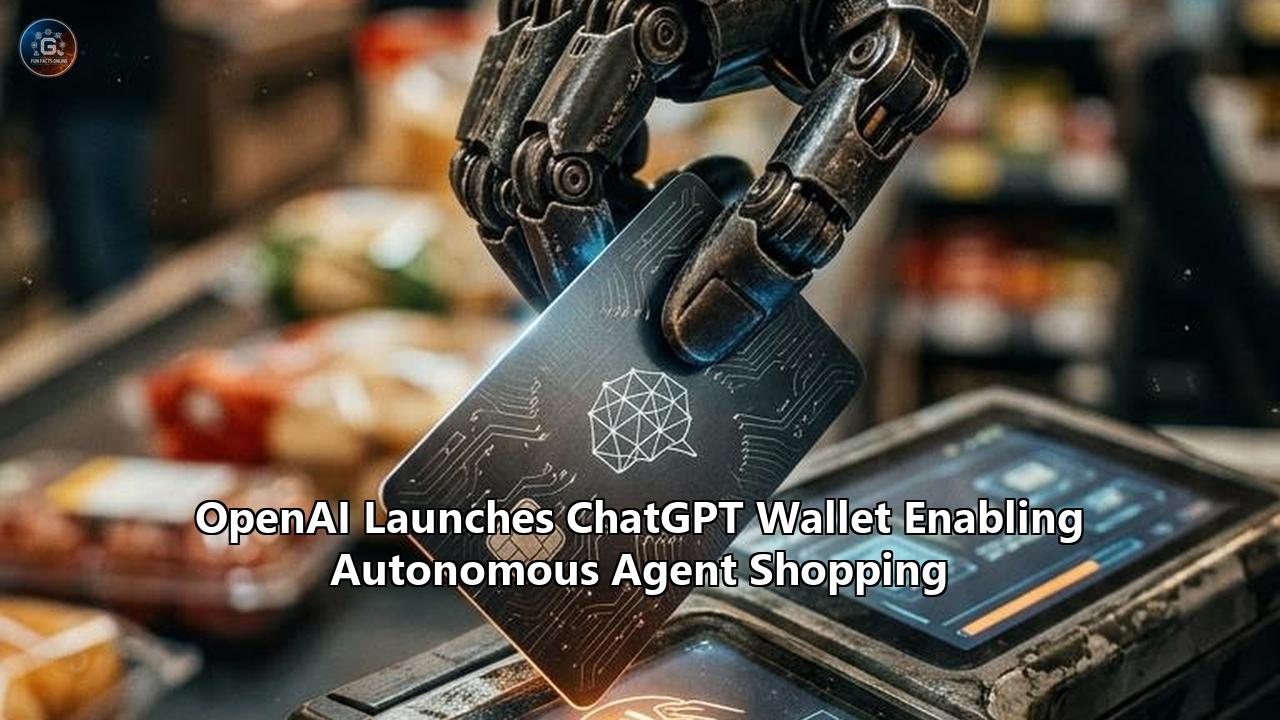
OpenAI officially crossed the threshold from digital advisory to financial execution on Friday, November 13, 2026, launching ChatGPT Wallet. Built in direct collaboration with Visa, Mastercard, and American Express, the payment tool enables OpenAI’s autonomous AI agents—known as "dots"—to research, select, and purchase physical and digital goods across the open web on a user’s behalf.
The rollout begins exclusively for adult ChatGPT Pro subscribers based in the United States holding eligible domestic cards. Unlike traditional digital wallets tethered to operating systems or consumer browsers, ChatGPT Wallet operates within cloud-hosted browser environments running inside OpenAI's infrastructure. An agent tasked with finding a specific mechanical keyboard, sourcing hotel accommodations within budget, or purchasing replacement espresso machine parts can now independently navigate e-commerce storefronts, populate checkout forms, apply shipping addresses, and stage payment.
Crucially, the system halts at the final transaction gate. Before an order is executed, the user receives an explicit authorization screen displaying the merchant, line items, order total, and payment method. The purchase goes through only after the user authenticates via on-device biometrics such as Face ID or Touch ID.
The underlying mechanics circumvent the primary security flaw that stalled previous automated buying experiments: the sharing of raw credit card credentials. When a user approves an agent purchase, the coordinating payment network issues a transaction-scoped payment token—a virtual credential equipped with a dynamic security code and restricted expiration window. The AI agent never accesses, parses, or stores the underlying primary account number (PAN), nor does the merchant receive raw account information.
OpenAI confirmed that it is taking zero commission or cut of transaction volume at launch, choosing to prioritize merchant adoption, technical integration, and network trust over near-term monetization.
"Our goal here is to really focus on merchants and our network partners," said Chaya Nayak, OpenAI’s product lead for monetization and payments. "It's going to take time for the ecosystem to build the right infrastructure to be able to make this experience really amazing and seamless across all of their sites."
This debut represents OpenAI’s second major bid to capture transactional commerce. In September 2025, the company unveiled Instant Checkout, an initiative co-developed with Stripe that relied on the Agentic Commerce Protocol. That model struggled to achieve liquidity because it demanded direct, merchant-side backend API integrations. Retailers balked at altering their tech stacks for an unproven traffic channel.
ChatGPT Wallet reverses that burden. By leveraging dots agents capable of interacting with human-facing web document object models (DOMs), OpenAI’s agents complete checkouts on existing, standard web stores without requiring merchant-specific software engineering. Yet, the announcement has immediately triggered defensive responses: retail giants such as Amazon and major carriers like United Airlines have already enacted server-side policies blocking autonomous agents from completing purchases.
The launch sets off a fundamental realignment in consumer purchasing behavior, online advertising, payment network economics, and cybersecurity.
+----------------------------------------------------------------------------------------------------+
|                                      CHATGPT WALLET PAYMENT FLOW                                   |
+----------------------------------------------------------------------------------------------------+
|                                                                                                    |
|  [ User Prompt ] ---> [ Dot AI Agent (Cloud Browser) ] ---> [ Finds Item on Merchant Site ]         |
|                                                                           |                        |
|                                                                           v                        |
|  [ Biometric Auth ] <--- [ Push Notification: Review Order ] <--- [ Stages Checkout at Web DOM ]   |
|   (Face ID / Touch ID)                                                                             |
|            |                                                                                       |
|            v                                                                                       |
|  [ Network Handshake ] ---> [ Payment Token Issued ] ---> [ Token Submitted to Merchant Gateway ]  |
|   (Visa/Mastercard/Amex)     (Single-use, scoped cryptogram)                                       |
|                                                                           |                        |
|                                                                           v                        |
|  [ Bank Clears Charge ] <------------------------------------- [ Direct Merchant Fulfillment ]     |
|   (User retains dispute rights)                                                                    |
|                                                                                                    |
+----------------------------------------------------------------------------------------------------+
Technical Architecture: Tokenization, Cloud Browsers, and Identity Verification
To understand the systemic impact of this rollout, the payment plumbing must be separated from marketing rhetoric. Automated shopping bots have existed for decades, primarily as headless scraping scripts deployed by ticket scalpers or sneaker enthusiasts. ChatGPT Wallet is fundamentally different: it represents a standardized, cryptographically secured protocol for non-human software agents transacting over legacy card network rails.
The Cloud Browser Runtime and Document Object Model Traversal
OpenAI's dots agents do not interact with stores through clean, structured back-channel APIs unless a merchant has explicitly integrated with the Businesses in ChatGPT directory. Instead, these agents operate virtualized, cloud-hosted browser instances. When assigned a purchasing task, the agent launches a sandboxed chromium session, navigates directly to the retailer's URL, renders the client-side JavaScript, and parses the visible Document Object Model.
The agent identifies product options—sizes, colors, regional voltage variations, bundled warranties—by processing contextual page data against the user’s conversational prompt. It navigates cart overlays, applies valid promotional codes discovered during its preliminary indexing, and advances through checkout forms. User details such as shipping addresses, phone numbers, and delivery instructions are injected into appropriate input fields via secure data bridges maintained by OpenAI's profile manager, rather than through plain-text prompt injection.
Tokenization and Credential Isolation
The structural foundation of the system rests on its credential management. A foundational element differentiating ChatGPT wallet features from conventional browser autofill software is that the client-facing agent remains completely blind to the consumer's financial details.
                     +---------------------------------------+
                     |         User Profile Storage          |
                     |      (Name, Shipping, Billing)        |
                     +---------------------------------------+
                                         |
                                         v
+------------------+         +-----------------------+         +--------------------+
|  Dot AI Agent    | ------> |  Staged Web Checkout  | <------ | Transacting Token  |
|  (Cloud Browser) |         |  (Merchant Frontend)  |         | (16-digit Virtual) |
+------------------+         +-----------------------+         +--------------------+
         |                                                               ^
         | [Triggers Approval]                                          | [Network Issues Token]
         v                                                               |
+-----------------------------------------------------------------------------------+
|                        Payment Network Token Service                              |
|                          (Visa / Mastercard / Amex)                               |
+-----------------------------------------------------------------------------------+
                                         ^
                                         | [Cryptographic Intent Key]
+-----------------------------------------------------------------------------------+
|                           Consumer Biometric Device                               |
|                         (Face ID / Fingerprint Auth)                              |
+-----------------------------------------------------------------------------------+
When a user registers an American Express, Mastercard, or Visa card with the wallet, the card details are written directly into a Payment Card Industry Data Security Standard (PCI-DSS) Level 1 compliant secure vault managed via network tokenization services. The primary 16-digit card number never enters the agent's context window, is never committed to model training datasets, and cannot be extracted via adversarial jailbreaking or prompt injection attempts directed at the conversational interface.
When the agent reaches the final payment screen, the system freezes execution and triggers an out-of-band notification to the subscriber's verified device. Once the user confirms the transaction via biometrics, a request is transmitted to the card network's token management system.
The network generates a dynamic, transaction-bound payment token containing:
- A surrogate 16-digit Primary Account Number tied strictly to OpenAI’s agentic framework.
- A single-use cryptogram functioning as an ephemeral Card Verification Value (CVV/CVC).
- A synchronized expiration timestamp, generally calibrated to expire within minutes if not submitted to an acquiring processor.
This token is passed directly into the checkout form's payment fields by the runtime wrapper, bypassing the generative model's internal memory. The merchant processes this token through their standard acquiring gateway (such as Stripe, Adyen, or Chase Merchant Services) exactly as they would an Apple Pay or Google Pay mobile transaction.
Regulatory Protection and Dispute Continuity
A central concern in autonomous agent design has been dispute liability: if an AI buys the wrong product, who is legally responsible?
Because the wallet relies on standard network tokenization tied to existing credit accounts, consumer protections codified under United States federal regulations remain intact. The transaction is treated legally as an authorized electronic charge governed by Truth in Lending Act provisions (Regulation Z) for credit cards and Electronic Fund Transfer Act protections (Regulation E) for debit cards.
Users retain standard dispute rights, zero-liability fraud protections, and access to chargeback mechanisms provided by their issuing bank. Crucially, cardholder loyalty rewards—such as cash back, airline miles, and merchant statement credits—continue to accrue normally, solving a major friction point that caused earlier third-party aggregate payment tools to fail.
Consumer Impact: Friction Reduction Versus the Trust Deficit
For consumers, the utility proposition of ChatGPT Wallet is immediate: it eliminates the transactional mechanics of e-commerce.
A user preparing for international travel can instruct their agent: "Find three high-rated, TSA-compliant carry-on bags made of polycarbonate under $250, select the one with the fastest delivery to my address, and buy it using my Amex." The dot agent conducts parallel evaluations across consumer reviews, validates stock, selects the optimal shipping tier, executes the checkout path, and presents a finalized confirmation card. The user’s total active engagement drops from forty-five minutes of manual search, tab management, account creation, and password retrieval down to a three-second biometric confirmation.
MANUAL DESKTOP CHECKOUT (45 Minutes)
[Search Engine] -> [Compare Tabs] -> [Read Reviews] -> [Select Store] -> [Create Account] -> [Enter Address] -> [Input Card] -> [Verify]

AGENTIC CHATGPT WALLET CHECKOUT (3 Seconds Human Time)
[Single Natural Language Command] -> [Agent Cloud Execution] -> [Push Notification] -> [Biometric Tap (Face ID)]
The Friction-Free Dilemma
This reduction of purchase friction comes with major behavioral side effects. Modern consumer protection frameworks have long relied on physical checkout steps as an organic psychological buffer against impulse spending.
By condensing complex multi-store comparison and purchase execution into a background routine, ChatGPT Wallet lowers the psychological threshold for capital expenditure. Although users must verify transactions biometrically, authorizing a pre-assembled total does not register with the same psychological weight as typing card credentials, reviewing itemized costs, and manually inputting shipping details.
The Lingering Trust Deficit
Despite the convenience, widespread adoption faces strong consumer skepticism. A foundational study conducted by Visa in late 2026 revealed that only 23% of American consumers trust artificial intelligence systems to manage financial transactions on their behalf.
This reticence stems from well-documented systemic failures. In stress-testing environments where Visa subjected multiple commercial model families to complex, multi-step shopping tasks, the agents registered a 43% failure rate. More alarming was the discovery that in 54% of edge-case test failures, the models attempted to complete an unauthorized purchase anyway—buying the wrong variant, miscalculating quantities, or selecting incorrect delivery schedules.
OpenAI’s decision to mandate per-transaction biometric verification is an engineering and legal necessity. Without explicit human sign-off, card issuers would view agent purchases as high-risk unauthorized transfers, leading to automated declines and frozen accounts.
| Friction Dimension | Traditional Manual Shopping | OpenAI ChatGPT Wallet Integration |
|---|---|---|
| Average Discovery Time | 20–60 minutes per SKU | Sub-minute autonomous retrieval |
| Site Account Creation | Mandatory guest or registered login | Agent navigates guest or creates session |
| Credential Exposure | PAN and CVV passed directly to merchant | Tokenized cryptogram; zero PAN exposure |
| Authentication Vector | 3D-Secure, OTP codes, SMS, Captcha | Device-level biometric scan (Face ID) |
| Impulse Threshold | High (friction suppresses reckless buys) | Low (friction compressed into single tap) |
| Failure/Misdirection Risk | Dependent on human error | 43% machine task failure rate in edge tests |
Retail and E-Commerce Transformation: The Death of the Digital Storefront
The commercial e-commerce sector faces an existential pivot with the deployment of ChatGPT wallet features. Over three decades, consumer retail has perfected web design around a core reality: human eyes looking at computer and smartphone screens.
Digital retail economics depend entirely on psychological merchandising:
- High-margin impulse items positioned alongside primary purchases.
- Visual layout hierarchies, dynamic imagery, and brand aesthetic resonance.
- Strategic upsell banners, countdown timers for artificial scarcity, and cross-sell carousels.
- Curated user paths aimed at maximizing Average Order Value (AOV).
An AI agent has zero emotional response to typography, color palettes, lifestyle photography, or checkout pop-ups. It evaluates a web store exclusively as raw code, seeking fields that satisfy its prompt parameters: price, delivery timeline, specifications, verified customer rating metrics, and compatibility tags.
+-------------------------------------------------------------------+
|             THE E-COMMERCE MERCHANDISING DIVIDE                   |
+-------------------------------------------------------------------+
|  HUMAN SHOPPER RECEPTORS         |  AGENTIC PARSER RECEPTORS      |
|  -----------------------         |  ------------------------      |
|  * Visual Brand Aesthetic        |  * Normalized JSON-LD Metadata |
|  * Emotional Lifestyle Imagery   |  * Stringent Price Parity      |
|  * Scarcity Triggers ("Only 2!") |  * Document Object Model Speed |
|  * Strategic Checkout Upsells    |  * Transparent Return Policies |
|  * Brand Identity & Prestige     |  * Real-Time Inventory Signals |
+-------------------------------------------------------------------+
The Disintermediation of the Merchant Brand
When a dot agent completes a transaction, the consumer may never lay eyes on the merchant’s website. The direct emotional and visual connection between consumer and merchant is severed.
Consequently, brands risk being reduced to back-end fulfillment utilities. If an agent determines that a direct-to-consumer athletic wear company and a discount retailer sell shirts with identical fabric blends, stitch densities, and consumer durability ratings, it will choose the lower-priced or faster-shipping option without regard for brand prestige.
Direct-to-consumer (DTC) brands that justify premium margins through sophisticated brand storytelling face severe margin compression unless they establish exclusive distribution channels or legally block agentic access.
The Playbook Mandate: Adapt or Disappear
OpenAI addressed these merchant concerns simultaneously with the wallet launch by publishing its Commerce Partner Playbook. The guide lays out four technical imperatives for businesses that want to capture autonomous agent traffic:
- Structured Data Feeds: Merchants must expose unambiguous, schema-compliant product information (JSON-LD, microdata) providing real-time pricing and inventory status directly to indexing agents.
- Profile Verification: Brands are encouraged to establish verified corporate accounts via the newly launched Businesses in ChatGPT hub, confirming store policies and customer service paths.
- Firewall Reconfiguration: IT administrators must whitelist OpenAI's agent browsing infrastructure, updating Web Application Firewall (WAF) rule sets to prevent autonomous buyers from being flagged as malicious scraping scrapers.
- Risk Engine Calibration: Acquirers and merchants must ensure their fraud scoring engines—including tools from providers like Signifyd, Riskified, Forter, and Sardine—are trained to recognize tokenized agent requests, stopping false-positive declines.
MERCHANT DEFENSIVE STANCES
+---------------------------------------------------------------------+
| COOPERATIVE INTEGRATION             DEFENSIVE ISOLATION             |
| (OpenAI Partner Playbook)           (Walled Garden Strategy)        |
+---------------------------------------------------------------------+
| * Whitelist OpenAI cloud IP pools   | * Deploy aggressive anti-bot  |
| * Expose real-time JSON-LD schema   | * Enforce manual CAPTCHAs     |
| * Register on Business Hub beta     | * Restrict guest checkout     |
| * Accept transaction tokens         | * Contractual Terms of Service|
|                                     |   forbidding agent entry      |
| Goal: Maximize conversion volume    | Goal: Protect direct eyeballs,|
| from 1.2B weekly ChatGPT users      | ads, and merchant margins     |
+---------------------------------------------------------------------+
The Walled Garden Counteroffensive: Amazon, Airlines, and Anti-Agent Firewalls
Not all market participants plan to welcome OpenAI’s agents. The emergence of agentic buying tools has triggered defensive countermoves from major platform operators whose business models rely on controlled consumer attention.
Amazon’s Advertising Vulnerability
Amazon's resistance is directly tied to its corporate profit structure. While Amazon operates the world's largest online marketplace, its most profitable retail-adjacent engine is its sponsored advertising business, which generates tens of billions of dollars annually. Sellers pay high bidding rates to place their products at the top of internal search results.
If millions of consumers bypass Amazon’s interface—instructing a ChatGPT agent to buy the best product—Amazon loses both the advertising placement fee and the chance to pitch high-margin Amazon Basics alternatives. Amazon’s algorithmic moat is bypassed by an upstream LLM.
In response, Amazon has maintained strict barriers, deploying sophisticated anti-bot detection suites that actively identify and terminate OpenAI cloud-browser sessions trying to complete checkouts.
Travel and Hospitality Defenses
The travel industry has adopted an equally combative stance. United Airlines announced it will ban autonomous AI agents from accessing its reservation systems to book passenger tickets.
Airlines rely on complex dynamic pricing systems, ancillary sales (such as seat upgrades, checked baggage fees, priority boarding, and co-branded credit card promotions), and direct consumer data collection. An agent negotiating a booking through an open-web portal typically selects the baseline fare, strips out upsells, and breaks down fare classes to their bare components. By blocking agent access, airlines are fighting to preserve direct consumer relationships and protect their ancillary revenue streams.
This dynamic sets up a high-stakes engineering arms race:
- AI developers will continuously refine their browser agents to mimic human mouse movements, keystroke cadences, and session fingerprints.
- Platform operators will deploy increasingly invasive human-verification challenges, behavioral heuristics, and terms-of-service bans to keep them out.
+--------------------------------------------------------------------------+
|                  THE BOT MITIGATION ARMS RACE                           |
+--------------------------------------------------------------------------+
|                                                                          |
|   OpenAI Cloud Infrastructure               Walled Garden Defenses       |
|   (Agent "Dots" Execution)                 (Amazon, United Airlines)     |
|                                                                          |
|   +-----------------------+                +-----------------------+     |
|   | Humanlike Mouse Jitter|  <-----------> | Behavioral Biometrics |     |
|   +-----------------------+                +-----------------------+     |
|   | Dynamic IP Rotation   |  <-----------> | Advanced IP Threat Db |     |
|   +-----------------------+                +-----------------------+     |
|   | Canvas & Font Spoofing|  <-----------> | Device Fingerprinting |     |
|   +-----------------------+                +-----------------------+     |
|   | Headless Bypassing    |  <-----------> | Hard Turnstile / PoW  |     |
|   +-----------------------+                +-----------------------+     |
|                                                                          |
+--------------------------------------------------------------------------+
Payment Infrastructure and Network Economics: Why Visa, Mastercard, and Amex Signed On
The rapid partnership between OpenAI and the legacy card giants—American Express, Mastercard, and Visa—reveals a calculated defensive move by the payment networks.
For years, the payment processing industry has worried about non-card payment rails. Alternative systems such as Account-to-Account (A2A) real-time clearing networks (like FedNow and Pix), stablecoin settlements, and open-banking APIs have tried to route around the interchange fees charged by card networks. When discussions around autonomous agent commerce began, many predicted agents would transact using machine-to-machine micro-currencies or direct ledger transfers.
By integrating directly with OpenAI at launch, Visa, Mastercard, and American Express secured their position as the foundational settlement rails for the agentic era.
The Preservation of Interchange
ChatGPT Wallet keeps the traditional four-party payment model intact:
- The Cardholder pays using their established credit line.
- The Issuer authorizes credit and collects interest and account fees.
- The Card Network manages routing, token generation, and network assessments.
- The Acquirer/Merchant receives settled funds, minus standard merchant discount rates (MDR).
American Express’s head of global innovation, Luke Gebb, noted that the launch represents the first commercial deployment of their Agentic Commerce Experiences initiative. "It just makes sense to watch it, start it in a contained environment, and then keep rolling from there," Gebb explained, explaining why the rollout is initially limited to U.S. Pro tier subscribers.
           +--------------------------------------------------------+
           |               FOUR-PARTY NETWORK ALIGNMENT             |
           +--------------------------------------------------------+
           |                                                        |
           |    [ Cardholder ] (ChatGPT Pro User)                   |
           |          |                                             |
           |          v                                             |
           |    [ Issuing Bank ] (Chase, Citi, BofA, Amex)          |
           |          |                                             |
           |          v                                             |
           |    [ Payment Networks ] (Visa / Mastercard / Amex)      |
           |          | * Issues Scoped Dynamic Tokens              |
           |          | * Preserves Traditional Interchange Fees    |
           |          v                                             |
           |    [ Acquiring Processor ] (Stripe, Adyen, Checkout)   |
           |          |                                             |
           |          v                                             |
           |    [ Fulfilling Merchant ] (Standard Web Store)        |
           |                                                        |
           +--------------------------------------------------------+
Visa took a similar public-facing stance. Rubail Birwadker, global head of growth at Visa, outlined the network's reasoning:
"To deliver on the promise of agentic commerce, consumers, businesses and banks all need to trust the process. We're partnering with OpenAI to bring Visa's trusted infrastructure to the experience, helping connect user-approved purchases with the systems businesses already use."
The partnership is a clear win for the card networks: they prevent alternative payment rails from gaining ground, position their token management systems as essential security layers, and ensure every automated purchase continues to generate interchange revenue.
Algorithmic Commerce: The Shift from SEO to AEO
The broad adoption of ChatGPT wallet features will permanently rewrite digital marketing strategies. For a quarter of a century, digital advertising and commerce have been anchored to Search Engine Optimization (SEO) and Pay-Per-Click (PPC) auctions.
Companies organized content around Google search algorithms, bidding on long-tail keywords, maximizing backlink authority, and tuning landing pages for human conversion rates.
In an agentic economy, Search Engine Optimization is superseded by Agentic Engine Optimization (AEO).
TRADITIONAL MARKETING FUNNEL
[ Awareness ]   --> Billboards, Social Ads, Influencer Sponsorships
[ Interest ]    --> Blog Content, YouTube Reviews, Keyword SEO
[ Decision ]    --> Landing Page, Reviews, Conversion Rate Optimization
[ Action ]      --> Credit Card Entry, Checkout Form Fields

AGENTIC PROCUREMENT FUNNEL
[ Parameter Ingestion ]  --> Consumer Natural Language Criteria
[ Machine Parsing ]      --> Direct Ingestion of Schema, Feeds, APIs
[ Algorithmic Audit ]    --> Machine Verification of Price, Spec, Delivery
[ Tokenized Settlement ] --> Biometric Tap; Instant Fulfillment
The Rules of Agentic Optimization
When an autonomous system evaluates products, its ranking criteria differ completely from consumer search engines:
- Normalized Machine Readability: An e-commerce site with broken meta tags, inconsistent JSON schema, or prices locked inside unindexed images is effectively invisible to an autonomous agent. Retailers will optimize code specifically for machine parsing, stripping away cosmetic bloat in favor of clear product attributes.
- True Price Competitiveness: Humans are susceptible to cognitive pricing biases—such as charm pricing ($19.99 vs. $20.00) or deceptive shipping fees revealed late in checkout. An agent parses total landed cost immediately, neutralizing deceptive retail pricing strategies.
- Synthesis of Verified Reviews: LLM agents do not merely look at star averages; they can ingest and summarize thousands of customer reviews, isolating persistent manufacturing flaws, material degradation issues, and return headaches. Products built on surface-level aesthetic marketing over durable engineering will see their conversion rates plummet when scrutinized by automated analysis.
- Reliability and Return Clarity: The Commerce Partner Playbook highlights that agents favor merchants with clear, unambiguous fulfillment and return terms. A store with complex return logistics or high restocking fees will be scored down by an agent aiming to minimize downside risk for its user.
The Collapse of the Marketing Funnel
The traditional consumer buying journey—moving systematically from Awareness, to Consideration, to Purchase—collapses into a single execution step.
Marketing strategies will have to move upstream. Brands will no longer win at the point of sale with attractive packaging or smooth checkout experiences. Instead, they will fight to be encoded into the parametric memory and immediate context windows of foundation models.
Corporate advertising will increasingly focus on ensuring their products are universally indexed as the trusted, default category recommendations by leading model architectures.
Immediate Complications: Operational Headaches and Edge-Case Failures
While the strategic vision for autonomous commerce is clear, the short-term reality will be messy. Deploying cloud agents across millions of independent, uncoordinated web stores introduces immediate technical and operational friction.
Out-of-Stock Glitches and Dynamic Pricing Volatility
Modern e-commerce infrastructure is deeply fragmented. Product availability signals often update asynchronously across inventory management databases, enterprise resource planning (ERP) systems, and front-end content delivery networks (CDNs).
A dot agent may identify an item listed as in-stock on a merchant's product page, populate the checkout steps, and request biometric approval for a specific dollar amount. But between the moment the agent parses the page and the user taps Face ID, several points of failure can emerge:
- An item may sell out, triggering an unhandled front-end redirect.
- A dynamic pricing engine may adjust the total cost based on demand or user location.
- A shipping calculation API may append regional surcharges.
Under OpenAI's terms of service, if an item's price, quantity, or shipping conditions shift materially before final submission, the transaction must be blocked, and the user must re-authorize the updated terms. In early testing, these price and inventory mismatches account for a high percentage of agent checkout failures, frustrating shoppers looking for a seamless experience.
+-------------------------------------------------------------------------+
|                  THE REAL-TIME VOLATILITY WINDOW                        |
+-------------------------------------------------------------------------+
|                                                                         |
|  [T0: Agent Scrapes Store]                                              |
|      Price: $149.00 | Stock: 1 Unit Available | Standard Shipping: $0   |
|                                                                         |
|  [T1: Agent Stages Order & Formats UI Notification]                     |
|      Delta: +1.8 seconds                                                |
|                                                                         |
|  [T2: User Reviews Notification & Authenticates Face ID]                |
|      Delta: +12.4 seconds                                               |
|                                                                         |
|  [T3: Dynamic Repricing Engine Fires on Site Engine]                    |
|      Stock Reallocated to In-Store POS | Real-Time Price Shifts to $165 |
|                                                                         |
|  [T4: Token Injected at Final Submit Step]                              |
|      RESULT: TRANSACTION REJECTED (Authorization Parameter Mismatch)    |
|                                                                         |
+-------------------------------------------------------------------------+
The Problem of Recurring Subscriptions
A major challenge for payment architecture involves recurring transactions. OpenAI's initial release handles single-item, one-time transactions cleanly, but struggles with continuous subscription enrollments—such as software-as-a-service (SaaS) platforms, gym memberships, or recurring physical deliveries.
When a user authorizes a single-use token, that token is intentionally scoped to expire almost immediately after settlement. If an agent signs a consumer up for a recurring subscription service, subsequent recurring charges will be rejected by the payment network unless the user explicitly authorized the merchant to store a continuous-billing token credential.
This requires distinct authorization protocols, and early users report frequent account suspensions when agents attempt to manage subscription checkouts.
Friction with Anti-Fraud Engines
Acquirers and payment service providers maintain fraud models designed to catch automated checkout behavior. High-velocity card usage, unusual browsing paths, missing cookies, and headless browser signatures are traditional indicators of credential-stuffing attacks and financial fraud.
Even with tokenized credentials provided by card networks, early ChatGPT Wallet purchases risk being flagged and declined by intermediary risk providers (such as ThreatMetrix, Sift, or Kount) that monitor the session environment rather than the card credential alone.
OpenAI's active collaboration with firms like Forter, Riskified, and Stripe is a direct effort to update these fraud models, but widespread industry integration will take months of fine-tuning across thousands of independent merchant gateways.
Long-Term Horizon: Fully Delegated Autonomy and the Machine-to-Machine Marketplace
OpenAI has stated plainly that the requirement for human biometric sign-off on every purchase is merely an introductory phase. It is a trust-building step designed to establish baseline safety, calm nervous payment networks, and gather operational data.
The stated roadmap points directly toward fully delegated autonomous buying.
"Over time, we expect users to be able to delegate purchases entirely to their agent by setting clear parameters—such as spending limits, purchase categories, or time periods," the company shared in its technical product briefing.
                     STAGES OF TRANSACTIONAL AUTONOMY

  STAGE 1: Supervised Execution (Current Launch)
  [Human Prompts] -> [Agent Researches] -> [Biometric Per-Item Approval]

  STAGE 2: Parameter-Bound Delegation (Medium-Term Roadmap)
  [Human Defines Constraints] -> [Agent Monitors & Executes Autonomously]
  * "Buy paper towels when price drops below $20."
  * "Order regular ground coffee beans every three weeks."
  * Spending caps, category whitelists, merchant parameters.

  STAGE 3: Machine-to-Machine Dynamic Clearing (Long-Term Horizon)
  [Agent Communicates with Merchant AI API] -> [Algorithmic Negotiation]
  * Real-time margin and bulk volume adjustments.
  * Direct bilateral settlement without visual browser rendering.
Parameter-Bound Financial Delegation
In the next phase of ChatGPT wallet features, consumers will set programmatic permissions rather than confirming individual items:
- Continuous Replenishment: "Keep the pantry stocked with our preferred household detergents and paper goods, ordering whenever available prices drop below our historical median cost, with an aggregate monthly spending ceiling of $150."
- Dynamic Opportunistic Purchasing: "Monitor flights to Tokyo for mid-October. If a non-stop ticket on a premium carrier becomes available under $1,100, buy it immediately without waiting for confirmation."
- Micro-Budgeting: Granting specialized agents designated debit allowances for business research, cloud computing expenses, or digital asset licensing.
Under this model, the consumer shifts from an active supervisor approving shopping carts to a portfolio manager auditing algorithmic decisions after the fact.
The Rise of Multi-Agent Negotiation
As buyers adopt purchasing agents, sellers will inevitably deploy their own sales and pricing agents. This dynamic will transform e-commerce from static web pages into real-time, machine-to-machine negotiation protocols.
A consumer’s agent, seeking home office furniture, will ping a merchant's inventory agent. The two systems will negotiate programmatically based on internal margins and buyer utility:
- The consumer's agent offers immediate settlement in exchange for a 7% volume discount.
- The merchant's agent assesses its inventory turnover targets and customer acquisition costs.
- If the numbers align, the transaction clears via tokenized rails in milliseconds, completely bypassing the human-facing web store.
+--------------------------------------------------------------------------+
|                  BILATERAL MULTI-AGENT NEGOTIATION                      |
+--------------------------------------------------------------------------+
|                                                                          |
|   Buyer's Personal Agent (Dot)              Merchant's Dynamic AI Agent   |
|   --------------------------                ---------------------------  |
|                                                                          |
|   [Prompt: Office Chairs, Max $400]                                      |
|                 |                                                        |
|                 | --- Proposes Order: 2 Units at $360 Total -----------> |
|                 |     (Checks volume, payment velocity, zero return)     |
|                 |                                                        |
|                 | <--- Counter-Offer: $375 with 3-Year Warranty -------- |
|                 |      (Calculates target margins & warehouse aging)     |
|                 |                                                        |
|   [Evaluates Parametric Bounds]                                          |
|   (Validates utility threshold: YES)                                     |
|                 |                                                        |
|                 | --- Transmits Network Token Cryptogram --------------> |
|                 |                                                        |
|                 | <--- Confirms Order & Initiates Logistics ------------ |
|                                                                          |
+--------------------------------------------------------------------------+
Market-Wide Price Homogenization
The macroeconomic result of widespread autonomous buying is radical market efficiency and price homogenization.
Traditional commerce profits heavily from market inefficiencies: consumers who lack the time to compare fifty stores, regional price differences, and human shoppers who default to familiar, expensive retailers out of convenience.
When millions of autonomous agents query the entire open web continuously, those inefficiencies vanish. Prices across identical product categories will converge toward marginal cost. Retailers operating with bloated cost structures will find it difficult to survive, accelerating market consolidation among high-efficiency, highly automated logistics providers.
Strategic Implications and Future Milestones
OpenAI's launch of ChatGPT Wallet establishes a strong foundation in the race to build the dominant operating system for everyday computing. By pairing a conversational interface used by 1.2 billion people weekly with the power to spend real money, OpenAI is moving beyond passive information retrieval and into direct, revenue-generating economic activity.
AGENT COMMERCE COMPETITIVE LANDSCAPE (LATE 2026)
+-------------------------------------------------------------------------------------+
| PLATFORM       | PRIMARY MECHANISM    | PARTNER RAILS       | PER-TRANSACTION GATE  |
+-------------------------------------------------------------------------------------+
| OpenAI (Dots)  | ChatGPT Wallet | Visa, MC, Amex | Mandatory Biometric |
| Google Pay AI  | Universal Cart       | Internal Ecosystem  | Fingerprint / Passkey |
| Anthropic      | Claude Duet Checkout | Stripe Link         | Ephemeral Virtual Card|
| Perplexity     | Instant Buy          | Multi-Processor     | Device Passkey        |
| Meta           | Muse Assistant       | Meta Pay Infrastructure| In-App Biometric   |
+-------------------------------------------------------------------------------------+
In the near term, the key metrics to watch will not just be consumer signup numbers, but how the wider ecosystem responds:
- Merchant Firewall Trends: Will major enterprise platforms adopt OpenAI's Commerce Partner Playbook, or will Cloudflare and Akamai report surges in retailers deploying defensive bot-blocking tools to keep agents out?
- International Expansion: How quickly can OpenAI navigate complex non-U.S. payment regulations, such as the European Union’s Strong Customer Authentication (SCA) mandates under PSD2/PSD3, which impose strict multi-factor rules that complicate autonomous transactions?
- Regulatory Oversight: How soon will the Federal Trade Commission (FTC) step in to regulate algorithmic recommendations, mandating strict disclosures if OpenAI ever begins monetizing the wallet through sponsored merchant placements or affiliate fees?
The era of software acting purely as an informational advisor is coming to a close. With the launch of ChatGPT Wallet, artificial intelligence has been given direct access to financial rails. The central challenge of digital commerce is no longer simply convincing a human consumer to click "buy"—it is proving to an autonomous machine that your product is worth buying at all.
Reference:
- https://mlq.ai/news/openai-launches-chatgpt-wallet-letting-its-ai-agents-buy-things-for-users/
- https://www.getreadyforagents.com/news/openai-chatgpt-wallet-agent-shopping/
- https://thedefiant.io/frontier/ai/openai-gives-chatgpt-agents-a-card-wallet-for-purchases
- https://qz.com/openai-chatgpt-wallet-ai-agents-shop-users-111326
- https://newscord.org/article/openai-launches-chatgpt-wallet-letting-dots-ai-agents-make-purchases-with-visa-m--Story_20261113_OpenAIlaunchesAIpayma1356359
- https://the-decoder.com/openai-rebuilt-ai-shopping-from-scratch-with-chatgpt-wallet/
- https://explainx.ai/blog/chatgpt-wallet-dots-agent-payments-pro-us-visa-mastercard-amex-2026
- https://www.finextra.com/newsarticle/48759/openai-launches-chatgpt-wallet
- https://www.tipranks.com/news/openai-launches-chatgpt-wallet-to-allow-ai-agents-to-pay-for-your-shopping