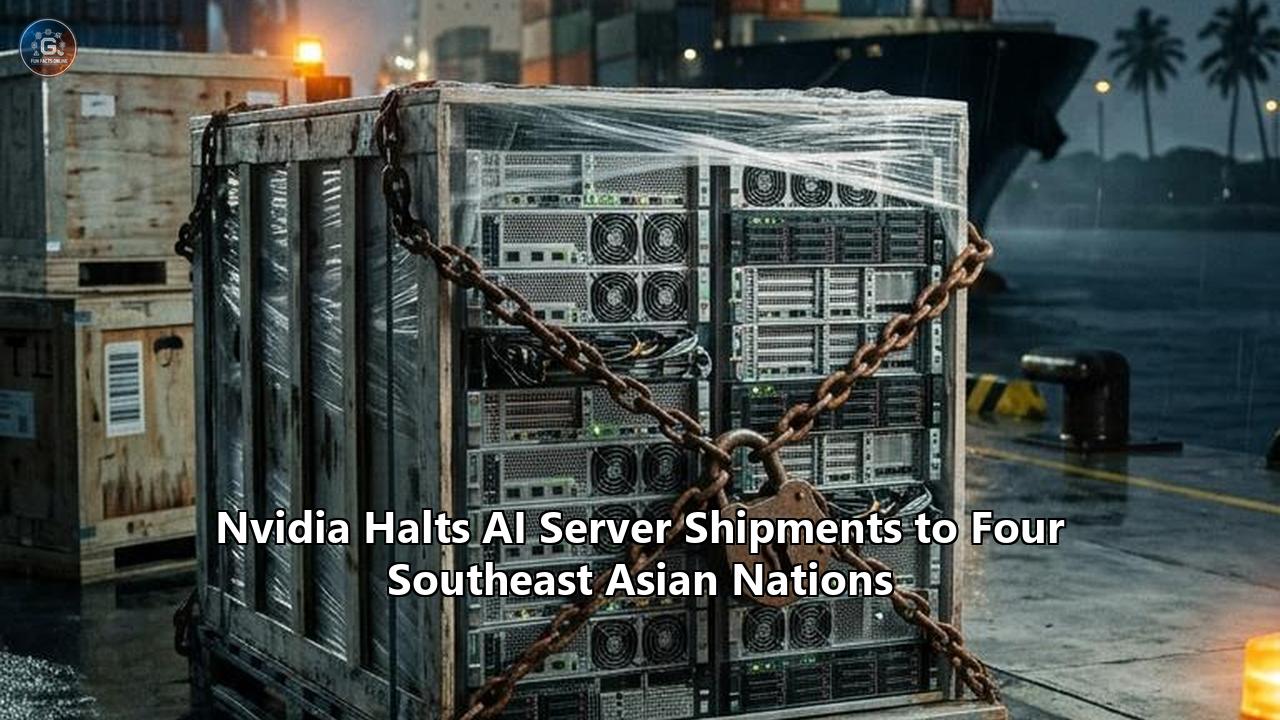
On factory floors across North America and East Asia, server racks packed with cutting-edge graphics processing units have abruptly ground to a halt. Nvidia has instructed its premier server integration partners—most notably Dell Technologies and Super Micro Computer—to freeze all pending shipments of artificial intelligence server systems bound for Malaysia, Singapore, Thailand, and Indonesia. The directive, disclosed on November 26, 2026, blocks customer deliveries across Southeast Asia's four primary computing hubs as the technology sector scrambles to decipher a sudden regulatory blockade enacted by the United States government.
The shipment freeze represents the immediate commercial fallout of an interim final rule issued by the U.S. Commerce Department’s Bureau of Industry and Security (BIS), which took regulatory effect on November 19, 2026. Designed to eliminate cross-border cloud workarounds exploited by Chinese technology firms, the regulation requires semiconductor manufacturers and original equipment manufacturers (OEMs) to obtain explicit government licenses before exporting advanced computing hardware to the four Southeast Asian nations and Brazil.
The sudden enforcement of the Nvidia AI server restrictions has thrown regional hyperscale projects, private equity financing, and cloud hosting contracts into immediate disarray. Commercial lenders have paused roughly $500 million in debt facilities intended to finance Nvidia graphics processing unit (GPU) clusters for Singapore-based cloud operator Aolani, which had contracted capacity to TikTok parent ByteDance. Meanwhile, channel distributors are urgently seeking alternative buyers for thousands of stranded high-performance processors, including Blackwell-series B300 systems.
Beyond the immediate market disruption, the freeze offers a critical case study in the mechanics of modern technological containment. It demonstrates how trade policy expands outward from direct bilateral trade embargoes into regional jurisdictional dragnets, why physical hardware controls fail without corresponding compute-as-a-service restrictions, and how corporate governance structures buckle when corporate growth strategies collide with sovereign national security mandates.
The Regulatory Trigger: Anatomy of the November 19 Interim Final Rule
The catalyst behind the export freeze is a sweeping regulatory revision published in the Federal Register by the Bureau of Industry and Security. For more than four years, Washington relied on technical performance thresholds designed to prevent advanced AI silicon from landing on mainland Chinese soil. Yet while those rules barred direct shipments of Nvidia’s flagship accelerators to Chinese entities, they left open a structural bypass: Chinese artificial intelligence developers could simply rent processing capacity hosted in third-party jurisdictions outside mainland borders.
The November 19 interim final rule closed that opening through a two-pronged mechanism:
- Geographic Expansion of Export Licensing: The rule added Singapore, Malaysia, Thailand, Indonesia, and Brazil to the list of destinations carrying a "higher-than-normal risk of diversion". Any physical shipment of high-performance computing hardware—such as Nvidia’s H100, H200, B200, and B300 platforms—now requires a verified BIS export license regardless of the stated end use.
- The Compute Access Ceiling: The regulation targets the service layer by establishing a performance threshold of 12 million units of Total Processing Performance (TPP). Data centers anywhere in the world that provide more than 12 million aggregate TPP—roughly the computing power generated by a cluster of 750 Nvidia H100 or H200 GPUs—to corporate entities headquartered in China, Macau, or other U.S. arms-embargoed jurisdictions must secure a license to continue operating.
                 U.S. COMMERCE DEPARTMENT (BIS)
                   Interim Final Rule (Nov 19)
                               │
       ┌───────────────────────┴───────────────────────┐
       ▼                                               ▼
PHYSICAL COMMODITY CONTROLS             REMOTE COMPUTE CAPACITY CONTROLS
Mandatory export licensing for:         12 Million TPP Threshold (~750 GPUs):
 • Singapore                             • Overseas data centers leasing
 • Malaysia                                compute to Chinese entities
 • Thailand                                must obtain BIS licenses
 • Indonesia                             • 90-day compliance window
 • Brazil                                • Exemption only for qualified
                                           U.S.-headquartered operators
The regulation established a 90-day grace period for regional hosting facilities already serving Chinese customers to submit license applications. However, it offered no interim safe harbor for new hardware shipments. Data center operators headquartered in the United States secured conditional exemptions provided they submit comprehensive monthly reporting on compute allocation.
Foreign-owned entities, local Southeast Asian colocation providers, and regional "neocloud" startups received no such carve-outs. Confronted with immense civil and criminal liabilities under the Export Control Reform Act, Nvidia directed its server partners to halt shipments immediately while internal compliance teams deciphered how—and if—licensing approvals could be obtained.
Governance Fallout: The Santa Clara Shockwave
The operational shockwave in Southeast Asia cannot be separated from the leadership crisis that engulfed Nvidia’s corporate headquarters in Santa Clara, California, just days prior.
On November 12, Jensen Huang abruptly resigned as Nvidia's president, chief executive, and director amid revelations concerning his personal relationship with Alice Huang, a former executive at Singapore-based cloud operator Megaspeed International. Megaspeed had been under active federal scrutiny since 2024 over allegations that it diverted high-end Nvidia accelerators into mainland China. U.S. intelligence officials alleged that Alice Huang had maintained ongoing contact with an officer from China’s Ministry of State Security while managing business relationships with Western semiconductor suppliers.
┌────────────────────────────────────────────────────────────────────────┐
│                        CHRONOLOGY OF ESCALATION                        │
├─────────────────┬──────────────────────────────────────────────────────┤
│ Date            │ Event                                                │
├─────────────────┼──────────────────────────────────────────────────────┤
│ Nov 12, 2026    │ Jensen Huang resigns amid personal controversy and   │
│                 │ scrutiny over Singapore-based Megaspeed.             │
│ Nov 16, 2026    │ BIS crafts interim final rule restricting Southeast  │
│                 │ Asian exports and remote compute access.             │
│ Nov 19, 2026    │ Interim final rule formally takes effect via Federal │
│                 │ Register publication.                                │
│ Nov 23, 2026    │ Nvidia board reinstates Jensen Huang as CEO following│
│                 │ direct assurances from executive officials.          │
│ Nov 24, 2026    │ BIS places Megaspeed and six regional affiliates on  │
│                 │ the U.S. Entity List.                                │
│ Nov 25, 2026    │ California DOJ issues subpoena; S&P places Nvidia's  │
│                 │ AA rating on CreditWatch Negative.                   │
│ Nov 26, 2026    │ Nvidia orders Dell and Supermicro to halt all AI     │
│                 │ server shipments to MY, SG, TH, and ID.              │
└─────────────────┴──────────────────────────────────────────────────────┘
The board reinstated Huang on November 23, citing senior administration input that his return posed no threat to national defense. To restore institutional credibility, the board formed an independent National Security and Export Control Committee to oversee trade compliance.
Yet regulatory momentum was already irreversible. On November 24, the Commerce Department added Megaspeed International and six regional affiliates across Singapore, Malaysia, and Thailand to the U.S. Entity List, citing their involvement in diverting advanced computing items to unauthorized end users.
By November 25, S&P Global Ratings placed Nvidia’s AA credit rating on CreditWatch Negative, citing vulnerabilities in corporate governance, board structure, and export-control oversight. The California Department of Justice served Nvidia with an investigative subpoena examining potential investor deception and supply chain diversions.
In this environment of heightened legal exposure, Nvidia possessed zero tolerance for regulatory ambiguity. Halting OEM server shipments was not merely an administrative delay; it was a defensive maneuver to prevent further enforcement actions against the chipmaker itself.
Anatomy of the Compute Loophole: Offshore Compute Arbitrage
To understand why Washington intervened so aggressively, one must examine the offshore compute arbitrage model that flourished across Southeast Asia between 2023 and 2026.
When export restrictions initially barred Chinese organizations from purchasing Nvidia’s A100, H100, and Blackwell processors, the measures targeted physical custody within Chinese territory. The regulations left untouched the remote consumption of compute. If a server rack sat inside a data center in Johor, Malaysia, or Singapore's Jurong industrial district, a software engineer in Beijing or Shanghai could train foundation models over high-bandwidth cross-border fiber connections without a single silicon wafer entering Chinese customs.
    ┌───────────────────────────┐
    │     BEIJING / SHANGHAI    │
    │  Chinese AI Laboratories  │
    │  (ByteDance, Alibaba, Z.AI)
    └─────────────┬─────────────┘
                  │ Encrypted API /
                  │ Remote SSH Compute Access
                  ▼
    ┌───────────────────────────┐
    │  SOUTHEAST ASIAN HUBS     │
    │  Singapore / Johor / BKK  │
    │                           │
    │  "Neocloud" Operators    │
    │  (Megaspeed, Aolani, etc) │
    │                           │
    │    ┌─────────────────┐    │
    │    │ AI Server Racks │    │
    │    │ (Dell / SMCI)   │    │
    │    │ H100/H200/B200  │    │
    │    └────────▲────────┘    │
    └─────────────┼─────────────┘
                  │ OEM Hardware Shipments
                  │ (NOW BLOCKED)
    ┌─────────────┴─────────────┐
    │       NVIDIA CORP         │
    │    Santa Clara, Calif.    │
    └───────────────────────────┘
This dynamic catalyzed the rise of specialized hosting companies known as neoclouds. Unencumbered by legacy software portfolios, these agile infrastructure operators raised hundreds of millions of dollars in venture capital and commercial debt to purchase Nvidia GPUs in bulk. Once racked, power-connected, and networked, the clusters were leased to Chinese technology conglomerates that were shut out of domestic access to Western semiconductors.
Megaspeed emerged as an early archetype of this strategy. Capitalizing on its status as an official Nvidia Cloud Partner, the company procured approximately $5 billion in AI compute infrastructure across Singapore and Malaysia starting in late 2023. Much of that capacity served Chinese corporate tenants.
In mid-2024, Alibaba Group funneled financing to Megaspeed through regional corporate affiliates, accepting the firm’s underlying business assets as collateral. The structure created an efficient offshore computing engine: Western silicon flowed into Southeast Asian data centers, financed by Chinese capital, delivering AI training power back to mainland technology developers.
The case of Singapore-based Aolani illustrates the fragility of this financial engineering under changing geopolitical rules. Aolani had developed structured leasing agreements to deliver high-density computing clusters—incorporating approximately 36,000 Nvidia B200 processors located in Malaysian facilities—to ByteDance.
To finance the multi-hundred-million-dollar hardware procurement, Aolani assembled a banking syndicate led by DBS to secure a $480 million to $500 million credit facility. Following the publication of the BIS interim final rule and Nvidia's subsequent shipping freeze, the lending consortium withheld loan disbursements. Deprived of the debt financing required to fulfill equipment purchase agreements with server OEMs, Aolani faces project cancellation, while ByteDance has been forced to reconsider its offshore infrastructure strategy entirely.
Supply Chain Whiplash: OEM Paralysis and the Hardware Resale Market
The enforcement of the Nvidia AI server restrictions bypassed Nvidia's direct customer relationships and landed squarely upon its original equipment manufacturers. While Nvidia designs and fabricates GPU architectures in partnership with Taiwan Semiconductor Manufacturing Company (TSMC), it does not directly assemble or rack the vast majority of enterprise AI servers. That complex manufacturing and integration work falls to partners like Dell Technologies, Super Micro Computer, Hewlett Packard Enterprise, and Taiwanese original design manufacturers like Foxconn and Wistron.
When the Commerce Department’s interim final rule removed the presumption of export approval for shipments to Malaysia, Singapore, Thailand, and Indonesia, Dell and Supermicro found themselves holding finished systems that could not be legally moved across borders. Fully integrated racks containing liquid-cooled Nvidia B200 and B300 accelerators cannot be rerouted casually; each unit is configured to match specific facility topologies, power envelopes, and interconnect fabrics.
                  CHIPS AT TSMC
                        │
                        ▼
            NVIDIA CHIP DESIGN & SALES
                        │
        ┌───────────────┴───────────────┐
        ▼                               ▼
    DELL TECH                       SUPERMICRO
  Server Assembly                 Server Assembly
        │                               │
        └───────────────┬───────────────┘
                        │
                        ▼
               WAREHOUSE STAGING
           (Hardware Physically Halted)
                        │
        ┌───────────────┴───────────────┐
   LICENSED PATH                  STRANDED ASSETS
  (90-Day Review)                 (Secondary Resale)
        │                               │
        ▼                               ▼
Approved U.S. Multinationals     Brokers seeking buyers for
in Singapore/Malaysia            unassigned B200/B300 systems
The freeze immediately created three systemic complications for hardware vendors:
- Working Capital Traps: Enterprise AI servers represent some of the most capital-intensive inventory in the electronics manufacturing industry, with individual multi-node racks commanding prices exceeding $3 million. Holding thousands of un-shipped server nodes inflates OEM inventory balances and constrains operating cash flow.
- Secondary Market Dumping: Within 48 hours of Nvidia’s shipment freeze, hardware brokers across Asia and North America began actively marketing unassigned allocations of Nvidia B300 and B200 GPUs. Systems originally destined for data centers in Kuala Lumpur and Jakarta were shopped to hyperscale buyers in Europe, Japan, and North America.
- Gross Margin Compression: Because these allocations were manufactured for contracts that suddenly vanished, hardware vendors face discounting pressure. If secondary buyers treat distressed inventory as spot-market purchases, average selling prices drop, compressing profit margins across the server manufacturing ecosystem.
A senior executive at an affected Southeast Asian cloud provider characterized the regulatory shock as operational gridlock:
"There is this new rule, but zero guidance on execution. No one knows how to apply for this license while the 90-day clock is actively running. It is causing sheer chaos across the entire regional market".
Infrastructure Collateral: Malaysia and Singapore Caught in the Dragnet
The geographical reach of the Nvidia AI server restrictions reveals how geopolitical containment disrupts third-party industrial development. Over the preceding four years, Southeast Asia positioned itself as the premier digital infrastructure corridor for the broader Indo-Pacific basin.
Malaysia, in particular, pursued a deliberate national strategy to become Asia’s primary computing hub. Benefiting from Singapore’s 2019–2022 moratorium on new data center construction—enacted due to land and power grid limitations—the southern Malaysian state of Johor and the technology district of Cyberjaya absorbed unprecedented capital inflows.
Data from the Malaysian Investment Development Authority (MIDA) shows that the country approved RM385.7 billion (roughly $94 billion) in data center-related investments between 2021 and the first half of 2026. Foreign direct investment accounted for RM271 billion, or 70 percent, of that total, with Chinese technology enterprises serving as principal anchor tenants. In the first nine months of 2026 alone, data center and cloud infrastructure accounted for 35.2 percent of Malaysia's total approved national investment capital.
┌────────────────────────────────────────────────────────────────────────┐
│                   MALAYSIA DATA CENTER CAPEX IMPACT                    │
├────────────────────────────────────────┬───────────────────────────────┤
│ Metric                                 │ Value                         │
├────────────────────────────────────────┼───────────────────────────────┤
│ Total Approved DC Investments (2021–26)│ RM385.7 Billion (~$94 Billion)│
│ Foreign Capital Share                  │ RM271.0 Billion (70%)         │
│ Share of Total 2026 National CapEx     │ 35.2%                         │
│ Operational Power Allocated            │ 4.5 Gigawatts (GW)            │
│ Power Committed Under Construction     │ 3.8 Gigawatts (GW)            │
│ Primary Vulnerability                  │ Chinese Anchor Tenancy        │
└────────────────────────────────────────┴───────────────────────────────┘
The scale of this infrastructure expansion created immense physical commitments. National utility Tenaga Nasional Berhad dedicated approximately 4.5 gigawatts of electrical capacity to operational facilities, with an additional 3.8 gigawatts committed to developments under active construction.
Now, with server hardware shipments frozen and Chinese tenants legally barred from utilizing clusters beyond the 12 million TPP ceiling, these capital investments face structural underutilization. Empty shell buildings, contracted substation feeds, and cooling installations risk becoming stranded capital assets if export licenses are systematically denied by Washington.
For Singapore, the exposure takes a corporate and fiscal form. While the island city-state exercises strict domestic zoning constraints over physical data center power consumption, it functions as the operational, contractual, and billing headquarters for the regional semiconductor trade.
Nvidia’s corporate accounts reveal that the company recorded an astounding $104 billion in revenue through its Singapore operating subsidiary in fiscal year 2025—a 72 percent surge over a 12-month period. While this statutory entity bills customer activity across multiple regional territories, including Taiwan and China, it illustrates Singapore's role as the legal conduit through which enterprise AI processing is financed and dispatched.
The new U.S. licensing regime disrupts this billing architecture, forcing multinational technology operators to review legal liabilities, rewrite service-level agreements, and restructure client bases to remove high-risk Chinese corporate entities.
Strategic Principles: Four Lessons from the Southeast Asian Freeze
The sudden implementation of the Nvidia AI server restrictions functions as a defining case study in geotechnology. Examining the mechanics of the November 26 freeze reveals four fundamental principles that govern modern technological competition and industrial policy.
1. Compute Fungibility Negates Physical Geography
Traditional trade controls assume that commodities are consumed where they are physically imported. A jet engine, machine tool, or raw chemical delivers economic utility at its physical point of delivery. High-performance computing behaves differently.
Because modern machine learning workflows operate via software networks, high-end compute functions as a completely fungible, globally liquid resource. As long as an accelerator is connected to electrical power and low-latency fiber, its economic and strategic capabilities can be accessed from any terminal worldwide.
The lesson extracted from Southeast Asia is clear: export control regimes that focus solely on physical customs inspections are fundamentally obsolete. True technological containment requires governing the logical compute layer, monitoring aggregate TPP throughput, and regulating remote access protocols.
                 TRADITIONAL TRADE CONTROLS
┌────────────────┐      Border Inspection     ┌────────────────┐
│   EXPORTER     ├───────────────────────────►│  END CONSUMER  │
└────────────────┘       Physical Flow        └────────────────┘
                  (Commodity consumed at site)

                 SOVEREIGN COMPUTE DRAGNET
┌────────────────┐      Hardware Export       ┌────────────────┐
│   EXPORTER     ├───────────────────────────►│ INTERMEDIARY   │
└────────────────┘                            │  DATA CENTER   │
                                              └───────┬────────┘
                                                      │ Logical Access
                                                      │ (12M TPP Rule)
                                                      ▼
                                              ┌────────────────┐
                                              │  REMOTE USER   │
                                              │(Restricted Terr)
                                              └────────────────┘
2. The Inevitability of the Jurisdictional Dragnet
Targeted sanctions inherently leak. When an enforcement agency places a hard trade restriction on a large, well-capitalized economic power like China, market incentives create intermediary commercial routes. Capital, shell entities, and infrastructure inevitably migrate to adjacent, friendly, or unaligned jurisdictions.
Consequently, regulators must repeatedly widen the jurisdictional net. What began in October 2022 as a direct restriction on selling advanced chips to Chinese corporate buyers expanded in October 2023 to capture modified China-specific chips (such as the A800 and H800).
By late 2026, the regulatory perimeter expanded again, swallowing neutral trade partners—Singapore, Malaysia, Thailand, Indonesia, and Brazil—into a strict licensing framework. Any third-party state that develops the infrastructure capacity to service restricted entities will eventually find its own sovereign technology access curtailed by Washington.
3. Asymmetric Sovereign Risk in Infrastructure Development
Developing nations pursuing digital industrialization face severe capital risks when their underlying business models depend on geopolitical arbitrage. Malaysia’s $94 billion data center surge was accelerated by providing a safe harbor for computing capital that faced resistance elsewhere.
However, building localized physical infrastructure—such as electrical sub-stations, high-voltage transmission lines, and water cooling infrastructure—requires decades-long amortization schedules. When foreign trade regulations invalidate anchor tenancy agreements overnight, the host country absorbs the real-world liabilities: strained utility grids, abandoned real estate developments, and canceled tax revenue streams. Aligning national industrial growth strategies with offshore circumvention capital creates extreme structural vulnerability.
4. Executive Autonomy Collapses Under National Security Oversight
The dramatic institutional crisis surrounding Jensen Huang’s resignation, the Commerce Department's investigation into Megaspeed, and Huang’s subsequent reinstatement illustrates the shifting boundaries of corporate executive authority.
For three decades, semiconductor executives navigated global markets using traditional commercial playbooks: maximizing enterprise value, courting global clients, and treating cross-border supply chains as frictionless global pipelines. In an era of great power competition, advanced computing is no longer treated as standard commercial commerce; it is managed as dual-use strategic weaponry.
Corporate governance models that fail to install robust, independent national security compliance frameworks—prioritizing sales quotas over verifiable end-user diligence—face swift intervention from state intelligence, defense, and justice departments.
Market Repercussions: The Split in Frontier Model Development
The immediate technological casualty of the shipment freeze is the development cycle for China’s frontier artificial intelligence models. Despite Beijing’s aggressive push toward domestic silicon self-reliance through state-backed champions like Huawei and its Ascend series accelerators, China’s elite private AI laboratories remain dependent on Nvidia’s CUDA software ecosystem and hardware architectures.
The timing of the freeze directly disrupts foundation model roadmaps. Chinese AI pioneer Z.AI has already signaled potential delays in launching its next-generation flagship model, GLM-5.5, which was scheduled for deployment in late 2026. Training runs of this magnitude require tens of thousands of synchronized, ultra-low-latency GPUs operating continuously across high-throughput clusters.
┌────────────────────────────────────────────────────────────────────────┐
│             DOWNSTREAM IMPACT ON AI COMPUTE ALLOCATIONS                │
├────────────────────┬───────────────────────────────────────────────────┤
│ Sector / Entity    │ Operational Impact                                │
├────────────────────┼───────────────────────────────────────────────────┤
│ Chinese AI Labs    │ Immediate compute starvation; delays to next-gen  │
│ (e.g., Z.AI)       │ flagship architectures like GLM-5.5.              │
│ Regional Neoclouds │ Debt facilities frozen; unable to monetize racked │
│ (e.g., Aolani)     │ hardware; risk of insolvency within 90 days.      │
│ Server OEMs        │ Finished rack inventory stranded; secondary sales │
│ (Dell, Supermicro) │ pressured by price discounts and margin erosion.  │
│ Western Hyperscalers│ Opportunity to acquire redirected B200/B300 chips │
│ (AWS, Azure, OCI)  │ at secondary market discounts.                    │
└────────────────────┴───────────────────────────────────────────────────┘
By cutting off the remote compute pipelines running through Southeast Asian data centers, Washington has constricted Chinese access to leading-edge compute. Domestic alternatives within China, such as the Ascend 910B and 910C, have made strides in inference processing, but Chinese engineers face chip-to-chip interconnect bottlenecks and higher memory failure rates when scaling these systems to train frontier models across tens of thousands of nodes.
The disruption forces Chinese research teams to embrace alternate engineering strategies, such as model distillation, algorithmic parameter optimization, and architectural adjustments, while they attempt to scale domestic server clusters.
The Road Ahead: The 90-Day Clock and Structural Compute Bifurcation
The global technology sector now enters an intense 90-day operational race. With public comments on the Commerce Department’s interim final rule closing on January 18, 2027, and the initial compliance window concluding in mid-February, data center operators across Southeast Asia face a high-stakes choice:
- Full De-linking from Chinese Tenancy: To receive BIS licenses and restart Nvidia server deliveries, regional cloud providers must purge their customer rolls of Chinese corporations, implement know-your-customer (KYC) identity protocols, and allow continuous monitoring of their cluster workloads.
- Pivot to Secondary Markets: Operators that cannot or will not forfeit their lucrative Chinese cloud contracts will be cut off from Western hardware completely. These facilities will be forced to transition into secondary maintenance roles, sourcing grey-market chips, retrofitting older hardware, or procuring domestic Chinese silicon.
Nvidia, for its part, must adjust to a divided global marketplace. The revenue windfalls generated by its Singapore subsidiary will face short-term deceleration as the company works to ensure that all sales across the Asia-Pacific territory comply with U.S. export licensing standards. As OEM assembly lines hold hardware at factory borders, the computing industry is witnessing the formal end of a globally unified technological stack.
The physical halting of AI servers bound for Malaysia, Singapore, Thailand, and Indonesia marks the decisive moment when compute capacity was permanently reclassified. It is no longer just commercial IT hardware; it is a restricted national strategic asset whose cross-border movement is dictated entirely by geopolitical borders.
Reference:
- https://www.malaymail.com/news/money/2026/11/26/ft-nvidia-stops-ai-shipments-to-malaysia-singapore-thailand-indonesia-as-us-tightens-china-curbs/244856
- https://www.financialexpress.com/world-news/nvidia-freezes-pending-ai-server-orders-to-4-southeast-asian-nations-report/4394785/
- https://www.freemalaysiatoday.com/category/highlight/2026/11/26/nvidia-halts-chip-shipments-to-southeast-asia-ft-reports
- https://certifiedstrategic.com/insights/nvidia-halts-ai-server-shipments-southeast-asia-malaysia-singapore
- https://www.crnasia.com/news/2026/components-and-peripherals/nvidia-halts-server-shipments-to-southeast-asia-as-us-tighte
- https://www.nacionale.com/en/articles/why-did-nvidia-halt-chip-shipments-southeast-asia-malaysia-singapore-thailand-indonesia
- https://www.siliconrepublic.com/business/ft-nvidia-turns-down-south-asian-shipments-after-new-us-chip-curbs
- https://www.forbes.com/sites/siladityaray/2026/11/26/nvidia-reportedly-halts-ai-chip-shipments-to-southeast-asia-as-us-tightens-china-curbs/
- https://www.hindustantimes.com/world-news/nvidia-halts-chip-shipments-to-southeast-asia-report-101795670060435.html
- https://www.tradingkey.com/analysis/stocks/us-stocks/262324009-nvidia-ai-server-shipment-halt-4-asean-markets-thousands-of-b300s-seek-buyers-3-risks-tradingkey
- https://www.tradingkey.com/analysis/stocks/us-stocks/262324009-nvidia-ai-server-shipment-halt-4-asean-markets-thousands-of-b300s-seek-buyers-3-risks-tradingkey
- https://www.tomshardware.com/tech-industry/policy/nvidia-stops-ai-gpu-shipments-to-southeast-asia-report-claims-data-centers-in-singapore-other-countries-in-trouble-as-commerce-department-requires-cloud-providers-to-obtain-export-license
- https://analyticsindiamag.com/ai-news/nvidia-halts-ai-server-shipments-to-4-southeast-asian-countries-report
- https://investingnews.com/nvidia-halts-southeast-asia-chips/
- https://walled.ai/blog/bis-ai-remote-access-rule
- https://www.taipeitimes.com/News/biz/archives/2026/11/27/2003868455
- https://www.cbsnews.com/news/nvidia-jensen-huang-megaspeed-investigations/
- https://www.engadget.com/2329200/nvidia-reportedly-halts-chip-shipments-to-southeast-asia/
- https://www.scmp.com/tech/tech-war/article/3375556/us-places-megaspeed-blacklist-jensen-huang-returns-helm-nvidia
- https://techcrunch.com/2026/11/25/the-questions-jensen-huang-and-nvidia-will-still-have-to-answer-about-megaspeed/
- https://www.theguardian.com/us-news/2026/nov/23/megaspeed-us-trade-blacklist-nvidia
- https://www.ventureatlas.org/news/2026-11-26-nvidia-sea-server-shipments
- https://www.investing.com/news/stock-market-news/nvidia-stops-shipping-ai-servers-to-4-southeast-asian-countries-ft-5052075
- https://www.itnews.asia/news/new-us-ai-chip-curbs-put-malaysias-datacentre-ambition-at-risk-630620
- https://en.wikipedia.org/wiki/Megaspeed
- https://www.trendforce.com/news/2026/11/26/news-nvidia-reportedly-suspends-ai-server-shipments-to-four-southeast-asian-countries-as-u-s-targets-chinese-ai-access/
- https://unn.ua/en/news/nvidia-restricted-chip-shipments-to-prevent-chinas-access-ft