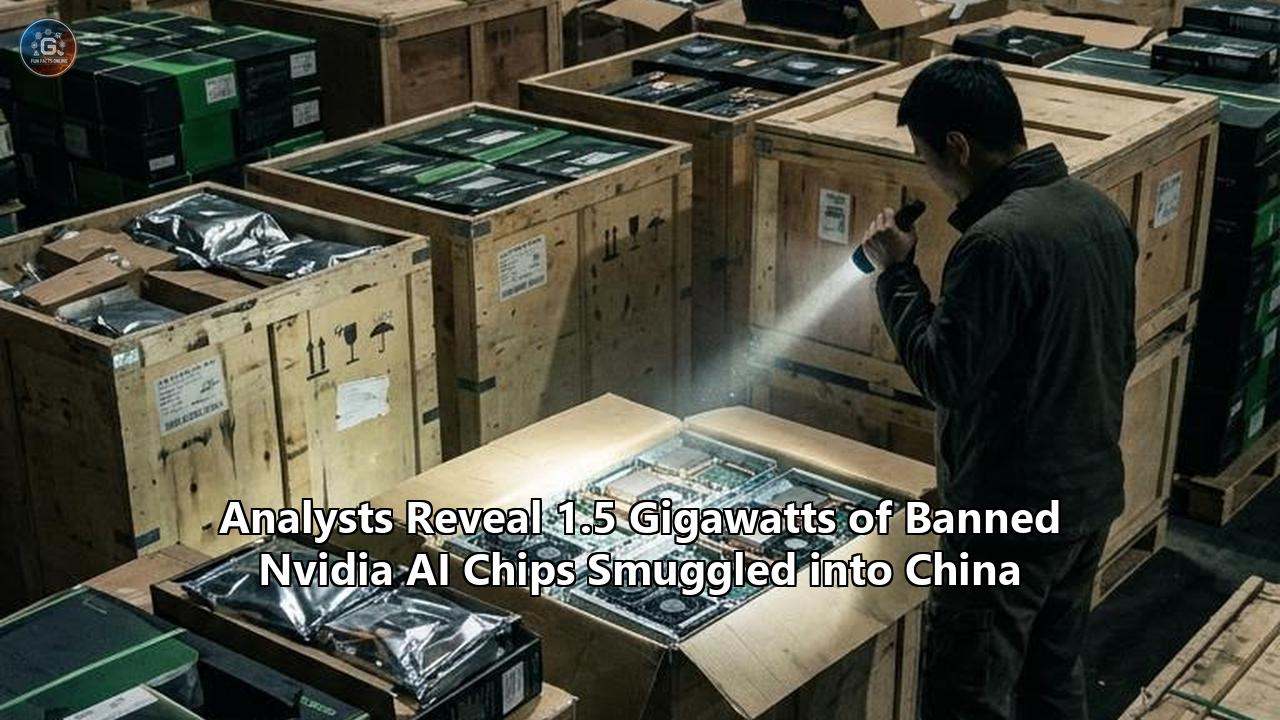
A massive illicit supply network has funneled more than 1.5 gigawatts of restricted Nvidia artificial intelligence processors into mainland China. The disclosure, published in an exhaustive supply-chain audit by semiconductor intelligence firm SemiAnalysis, establishes that Chinese technology giants, research institutions, and state-backed laboratories have successfully circumvented multiple rounds of United States Department of Commerce export controls. The volume of silicon identified in the report does not refer to consumer-grade hardware or stripped-down compliance processors; it consists of high-end, export-restricted accelerators from Nvidia’s Hopper and Blackwell architectures.
The revelation arrived in tandem with a seismic leadership shock in Silicon Valley: the sudden resignation of Nvidia co-founder and chief executive officer Jensen Huang on November 12, 2026. While initial company filings pointed to internal board inquiries regarding undisclosed personal relationships with subordinates and a foreign client, the SemiAnalysis report and subsequent disclosures from Washington suggest that federal intelligence agencies played an instrumental role in accelerating Huang’s departure. The Department of Commerce’s Bureau of Industry and Security (BIS) has independently converged on the same conclusion: an aggregate computational capacity exceeding 1.5 gigawatts of restricted American silicon is operating inside Chinese borders outside international regulatory oversight.
To grasp the geopolitical and technological gravity of this discovery requires looking past political talking points. Moving 1.5 gigawatts of computing hardware across international borders is not an operation carried out in passenger luggage. It represents hundreds of thousands of specialized server chassis, millions of high-bandwidth memory dies, liquid-cooling loops, and advanced networking fabrics rerouted through shell corporations, deceptive audits, and transshipment corridors spanning Southeast Asia.
Understanding why this hardware matters, how it reached Chinese data centers, and why power ratings have replaced unit counts as the defining metric of artificial intelligence supremacy requires dissecting the engineering, logistics, and microeconomics of the global chip trade.
Decoding the Metric: Why Analysts Measure Processors in Gigawatts
In conventional consumer electronics, production and distribution metrics are cataloged in unit volumes: millions of smartphones, tens of thousands of vehicles, or crates of desktop graphics cards. In frontier artificial intelligence, raw unit counts have become obsolete. Modern high-performance computing (HPC) facilities measure computational capacity through power envelopes, specifically megawatts (MW) and gigawatts (GW).
+-----------------------------------------------------------------------------------+
|               1.5 GIGAWATTS OF BANNED COMPUTE: HARDWARE EQUIVALENTS               |
+-----------------------------------------------------------------------------------+
| Pure Hopper Deployment (Nvidia H200 SXM @ 700W TDP):                              |
| [ ~2,142,000 GPUs ] --> ~267,750 HGX 8-GPU Baseboards                             |
+-----------------------------------------------------------------------------------+
| Pure Blackwell Deployment (Nvidia B200 SXM @ 1,000W TDP):                         |
| [ ~1,500,000 GPUs ] --> ~187,500 HGX 8-GPU Baseboards                             |
+-----------------------------------------------------------------------------------+
| NVL72 Rack Architecture (Nvidia GB200 NVL72 @ ~120 kW per rack):                  |
| [ ~12,500 Full Liquid-Cooled Racks ] --> Complete Hyperscale Campus Footprint     |
+-----------------------------------------------------------------------------------+
The Physics of Thermal Design Power
Modern AI accelerators push the limits of silicon physics and electrical engineering. An individual graphics processing unit (GPU) designed for enterprise AI workloads operates at an immense Thermal Design Power (TDP)—the maximum amount of heat an electrical component generates that the cooling system is designed to dissipate under maximum workload:
- Nvidia H100 / H200 SXM: Rated at 700 watts per processor package.
- Nvidia B200 SXM (Blackwell): Rated at 1,000 watts (1 kilowatt) per processor package.
- Nvidia GB200 NVL72 Rack Architecture: Integrates 72 Blackwell GPUs and 36 Grace CPUs into a unified, liquid-cooled cabinet pulling approximately 120 to 140 kilowatts per rack.
When semiconductor analysts calculate computational volume using energy ratings, they multiply the package-level rated power of the accelerators by the total volume of operational hardware identified across supply-chain manifests, import declarations, and telemetry leaks.
If the 1.5-gigawatt pool documented by SemiAnalysis consisted entirely of H200 accelerators running at 700 watts, the total translates to approximately 2.14 million individual GPUs. If the footprint is composed of newer, 1,000-watt Blackwell B200 accelerators, the total equals 1.5 million processors. Across realistic deployments featuring a blended generational architecture, the figure establishes that between 1.5 million and 2.1 million elite American chips are operating inside China without valid BIS export licenses.
The Industrial Scale of 1.5 Gigawatts
To contextualize 1.5 gigawatts of enterprise computing power, consider the standard energy demands of industrial infrastructure:
- Municipal Power: One gigawatt produces enough electricity to power roughly 750,000 American households simultaneously. A 1.5-gigawatt demand is roughly equivalent to the entire electrical grid capacity required to run a metropolitan area the size of San Francisco or Amsterdam.
- Nuclear Output: A standard commercial nuclear power reactor, such as a Westinghouse AP1000, generates roughly 1.1 gigawatts of net electrical output. Operating this smuggled compute base at peak utilization consumes the equivalent output of one and a half commercial nuclear reactors.
- Frontier Datacenter Parity: Elon Musk’s xAI built the "Colossus 1" supercomputing cluster in Memphis, Tennessee, utilizing roughly 220,000 Hopper H100 and H200 accelerators, drawing an estimated 150 to 180 megawatts of facility power. The 1.5 gigawatts of restricted hardware tracked into China represents roughly seven to eight times the computing envelope of the original Colossus installation, directly rivaling or exceeding the multi-phase targets planned for Colossus 2.
By translating tracking data into electrical capacity, analysts sidestep the accounting games that distributors use to disguise sales volumes. While individual server chassis can be disassembled, relabeled, and re-registered as low-end parts, their electrical consumption and thermodynamic footprint remain constant. A data center built to draw hundreds of megawatts of three-phase power to cool thousands of high-density server racks leaves an indelible infrastructural footprint.
The Silicon Hierarchy: Why Compliance Chips Failed to Quench Demand
To understand why a multi-billion-dollar grey market formed, one must examine the specific regulatory boundaries established by Washington and the architectural bottlenecks that rendered legally compliant chips insufficient for frontier artificial intelligence research.
+-------------------------------------------------------------------------------------------------+
|                                CHIP ARCHITECTURE VS. SANCTION LIMITS                            |
+--------------------+---------------------+----------------------+-------------------------------+
| Processor Model    | Architecture Tier   | Interconnect Speed   | Legal Status in China         |
+--------------------+---------------------+----------------------+-------------------------------+
| Nvidia H100 SXM    | Hopper (Frontier)   | 900 GB/s (NVLink 4)  | Banned (Oct 2022 / Oct 2023)  |
| Nvidia H200 SXM    | Hopper (Frontier)   | 900 GB/s (NVLink 4)  | Banned (Oct 2023 Update)      |
| Nvidia B200 / B300 | Blackwell (Next-Gen)| 1,800 GB/s (NVLink 5)| Banned (Immediate)            |
| Nvidia H800        | Hopper (Compliance) | 400 GB/s (Throttled) | Banned (Oct 2023 Update)      |
| Nvidia H20         | Hopper (Compliance) | 400 GB/s, Low Compute| Restricted / Special License  |
+--------------------+---------------------+----------------------+-------------------------------+
The Evolution of Export Sanctions
The United States government structured its export control regime through escalating thresholds administered by the Bureau of Industry and Security:
- October 7, 2022 Rules: The initial framework restricted any integrated circuit possessing bidirectional interconnect bandwidth exceeding 600 gigabytes per second (GB/s) alongside a processing performance threshold of 4,800 bits, effectively prohibiting the export of Nvidia’s flagship A100 and H100 accelerators.
- The Compliance Workaround (Phase One): Nvidia engineered the A800 and H800. These processors preserved internal mathematical computing power (tensor core floating-point performance) but reduced the physical communication pipeline (NVLink interconnect) below the 600 GB/s ceiling, locking it at 400 GB/s.
- October 17, 2023 Rules: Closing the loophole, BIS instituted a revised standard focused on Total Processing Performance (TPP) and Performance Density, factoring in die size. This revision banned the H800 and consumer-adjacent hardware such as the RTX 4090.
- The Compliance Workaround (Phase Two): Nvidia released the H20. Built on the Hopper architecture, the H20 slashed raw compute capabilities down to roughly 15% of an H100's FP16 throughput, though it retained high memory bandwidth via 96 gigabytes of HBM3 memory.
The Mathematics of the Distributed Computing Bottleneck
Frontier artificial intelligence systems, including trillion-parameter Large Language Models (LLMs) and multi-modal neural networks, cannot be trained on a single chip. These models exceed the memory capacity of any individual silicon die by orders of magnitude. A 1.8-trillion parameter Mixture-of-Experts (MoE) model requires tens of terabytes of memory merely to store its weights, activation states, and optimization matrices during training.
To solve this, computer scientists use distributed training, partitioning the model across thousands of processors working in lockstep through three distinct methodologies:
- Tensor Parallelism: Splitting individual matrix multiplications within a neural network layer across multiple GPUs.
- Pipeline Parallelism: Distributing consecutive layers of the network across different processors.
- Data Parallelism: Replicating the model across clusters, feeding distinct batches of training data to each, and averaging calculated gradients across all nodes.
       [ MASTER PARAMETER WEIGHTS: DISTRIBUTED OVER THOUSANDS OF CHIPS ]
                                      |
         +----------------------------+----------------------------+
         |                                                         |
         v                                                         v
   [ GPU Node 1 ] <====== NVLINK CLUSTER FABRIC ======> [ GPU Node 2 ]
   (900-1800 GB/s)      (Inter-Die Gradient Exchange)    (900-1800 GB/s)
         |                                                         |
         +----------------------------+----------------------------+
                                      |
                       [ ALL-REDUCE SYNCHRONIZATION ]
         (If Interconnect Bandwidth drops to 400 GB/s, Tensor Cores IDLE)
Tensor parallelism requires near-instantaneous communication between processors. During training steps, every chip must pause execution, broadcast its intermediate calculations, and synchronize its internal memory registers with its peer chips via an operation known as an All-Reduce.
On a standard Nvidia H100 SXM system, processors communicate across an internal NVLink 4 interconnect fabric delivering 900 GB/s of bidirectional bandwidth per GPU. On Blackwell systems, NVLink 5 elevates this transfer rate to 1.8 terabytes per second (TB/s).
When Chinese labs attempted to train frontier models using compliance silicon like the H20 or throttled H800s, the interconnect pipeline acted as a severe choke point. At 400 GB/s or across standard peripheral component interconnect express (PCIe) buses, communication latency exploded. High-performance tensor cores sat idle, waiting for parameter data to cross the throttled network interface.
To achieve the computational throughput of an 8,000-chip H100 cluster using H20 hardware, an engineering team would have to scale the network to tens of thousands of individual dies. That configuration exponentially multiplies data center surface area, optical transceiver counts, network switch hops, structural power consumption, and points of physical failure.
Because scaling throttled chips introduced unsustainable overhead, Chinese artificial intelligence labs, autonomous driving teams, and military research organizations maintained an urgent demand for unrestricted silicon. This architectural bottleneck drove the underground market for Nvidia chips smuggled China researchers eventually traced.
Anatomy of the Underground Pipeline
Smuggling an integrated circuit the size of a coin is straightforward. Transporting over 1.5 gigawatts of enterprise computing infrastructure—packaged inside industrial-grade server chassis that weigh up to 500 pounds and require specialized three-phase liquid-cooling infrastructure—is an intricate logistics operation.
Federal indictments, customs seizures, and investigative documentation show the network of Nvidia chips smuggled China leveraged three distinct vectors: Southeast Asian transshipment hubs, domestic server-assembly substitutions, and insider-driven export falsification.
+-------------------------------------------------------------------------------------------------+
|                           THE THREE-STAGE TRANSSHIPMENT PIPELINE                                |
+-------------------------------------------------------------------------------------------------+
| 1. LEGAL EXPORT: Silicon Valley OEMs ship fully populated HGX H100/H200/B200 servers to         |
|    vetted "Cloud Partners" in Singapore, Malaysia, and Thailand under valid licenses.           |
+-------------------------------------------------------------------------------------------------+
                                                |
                                                v
| 2. SHELL DIVERSION: Equipment lands in regional free-trade zones. Servers are de-racked,         |
|    re-boxed into unbranded freight crates, and assigned forged bills of lading.                 |
+-------------------------------------------------------------------------------------------------+
                                                |
                                                v
| 3. INFILTRATION: Secondary freight forwarders move hardware via maritime feeder vessels into     |
|    Guangdong ports or air-cargo routes through Hong Kong, clearing customs via falsified HS-codes.|
+-------------------------------------------------------------------------------------------------+
Vector 1: The Southeast Asian Transshipment Corridor
The primary artery for diversion runs through legitimate commercial technology centers in Southeast Asia, notably Singapore, Malaysia, and Thailand.
The Southern District of New York (SDNY) detailed the operational architecture of this pipeline in a federal indictment unsealed in March 2026 (United States v. Liaw et al.). Federal prosecutors charged Yih-Shyan "Wally" Liaw, a co-founder and senior vice president of server giant Super Micro Computer (Supermicro), alongside Ruei-Tsang "Steven" Chang, a sales executive in Taiwan, and Ting-Wei "Willy" Sun, a logistics contractor.
                                  [ THE SDNY CASE ARCHITECTURE ]
                                                 |
                                                 v
                       +---------------------------------------------------+
                       |    Super Micro Computer Corporate Headquarters    |
                       |              (San Jose, California)               |
                       +---------------------------------------------------+
                                                 |
                                     ($2.5B Total Server Orders)
                                                 |
                                                 v
                       +---------------------------------------------------+
                       |          OBON / Regional Front Companies          |
                       |                (Bangkok, Thailand)                |
                       +---------------------------------------------------+
                                                 |
                                      ($510M Verified Diversion)
                                                 |
                                                 v
                       +---------------------------------------------------+
                       |              Chinese Hyperscalers                 |
                       |       (e.g., Alibaba Cloud Infrastructure)        |
                       +---------------------------------------------------+
According to prosecutors, between 2024 and 2025, an intermediary enterprise in Southeast Asia—subsequently identified as Bangkok-based infrastructure provider OBON—placed approximately $2.5 billion in server orders with Supermicro. The purchase documentation certified that the servers, packed with Nvidia H200 and Blackwell-generation accelerators, were earmarked exclusively for local data center infrastructure in Southeast Asia.
Once the hardware cleared American export controls and arrived in regional warehouses, a systematic diversion unfolded:
- De-Labeling and Re-Packaging: Technicians stripped corporate asset tags, serial numbers, and regulatory compliance stickers from server chassis. Logistics handlers used industrial heat guns to preserve the original warranty and chassis labels while altering manifest documentation.
- Manifest Falsification: High-performance HGX baseboards housing Nvidia H100 and H200 chips were re-registered on international shipping documents as legacy networking equipment, low-end server components, or standard computer chassis under broad Harmonized System (HS) customs codes.
- Cross-Border Maritime Routing: Over a three-week window in the spring of 2025, at least $510 million worth of hardware was redirected from Southeast Asian holding facilities onto commercial cargo ships bound for mainland ports, with shipments arriving directly into Chinese hyperscalers, including Alibaba.
Vector 2: The Audit Manipulation Scheme
To prevent regulatory alerts from triggering inside American export compliance software, the illicit network developed methods to pass on-site verification audits:
- The Replica Warehouse Tactic: In August 2025, anticipating corporate and federal compliance audits, conspirators in Southeast Asia staged warehouses with thousands of non-functional replica chassis. These dummy units matched the external dimensions, weight, and chassis branding of functional HGX systems but contained inert sheet metal and discarded printed circuit boards.
- The Decoy Audit: According to federal prosecutors, when federal inspectors from the Department of Commerce visited overseas facilities in December 2025, local handlers reused these dummy chassis to simulate real inventory. At the same time, regional compliance personnel were treated to off-site entertainment to minimize inspection time inside active server halls.
Vector 3: Insider Compromise and Transshipment Networks
Complementing the Southeast Asian route, Taiwanese prosecutors dismantled an insider-driven smuggling ring centered in Taipei and Keelung in August 2026.
Taiwan's Keelung District Prosecutors' Office indicted nine individuals, including an internal partner manager at Nvidia's Taiwan corporate unit named Chang, two senior sales managers at Supermicro's Taiwan branch, and executive personnel from distributor Albatron Technology.
                                  [ THE TAIWAN EXPORT CONSPIRACY ]
                                                 |
                                                 v
                       +---------------------------------------------------+
                       |             Nvidia Corporate Whitelist            |
                       |       (Manipulated by Insider Partner Mgr)        |
                       +---------------------------------------------------+
                                                 |
                                     (130 Nvidia B300 Servers)
                                                 |
                                                 v
                       +---------------------------------------------------+
                       |          Flying Tiger Technology (Feihu)          |
                       |        (Declared Site: Chief Telecom Facility)    |
                       +---------------------------------------------------+
                                                 |
                                       (On-Site Audit Failed)
                                (Site Lacked Required Power/Cooling)
                                                 |
                                                 v
                       +---------------------------------------------------+
                       |         False Verification Issued Anyway          |
                       +---------------------------------------------------+
                                                 |
                        +------------------------+------------------------+
                        |                                                 |
                 (74 Servers Diverted)                         (56 Intercepted)
                        |                                                 |
                        v                                                 v
           +--------------------------+                      +--------------------------+
           | Direct Mainland Shipping |                      | Taiwan Customs Seizure   |
           | Indonesia Transshipment  |                      +--------------------------+
           | Japan -> Hong Kong Route |
           +--------------------------+
The operation targeted next-generation enterprise hardware: 130 server cabinets packed with Nvidia Blackwell B300 processors. To bypass Nvidia’s strict global allocation whitelist, the defendants executed an end-around verification:
- Shell Procurement: A local trading firm, Flying Tiger Technology, secured a spot on Nvidia's authorized customer whitelist by claiming the servers would be installed inside an AI facility operated by Chief Telecom in Taiwan.
- Failed Physical Verification: An internal on-site inspection of the declared Chief Telecom facility in September 2025 revealed the space lacked the electrical substations, liquid-cooling manifolds, and fiber-optic networking lines required to operate B300-class hardware.
- Falsified Clearance: Despite the facility's clear infrastructural deficiencies, the indicted Nvidia Taiwan manager bypassed standard compliance flags, transmitting an official certification to Nvidia headquarters affirming that the deployment was legitimate.
Of the 130 Blackwell B300 servers routed through the scheme, 74 reached buyers in mainland China via direct shipping lines and triangular routes through Indonesia and Japan before Taiwanese customs authorities intercepted the remaining 56 units.
Because Taiwanese law at the time lacked a dedicated legal statute criminalizing violations of American export bans, prosecutors were forced to indict the executives under domestic provisions covering document forgery, corporate embezzlement, and criminal breach of trust under the Securities and Exchange Act.
Vector 4: Executive Networks and the Megaspeed Probe
The scale of the illicit hardware flow also intersected directly with Nvidia's corporate leadership. Bloomberg and the New York Times revealed that Chinese data center developer Megaspeed International, along with allied entities founded by technology executive Alice Huang (born Huang Le), secured thousands of export-controlled Nvidia processors for data centers in mainland China.
                                  [ THE MEGASPEED ARTERY ]
                                             |
                                             v
                   +---------------------------------------------------+
                   |         Alice Huang / Megaspeed International     |
                   |               (Singapore Infrastructure)          |
                   +---------------------------------------------------+
                                             |
                                 (Nvidia Cloud Partner Status)
                                             |
                                             v
                   +---------------------------------------------------+
                   |          Aperia Cloud Services (Singapore)        |
                   |       (Purchased Dell PowerEdge H800 Servers)     |
                   +---------------------------------------------------+
                                             |
                               (Unauthorized Hardware Diverted)
                                             |
                                             v
                   +---------------------------------------------------+
                   |       Yangtze River Delta Project (Shanghai)      |
                   |       (Operated by Shanghai Longteng Computing)   |
                   +---------------------------------------------------+
                                             |
                                (Assets Pledged for Loans):
                           - 52 Supermicro H100/H200 Servers
                           - 22 Dell Technologies H800 Servers
                           - 119 Gigabyte Technology HPC Servers
Public regulatory filings from Shanghai Longteng Intelligent Computing—a firm founded by Alice Huang and operated alongside private equity executive Kang Wei—showed that the company pledged high-end hardware as collateral for domestic Chinese bank financing in January 2025:
- 52 Supermicro server systems fitted with restricted Nvidia H100 and H200 SXM processors.
- 22 Dell Technologies PowerEdge enterprise systems equipped with banned H800 silicon.
- 119 Gigabyte Technology high-density server units.
This hardware was installed directly inside the Yangtze River Delta Project, an AI data center operating on the outskirts of Shanghai. Dell subsequently severed all sales and support relationships with Megaspeed's affiliate, Aperia Cloud Services, citing diversion concerns, while Singapore authorities arrested Aperia’s chief executive.
The revelation that Jensen Huang maintained an undisclosed personal relationship with Alice Huang—who was concurrently under investigation by the Federal Bureau of Investigation and Central Intelligence Agency as a potential intelligence asset for Beijing—set off alarms across the National Security Council. The intersection of corporate access, executive relationships, and back-channel chip flows intensified pressure from federal agencies, culminating in Huang's resignation from Nvidia.
The Economics of Evasion: The 300% Black-Market Premium
The financial scale of the underground processor trade rivals traditional illicit resource markets, such as weapons or narcotics trafficking. The persistent flow of restricted silicon is driven by an unavoidable economic reality: the profit margins generated by evading export controls are high enough to absorb significant risks, legal penalties, and logistics overhead.
+-------------------------------------------------------------------------------------------------+
|                        GPU MARKET VALUE: AUTHORIZED VS. ILLICIT CHANNELS                        |
+---------------------+-------------------------------+-------------------------------------------+
| Accelerator Model   | Authorized Base Price (MSRP)  | Chinese Black-Market Price (Shenzhen)     |
+---------------------+-------------------------------+-------------------------------------------+
| Nvidia H100 SXM5    | $30,000 - $35,000             | $55,000 - $75,000 (100% - 114% Premium)   |
| Nvidia H200 SXM     | $38,000 - $42,000             | $80,000 - $95,000 (110% - 126% Premium)   |
| Nvidia B200 SXM     | $40,000 - $45,000             | $120,000 - $140,000 (200% - 211% Premium) |
+---------------------+-------------------------------+-------------------------------------------+
Capital Sourcing and Procurement Architecture
The capital underwriting these procurement networks is drawn from three distinct domestic sources:
- Hyperscale Balance Sheets: Chinese technology giants—facing pressure to match Western LLM developments such as OpenAI's GPT-5 and Google's Gemini architectures—routinely deploy overseas capital reserves held in Hong Kong, Singapore, and European subsidiaries to finance hardware purchases through intermediaries.
- Municipal and Provincial Guidance Funds: Local governments across Shanghai, Shenzhen, and Beijing have established hundreds of billions of yuan in state-backed AI infrastructure funds. These vehicles subsidize compute acquisition costs for regional enterprises by up to 30% to 50% via "compute vouchers," subsidizing the black-market premiums charged by smuggling cartels.
- Cross-Border Trade Finance Arbitrage: Smuggling networks execute payments through complex trade-billing systems:
An overseas shell company purchases agricultural equipment, industrial machine tools, or standard consumer hardware from global suppliers.
Invoices are artificially inflated by tens of millions of dollars.
The surplus capital is redirected through offshore escrow accounts in Dubai or the Cayman Islands to pay hardware distributors for diverted GPUs.
Settlement verification is increasingly managed through tethered stablecoins and offshore yuan clearances that bypass Western clearinghouses and SWIFT monitoring.
Aggregate Valuation of the 1.5-Gigawatt Smuggled Inventory
Calculating the economic footprint of 1.5 gigawatts of diverted computing infrastructure requires factoring in the supporting hardware required to run high-density computing clusters:
- Silicon Base: Across a blended volume of 1.7 million processors (Hopper and Blackwell generations), the legitimate baseline equipment value stands between $50 billion and $60 billion.
- The Black-Market Multiplier: With markups averaging 100% to 200% across the supply chain, the gross capital transacted to acquire this hardware inside mainland China reaches an estimated $75 billion to $100 billion.
- Data Center Infrastructure: A 1.5-gigawatt computing footprint requires complementary hardware that cannot be substituted with consumer parts. This includes hundreds of thousands of Mellanox ConnectX-7 and ConnectX-8 network interface cards, thousands of 800 Gb/s Quantum-2 InfiniBand and Spectrum-4 Ethernet switches, specialized optical transceivers, and complex liquid-to-air cooling loops.
The scale of this capital expenditure shows that smuggling operations are not isolated, opportunistic crimes. They are organized, systemic corporate initiatives that reflect long-term national planning.
The AI Superpower Reality: What Chinese Labs Are Running
The scale of the illicit hardware flow raises a central strategic question: Why did Chinese research institutions pay inflated prices for banned Western processors when domestic semiconductor options like Huawei's Ascend lineup were available?
The answer lies in two technical bottlenecks: interconnect scalability and the deep integration of the CUDA software stack.
+-------------------------------------------------------------------------------------------------+
|                       WESTERN FRONTIER HARDWARE VS. DOMESTIC CHINESE SILICON                    |
+-----------------------------------+---------------------------+---------------------------------+
| Architectural Feature             | Nvidia H100 / H200        | Huawei Ascend 910B / 910C       |
+-----------------------------------+---------------------------+---------------------------------+
| Native Fab Process                | TSMC 4N (Custom 5nm Node) | SMIC N+2 / N+3 (7nm Equivalent) |
| On-Package Memory                 | 80GB - 141GB HBM3 / HBM3e | 32GB - 64GB HBM2e (Yield Limits)|
| Interconnect Bandwidth (Scale-Out)| 900 GB/s (NVLink 4)       | ~392 GB/s (HCCS Bus)            |
| Software Optimization Framework   | CUDA (20 Years of Native) | CANN (Requires Translation)     |
| Silicon Cluster Reliability (MTBF)| High (30+ Days Continuous)| Lower (Frequent Node Resets)    |
+-----------------------------------+---------------------------+---------------------------------+
The Domestic Alternative Gap: The Huawei Ascend Wall
China’s domestic semiconductor champion, Huawei, has developed notable hardware with its Ascend 910B and 910C processors. These chips match an older Nvidia A100's raw matrix-math throughput on paper. However, deep fabrication and architectural limitations emerge at scale:
- Fabrication and Yield Constraints: Huawei relies on domestic foundries like Semiconductor Manufacturing International Corporation (SMIC). Because export controls block SMIC from acquiring Dutch ASML extreme ultraviolet (EUV) lithography scanners, the foundry relies on multiple-patterning deep ultraviolet (DUV) techniques to print sub-10-nanometer circuits. This complex manufacturing process produces high defect rates. Industry estimates place functional chip yields for advanced Ascend processors between 20% and 40%, inflating production costs and constraining total output.
- High-Bandwidth Memory (HBM) Deficits: Modern AI workloads rely heavily on memory bandwidth. While Nvidia leverages advanced HBM3e stacks from SK Hynix and Micron, domestic Chinese memory fabricators such as ChangXin Memory Technologies (CXMT) struggle to produce high-density HBM packaging at commercial scale. Ascend processors often use older HBM2e memory, creating a persistent data-transfer bottleneck.
- Mean Time Between Failures (MTBF): Training a modern reasoning or multi-modal foundation model takes between 45 and 120 days of non-stop computation across thousands of synchronized chips. If an individual GPU suffers a hardware failure, memory fault, or thermal shutdown, the entire cluster must pause. The system rolls back to the last recorded checkpoint, discarding hours of computation.
In real-world hyperscale operations, clusters running domestic Chinese accelerators experience significantly lower MTBF than Nvidia clusters. While a 10,000-chip H100 cluster can operate for days between node dropouts, an equivalent cluster built on improvised silicon often suffers multiple hardware interruptions every 24 hours, severely slowing training progress.
The CUDA Software Moat
Beyond physical packaging, Nvidia’s most resilient defensive barrier is its proprietary software ecosystem: CUDA (Compute Unified Device Architecture).
Over two decades, millions of developers, data scientists, and systems engineers have written AI libraries, compilation pipelines, mathematical primitives, and performance optimization kernels natively inside the CUDA framework:
- Software Libraries: Foundational frameworks—including PyTorch, JAX, Hugging Face DeepSpeed, vLLM, and Triton—are tuned to leverage the physical layout of Nvidia tensor cores and cache hierarchies.
- Translation Layer Overhead: Huawei provides CANN (Compute Architecture for Neural Networks) as an abstraction layer designed to translate CUDA calls into native Ascend instructions. In production environments, this translation layer introduces latency, bugs, and compilation failures. Engineering teams often spend months rewriting low-level kernel code rather than training models.
       [ HIGH-LEVEL MACHINE LEARNING CODE: PYTORCH / JAX / DEEPSPEED ]
                                      |
         +----------------------------+----------------------------+
         |                                                         |
         v                                                         v
   [ NVIDIA CUDA PIPELINE ]                                [ HUAWEI CANN PIPELINE ]
   - Direct Register Mapping                               - Instruction Translation Layer
   - Native Tensor Core Dispatch                           - Emulated Primitives
   - Zero-Latency Kernel Execution                         - 15% to 35% Performance Overhead
         |                                                         |
         v                                                         v
   [ 100% Hardware Efficiency ]                            [ Fragmented Hardware Yield ]
By acquiring full-spec Hopper and Blackwell processors, Chinese research teams avoid these software translation penalties entirely. Models are developed, scaled, and debugged using standard global workflows, ensuring immediate software compatibility with research produced across Western academia and industry.
The Dual-Track Architectural Strategy
With 1.5 gigawatts of banned Nvidia silicon secured, Chinese engineering teams have established a two-track data center architecture:
- Track A (The Illicit Nvidia Core): Banned H100, H200, and Blackwell clusters are clustered inside high-density facilities near Beijing, Shanghai, and Hangzhou. These systems are reserved for high-risk frontier development: pre-training core multi-modal foundation models, synthesizing high-density reasoning frameworks, and running advanced mathematical and scientific simulations.
- Track B (The Domestic Inference Layer): Domestic chips, such as Huawei's Ascend and hardware from Moore Threads, Biren Technology, and Enflame, are deployed across secondary tasks: model fine-tuning, inference serving, retrieval-augmented generation (RAG), and municipal data platforms.
This hybrid approach allows Chinese organizations to conserve their Western silicon for complex, high-bandwidth training workloads, while using domestic accelerators for less demanding tasks.
Washington's Enforcement Divide and Policy Fallout
The discovery that a gigawatt-scale computing footprint bypassed federal controls has triggered internal disputes across Washington's national security, trade, and intelligence agencies.
+-------------------------------------------------------------------------------------------------+
|                       THE BATTLE OVER CHIP RESTRICTIONS: FACTIONS AND AGENDAS                   |
+--------------------+--------------------------------+-------------------------------------------+
| Faction            | Key Entities                   | Policy Position                           |
+--------------------+--------------------------------+-------------------------------------------+
| National Security  | CIA, NSA, Select Committee on  | Absolute containment: Total ban on all   |
| Hawks              | the CCP, Treasury (Bessent)    | silicon; strict criminal liability; RASA. |
|                    |                                |                                           |
| Trade / Industry   | Commerce Department (BIS),     | Calibrated restrictions: Protect U.S.     |
| Realists           | Tech OEMs, Cloud Alliances     | revenue; permit compliance silicon (H20); |
|                    |                                | prevent driving China to local chips.     |
+--------------------+--------------------------------+-------------------------------------------+
The Bureaucratic Clash: BIS vs. The Intelligence Community
The scale of the leaks documented by analysts has exposed growing friction over how export rules are enforced:
- The Intelligence Assessment: Analysts at the Central Intelligence Agency and National Security Agency have argued that physical export controls are rapidly eroding. The volume of Nvidia chips smuggled China researchers have documented demonstrates that third-country transshipment schemes easily defeat passive end-user certification checks. These agencies favor aggressive secondary sanctions targeting foreign logistics firms, cloud resellers, and financial intermediaries across Southeast Asia and the Middle East.
- The Enforcement Slowdown: Reporting from Axios revealed that despite the White House approving expanded enforcement measures against third-party diversion rings, implementation encountered friction within the executive branch. Treasury Secretary Scott Bessent reportedly pressed Commerce Secretary Howard Lutnick over delays in issuing formal administrative designations and asset freezes against suspected front companies operating in Hong Kong and Bangkok.
- The Industry Pushback: Technology vendors have pointed out the economic risks of broad trade bans. If American manufacturers are entirely prohibited from serving Chinese enterprises, foreign buyers will migrate their infrastructure to domestic alternatives like Huawei. This transition would deprive American tech companies of research and development revenue while fostering the growth of a parallel, sanctions-proof semiconductor ecosystem.
The Remote Access Security Act (RASA)
The debate has shifted toward closing the "cloud loophole." While the physical smuggling of server chassis into China violates federal trade law, Chinese developers can still legally lease access to frontier computing infrastructure hosted in foreign data centers.
A software engineer in Shenzhen can log into a cloud computing cluster in Frankfurt, Dublin, or Dubai via a standard virtual private network (VPN) and train foundation models on remote clusters of Nvidia H200 or B200 processors. The data never physically enters China; only training weights and textual tokens cross the border.
 [ CHINESE AI RESEARCH LAB (BEIJING) ]
                  |
         (Encrypted SSH / VPN)
                  |
                  v
 [ OVERSEAS CLOUD DATA CENTER (DUBAI / EUROPE) ]
                  |
     [ UNRESTRICTED NVIDIA B200 CLUSTER ]
   (Physical Silicon Never Enters China)
   (Result: Complete Model Weights Downloaded to Beijing)
To counter this, the United States House of Representatives passed the Remote Access Security Act (RASA). The legislation expands Department of Commerce export-licensing authority beyond physical hardware shipments, creating a legal mandate to regulate virtual access:
- Mandatory "Know-Your-Customer" (KYC) Protocols: Foreign cloud computing providers operating advanced American silicon must verify the ultimate beneficial ownership of all remote clients.
- Virtual Access Bans: Direct prohibition against leasing computational time on enterprise AI systems to any firm, subsidiary, or investment fund affiliated with a designated foreign adversary.
- Secondary Sanctions on Data Center Hosts: Foreign hyperscalers that fail to audit remote client identities face potential loss of access to Western hardware supply chains.
The legislative momentum behind RASA faced sustained opposition from American hardware manufacturers and cloud infrastructure firms, who warned the measure would complicate global enterprise software deployments and hand foreign cloud providers an advantage. However, the unexpected resignation of Jensen Huang removed one of the tech sector's most influential and persistent voices against expanding trade restrictions, accelerating the bill's path through the Senate.
The Technical Limits of Containment: What Happens Next
The discovery of more than 1.5 gigawatts of banned hardware operating inside China shows that legacy export-control playbooks—designed during the Cold War to track heavy industrial machinery, centrifuges, and nuclear materials—are struggling to contain modern semiconductor supply chains.
       [ THE ENFORCEMENT TRILEMMA: WHY PHYSICAL TRACKING BREAKS DOWN ]
                                      |
         +----------------------------+----------------------------+
         |                                                         |
         v                                                         v
 [ HARDWARE TELEMETRY ]                                    [ GEOGRAPHIC ENCLAVES ]
 - Relies on Network Reporting                             - Easily Defeated via Hardware Interposers
 - Blocked by Deep Physical Firewalls                       - BMC / Baseboard Firmware Can Be Flashed
 - Offline Data Centers Ignore Pings                       - Air-Gapped High-Performance Datacenters
Can Processors Be Tracked Remotely?
In response to smuggling networks, defense analysts and policymakers have suggested mandating silicon-level hardware tracking: building cryptographically signed GPS modules, remote disable switches, and persistent network pingback telemetry directly into server motherboards.
From an engineering perspective, however, remote tracking mechanisms are difficult to enforce once an adversary secures physical control of the hardware:
- Air-Gapped Operation: Enterprise AI training data centers do not need to be connected to the public internet. A high-performance computing facility can operate on an isolated local area network (LAN). Without outbound internet routing, embedded tracking modules cannot transmit telemetry pings or check licensing status with cloud servers.
- Baseboard Management Controller (BMC) Exploits: Remote hardware management is typically handled by a server's Baseboard Management Controller (BMC). This is an independent specialized processor on the motherboard running low-level firmware, such as OpenBMC. Smuggling rings and domestic reverse-engineering labs routinely flash custom firmware onto these controllers, disabling diagnostic routines and blinding the system to its physical location.
- Hardware Interposers and Clock Emulation: Physical interposers can be soldered into server motherboard diagnostic buses to feed false environmental data to supervisory chips, spoofing network addresses, timing signals, and thermal profiles.
Short of embedding destructive tamper-evident self-destruct circuits inside the silicon die itself—an approach that would raise complex safety, reliability, and manufacturing liability issues for enterprise hardware—securing absolute physical control over silicon remains technically elusive once hardware leaves authorized facilities.
Key Milestones to Watch
As governments and industries react to the 1.5-gigawatt revelation, several developments will determine the direction of global technology trade:
- Federal Indictment Proceedings (U.S. v. Liaw et al.): Scheduled for trial in March 2027 in the Southern District of New York, the prosecution will reveal extensive internal communications between hardware distributors, logistics intermediaries, and foreign buyers. The findings could create legal precedents for corporate liability in technology transshipment cases.
- The Department of Commerce’s Comprehensive Audit: Following the SemiAnalysis report, congressional oversight committees have demanded that BIS publish its internal estimates detailing the volume of advanced American computing hardware operating inside non-compliant jurisdictions.
- Taiwan’s Strategic Trade Legislation: Taiwan's legislature is considering new legal frameworks that would explicitly criminalize violations of allied technology export controls, closing the legal loopholes that forced prosecutors to rely on document forgery and breach-of-trust statutes.
- Hardware-Anchored Identity Standards: A growing consortium of hardware manufacturers, cryptography researchers, and trade officials is evaluating whether to integrate cryptographic roots-of-trust directly into next-generation processor packages. This technology would require continuous physical attestation across encrypted optical networking lines, making it impossible to assemble functional computing clusters from unverified or diverted components.
The Long-Term Paradox of Export Controls
The underground flow of 1.5 gigawatts of advanced processors illustrates the central paradox of international technology policy.
Targeted export controls were designed to preserve a decisive computing advantage for American enterprises and allies by denying strategic adversaries access to critical computational tools. In the short term, restrictions have imposed real costs on Chinese technology initiatives: Chinese firms have spent tens of billions of dollars in black-market premiums, assembled improvised supply chains, and weathered legal fallout across international jurisdictions.
Yet the very success of diversion networks has demonstrated that software, data, and silicon flow toward demand. By maintaining access to elite hardware, Chinese developers have preserved their position on the AI frontier, continuing to iterate foundational models even while operating under severe regulatory pressure.
At the same time, the tightening of export boundaries has triggered an unprecedented mobilization of state capital inside China. Billions of dollars are being poured into domestic lithography, packaging, memory development, and software compilers like CANN to build an independent supply chain free from Western technology.
The tracking of 1.5 gigawatts of banned silicon confirms that the battle for artificial intelligence leadership is not governed simply by executive orders, export licenses, or corporate whitelists. It is determined by the cold realities of physics, electrical power, and the global economics of computing hardware. As governments attempt to draw technological borders around silicon, the infrastructure of modern computation continues to demonstrate that wherever compute power is treated as an existential national resource, market forces and engineering ingenuity will find a way through the cracks.
Reference:
- https://www.tomshardware.com/tech-industry/artificial-intelligence/mass-smuggling-of-nvidia-ai-gpus-could-be-the-underlying-cause-of-jensen-huangs-departure-analysts-claim-more-than-1-5-gigawatts-of-banned-chips-tracked-to-china-despite-export-controls
- https://mlq.ai/news/semianalysis-says-more-than-15-gw-of-banned-nvidia-chips-reached-china/
- https://newsletter.semianalysis.com/p/nvidia-and-the-world-without-jensen
- https://fortune.com/2026/11/12/jensen-huang-affair-megaspeed-supermicro-nvidia-smuggling-doj/
- https://www.benzinga.com/markets/prediction-markets/26/11/63236044/jensen-huang-intelligence
- https://aiweekly.co/alerts/semianalysis-15gw-of-banned-nvidia-gpus-tracked-into-china
- https://imaskintel.us/insights/04jjivj23c3aqcj1zirvyopt1et0mz
- https://aiweekly.co/alerts/taiwan-indicts-nine-over-nvidia-b300-servers-smuggled-to-china
- https://qz.com/nvidia-chips-alice-huang-shanghai-data-center-111326
- https://en.wikipedia.org/wiki/Alice_Huang_(executive))
- https://ir.supermicro.com/news/news-details/2026/Super-Micro-Computer-Issues-Statement-on-Action-by-U-S--Attorneys-Office/default.aspx
- https://explainx.ai/blog/taiwan-nvidia-b300-smuggling-export-controls-august-2026
- https://www.implicator.ai/taiwan-indicts-nine-over-74-nvidia-b300-servers-routed-to-china/
- https://fusionlabs.info/investigations/68f13d1a-2334-44ea-91fd-49b22044ffb0
- https://mlq.ai/news/taiwan-indicts-nine-over-alleged-export-of-74-nvidia-b300-servers-to-china/
- https://www.engadget.com/2315710/bloomberg-details-web-of-chinese-ai-companies-with-smuggled-nvidia-chips-linked-to-alice-huang/
- https://www.businessinsider.com/jensen-huang-allies-rally-questions-alice-huang-spy-suspicions-2026-11
- https://www.tomshardware.com/tech-industry/artificial-intelligence/mass-smuggling-of-nvidia-ai-gpus-could-be-the-underlying-cause-of-jensen-huangs-departure-analysts-claim-more-than-1-5-gigawatts-of-banned-chips-tracked-to-china-despite-export-controls
- https://www.futunn.com/403
- https://aiweekly.co/alerts/semianalysis-15gw-of-banned-nvidia-gpus-tracked-into-china