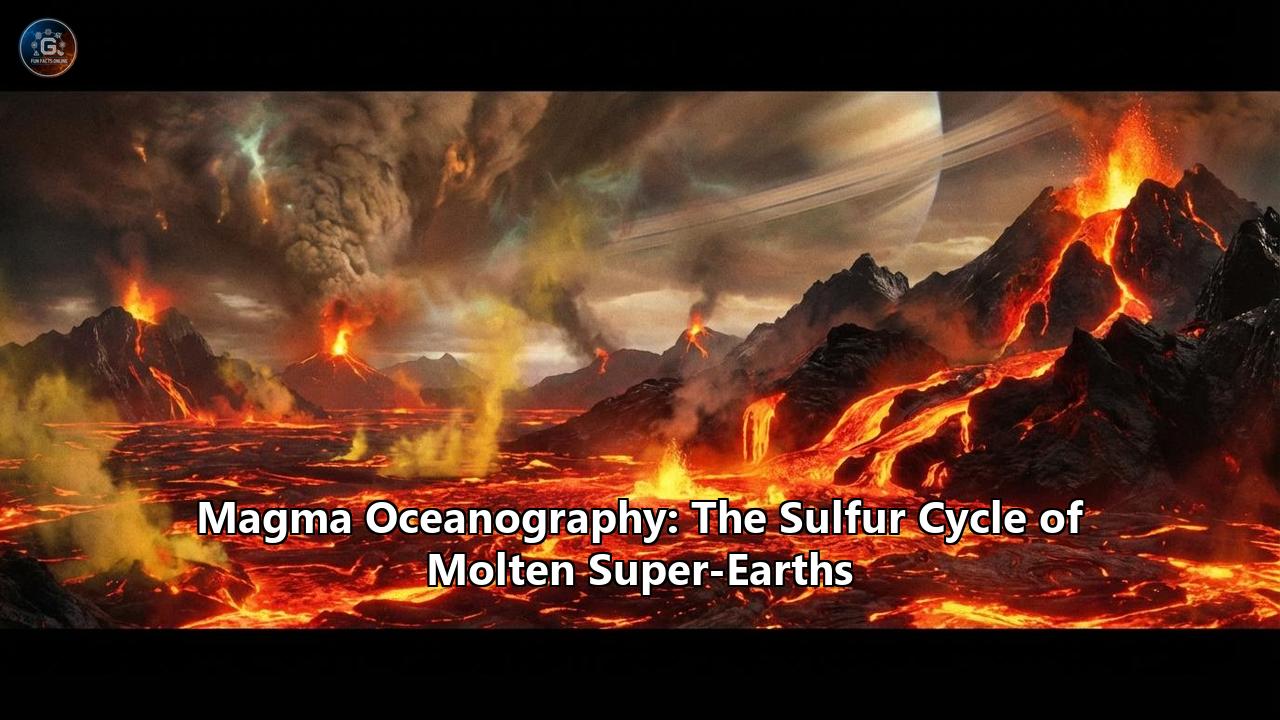
Imagine standing on the precipice of a world where the ground beneath you is not solid rock, but a churning, incandescent sea of liquid silicate extending down for thousands of miles. The air is suffocatingly heavy, opaque with photochemical hazes, and carries the distinct, pungent stench of rotten eggs. You are 35 light-years from Earth, looking at an exoplanet that has recently upended our understanding of planetary science. Welcome to the extreme, mesmerizing frontier of Magma Oceanography.
For decades, oceanography was a discipline strictly bound to the watery depths of our pale blue dot. But as our telescopes peer deeper into the cosmos, a new kind of ocean has emerged as a dominant feature of the galactic census: the global magma ocean. Far from being a mere transitional phase in a planet's chaotic youth, for many Super-Earths—rocky planets significantly more massive than our own—this molten state is a permanent, dynamic condition.
At the heart of these seething infernos lies a complex, alien geochemical engine: the exoplanetary sulfur cycle. Unlike Earth's sulfur cycle, which is heavily mediated by plate tectonics, weathering, and biology, the sulfur cycle of a molten Super-Earth is driven by the sheer thermodynamic fury of a liquid planet interacting with a bloated, highly irradiated atmosphere.
The Architecture of a Molten Super-EarthTo understand the sulfur cycle of a magma world, we must first understand the anatomy of the planet itself. When rocky planets form, the violent accretion of planetesimals, the decay of short-lived radioactive isotopes, and the immense gravitational energy of core formation release enough heat to melt the entire planetary mantle.
On Earth, this "magma ocean" phase was transient, lasting perhaps only a few million years before the surface cooled and crystallized into a solid crust. But out in the galaxy, many Super-Earths find themselves trapped in a molten state for billions of years. This prolonged liquefaction occurs for several reasons. Some are "lava planets" orbiting perilously close to their host stars, tidally locked so that their dayside is blasted by stellar radiation, keeping the rock permanently above its melting point. Others are kept molten by an immense greenhouse effect generated by a thick, primordial atmosphere, combined with intense tidal heating driven by the gravitational tug-of-war with neighboring planets.
In these enduring magma oceans, the planet is not a static ball of lava. It is a vigorously convecting fluid dynamic system. Massive convection currents dredge up material from the deep interior, exposing it to the surface before dragging it back down to the abyssal depths near the core-mantle boundary. This planetary-scale churning creates the perfect conditions for a continuous, abiotic chemical cycle. And among all the elements dancing in this molten crucible, sulfur plays a starring role.
Sulfur: The Shape-Shifter of Planetary InteriorsWhy sulfur? In the cosmic recipe book, sulfur is classified as a volatile element, yet it possesses a unique chemical versatility that makes it a powerful tracer of planetary evolution. It is highly sensitive to the "redox" (reduction-oxidation) state of its environment, which geochemists measure by oxygen fugacity.
In the immense pressures and temperatures of a magma ocean, sulfur acts as a planetary shapeshifter. Its behavior dictates whether a planet will lock its volatiles away in its dark, metallic core or belch them out to form a choking atmosphere.
- The Reducing Magma Ocean: If the magma is oxygen-poor (reducing), sulfur primarily exists as the sulfide anion. Under these conditions, as the magma churns and cools, it may reach the "Sulfur Content at Sulfide Saturation" (SCSS). When this threshold is crossed, heavy, immiscible droplets of iron sulfide—an exotic "sulfide matte"—precipitate out of the silicate melt. Like a heavy metallic rain, these dense droplets sink through the magma ocean, dragging sulfur and other iron-loving (siderophile) elements down to join the forming planetary core.
- The Oxidizing Magma Ocean: If the magma ocean is relatively rich in oxygen, sulfur transforms into the sulfate anion. Sulfates are highly soluble in silicate melts, meaning the sulfur remains dissolved in the magma ocean rather than sinking to the core. This dissolved sulfur is then readily transported by convection currents to the planet's surface, where the plummeting pressure causes it to violently outgas into the atmosphere.
Recent high-pressure laboratory experiments using laser-heated diamond anvil cells have revealed that the SCSS in deep magma oceans is far higher than previously assumed by early planetary models. This means that a deep, molten Super-Earth can hold a staggering amount of sulfur in its mantle without it raining out into the core. Instead, the sulfur remains available in the mantle to participate in a violent, continuous exchange between the churning silicate sea and the sky above.
The Abiotic Exoplanet Sulfur CycleOn modern Earth, sulfur moves through volcanoes, oceans, the atmosphere, and living organisms. On a molten Super-Earth, the cycle is purely geophysical and photochemical, yet it is no less complex. It functions as a massive, self-regulating planetary engine.
1. The Great OutgassingAs the superheated magma rises from the deep interior to the surface, the ambient pressure drops dramatically. The magma can no longer keep its dissolved gases in solution. Like opening a warm, shaken bottle of soda, the magma ocean violently outgasses. Depending on the redox state of the melt, the planet exhales a vast cocktail of sulfurous gases: primarily hydrogen sulfide ($H_2S$), sulfur dioxide ($SO_2$), and elemental sulfur gas.
2. Photochemical AlchemyOnce in the atmosphere, these gases are subjected to a brutal bombardment of ultraviolet (UV) radiation from the host star. This stellar radiation acts as an atmospheric alchemist, driving complex photochemical reactions. UV light breaks apart molecular bonds, leading to the creation of secondary chemical species. Even in a predominantly hydrogen-rich atmosphere, these reactions can generate significant amounts of oxidized sulfur compounds like sulfur dioxide. These photochemically produced gases form thick, opaque cloud decks and high-altitude hazes, creating an impenetrable atmospheric shroud.
3. The Buffer Effect and IngassingWhat goes up must come down—or in the case of a magma ocean, what is outgassed can be reabsorbed. The sheer scale of a global magma ocean means it acts as a planetary-scale chemical buffer. Because the surface is entirely liquid, gases in the lower atmosphere are in direct physical contact with the silicate melt. As atmospheric pressures fluctuate and the chemical composition of the air changes, the magma ocean can dissolve these gases back into its depths in a process known as ingassing.
The atmospheric sulfur is thus continuously recycled. UV-driven chemical reactions create heavy sulfur aerosols that slowly sink back to the planetary surface, where they are re-dissolved into the seething magma. Convection currents then drag this sulfur back down into the deep mantle, only for it to be dredged up again millions of years later. This cyclical "breathing" between the atmosphere and the interior maintains a dynamic equilibrium, allowing the planet to sustain a thick, sulfur-rich atmosphere for billions of years without losing all its volatiles to the vacuum of space.
A Stinking Masterpiece: The Case of L 98-59 dThis theoretical framework recently transitioned from the realm of computer models to hard observational reality thanks to the James Webb Space Telescope (JWST). The poster child for this new field of magma oceanography is L 98-59 d, a Super-Earth exoplanet located roughly 35 light-years away in the southern constellation of Volans (the Flying Fish).
L 98-59 d is roughly 1.5 times the mass of Earth and orbits a cool red dwarf star. Initially, based on its surprisingly low overall density, astronomers hypothesized it might be a "water world" possessing a deep, global ocean of liquid H2O. But when JWST analyzed the starlight filtering through the planet's atmosphere during a transit, the chemical spectrum told a wildly different and far more hellish story.
Researchers found absolutely no trace of carbon dioxide or water vapor. Instead, the planet's atmospheric spectrum was dominated by hydrogen sulfide ($H_2S$)—the gas responsible for the smell of rotten eggs—and sulfur dioxide ($SO_2$). The presence of these specific gases, coupled with the planet's low density, led scientists to a startling conclusion: L 98-59 d is not a watery paradise, but a world completely encased in a deep ocean of magma beneath a thick, hydrogen-and-sulfur-dominated atmosphere.
The amount of sulfur deduced to be on this planet is staggering, estimated to make up at least 1.8% of the planet's total mass. To put that in perspective, Earth's crust and mantle contain only a tiny fraction of a percent of sulfur. To accumulate so much of this volatile element, L 98-59 d must have formed further out in its solar system, in a colder, volatile-rich region where heavy sulfur compounds existed as solid ice, before eventually migrating inward to its current, scorching orbit.
The atmosphere of L 98-59 d is a direct manifestation of an active, ongoing sulfur cycle. The deep magma ocean is constantly releasing sulfur gases, while the intense UV light from its host star drives the photochemistry that generates the observed $SO_2$. The deep ocean of magma acts as the great regulator, absorbing and releasing volatiles to keep the suffocating atmosphere intact over the eons. Furthermore, the intense volcanic and convective activity is likely fueled by tidal heating; gravitational interactions with the star and other planets in the system continuously knead the planet's interior, generating internal friction that keeps the magma ocean from freezing over. It is a planetary dynamic reminiscent of the violent volcanism on Jupiter's moon Io, but scaled up to the mass of an entire Super-Earth.
Why Magma Oceanography MattersThe study of the sulfur cycle on molten Super-Earths is not merely a cataloging of cosmic oddities. It is a time machine. By studying these permanent magma oceans, we are observing the exact processes that shaped our own planet during the Hadean Eon, over 4 billion years ago.
The partitioning of sulfur between the atmosphere, the magma ocean, and the core during a planet's formative years sets the stage for everything that follows. It determines the final composition of the planet's atmosphere once it eventually cools. It influences the oxidation state of the mantle, which in turn dictates the types of volcanic gases that will be erupted later in the planet's geological history.
Moreover, sulfur is an essential element for life as we know it, playing a critical role in amino acids and deep-time metabolic processes. Understanding how abiotic sulfur cycles operate on exoplanets is crucial for astrobiology. When searching for biosignatures (signs of life) on cooler, potentially habitable exoplanets, scientists must be able to distinguish between gases produced by living organisms and those produced by deep, abiotic geological processes. The violent sulfur cycles of magma worlds provide the ultimate "null hypothesis" for volatile behavior in the absence of biology.
A New Paradigm in Planetary ScienceWe are entering a golden age of exoplanet exploration. The traditional categories of planets—rocky like Earth, gas giants like Jupiter, and ice giants like Neptune—are proving to be vastly inadequate to describe the true diversity of the cosmos. The universe is far more creative, and far more violent, than we ever imagined.
Magma oceanography forces us to look at planets not as static spheres of rock and gas, but as complex, coupled fluid-dynamics systems where the boundaries between interior and atmosphere are entirely blurred. On molten Super-Earths, the ocean is the mantle, the atmosphere is a direct extension of the deep interior, and the sulfur cycle is the heartbeat of the world.
As observatories like JWST continue to point their golden mirrors toward the stars, we will undoubtedly find more of these seething worlds. We will map their weather patterns, measure their outgassing rates, and perhaps even watch as extreme tidal forces trigger planetary-scale eruptions. The sulfur cycle of molten Super-Earths is just the beginning of a profound realization: the most extreme environments in the galaxy are not anomalies, but fundamental chapters in the grand story of planetary evolution. It is a story written in fire, etched in liquid rock, and scented with the unmistakable tang of alien brimstone.
Reference:
- https://skyandtelescope.org/astronomy-news/molten-sulfurous-world-blurs-exoplanet-categories/
- https://en.clickpetroleoegas.com.br/exoplanet-l-98-59-d-magma-ocean-sulfur-caes/
- https://universemagazine.com/en/ocean-of-magma-sulfur-rich-atmosphere-hints-at-exoplanets-secrets/
- https://www.researchgate.net/publication/355437235_Redox_Controls_during_Magma_Ocean_Degassing
- https://astrobiology.com/2026/03/global-abiotic-sulfur-cycling-on-earth-like-terrestrial-planets.html
- https://www.science.gov/topicpages/e/early+earth+processes
- https://www.researchgate.net/publication/331858615_What_Factors_Affect_the_Duration_and_Outgassing_of_the_Terrestrial_Magma_Ocean
- https://carnegiescience.edu/sulfur-solubility-deep-magma-ocean-and-implications-deep-sulfur-cycle
- https://www.researchgate.net/publication/342970422_Core_formation_and_magma_ocean_outgassing_set_planetary_N-S-C_ratios