The struggle to replicate the sheer brilliance of biological vision has long been one of the greatest bottlenecks in modern engineering. For decades, we have equipped our machines with increasingly sophisticated lenses, billions of pixels, and highly complex artificial intelligence to process the visual world. Yet, any driver who has ever exited a dark mountain tunnel into blinding midday sunlight—or any roboticist whose drone has been temporarily blinded by the glare of a setting sun—knows the fundamental flaw of modern cameras. Traditional machine vision systems rely on software to make sense of poor lighting, whereas biological entities rely on the physical, immediate, and elegant mechanics of the eye itself.
Now, a monumental leap in bioinspired engineering has bridged the gap between nature and machine. By harnessing the transformative properties of liquid-metal optics, scientists have successfully created a bionic eye capable of mimicking the closed-loop pupil reflexes of humans and animals. This breakthrough, recently detailed in the journal Science Robotics, marks a paradigm shift. It moves the burden of environmental adaptation from computational software to dynamic, physical hardware, paving the way for robots, autonomous vehicles, and potentially medical prostheses that can see the world exactly as we do—and perhaps one day, even better.
To fully appreciate the magnitude of liquid-metal optics, we must embark on a comprehensive journey through the evolutionary biology of the eye, the physics of shape-shifting metals, the intricate architecture of these new artificial vision systems, and the profound implications they hold for the future of humanity and machines.
The Biological Blueprint: Millions of Years of Evolutionary R&D
Nature is the ultimate engineer. For millions of years, evolution has relentlessly beta-tested visual systems, resulting in an astonishing array of optical instruments tailored to specific survival needs. The core feature that unites the most advanced biological eyes is the ability to physically adapt to sudden and drastic changes in illumination—a mechanism known as the pupillary light reflex.
Consider the human eye. When you step from a dark room into bright sunlight, the circular sphincter muscle of your iris rapidly contracts, shrinking the pupil to a pinpoint. This action physically blocks excess photons from overwhelming the delicate photoreceptor cells on your retina. Conversely, in near darkness, the dilator muscle pulls the pupil wide open to capture every available photon.
Other animals have evolved even more specialized pupil shapes to dominate their respective environments. The vertical slit pupil of a cat or a crocodile allows for incredibly precise depth perception and focus, critical for an ambush predator striking in low-light conditions. The horizontal, rectangular pupil of a sheep or a goat provides a panoramic field of view, enabling them to scan a broad horizon for predators while grazing.
What all these natural designs share is a "closed-loop" feedback system. Light enters the eye, the brain (or the localized neural circuitry) instantly processes the intensity of that light, and a physical command is sent back to the ocular muscles to adjust the aperture in real-time.
Historically, human-made cameras have tried to simulate this via mechanical apertures (which are bulky, slow, and prone to mechanical wear) or through post-processing software, such as High Dynamic Range (HDR) imaging. In a traditional machine vision system deployed in a self-driving car, a sudden blast of light washes out the camera sensor. The software then scrambles to algorithmically balance the exposure, artificially combining multiple frames taken at different exposures. But software adaptation takes time, computational power, and battery life. At highway speeds, the split-second latency of an algorithm trying to resolve a blown-out image can mean the difference between life and death.
To build machines that can truly navigate the unpredictable real world, we needed an artificial eye that doesn't just take pictures and fix them later, but one that actively protects its own vision in real-time. We needed a pupil that could morph seamlessly, instantly, and without rigid mechanical parts. We needed liquid metal.
The Magic of Liquid Metals
To understand how a liquid-metal pupil works, we must first look at the material science that makes it possible. When most people hear "liquid metal," they immediately picture the T-1000 from Terminator 2—a silvery, shapeshifting mass capable of rearranging its atomic structure at will. While we are not yet building shapeshifting humanoid assassins, the reality of modern liquid metals is every bit as fascinating.
Traditional solid electronics are fundamentally at odds with biological systems. Humans and animals are soft, pliable, and capable of bending and stretching without snapping. Solid silicon and rigid metals undergo fatigue; they snap when bent too far and break when dropped. Liquid metals, however, offer the best of both worlds: they flow like water but retain the conductive, thermal, and electronic properties of solid metals.
Mercury is the most famous liquid metal, but its high toxicity makes it useless for wearable technology or mass-produced robotics. Today, materials scientists rely heavily on gallium-based alloys, such as Galinstan (a mix of gallium, indium, and tin) or Field's alloy (bismuth, indium, and tin). Gallium flows easily at or near room temperature and boasts a remarkably low vapor pressure, meaning it won’t easily evaporate into the atmosphere.
The defining characteristic of gallium alloys, and the secret to their use in bionic eyes, is their surface tension. Gallium has a surface tension roughly ten times that of water. When exposed to oxygen, it instantly forms a microscopic, stiff outer oxide layer, like a skin, which allows it to hold specific shapes.
Crucially, this surface tension can be manipulated dynamically. By placing the liquid metal in a specialized fluid (like an electrolyte solution or mild acid) and applying targeted electrical voltages, scientists can dramatically alter the metal's surface tension in milliseconds. This electrical actuation causes the liquid metal droplet to stretch, flatten, contract, or form complex geometries. If you introduce magnetic particles (like iron or nickel) into the liquid metal matrix, you can even manipulate it in three-dimensional space using magnetic fields, pulling the metal horizontally and vertically to complete circuits or actuate miniature mechanical systems.
For years, researchers have been utilizing these properties to develop flexible electronic skin, self-repairing circuits, and soft robotics. But applying this technology directly to optics—to create a frictionless, instantly adjustable artificial aperture—is a masterstroke of interdisciplinary engineering.
Deconstructing the Liquid-Metal Bionic Eye
In March 2026, researchers from the University of North Carolina at Chapel Hill, alongside collaborators from Westlake University and other leading institutes, unveiled an artificial vision system that perfectly marries liquid-metal shapeshifting with machine vision. Led by Dr. Kun Liang and Wubin Bai, the team constructed an artificial eye that doesn't just mimic the appearance of a biological eye, but replicates its deepest neural and physical behaviors.
The architecture of this liquid-metal bionic eye can be broken down into three revolutionary components: the hemispherical artificial retina, the liquid-metal visual "neurons," and the adaptive liquid-metal pupil.
1. The Hemispherical Artificial Retina
Traditional camera sensors are flat. Biological retinas are curved. A flat sensor requires a complex array of heavy, curved glass lenses to focus light without distortion, which limits the field of view and adds bulk. The research team instead developed a dome-shaped, hemispherical array of light sensors. By matching the concave curvature of a real eye, this artificial retina achieves an ultra-wide field of view of approximately 108 degrees without the need for massive optical lens arrays. This structural biomimicry ensures that the light falling on the edges of the sensor is just as sharp as the light falling in the dead center.
2. Liquid-Metal "Neurons"
In a biological eye, when light hits the retina, it doesn't just record an image; it generates electrical spikes that travel through the optic nerve to the brain, which then fires signals back to the iris. The UNC-Chapel Hill researchers replicated this using liquid-metal components that act as simple artificial neurons.
Instead of relying on a centralized, power-hungry computer processor to analyze the image and decide what to do, the artificial retina generates light signals that these liquid-metal neurons convert directly into pulse-like electrical spikes—rapidly switching between short and open circuits. This mimics the "spike nerve signals" found in biology. It constitutes edge computing at its most fundamental, physical level. The eye is essentially making its own decisions, entirely bypassing the "brain" (the robot's central processor) to manage its own light intake.
3. The Adaptive Liquid-Metal Pupil
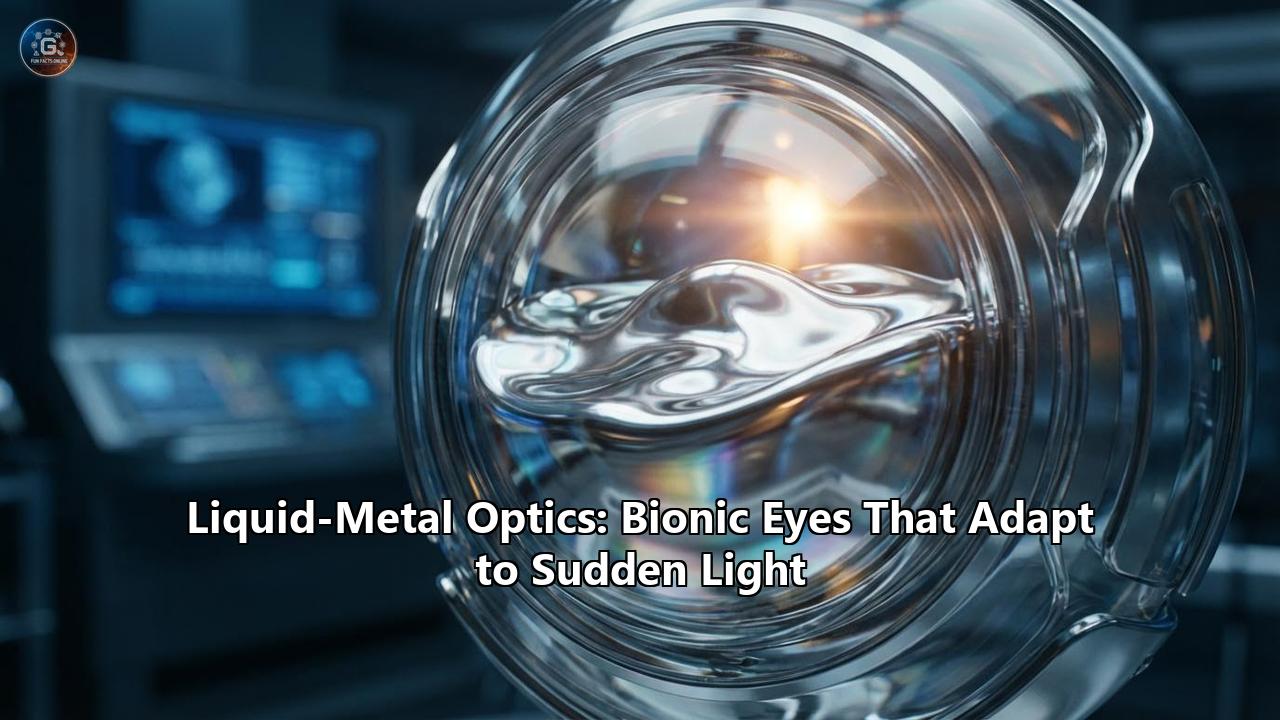
The climax of the system is the pupil itself, driven by a ring of independent electrical actuators. When the liquid-metal neurons detect an overwhelming surge of light, they send instantaneous electrical pulses to the actuators surrounding the liquid-metal pupil. The applied voltage alters the surface tension of the liquid metal, causing it to rapidly spread out and block a portion of the aperture. The liquid metal acts as an opaque shutter, physically reducing the amount of light striking the sensitive artificial retina.
Conversely, if the environment plunges into darkness, the electrical signals change, the surface tension alters again, and the liquid metal retracts, pulling back to widen the aperture and flood the retina with light.
Because the liquid metal is manipulated by eight independently controlled actuators, it is not limited to a simple circular human pupil. The controlled deformation of the metal allows the researchers to programmatically recreate a wide range of animal pupil shapes—from the vertical slit of a feline predator to the horizontal slit of a grazing herbivore—depending on the specific visual task the machine is assigned to perform.
The Quantifiable Leap in Machine Vision
The theoretical elegance of a liquid-metal eye means nothing without quantifiable real-world results. Traditional machine vision systems—the backbone of today's AI-driven world—are notoriously fragile. While they excel in perfectly lit laboratories or overcast days with even, diffuse lighting, their performance plummets when subjected to the chaotic lighting of the real world.
In rigorous testing under high-contrast, harsh lighting conditions, standard fixed-aperture cameras suffered severe overexposure, washing out critical details and leaving object recognition algorithms guessing. However, when the closed-loop liquid-metal pupil was activated, the bionic eye physically choked off the blinding light before it could overwhelm the sensor.
The results were staggering. In environments that simulated extreme light shifts, the image recognition accuracy of the AI system leaped from a dismal 68% to over 83%.
This 15% increase in absolute accuracy is monumental. In the context of an autonomous vehicle traveling at 70 miles per hour, that 15% improvement is the difference between recognizing a pedestrian stepping out of a shadow and failing to brake in time. Furthermore, because the pupil is adjusting physically via the liquid-metal reflex, it drastically reduces the computational load on the machine's primary processors. The system doesn't need to burn electrical energy running heavy HDR algorithms; it simply sees clearly in the first place. This hardware-level efficiency is critical for mobile platforms like drones, robotic rovers, and wearable tech, where battery life and weight are strictly limited.
Revolutionizing Robotics and Autonomous Systems
The ripple effects of liquid-metal optics will first be felt in the realms of robotics, security, and transportation.
For autonomous vehicles, sudden changes in illumination are currently one of the most persistent "edge cases" holding back the promise of Level 5 full autonomy. A camera array on a Tesla or Waymo vehicle driving into a dark tunnel must instantly adjust its ISO and shutter speed, introducing digital noise and motion blur. Exiting that tunnel into the glare of a setting sun can temporarily blind the car. A liquid-metal bionic eye provides the automotive industry with a sensor that reacts with the smooth, instantaneous fluidity of a biological eye, maintaining a pristine, balanced data stream for the car's neural networks to process.
In the defense and security sectors, surveillance drones equipped with these bioinspired eyes will be immune to optical countermeasures like blinding spotlights or lasers that aim to fry or overwhelm traditional sensors. A drone could program its liquid-metal pupil into a horizontal slit to scan a wide perimeter, and then dynamically shift to a vertical feline slit to focus intently on a single moving target in a cluttered, poorly lit environment.
Moreover, as we move closer to integrating humanoid robots into our daily lives—for eldercare, manufacturing, and domestic assistance—the physical appearance and behavior of their eyes will play a massive role in human-robot interaction. A humanoid robot equipped with liquid-metal irises that dilate and constrict naturally as lighting changes will cross the "uncanny valley," making machines appear more lifelike, amicable, and less jarring to the humans working alongside them.
The Medical Horizon: The Quest to Restore Human Sight
While outfitting robots with superior vision is a lucrative and transformative goal, the most profound application of liquid-metal bionic eyes lies in human medicine. For millions of people worldwide suffering from profound vision loss due to retinal degenerative diseases—such as age-related macular degeneration (AMD) and retinitis pigmentosa (RP)—bionic eyes represent the ultimate hope for regaining independence.
The history of visual prosthetics is a story of slow but miraculous progress. Devices like the Argus II, which was approved by the FDA in 2013, paved the way. It functioned by utilizing a camera mounted on glasses that transmitted crude, low-resolution pixelated images (as few as 60 pixels) wirelessly to a rigid silicon chip implanted on the patient’s retina. This chip then stimulated surviving bipolar cells, sending rough flashes of light to the brain, allowing blind patients to detect doorways or the outlines of people. Later models like the PRIMA implant vastly increased the number of electrodes, pushing the resolution higher.
Yet, traditional rigid implants are inherently limited. They struggle with biocompatibility; the human body is a hostile, wet, moving environment that does not tolerate rigid, sharp-edged silicon boards well. Furthermore, routing the massive bandwidth of visual data through rigid electronic interfaces creates bottlenecks.
Liquid-metal optics and soft electronics change this calculus entirely. An artificial eye utilizing a hemispherical retina—matching the exact anatomical curvature of the human eyeball—could theoretically replace a diseased biological eye seamlessly. Instead of rigid wires, the connection to the human optic nerve could be facilitated by flexible, high-density nanowires and soft, magnetically actuated liquid-metal microelectrodes. Because liquid metals conform to soft tissue and can withstand the continuous micro-movements of the human body without fatiguing, they are vastly superior candidates for permanent neural interfacing.
Furthermore, earlier research into electrochemical artificial eyes—such as the EC-Eye developed by the Hong Kong University of Science and Technology—has already demonstrated that we can pack nanowire light sensors denser than the photoreceptors in a natural human retina. By combining ultra-dense nanowire retinas with the self-regulating liquid-metal pupil, we are looking at the foundation of a visual prosthesis that doesn't just restore crude, pixelated sight, but could eventually offer high-definition vision that exceeds natural biological limits.
Imagine a visual implant that not only perfectly adjusts to the glaring sun without the user needing sunglasses, but also integrates sensors capable of seeing into the infrared spectrum. A patient with this implant could see clearly in total darkness, detecting the heat signatures of living things, effectively gaining night-vision capabilities alongside their restored daytime sight.
The Convergence: Liquid Metal, Graphene, and the Soft Robot Revolution
The integration of liquid-metal optics is just one piece of a much larger revolution in soft robotics and bionic augmentation. If robots are to see like us, they must also feel like us.
The same principles governing liquid-metal shape-shifters in the eye are being applied to robotic skin. Researchers at the University of Cambridge have recently developed advanced tactile sensors by embedding deformable liquid metal microdroplets and graphene into a soft, flexible silicone matrix. Shaped into microscopic pyramids inspired by human skin, these liquid-metal composites allow robotic fingers to detect not just the pressure of an object, but the sheer force, the direction of slipping, and the microscopic roughness of a surface. The sensor is so remarkably precise it can feel the presence of a single grain of sand.
When we combine liquid-metal tactile skin with a liquid-metal adaptive visual system, we step into an entirely new era of autonomy. A surgical robot, for instance, could look deep into a brightly lit, highly reflective surgical cavity without its camera washing out, while its liquid-metal fingertips delicately manipulate tissues with the exact spatial resolution and pressure sensitivity of a human surgeon.
These liquid metal architectures are also inherently durable. A robotic limb or drone chassis built with liquid-metal lattices coated in shape-memory silicone can be completely crushed under immense weight, only to perfectly spring back into its original shape when exposed to mild heat. The rigid, fragile machines of the 20th century are making way for the soft, adaptive, and virtually indestructible machines of the 21st century.
The Road Ahead: Challenges and Commercialization
Despite the miraculous nature of the Science Robotics breakthrough, the transition from the laboratory bench to mass-produced commercial implementation involves significant engineering hurdles.
Currently, the primary challenge lies in extreme miniaturization. While the hemispherical retina and liquid-metal pupil have been proven effective in a lab setting, shrinking the independent actuators, liquid-metal reservoirs, and neural-spike electronics down to the microscopic scales required for contact lenses or seamless ocular implants requires advances in nanofabrication.
Additionally, researchers are pushing to expand the artificial eye's sensory palette. Current iterations focus heavily on light intensity and basic object recognition. The next immediate step is integrating color spiking encoding and opponent preprocessing. By emulating how the biological retina and brain integrate spatial and chromatic (color) spiking signals, scientists aim to create artificial visual neurons that generate excitatory or inhibitory responses to specific wavelengths of light. This will allow the liquid-metal eye to process complex, full-color multispectral environments with the same energy-efficient, closed-loop grace it currently uses for brightness adaptation.
There is also the challenge of operating temperatures. While gallium-based alloys like Galinstan remain liquid at room temperature, extreme environments—such as the sub-zero temperatures of high-altitude drone flights or outer space—could cause the metal to sluggishly increase in viscosity or freeze outright. Formulating new alloys and integrating microscopic, self-regulating thermal grids into the artificial eye will be necessary to ensure the liquid metal remains perfectly fluid regardless of the external climate.
Despite these challenges, experts agree that the commercialization bottleneck is no longer strictly scientific, but rather economic and application-driven. In the coming years, as manufacturing processes for liquid-metal hybrids become standardized, we will see these dynamic optical systems actively integrated into the next generation of mobile phones, action cameras, driver-assistance modules, and robotic vision suites.
Conclusion: A Synthesis of Biology and Engineering
The creation of a liquid-metal bionic eye that adapts to sudden light changes is more than just an engineering novelty; it is a profound philosophical milestone. For centuries, our approach to technology has been distinctly anti-biological. We built our machines out of stiff iron, rigid silicon, and brittle glass, forcing the analog world to conform to binary, digital, and mechanical constraints. We relied on brute-force mathematics and computationally heavy software to process our reality.
The researchers at the University of North Carolina at Chapel Hill and their global collaborators have reversed this paradigm. By observing the elegant, millions-of-years-old designs of the human pupil, the feline slit, and the neural spike, and translating them into the alien, shapeshifting medium of liquid metal, they have created a technology that thinks and acts like a living organism.
We are standing on the precipice of an age where the line between the biological and the artificial is irrevocably blurred. The machines of tomorrow will not stare out at us through cold, unblinking glass lenses that falter in the sunlight. They will look back at us with soft, adaptive, liquid pupils that dilate in the shadows and constrict in the glare, navigating the world with the exact same visual resilience that nature bestowed upon us. Through liquid-metal optics, we are finally teaching the artificial world how to truly see.
Reference:
- https://nationaltoday.com/us/nc/chapel-hill/news/2026/03/07/liquid-metal-tech-promises-better-eyes-for-robots-and-cars/
- https://orcid.org/0009-0002-6980-099X
- https://sciprofiles.com/profile/2867689
- https://lifeboat.com/blog/2026/03/liquid-metal-pupil-helps-an-artificial-eye-adapt-to-sudden-light-changes
- https://www.sciencedaily.com/releases/2017/10/171017091921.htm
- https://www.inverse.com/science/gallium-liquid-metal-robots
- https://www.intelligentliving.co/liquid-metal-shape-shifting-robots/
- https://pubs.acs.org/doi/10.1021/accountsmr.1c00182
- https://www.britannica.com/video/Terminator-like-liquid-metal-moves-and-stretches/-246889
- https://baigroup.org/publications/
- https://www.researchgate.net/scientific-contributions/Yihan-Liu-2188831192
- https://www.independent.co.uk/tech/robot-artificial-eye-bionic-retina-blind-a9525151.html
- https://www.brightfocus.org/resource/the-latest-developments-in-retinal-implants/
- https://www.fightingblindness.ca/resources/the-bionic-eye/