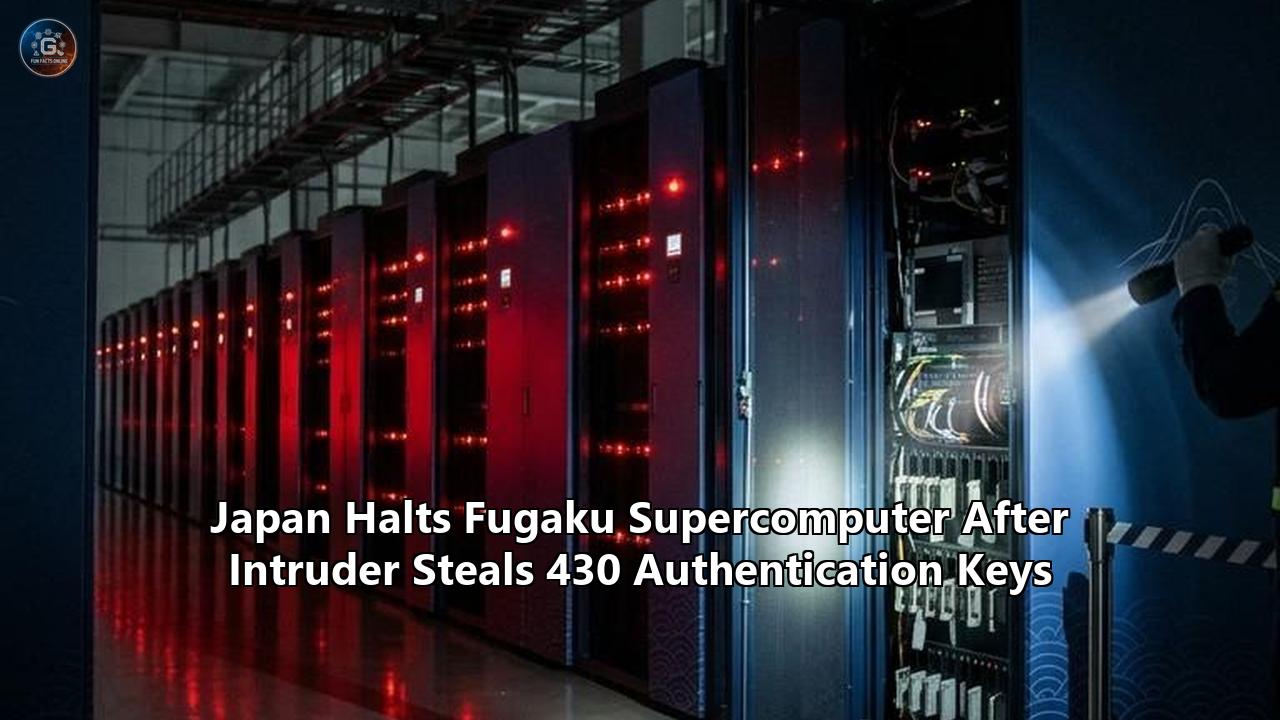
At 4:30 a.m. on November 14, 2026, engineers at the RIKEN Center for Computational Science (R-CCS) in Kobe, Japan, pulled the plug on Fugaku, terminating all active workloads on the nation’s 537-petaflop flagship computing system. The emergency shutdown severed external connectivity for 158,976 compute nodes, sidelined ongoing jobs for thousands of academic and industrial scientists, and froze access to an adjacent 64-petaflop artificial intelligence cluster named Rikyu. Six days later, a forensic audit published by RIKEN revealed the scope of the incident: an unidentified intruder breached the facility's internal operations network and exfiltrated 430 authentication credentials directly from researchers' home directories.
The quantitative breakdown of the stolen credentials exposed a fundamental operational vulnerability. Of the 430 exfiltrated authentication items—primarily Secure Shell (SSH) private keys and external cloud access tokens—233 keys (54.19%) carried no passphrase protection whatsoever. The remaining 197 keys (45.81%) were passphrase-encrypted. Because more than half of the harvested keys were stored as unprotected plaintext, the adversary obtained immediate, unauthenticated ingress into whatever secondary servers, university clusters, or commercial cloud environments recognized those credentials. Investigators confirmed that the intruder had already leveraged subsets of these stolen keys in attempts to access external scientific networks.
The breach compromised user accounts across Japan's premier research network. RIKEN confirmed that 4,597 registered users were exposed, consisting of 4,222 researchers on Fugaku and 375 on Rikyu. The data harvest extended far beyond digital identities. Alongside cryptographic tokens, the attacker collected administrative user records containing researchers' names, email addresses, unique account IDs, institutional affiliations, telephone numbers, physical office addresses, and the specific identity verification document types submitted during vetting.
| Metric / Parameter | Value / Count |
|---|---|
| System Theoretical Peak Performance | 537 Petaflops (Fugaku) + 64 Petaflops (Rikyu) |
| Total Number of Processor Nodes | 158,976 Fujitsu A64FX Nodes |
| Confirmed Exfiltrated Authentication Keys | 430 Credentials |
| Unprotected (Passphrase-less) Private Keys | 233 (54.19%) |
| Passphrase-Protected Private Keys | 197 (45.81%) |
| Total Compromised User Profiles | 4,597 Accounts (4,222 Fugaku; 375 Rikyu) |
| Duration of Intruder Network Foothold | Approximately 72 Hours (Nov 10 – Nov 13) |
| Time to Full Production Isolation | ~12 Hours after Confirmation (Nov 14, 4:30 a.m. JST) |
Speaking in Tokyo following the system's decommissioning, Japan’s Chief Cabinet Secretary Minoru Kihara characterized the facility as a cornerstone of national capability, stating that Fugaku "plays a vital role in our country's research and development infrastructure". With the cluster sitting completely dark and thousands of high-performance jobs canceled, the Fugaku supercomputer security breach highlights how minor edge interfaces can cripple sovereign computing assets and propagate risk across international research networks.
Forensic Chronometry: Mapping the 72-Hour Intrusion Window
The compromise of Fugaku was neither instantaneous nor an isolated system ping; it unfolded across a multiday progression of exploitation, internal lateral traversal, and data collection. The incident timeline assembled from RIKEN’s technical briefings and notifications to Japan’s Ministry of Education, Culture, Sports, Science and Technology (MEXT) documents how long the adversary remained undetected inside the cluster's supporting infrastructure.
Nov 10, 2026: Intruder exploits public status dashboard vulnerability
      │
Nov 12, 2026: Anomalous outbound communications flagged by monitoring tools
      │
Nov 13, 16:33 JST: Unauthorized presence internally verified by security teams
Nov 13, 22:07 JST: Initial compromised ingress node isolated
      │
Nov 14, 04:30 JST: Complete Fugaku production halt; all network connectivity severed
Nov 14, 20:20 JST: Primary administrative credentials and internal keys replaced
      │
Nov 15, 16:18 JST: Running/queued job pipelines terminated; all user public keys invalidated
      │
Nov 20, 2026: Second forensic report confirms 430 external keys exfiltrated
The initial breach took place between November 10 and November 13. During this 72-hour window, the adversary targeted a publicly accessible operational status dashboard. The web application, deployed to provide real-time updates regarding cluster availability, queue wait times, and system load, possessed an unsegmented network route into the cluster’s internal administration environment.
RIKEN's outsourced network maintenance vendor first observed suspicious communications traversing the perimeter on November 12. Forensic engineers initiated an urgent trace, but it took until 4:33 p.m. on November 13—more than 24 hours later—to confirm active, unauthorized access inside the cluster's operational boundary. The immediate response proceeded in stages:
- November 13, 10:07 p.m. JST: Administrators isolated the specific servers hosting the status dashboard.
- November 14, 4:30 a.m. JST: With evidence indicating the attacker had breached secondary operational servers, RIKEN cut all external routing, suspended production computing, and initiated emergency fail-safes.
- November 14, 8:20 p.m. JST: Core cluster administrative keys were purged and replaced across the entire control plane.
- November 15, 4:18 p.m. JST: System administrators issued a total workflow termination order. Every queued and running computational job was stopped. Simultaneously, the authentication infrastructure invalidated all registered user public keys, effectively locking 4,222 external Fugaku researchers out of the cluster.
The forensic timeline underscores a critical security reality: the adversary operated inside the network for up to three days before detection, then spent an additional 12 hours accessing internal file stores before administrators severed production routing. That gap provided sufficient time to run automated discovery scripts across user storage volumes, locate unencrypted credential directories, and stage exfiltration packets.
Cryptographic Failure: The Mechanics Behind 430 Stolen Authentication Keys
The centerpiece of RIKEN's second disclosure was the theft of 430 external authentication tokens from users' home directories (/home/username). Supercomputing facilities are distributed computing nodes within a broader research pipeline. Computational scientists rarely compute in isolation; they use batch scripts to transfer datasets between Fugaku, university-level supercomputing nodes, academic storage repositories, and commercial public clouds such as Amazon Web Services and Sakura Cloud.
To automate workflows within cluster scheduling frameworks like Slurm or PBS Professional, users frequently generate asymmetric cryptographic key pairs. An SSH private key stored within a user's cluster home directory enables background scripts to authenticate to remote machines via Secure Copy Protocol (SCP) or Rsync without requiring manual password prompts.
                                  [ Fugaku User Home Directory ]
                                                │
                       ┌────────────────────────┴────────────────────────┐
                       ▼                                                 ▼
             233 Plaintext Keys                                197 Passphrase Keys
                  (54.19%)                                          (45.81%)
                       │                                                 │
                       ▼                                                 ▼
            [ Zero Protection ]                                [ Password-Protected ]
                       │                                                 │
      Instant adversary reuse against                 Requires offline brute-force cracking
     remote universities & cloud nodes                (AES-256 / bcrypt key derivation delays)
                       │                                                 │
                       └────────────────────────┬────────────────────────┘
                                                │
                                                ▼
                               [ Lateral Blast Radius: 430 Keys ]
                               Secondary Intrusions Attempted Across
                                     External Scientific Networks
The data shows that 233 keys lacked passphrases. In standard cryptographic practice, a private key should be encrypted at rest using an algorithm such as AES-256-CBC, derived via a key derivation function (like PBKDF2 or bcrypt) from a user-supplied passphrase. When a passphrase is set, an attacker who steals the .pem or id_rsa file cannot use it without either intercepting the passphrase in memory or spending significant computational time running offline dictionary attacks.
Conversely, for the 54.19% of keys without a passphrase, the adversary faced zero cryptographic friction. Once copied, those keys functioned as valid digital passes. The intruder did not merely archive these keys; RIKEN confirmed that digital footprints showed direct attempts to use these stolen tokens to establish connections with off-site supercomputing systems.
The remaining 197 keys were encrypted with passphrases. While protected from immediate reuse, their theft subjects them to offline brute-force attacks. If users employed short, simple passphrases to simplify their automated scripts, modern GPU-accelerated hashing platforms can crack them in hours or days, creating a delayed security risk for the institutions associated with those keys.
User Demographics and Blast Radius: 4,597 Compromised Researcher Profiles
The lateral reach of the Fugaku supercomputer security breach encompasses thousands of scientists, exposing institutional infrastructure across Japan and its global partners. The demographic footprint of the breach includes:
Compromised Users by Computational Platform:
├── Fugaku Flagship System: 4,222 Users (91.84%)
└── Rikyu AI Cluster:         375 Users (8.16%)
Total Compromised Profiles: 4,597 Users (100%)
The information harvested from user registration profiles gives the attacker a detailed directory of leading computational researchers across the Asia-Pacific region and international research consortia. The data points confirmed exposed in RIKEN's second audit include:
- Basic Identity Data: Full legal names, system user IDs, and active institutional email addresses.
- Institutional Profiles: University or corporate affiliations, departmental assignments, and job titles.
- Contact & Physical Information: Direct telephone numbers and physical postal addresses for researchers' laboratories or residences.
- Verification Records: Metadata detailing the types of formal identity documents used during initial provisioning (such as official staff identification or government identity certificates).
Compromised Data Categories Across Accounts:
[==================================================] 100% Full Legal Names
[==================================================] 100% Institutional Email Addresses
[==================================================] 100% System User IDs
[========================================          ]  80% Institutional Affiliations
[========================================          ]  80% Office/Mailing Addresses
[========================================          ]  80% Direct Phone Numbers
[==========                                        ]  20% Exfiltrated Identity Verification Metadata
This degree of demographic exfiltration represents an intelligence asset for sophisticated adversaries. By correlating stolen personal profiles with the specific research domains allocated to Fugaku's cycles, an adversary can mount highly targeted spear-phishing campaigns. A researcher working on proprietary semiconductor physics, solid-state battery chemistry, or pathogenic modeling can be targeted with customized lures referencing specific user IDs, project numbers, and colleagues' stolen contact information.
RIKEN clarified that its ongoing forensic log review—supported by machine-learning-driven telemetry tools—has not uncovered evidence that final scientific research datasets or intellectual property files were systematically exfiltrated. However, files stored within users' individual home directories were accessed. These directories frequently house working scripts, algorithm definitions, input datasets, and experimental documentation, leaving the operational integrity of ongoing projects in question.
Anatomy of the Vulnerability: Exploiting Public Telemetry for Internal Pivots
High-performance computing centers deploy advanced hardware architectures, but their operational management systems frequently rely on commodity software stacks that remain susceptible to conventional web attack vectors. The attack path documented at RIKEN demonstrates how internet-facing monitoring interfaces can become direct conduits into isolated compute networks.
                     ATTACK PATH ARCHITECTURE

 [ Internet ]
      │
      ▼
 [ Public Status Dashboard ] ─── (T1190: Exploitation of Public Web Interface)
      │
      ▼ (Inadequate Network Segmentation / Bypassed Firewall)
 [ Operational Network Subnet ]
      │
      ├─► (T1105: Ingress Tool Transfer / Malware Installation)
      │
      ├─► (T1059.004: Arbitrary Shell Execution Across Internal Servers)
      │
      └─► (T1552.001 / T1552.004: Credential Scraping in /home/*)
            │
            ├─► 233 Unprotected SSH Private Keys
            ├─► 197 Passphrase-Protected SSH Private Keys
            └─► 4,597 Researcher Demographics
MITRE ATT&CK Framework Mapping
The attack sequence observed during the breach aligns with standard adversary tactics, techniques, and procedures (TTPs):
- Initial Access — T1190 (Exploit Public-Facing Application): The adversary targeted the operational status dashboard. Public status portals aggregate internal cluster health—such as node availability, cooling temperatures, power load, and pending batch queues—and present that telemetry on a publicly accessible web page. A software flaw in this interface (such as an unauthenticated remote code execution vulnerability, an injection bug, or a compromised dependency) gave the attacker their initial foothold.
- Command and Control / Execution — T1105 & T1059.004 (Ingress Tool Transfer & Unix Shell): Following the initial exploit, the intruder downloaded unauthorized payloads directly onto operational servers. Telemetry confirmed that malicious software was installed and executed within the internal environment, providing persistent shell access and command-and-control communication channels.
- Credential Access — T1552.001 & T1552.004 (Unsecured Credentials: Files & Private Keys): The attacker surveyed user storage areas, targeting files and directories such as ~/.ssh/id_rsa, ~/.ssh/id_ed25519, ~/.bashrc, and cloud configuration manifests (~/.aws/credentials). This systematic sweep yielded the 430 cryptographic keys.
- Lateral Movement — T1078 (Valid Accounts): Armed with harvested plaintext credentials, the adversary pivoted beyond Fugaku, attempting to initiate SSH sessions against external supercomputing nodes and research networks across Japan.
The core architectural flaw was the lack of strict network segmentation between the public-facing dashboard and internal cluster operations. In high-security facilities, public monitoring telemetry should be pushed outbound across a one-way data diode or via isolated messaging queues to an independent, cloud-hosted reverse proxy with no network route back to production nodes. Fugaku's status dashboard, however, sat in a position that allowed the attacker to pivot from a public web port directly into the cluster's internal management network.
Quantifying the Losses: Processing Capacity and Research Downtime
Measuring the impact of the Fugaku supercomputer security breach requires evaluating the compute capacity, power budgets, and research projects suspended during the shutdown. Fugaku is not merely a data repository; it is an industrial-scale simulation platform. Halting it idles some of the world's most powerful research hardware.
Fugaku System Architecture Parameters:
├── Peak Theoretical Performance: 537 Petaflops (FP64 / Double Precision)
├── Sustained Linpack (Rmax):     442.01 Petaflops
├── Processor Hardware:           158,976 Fujitsu A64FX Processors
├── Total Compute Cores:          7,630,848 Processing Cores
├── Internal Memory Architecture: 4.85 Petabytes High-Bandwidth Memory (HBM2)
├── Aggregate Memory Bandwidth:   163 Petabytes per Second
└── Typical Electrical Load:      ~15.9 Megawatts
When operating at peak, Fugaku's 158,976 A64FX processors deliver up to 537 quadrillion floating-point operations per second. Over a 24-hour period, the cluster provides approximately 183.14 million core-hours of computational throughput (7,630,848 cores × 24 hours).
Every single day the supercomputer remains halted removes approximately 183 million core-hours from scientific use. A two-week operational suspension erases roughly 2.56 billion core-hours of computational simulation capacity.
Cumulative Compute Capacity Lost by Downtime Duration:
[Day 01]  183.14 Million Core-Hours
[Day 03]  549.42 Million Core-Hours
[Day 07]  1.28 Billion Core-Hours
[Day 14]  2.56 Billion Core-Hours
[Day 30]  5.49 Billion Core-Hours
The financial cost of the outage is substantial. Fugaku was developed under a joint initiative between RIKEN and Fujitsu with a total budget of roughly ¥130 billion (approximately $1 billion to $1.2 billion depending on exchange rates). Factoring in capital depreciation over a projected six-year service lifespan alongside baseline operational staffing, power, and facilities management, running Fugaku costs an estimated ¥21.6 billion ($145 million) annually, or roughly ¥59.3 million ($398,000) per day.
While taking the machines offline avoids Fugaku’s ~15.9-megawatt active power draw, the fixed operational costs of maintenance, staffing, and forensic response continue to accrue alongside the lost economic output of stalled research programs.
The non-monetary toll on research pipelines is just as acute:
- Drug Discovery and Molecular Dynamics: Fugaku was designed to run high-throughput virtual screening of small-molecule drug libraries. During earlier health initiatives, the cluster screened over 2,000 existing chemical compounds in molecular simulations within days. The breach froze ongoing oncology and structural biology simulations, stalling preclinical pipelines across dozens of university laboratories.
- Severe Weather Modeling & Disaster Preparedness: Operated in collaboration with the Japan Meteorological Agency (JMA), Fugaku runs ultra-high-resolution phased-array radar data-assimilation models designed to forecast sudden torrential rainfall ("guerrilla rainstorms") and typhoon landfall vectors. Suspending these simulations forces meteorologists back onto lower-resolution fallback clusters, reducing early-warning windows for extreme weather events.
- National AI Foundation Models: The shutdown also took the 64-petaflop Rikyu AI supercomputer offline. Rikyu trains specialized, large-scale Japanese language models and scientific AI architectures tailored for materials design and synthetic biology. Those training runs, which often take weeks of continuous execution, were aborted, corrupting active checkpoints and wasting past compute cycles.
Secondary Threat Vectors: SINET6, HPCI, and the Academic Blast Radius
The attacker's exfiltration of 430 authentication keys created a secondary risk vector that extends far beyond the physical walls of the Kobe data center. RIKEN does not operate in an academic vacuum; it serves as a central hub within Japan’s High Performance Computing Infrastructure (HPCI). This national computational consortium links Fugaku to nine major regional computing centers, including:
              JAPAN'S HIGH-PERFORMANCE COMPUTING INFRASTRUCTURE (HPCI)

                                  [ FUGAKU / RIKEN ]
                                  (Kobe - Compromised)
                                           │
                        ┌──────────────────┴──────────────────┐
                        ▼                                     ▼
                [ SINET6 Network ]                   [ Cloud Resources ]
              (400 Gbps Backbone)                  (AWS, Sakura, Private)
                        │                                     │
       ┌────────────────┴────────────────┐                    │
       ▼                                 ▼                    ▼
 [ University of Tokyo ]        [ Kyoto University ]   [ Commercial Hosts ]
 [ Osaka University    ]        [ Tohoku University]   (Secondary Intrusions
 [ Nagoya University   ]        [ Kyushu University]    Attempted Using
 [ Hokkaido University ]        [ Tokyo Tech / etc.]    Plaintext Keys)
The physical and logical interconnect behind this ecosystem is SINET6 (Science Information Network 6), an ultra-high-speed academic network backbone operated by Japan's National Institute of Informatics (NII). Upgraded to deliver 400 Gbps line rates across all of Japan’s 47 prefectures, SINET6 links more than 1,000 universities and research centers with low-latency optical connections.
Researchers routinely manage accounts across multiple nodes on this backbone. A computational physicist at Kyoto University, for example, might run pre-processing data extraction on a local university cluster, transfer the resulting matrices to Fugaku over SINET6 for primary processing, and sync the processed output to an Amazon Web Services S3 bucket for analysis. To manage this workflow automatically, the researcher often reuses the same SSH key pair across all three targets.
When the intruder extracted 233 plaintext private keys from Fugaku's file directories, those credentials gave them immediate, valid access to every external system that listed the corresponding public key in its ~/.ssh/authorized_keys file. RIKEN confirmed that the attacker attempted to use stolen credentials against remote research nodes, triggering incident-response alerts at connected universities and external infrastructure providers across Japan.
In response, administrators across Japan's academic network initiated credential revoking protocols:
- Academic computing centers audited all incoming authentication logs dating back to November 10, searching for unauthorized sessions originating from Fugaku’s IP subnets.
- Universities instructed all affiliated researchers to immediately revoke and purge any public keys deployed on campus servers that matched private keys stored on Fugaku.
- Cloud administrative teams rotated API access tokens and verified whether any Fugaku-originating sessions modified identity and access management (IAM) policies or provisioned unauthorized instances.
This cascading risk turned what began as an edge breach on a public dashboard into a nationwide credential-rotation crisis that taxed administrative teams at dozens of independent research organizations.
Historical Context: The Precedent of High-Performance Computing Breaches
The security incident at Fugaku is part of a broader, well-documented trend: attackers increasingly target high-performance computing centers to steal credentials and move laterally across academic networks. Supercomputing environments are attractive targets for sophisticated adversaries because their academic architecture prioritizes high data throughput and collaborative data sharing, often at the expense of strict perimeter controls.
Major High-Performance Computing Cyber Incidents:
├── May 2020: Pan-European HPC Compromise Wave
│   ├── Targets: ARCHER (UK), bwUniCluster (Germany), CSCS (Switzerland), Hawk, Cineca
│   ├── Vector: Compromised academic SSH credentials from Polish/German researchers
│   └── Payload: Monero cryptocurrency mining engines, credential harvesters
│
├── December 2021: Log4Shell Vulnerabilities on Scientific Clusters
│   ├── Targets: Global academic HPC job schedulers, web portals, and visualization nodes
│   └── Vector: JNDI injection exploits through user-controlled job names and loggers
│
└── November 2026: Fugaku Supercomputer Security Breach
    ├── Targets: Fugaku (537 PFlops), Rikyu (64 PFlops), RIKEN R-CCS
    ├── Vector: Unauthenticated pivot via public-facing status dashboard
    └── Payload: Exfiltration of 430 external SSH keys; 4,597 researcher PII compromised
In May 2020, an international cyber incident hit supercomputing nodes across the United Kingdom, Germany, Switzerland, and Italy. Facilities including ARCHER (the UK's primary national academic supercomputer), the High-Performance Computing Center Stuttgart (HLRS), the Leibniz Supercomputing Centre (LRZ), and the Swiss National Supercomputing Centre (CSCS) were forced offline nearly simultaneously.
The entry vector in the 2020 campaign closely mirrored the Fugaku attack: adversaries compromised user SSH credentials at academic institutions in Poland and Germany, used those keys to access supercomputing login nodes, exploited local privilege escalation vulnerabilities to gain root access, and deployed modified malware payloads designed to mine cryptocurrency and harvest additional credentials.
The 2026 Fugaku supercomputer security breach represents an escalation in this threat profile. While the 2020 attackers primarily sought compute cycles for illicit cryptocurrency mining, the forensic evidence at Fugaku points to credential theft and structural intelligence gathering. By targeting authentication information that connects to outside institutions, the attacker treated one of the world's fastest computing facilities as an intelligence pivot point to access broader, sovereign academic infrastructure.
The Technical Remediation Protocol: Rebuilding Fugaku from Bare Metal
Restoring an advanced supercomputing cluster after an unauthorized root-level intrusion requires far more than patching a single vulnerable web package. RIKEN's leadership announced that operations will not resume until the environment undergoes a comprehensive rebuild and architectural redesign.
                 FOUR-STAGE TECHNICAL REBUILD ARCHITECTURE

 [ Stage 1: Forensic Triage & Image Quarantine ]
 ├── Bit-stream disk preservation on all affected control/login servers
 ├── Memory dump acquisitions from compromised virtualized appliances
 └── Static/dynamic reverse engineering of installed malware binaries
                         │
                         ▼
 [ Stage 2: Bare-Metal Cluster Re-Imaging ]
 ├── Complete wipe and reinstallation of control-plane operating systems
 ├── Cryptographic verification of base OS images via offline golden masters
 └── Microcode and UEFI firmware validation across all head/login nodes
                         │
                         ▼
 [ Stage 3: Zero-Trust Identity Overhaul ]
 ├── Complete invalidation of all existing user public keys
 ├── Deployment of mandatory FIDO2/WebAuthn hardware authentication
 ├── Automated scanning pipelines to detect passphrase-less private keys
 └── Enforced separation of user home directories from cluster admin subnets
                         │
                         ▼
 [ Stage 4: Microsegmented Network Redesign ]
 ├── Complete physical/logical isolation of all public monitoring systems
 ├── Deployment of one-way data diodes for external cluster health metrics
 └── Implementation of AI-driven deep packet inspection on internal buses
Stage 1: Forensic Triage and Image Quarantine
Before wiping systems, forensic teams must preserve evidence for law enforcement. Because the adversary tampered with multiple internal servers and planted malicious programs, engineers performed bit-stream disk images and volatile memory captures across all compromised nodes. Analysts are reverse-engineering these binaries to extract command-and-control indicators of compromise (IOCs), identify attribution artifacts, and determine whether any rootkits were deployed.
Stage 2: Bare-Metal Control-Plane Re-Imaging
In high-performance computing, compute nodes often boot from stateless, in-memory images, but head nodes, login nodes, file system controllers, and job schedulers maintain persistent storage. Because the adversary operated inside the operational network for days, no existing operational server image can be trusted. RIKEN is rebuilding these operating environments from verified golden masters, flashing baseboard management controllers (BMCs), and validating system firmware to rule out persistent, low-level implants.
Stage 3: Identity Infrastructure and Key Enforcement
The practice of permitting users to store unencrypted SSH private keys in their home directories is being eliminated. RIKEN's recovery plan includes automated compliance checking within the file system. When users stage files, automated security scanners will inspect files for unencrypted private key headers (such as -----BEGIN RSA PRIVATE KEY----- without an ENCRYPTED block) and automatically quarantine insecure tokens. RIKEN is also revoking all previously issued user public keys, requiring researchers to generate new key pairs and enroll through multi-factor authentication (MFA) protocols backed by hardware security tokens.
Stage 4: Microsegmented Network Redesign
The edge monitoring interface that allowed the intrusion is being redesigned. Moving forward, public dashboards will not query cluster subnets directly. Instead, internal telemetry will be pushed outbound to an isolated demilitarized zone (DMZ) through one-way data diodes or read-only operational message brokers. Even if an internet-facing monitoring node is compromised in the future, it will have no routing path back into the cluster's internal network.
Policy and Governance Fallout: National Directives and Accountability
The operational shutdown of Fugaku has triggered intense scrutiny from Japan's government and cybersecurity regulators. Because the supercomputer represents both a sovereign technological asset and a system supported by public funds, the breach carries significant policy and regulatory implications.
Regulatory and Oversight Jurisdiction:
├── Cabinet Secretariat: National center of Incident readiness and Strategy for Cybersecurity (NISC)
├── Sponsoring Ministry: Ministry of Education, Culture, Sports, Science and Technology (MEXT)
├── Privacy Authority:   Personal Information Protection Commission (PPC)
├── Consortium Level:    High Performance Computing Infrastructure (HPCI) Governance Council
└── Legislative Scope:   Economic Security Promotion Act (Critical Infrastructure Security)
RIKEN formally reported the incident to MEXT on November 13, followed by a data-breach notification to the Personal Information Protection Commission (PPC) on November 16. Under Japan’s Act on the Protection of Personal Information (APPI), organizations that suffer leaks of personal data affecting more than 1,000 individuals—or incidents involving credentials that could cause financial or secondary systemic harm—face mandatory disclosure rules, strict compliance audits, and potential administrative penalties.
The incident comes as Japan implements broader investments in its national cybersecurity posture. Prior to the Fugaku disclosure, the Japanese Cabinet approved an expanded ¥9.8 billion ($63 million) cybersecurity initiative focused on vulnerability testing and incident response across critical public infrastructure. Although this initiative was planned prior to the incident, the Fugaku breach has accelerated calls to subject national laboratories to the same security standards applied to traditional critical infrastructure sectors like electrical grids, telecommunications networks, and financial systems.
To manage the institutional fallout, RIKEN is assembling an independent investigative committee that includes external cybersecurity professionals, network architects, and legal specialists. The committee is tasked with determining why third-party maintenance contractors failed to detect the breach for over 24 hours, evaluating the cluster's network segmentation architecture, and drafting new security requirements for high-performance computing centers across Japan.
The Horizon: Unresolved Questions and What to Watch Next
As Fugaku remains offline, the incident leaves several critical technical and strategic questions unresolved for RIKEN and the broader scientific computing community.
- Attribution and Motive: RIKEN has not attributed the breach to any specific threat actor, advanced persistent threat (APT) group, or criminal syndicate. The forensic artifacts—specifically the systematic harvesting of credentials used to access external scientific networks rather than the immediate deployment of ransomware—mirror the tactics of state-sponsored espionage operations. Investigators from the National Police Agency and internal forensic units are analyzing server logs and command histories to determine whether the intruder sought specific intellectual property or was building long-term persistence across Japan's academic networks.
- The Return-to-Service Milestone: RIKEN has announced no official target date for resuming operations. Restarting the cluster requires completing software patches, verifying system images across hundreds of operational and storage controllers, and ensuring thousands of external users replace their invalid login keys. Whether RIKEN will stage a phased return—bringing batch compute online for internal researchers before opening external network portals—remains under review.
- The Architectural Blueprint for Fugaku-NEXT: Japan is actively planning Fugaku's successor, an exascale-class platform provisionally designated "Fugaku-NEXT," targeted for deployment around 2030. The breach will influence the hardware, networking, and system-software specifications for that future system. Security features such as hardware-enforced memory isolation, immutable operating system boot media, and cryptographically verified telemetry pipelines will likely be integrated directly into the next platform's core design.
- Secondary Compromise Disclosures: The most pressing immediate concern is whether any of the 430 exfiltrated authentication keys were successfully used to breach secondary university clusters or cloud environments. As external academic centers complete their log reviews and authentication audits, secondary disclosures from connected research institutions will reveal the true reach of the intrusion.
The breach at RIKEN demonstrates that supercomputing security cannot rely on physical isolation or computational scale alone. A cluster capable of executing 537 quadrillion calculations every second was brought to a complete halt by an unsegmented operational dashboard and a collection of unencrypted text files. Until the operational infrastructure of high-performance computing adopts the same rigorous zero-trust architectures applied to standard enterprise systems, the world's most powerful research engines will remain vulnerable to single-point edge failures.
Reference:
- https://finance.biggo.com/news/e3e6d193-c04b-4a7f-8748-3c5f53fc264d
- https://www.bleepingcomputer.com/news/security/japan-takes-fugaku-supercomputer-offlline-after-cyberattack/
- https://windowsforum.com/news/fugaku-supercomputer-suspended-after-status-page-breach-researcher-credentials-at-risk.452831/
- https://www.tomshardware.com/tech-industry/supercomputers/japans-most-powerful-supercomputer-may-have-been-hacked-over-4-000-users-personal-data-stolen-investigation-opened-into-fugaku-breach-after-unauthorized-software-installed
- https://finance.biggo.com/news/932e2ce0-7393-4d28-a580-23691a034782
- https://www.riken.jp/en/news_pubs/news/2026/20261120_1/index.html
- https://www.esecurityplanet.com/threats/news-japan-fugaku-supercomputer-cyberattack-apac/
- https://aviatrix.ai/threat-research-center/japan-fugaku-supercomputer-offline-cyberattack-2026/
- https://www.spectrum.security/threats/fugaku-supercomputer-breach
- https://sparkfire.us/blog/japan-s-fugaku-supercomputer-hit-by-cyberattack