For centuries, human civilization has held a singular, unshakable belief about the physical limits of the natural world: nothing is harder than a diamond. Forged in the crushing depths of the Earth’s mantle and carried to the surface by violent volcanic eruptions, the diamond has reigned supreme in both the cultural imagination and the brutal, utilitarian world of industrial manufacturing. On the Mohs scale of mineral hardness, it sits at a perfect 10, a definitive ceiling that leaves no room for anything stronger. It cuts, it grinds, it polishes, and it resists destruction with an atomic resilience that seems almost supernatural.
But what if the Earth’s ultimate mineral was only the beginning? What if the universe, in its infinite violence and complexity, had already engineered a material that makes our hardest diamonds look almost fragile by comparison?
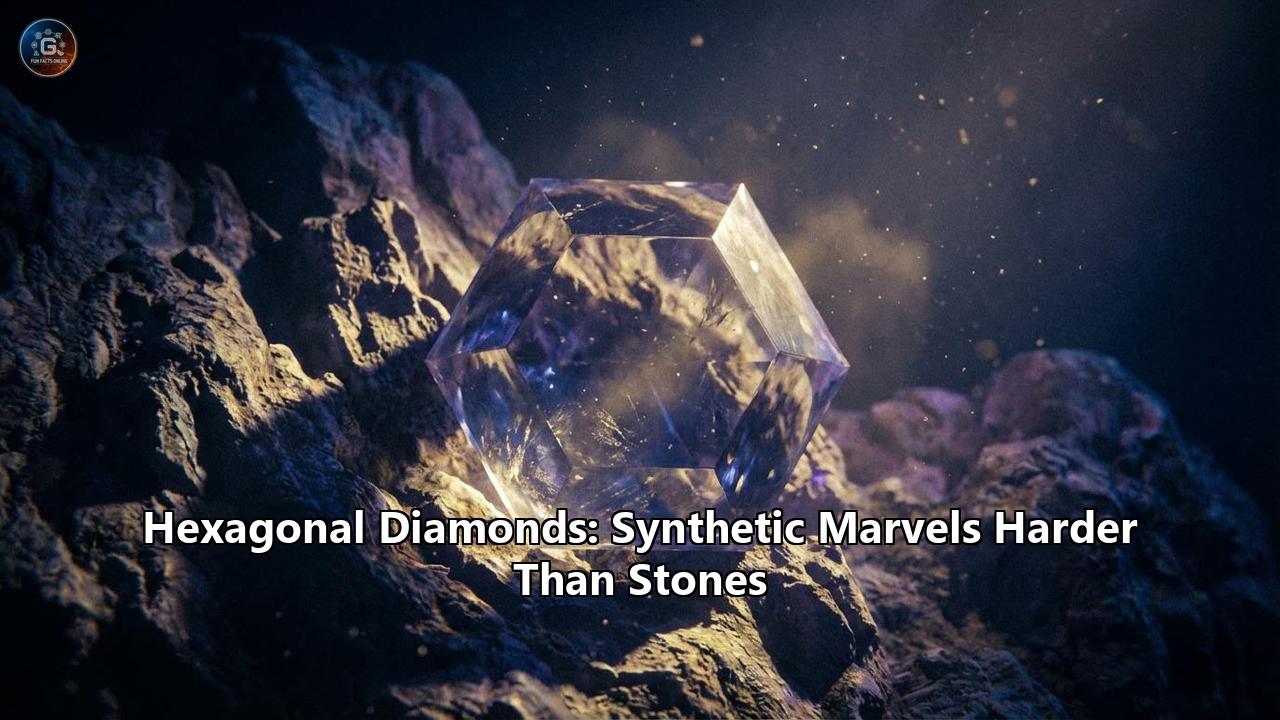
Enter lonsdaleite—a mineral born from the catastrophic collision of celestial bodies, hiding in the microscopic fissures of ancient meteorites, and possessing an atomic architecture so perfectly arranged that it shatters our terrestrial understanding of materials science. Often referred to as the "hexagonal diamond," this cosmic gem has been the subject of awe, intense scientific pursuit, and bitter controversy for over half a century. For decades, it existed almost entirely in the realm of theoretical physics and astronomical anomalies.
Today, however, the narrative has shifted from astronomical wonder to human mastery. In a series of breathtaking breakthroughs culminating in 2025 and 2026, scientists have finally done what was once thought impossible: they have brought the power of a cosmic collision into the laboratory, synthesizing pure, millimeter-sized hexagonal diamonds that definitively prove to be significantly harder, stiffer, and more resilient than any diamond ever mined from the Earth.
This is the story of an elusive super-mineral, the brilliant minds who chased it across the cosmos and through the rigid laws of crystallography, and the dawn of a new era in materials science where the hardest substance known to humanity has officially been dethroned.
The Cosmic Crucible: A Birth in the Stars
To understand the sheer magnitude of the hexagonal diamond, we must first look to the stars—specifically, to a time roughly 4.5 billion years ago, when our solar system was a chaotic, swirling theater of planetary formation. It was during this violent epoch that a dwarf planet collided with a massive asteroid. The kinetic energy released in this impact was incomprehensible, generating shockwaves of heat and pressure that instantly vaporized rock and melted the mantles of the colliding bodies.
Within the carbon-rich mantle of the dwarf planet, layers of graphite—the exact same soft, flaky material found in a modern pencil—were subjected to this apocalyptic force. But instead of being destroyed, the graphite underwent a miraculous, instantaneous transformation. The immense pressure forced the carbon atoms to bond together, stripping away their slippery, two-dimensional planes and locking them into a rigid, three-dimensional lattice. However, because of the specific nature of the shockwave, these atoms did not arrange themselves into the standard shape of a diamond. Instead, they locked into a unique hexagonal formation.
Billions of years later, fragments of this ancient collision wandered through the void of space before eventually caught in the gravitational pull of a blue, watery planet. Around 50,000 years ago, one such fragment plummeted through the Earth's atmosphere and slammed into the high desert of what is now Arizona. The impact carved out the massive Barringer Crater (also known as Meteor Crater) and scattered fragments of the Canyon Diablo meteorite across the landscape.
It wasn't until 1967 that scientists, peering through powerful microscopes at slices of the Canyon Diablo meteorite, noticed something astonishing. Embedded within the iron and standard diamonds of the space rock were microscopic, transparent, brownish-yellow crystals. They refracted light differently than normal diamonds. They were an entirely new allotrope of carbon, a hidden phase of matter delivered directly from the cosmos.
The scientific community named this new mineral lonsdaleite, in honor of Dame Kathleen Lonsdale, an Irish pioneer of crystallography and one of the first women elected as a fellow of the Royal Society. Lonsdale had spent her life unraveling the atomic structures of complex molecules using X-ray diffraction, and it was deeply fitting that nature’s most geometrically fascinating carbon structure would bear her name.
The Geometry of Perfection: Cubic vs. Hexagonal
To grasp why lonsdaleite is theoretically superior to the diamonds we mount on engagement rings or industrial drill bits, one must delve into the invisible, sub-microscopic world of atomic architecture.
Both standard diamonds and lonsdaleite are composed of exactly the same ingredient: pure carbon. Carbon is a chemical shapeshifter, capable of forming wildly different materials depending entirely on how its atoms are connected. When carbon atoms form flat sheets of loosely connected hexagons, you get graphite—soft enough to leave a mark on paper. When they form a hollow sphere, you get a fullerene. When they form a single, one-atom-thick sheet, you get graphene.
But when carbon atoms are subjected to extreme pressure, they form sp3 hybridized bonds. In this state, each carbon atom reaches out and grips four other carbon atoms in an incredibly strong, three-dimensional tetrahedral pyramid. This is the secret to a diamond's hardness.
The difference between a regular diamond and a hexagonal diamond lies entirely in the stacking sequence of these carbon layers.
In a conventional diamond, the atomic layers are stacked in a cubic sequence (ABCABC). The rings of carbon atoms lock together in what chemists call a "chair" conformation, creating a highly symmetrical, face-centered cubic lattice. It is incredibly strong, but it has a microscopic Achilles' heel: its cubic cleavage planes. If you strike a standard diamond at precisely the right angle, it will cleanly split along these planes.
Lonsdaleite, on the other hand, stacks its atomic layers in a hexagonal sequence (ABABAB). Within this honeycomb-like structure, some of the carbon rings adopt a "boat" conformation rather than a chair conformation. This subtle shift in geometry drastically shortens the bonds between the hexagonal layers and forces the carbon tetrahedrons into a slightly distorted, interlocking grip.
The result of this structural quirk is profound. Theoretical physicists and mineralogical simulations have long predicted that this hexagonal lattice would make lonsdaleite up to 58% harder than a standard cubic diamond, capable of resisting indentation pressures that would shatter earthly gemstones into dust. Furthermore, the hexagonal structure was predicted to offer superior stiffness (the ability to resist deformation under pressure), greater thermal conductivity, and a higher resistance to oxidation.
Nature had seemingly provided the blueprints for the ultimate super-material. But there was a massive problem: finding it on Earth proved impossible, and the cosmic samples were deeply flawed.
The Half-Century Illusion: The Controversy of the "Fake" Diamond
For decades following its discovery in 1967, lonsdaleite was a source of immense frustration for materials scientists. The samples recovered from the Canyon Diablo meteorite, the Kenna meteorite in New Mexico, and the Allan Hills meteorite in Antarctica were infinitesimally small—often thinner than a human hair and measuring mere nanometers or micrometers across. Because they were so small, scientists could not perform traditional scratch tests to physically verify their legendary hardness.
Worse still, when researchers finally managed to test the natural samples, the results were wildly disappointing. Instead of registering off the charts, the natural lonsdaleite exhibited a Mohs hardness of just 7 to 8—significantly softer than a regular diamond, and closer to the hardness of quartz.
The scientific community eventually realized why: the cosmic anvils that forged these meteoritic diamonds were violent and messy. The natural samples were riddled with lattice defects, chemical impurities, and microscopic inclusions of soft, unconverted graphite. They were structural compromises, heterogeneous composites rather than pure crystals.
The mystery deepened, and the frustration mounted to the point of existential doubt. In 2014, a highly publicized quantitative analysis threw a massive wrench into the legacy of the hexagonal diamond. A team of crystallographers analyzed the X-ray diffraction data of lonsdaleite and made a shocking claim: pure lonsdaleite did not exist. They argued that the mineral was an illusion—a standard cubic diamond that had been violently twinned, fractured, and stacked with disordered structural defects during a meteorite impact. What scientists had been calling a "hexagonal diamond," they argued, was simply a highly defective regular diamond masquerading as a new phase of matter.
For several years, it seemed that the dream of a super-diamond harder than anything on Earth was dead, relegated to the graveyard of scientific misunderstandings. But human ingenuity, driven by the tantalizing allure of theoretical perfection, refused to let the hexagonal diamond fade into obscurity.
Gunpowder, Lasers, and the Dawn of Shock Physics
If nature could not provide a pure sample of lonsdaleite, humanity would have to build one itself. However, synthesizing a hexagonal diamond required mimicking the cataclysmic energy of a planetary impact. Traditional laboratory presses, which squeeze materials slowly between diamond anvils, routinely produced regular cubic diamonds. To get the hexagonal structure, scientists needed dynamic, explosive shock compression.
The first major turning point in the modern resurrection of lonsdaleite occurred in early 2021 at Washington State University’s Institute for Shock Physics. Led by physicist Yogendra Gupta, a team of researchers devised a brilliant, albeit destructive, experiment to settle the debate over whether hexagonal diamonds were truly stiffer than their cubic counterparts.
Using a combination of gunpowder and compressed gas, the team essentially built a high-tech cannon. They loaded dime-sized disks of pure graphite into the barrel and fired them at a transparent barrier at an astonishing speed of 15,000 miles per hour (24,100 km/h).
Upon impact, the kinetic energy instantly sent a massive shockwave coursing through the graphite disk. For a fraction of a nanosecond, the intense heat and pressure forced the carbon atoms to snap into the elusive hexagonal lattice. Because stiffness determines how fast sound travels through a medium, the researchers fired a small sound wave through the newly formed crystal immediately upon impact, using ultra-fast lasers to track its progress.
The results were spectacular. The lasers confirmed that sound traveled significantly faster through the shock-compressed material than it did through conventional diamonds, proving definitively that the hexagonal diamond was highly rigid and intrinsically stiffer. Because stiffness is directly correlated with hardness and scratch resistance, the experiment provided the first empirical evidence that the 58% hardness increase predicted by computer models was mathematically plausible.
There was, however, a catch. The same explosive force used to create the hexagonal diamonds obliterated them mere nanoseconds later. The Washington State University team had proven the material's properties, but they were left with nothing but vaporized dust. You cannot coat a drill bit or build a microchip out of a mineral that exists for less than a billionth of a second. The ultimate goal—synthesizing pure, stable, bulk hexagonal diamonds that you could hold in your hand—remained frustratingly out of reach.
The Alchemists of the 21st Century: The 2025/2026 Breakthroughs
The race to capture the ghost crystal accelerated. The holy grail of materials science was no longer just proving that lonsdaleite existed; it was figuring out how to pull it from the extreme high-pressure environment without letting it revert back to graphite or collapse into a cubic diamond.
The climax of this decades-long quest arrived between late 2025 and early 2026, driven by brilliant collaborative efforts across several elite Chinese research institutions, including Jilin University, Sun Yat-sen University, and Zhengzhou University. Their findings, published in leading journals such as Nature and Nature Materials, did not just inch the science forward—they shattered the paradigm entirely.
The Chinese research teams realized that the brute-force explosions of shock physics were too chaotic to yield large, stable crystals. They needed an approach that was meticulously controlled, manipulating atomic bonds with surgical precision at the very edge of extreme physics.
The secret lay in a highly specialized precursor material known as highly oriented pyrolytic graphite (HOPG). Unlike regular graphite, where the carbon sheets are jumbled, HOPG is a synthetic form of carbon where all the atomic layers are perfectly aligned in a highly ordered stack.
In a meticulously designed experimental setup, the researchers placed this highly oriented graphite into a specialized apparatus capable of generating static, extreme pressure. But they didn't just squeeze it from all sides as one would to make a regular synthetic diamond. They applied uniaxial compression—meaning they squished the graphite exclusively from the top down, pressing precisely along the crystal's "c-axis" (the axis perpendicular to the carbon sheets).
Simultaneously, they subjected the sample to mind-bending conditions: pressures reaching 20 gigapascals (roughly 200,000 times the atmospheric pressure at sea level) and blistering temperatures ranging between 1,300 and 1,900 degrees Celsius (2,372 to 3,452 degrees Fahrenheit).
By applying a precise temperature gradient and carefully controlling the angle of compression, the scientists forced a miraculous atomic choreography. The layered sheets of graphite did not shatter or melt. Instead, they buckled, slid, and bonded directly into the highly coveted hexagonal honeycomb structure. The researchers observed a direct epitaxial transformation: the specific lattice planes of the graphite reorganized seamlessly into the characteristic planes of hexagonal diamond.
Crucially, by carefully releasing the extreme pressure, the scientists were able to stabilize the structure. When the high-pressure anvils were finally opened, the material did not vanish or revert to soft graphite.
For the first time in human history, scientists had successfully synthesized millimeter-sized, pure-phase, highly ordered bulk hexagonal diamonds. These weren't microscopic specks buried in a meteorite, nor were they fleeting nanosecond anomalies. They were visible, tangible, perfectly crystallized "super-diamonds".
Beyond the Mohs Scale: Redefining the Limits of Hardness
The synthesis of bulk hexagonal diamond allowed scientists to finally subject the material to rigorous, physical characterization. They probed the millimeter-sized crystals with advanced synchrotron X-ray diffraction and high-resolution atomic-scale electron microscopy, unequivocally confirming that the structure was purely hexagonal with virtually zero defects.
But the most highly anticipated moment was the hardness test. Because the Mohs scale tops out at 10 (diamond), materials scientists use a much more precise measurement known as the Vickers hardness test, which involves pressing a pyramid-shaped diamond indenter into a material with a specific, intense force and measuring the size of the resulting indentation.
A standard natural cubic diamond typically exhibits a Vickers hardness of around 100 GPa (Gigapascals), sometimes reaching 110 GPa on specific crystal planes. The absolute purest natural cubic diamonds (Type IIa) can resist pressures up to 162 GPa on their strongest microscopic tips, though bulk measurements are generally much lower.
When the Chinese researchers subjected their lab-grown bulk lonsdaleite to the Vickers test, the results were staggering. The synthetic hexagonal diamonds achieved an asymptotic Vickers hardness of up to 155 to 164 GPa. Furthermore, tests revealed a Young's modulus (a measure of stiffness) of roughly 1229 GPa, outperforming the stiffness of pristine single-crystal cubic diamonds.
The theoretical physicists had been right all along. This subtle shift from a cubic atomic stack to a hexagonal atomic stack had produced an artificial material that was definitively, measurably harder and far more durable than the hardest natural material on Earth. The achievement prompted discussions on whether the ancient Mohs hardness scale might soon need an addendum—a theoretical "10+" or an 11 to account for this new class of super-materials.
In addition to its jaw-dropping hardness, the synthetic lonsdaleite proved to be highly resistant to oxidation, maintaining its structural integrity under extreme thermal cycling that would ordinarily cause cubic diamonds to degrade, burn, or lose their mechanical efficacy. The "boat" conformation of the hexagonal lattice had yielded a thermal and physical fortress.
The Industrial Revolution 2.0: Forging the Future
The successful synthesis of bulk hexagonal diamond is not merely an academic triumph; it is the ignition spark for a potential multi-trillion-dollar revolution in advanced materials science. While the sparkling, transparent beauty of standard diamonds will forever ensure their dominance in the luxury jewelry market, the future of lonsdaleite lies not in adornment, but in absolute, uncompromising utility.
The implications of possessing a material roughly 40% to 58% harder than diamond are vast and transformative across a wide spectrum of critical industries:
Deep-Earth Mining and Drilling:Currently, the most advanced drill bits used in geothermal energy extraction, deep-sea oil drilling, and hard-rock mining are studded with synthetic cubic diamonds or polycrystalline diamond compacts (PDCs). However, even diamonds wear down, fracture, and degrade under the extreme thermal friction and crushing pressures found deep within the Earth's crust. Hexagonal diamonds, with their superior wear resistance, stiffness, and thermal stability, could exponentially increase the lifespan and penetration rates of industrial cutting devices. Drill bits coated in lonsdaleite could bore deeper into geothermal reservoirs than ever before, unlocking virtually limitless clean energy from the Earth's magma.
Precision Machining and Manufacturing:In the aerospace, automotive, and defense sectors, manufacturing components out of ultra-hard alloys (like titanium or specialized ceramics) requires cutting tools that can withstand intense wear. Lonsdaleite cutting tools would allow for the machining of advanced alloys with unprecedented precision and speed. The lack of cubic cleavage planes in the hexagonal structure makes it far less likely to chip or fracture upon impact, drastically reducing tool replacement costs and downtime.
Next-Generation Semiconductors and Quantum Computing:Perhaps the most exciting, and least anticipated, application of pure hexagonal diamond lies in the microscopic world of electronics. Standard diamond is already highly prized in experimental electronics for its extreme thermal conductivity and its ability to act as a wide-bandgap semiconductor. Because hexagonal diamonds possess an altered crystal symmetry, they are predicted to exhibit highly unique electronic and optical properties.
Researchers are investigating the use of lonsdaleite in next-generation thermal management systems for high-power electronics. As computer chips become smaller and exponentially more powerful, they generate localized heat that threatens to melt the circuitry. Hexagonal diamond heat sinks could pull heat away from critical processors far more efficiently than copper or standard synthetic diamond, paving the way for faster, more powerful supercomputers. Furthermore, controlled defects within the hexagonal lattice could serve as highly stable qubits, accelerating the development of room-temperature quantum computing.
Space Exploration and Spacecraft Shielding:It is deeply poetic that a material born from the violent collisions of outer space may soon be used to help humanity return to the stars. The immense strength and low weight of carbon-based super-materials make them ideal candidates for aerospace engineering. Thin layers of synthetic hexagonal diamond could eventually be used as ultra-durable, transparent shielding for spacecraft windows or optical sensors, protecting vital equipment from the devastating impact of micrometeoroids traveling at hypervelocity.
Superconductors and Advanced Energy:Emerging research suggests that the unique geometry of the hexagonal carbon lattice, particularly when doped with other elements or subjected to specific extreme conditions, may unlock new avenues in the quest for advanced superconductors. While still highly experimental, the ability to predictably synthesize bulk lonsdaleite provides physicists with a pristine canvas upon which to test exotic theories of quantum mechanics and electrical resistance.
The Triumph of Perseverance
The journey of the hexagonal diamond is a profound testament to the relentless nature of the scientific method. It is a story that begins in the chaotic fires of a cosmic impact billions of years ago, slumbers in a crater in the Arizona desert, tantalizes crystallographers in the 1960s, suffers the indignity of being labeled a "fake" anomaly, and is finally resurrected by the sheer ingenuity of modern physicists and chemists.
To synthesize pure, bulk lonsdaleite required defying the natural resting state of carbon. It demanded machinery capable of simulating the pressure of an planetary core, and the intellectual audacity to squeeze atoms into a shape they do not naturally want to take on Earth.
The researchers who finally cracked the code—carefully aligning pyrolytic graphite, calculating the exact axis of compression, and navigating the razor-thin margin between destruction and crystallization—have done more than invent a new industrial abrasive. They have fundamentally expanded humanity's library of materials. They have proven that the theoretical limits of the physical world are often just temporary boundaries, waiting for a combination of extreme physics and profound patience to push past them.
As we stand on the precipice of this new era in materials science, the hexagonal diamond ceases to be just a celestial oddity. It transforms into a tangible tool for the future. We now possess the blueprints to engineer the hardest material in the known universe. The stone that fell from the sky has finally been mastered on Earth, and it promises to cut a path toward technological advancements as limitless as the cosmos from which it originated.
Reference:
- https://dalesjewelers.com/blog/2022/09/14/born-of-a-cosmic-collision-lonsdaleite-is-harder-than-any-material-found-on-earth/
- https://uniquejewelshouston.com/blog-details/born-of-the-stars,-recreated-on-earth:-lonsdaleite-is-the-hardest-diamond-yet
- https://www.idexonline.com/FullArticle?Id=50238
- https://gizmodo.com/scientists-claim-theyve-finally-made-the-elusive-hexagonal-diamond-2000730287
- https://bioengineer.org/breakthrough-in-bulk-hexagonal-diamond-synthesis/
- https://nationaltoday.com/us/nv/las-vegas/news/2026/03/05/chinese-researchers-claim-breakthrough-in-creating-elusive-hexagonal-diamond/
- https://thedebrief.org/rare-hexagonal-diamond-is-finally-created-in-the-lab-overturning-decades-of-controversy/
- https://www.chemeurope.com/en/encyclopedia/Lonsdaleite.html
- https://en.wikipedia.org/wiki/Lonsdaleite
- https://jewellerysingapore.sg/scientists-develop-lab-grown-lonsdaleite-harder-than-natural-diamond/
- https://www.popularmechanics.com/science/environment/a63870319/lonsdaleite-synthesize/
- https://arxiv.org/pdf/2111.09176
- https://www.freethink.com/science/lonsdaleite-crystal
- https://scienmag.com/breakthrough-in-bulk-hexagonal-diamond-synthesis-2/