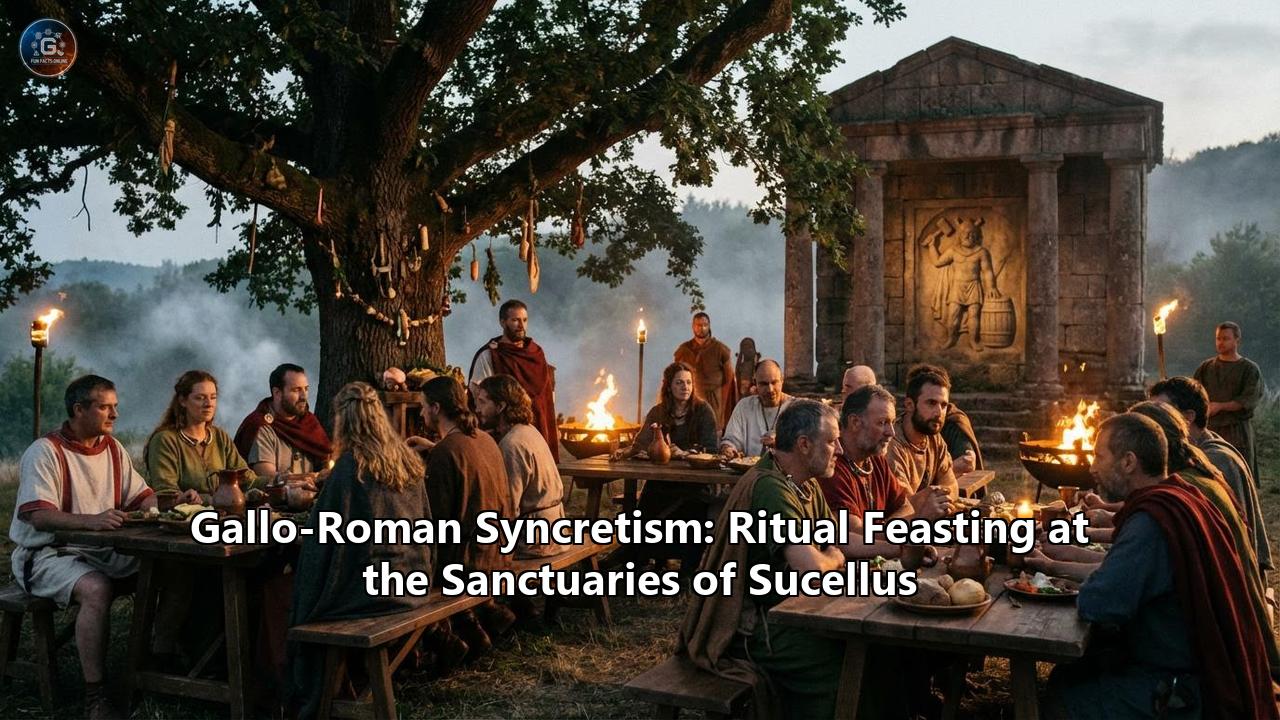
The heavy scent of woodsmoke, roasting pork, and spilled wine drifts through the crisp evening air, settling over a sprawling sanctuary complex nestled in the forested hills of Roman Gaul. Around blazing fire pits, hundreds of people—local farmers, wealthy merchants, and Romanized Celtic elites—gather to share a massive communal meal. They pass around ceramic drinking vessels brimming with imported Mediterranean wine and dark, foaming local ales. At the center of this vibrant, noisy celebration stands a stone altar, and upon it, the carved image of a mature, bearded god wearing a wolf-skin cloak. In one hand, he grips a long-handled mallet; in the other, a small pot known as an olla. This is Sucellus, the Gaulish god of agriculture, forests, and the intoxicating joy of the otherworldly banquet.
To understand the religious landscape of Western Europe in the centuries following Julius Caesar’s conquest of Gaul, one must look beyond the battlefield and into the sacred groves and temple precincts where two distinct cultures collided, intertwined, and birthed something entirely new. This phenomenon, known as Gallo-Roman syncretism, was not a simple erasure of indigenous Celtic beliefs by an imperial Roman monolith. Instead, it was a dynamic, living compromise. The conquered Gauls and the conquering Romans found common ground in their pantheons, merging local deities with classical counterparts. No practice exemplifies this rich cultural blending better than the ritual feasts held at the sanctuaries of Sucellus, where the ancient Celtic tradition of the communal banquet met the structured religious architecture of the Roman world.
The Good Striker: Understanding the God Sucellus
Long before the Roman legions marched across the Alps, the Celtic tribes of Gaul worshipped a deep and complex pantheon of nature spirits, warrior deities, and chthonic ancestors. Among the most beloved and widely venerated was Sucellus, a name that translates from the ancient Gaulish as "The Good Striker".
Sucellus is instantly recognizable in the archaeological record due to his highly specific and unique iconography. He is almost always depicted as a mature, bearded man—projecting authority, wisdom, and paternal care—dressed in a rustic tunic or draped in the skin of a wolf. His most famous attributes, however, are the tools he carries. In his right hand, he wields a massive, long-shafted mallet or hammer. In his left, he cradles an olla, a small, barrel-like pot or drinking vessel. He is frequently accompanied by a loyal dog, a symbol of protection, hunting, and the underworld.
The symbolism of Sucellus’s mallet has fascinated historians and archaeologists for centuries. Unlike the war hammers of Norse mythology, Sucellus’s mallet is generally interpreted as an instrument of creation, agriculture, and divine boundaries. Some scholars suggest the hammer represents the driving of fence posts, marking the boundaries of pastoral land and protecting the domestic sphere from the wild. Others view it as a cooper’s mallet, directly linking him to the crafting of wine and beer barrels—an association further strengthened by the olla he carries. On a more mystical level, the mallet is thought to be a chthonic tool used to strike the earth, awakening the soil from its winter slumber to bring forth the fertility of spring, or acting as a bridge between the upper world of the living and the lower world of the dead.
Sucellus did not usually govern alone. In inscriptions and monumental reliefs found across France, Germany, and Luxembourg, he is frequently paired with his divine consort, the goddess Nantosuelta. Often depicted carrying a model of a house or a dovecote on a pole, Nantosuelta was a goddess of domesticity, the hearth, and nature's abundance. Together, the divine couple represented the ultimate patrons of prosperity, the harvest, and the home.
Two Worlds Collide: Syncretism, Silvanus, and Dis Pater
When the Romans established their administration over Gaul, they employed a philosophical and theological tool known as Interpretatio Romana—the practice of identifying foreign deities as local manifestations of their own Roman gods. For Sucellus, this resulted in a fascinating theological evolution.
In the sun-drenched regions of southern Gaul (modern-day Provence and Languedoc), Sucellus was heavily syncretized with the Roman god Silvanus. In traditional Roman religion, Silvanus was a protector of the woods, fields, and flocks, often depicted as a rustic old man carrying a pruning knife (falx) and a branch of pine. As the two cultures merged, a composite deity—Sucellus-Silvanus—emerged. Sculptures from southern Gaul show a fascinating hybrid: a god who maintains the wild, woodland nature of Silvanus but proudly wields the giant hammer and olla of the Celtic Sucellus. Sacrifices to this merged entity were lavish, comprising pigs, milk, wine, lamb's blood, and grains.
In northern and central Gaul, however, Sucellus’s darker, more mysterious aspects were emphasized. Julius Caesar, in his Commentaries on the Gallic War, wrote that all Gauls believed they were descended from a single ancestor god of the underworld, whom he equated with the Roman god of the dead, Dis Pater. Many modern scholars believe that the Gaulish deity Caesar was referring to was none other than Sucellus. The god's connection to the earth (fertility and agriculture) inherently linked him to what lay beneath it (minerals, wealth, and the realm of the ancestors). His olla was not just a drinking cup; it was the vessel of the otherworldly feast, promising sustenance and joy in the afterlife.
The Architecture of the Divine: Gallo-Roman Sanctuaries
To house this newly syncretized pantheon, the physical landscape of Gaul underwent a massive transformation. Pre-Roman Celtic religion often centered around natural features—sacred groves (nemeton), springs, bogs, and hilltops—where open-air rituals and sacrifices took place. Under Roman influence, these organic sacred spaces were monumentalized in stone, resulting in the classic Gallo-Roman sanctuary.
These sanctuaries were sprawling, multi-functional complexes designed to handle large crowds of pilgrims. They typically featured a central temple known as a fanum, characterized by a tall, square central shrine (cella) surrounded by a covered ambulatory or walkway. But the temple itself was only one part of the site. The surrounding sacred enclosure (temenos) was outfitted with gathering areas, porticoes, auxiliary shrines, and, crucially, massive spaces dedicated to the preparation and consumption of ritual meals.
Recent archaeological excavations continue to shed light on the sheer scale of these complexes. In 2025 and 2026, archaeologists excavating the Gallo-Roman sanctuary of Mancey in the Burgundy region of France uncovered a sprawling ritual complex that had remained active for nearly five centuries. Among the ruins of a temple identified as Monument M3, they discovered what is believed to be the first-ever painted depiction of Sucellus on an altar block. The floors of this sanctuary were packed with the remnants of centuries of ritual feasts—thousands of bones from pigs, birds, and fish, intermingled with discarded drinking vessels, coins, and jewelry.
Similarly, multidisciplinary studies of the sanctuary at Kempraten in Switzerland have revealed how phases of intense, bustling human activity alternated with periods of quiet at these sacred groves. The Kempraten site shows a heavy emphasis on the ritual offering and consumption of domestic fowl and cattle, proving that these sanctuaries were the focal points of massive, coordinated agricultural and culinary efforts.
The Ritual Feast: Meat, Wine, and Magic
Feasting is one of the oldest and most universal forms of human social bonding, with archaeological evidence of ritual communal meals dating back over 12,000 years to early hunter-gatherer societies. In the Gallo-Roman world, however, the feast was elevated to an art form, a political tool, and a supreme act of religious devotion.
A feast dedicated to Sucellus was far more than a simple meal; it was a carefully choreographed communion between mortals and the divine. The god's olla symbolized his role as the divine host of the banquet, providing limitless sustenance. When worshippers gathered at his sanctuaries, they were essentially recreating the great feasts of the Otherworld here on earth.
The Sacrifice and the MenuThe feast began with sacrifice. Animals were led to the sanctuary altars, consecrated, and ritually slaughtered. The division of the animal was strictly regulated by theological and social custom. The blood, bones, and fat were often burned on the altar, the smoke rising to the heavens to nourish the gods. The meat, however, was boiled or roasted to feed the human attendees.
Archaeozoological analysis of sanctuary bone beds reveals a diverse and rich diet. Cattle and pigs were the primary sources of meat. Pork had long been considered a sacred and high-status meat among the Celts, a tradition that carried over seamlessly into the Gallo-Roman period. In sanctuaries like Kempraten, poultry also played a massive role in cultic offerings. Fish, oysters, and game animals supplemented the menu, depending on the region.
The Flow of Wine and BeerNo feast of Sucellus was complete without alcohol. The god’s association with barrels, vats, and drinking cups highlights the central role of intoxication as a means of connecting with the divine. Before the Roman conquest, the Gauls were famous for their consumption of cervisia (beer) and mead. However, integration into the Roman Empire brought a flood of imported Mediterranean wine.
Sanctuary sites are frequently littered with the shattered remains of amphorae—large ceramic shipping containers used to transport wine from Italy and southern Gaul to the northern provinces. At the feast, wine was often mixed with water, spices, or honey, and poured generously. Libations—liquid offerings poured directly onto the earth or over the altar—were given to Sucellus to ensure his continued blessing over the vineyards and barley fields.
Social Cohesion and PowerWhile the theological purpose of the feast was to honor Sucellus, its social purpose was equally profound. In the transition from Celtic tribal structures to Roman civic administration, feasting became a vital mechanism for expressing and maintaining social class.
Wealthy Gallo-Roman aristocrats, magistrates, and landowners would act as benefactors, funding the massive costs of the sanctuary feasts. By providing high-quality meat and exotic imported wines to the local populace, these elites demonstrated their wealth, secured political loyalty, and justified their high social standing. Yet, despite this hierarchy, the feast remained a communal event. For the poorer farmers and rural laborers, the sanctuary festivals might have been the only times of the year they consumed significant amounts of fresh meat and fine wine. Sharing food in the presence of the "Good Striker" forged a shared Gallo-Roman identity, binding conqueror and conquered together over the roasting pits.
Unearthing the Banquets: The Archaeological Echoes
Today, the songs, prayers, and laughter of the Gallo-Roman feasts have long since faded, but the earth remembers. Modern archaeologists utilize a wide array of scientific techniques to reconstruct these ancient rituals with astonishing precision.
The most obvious evidence comes in the form of massive bone assemblages. By analyzing the cut marks on animal bones, archaeozoologists can determine exactly how the animals were butchered, cooked, and distributed. The high concentration of specific, meat-rich cuts of cattle and pig in sanctuary dining areas confirms that these animals were consumed on-site in joyous communal gatherings, rather than being discarded as mere waste.
Pottery also tells a vivid story. Excavations of sanctuary dining pavilions frequently yield thousands of fragments of Samian ware—bright red, glossy Roman tableware—alongside rougher, locally made cooking pots. The sheer volume of drinking cups, flagons, and shattered wine amphorae speaks to the heavily alcoholic nature of the celebrations.
Furthermore, the attendees left behind deeply personal tokens of their faith. Votive offerings are found by the thousands at these sites. Worshippers seeking the blessing of Sucellus would purchase miniature bronze hammers or tiny ollae from sanctuary merchants and deposit them at the altars. Coins were thrown into sacred springs or buried beneath temple foundations. Occasionally, epigraphic evidence survives—stone plaques inscribed with vows (the votum), thanking Sucellus for a successful harvest, a cured illness, or a safe journey.
In highly unique cases, the very soil of the sanctuaries reveals the manipulation of human remains in ways that echo pre-Roman ancestral rites. At sites blending Neolithic and Roman history, such as Pommerœul in Belgium, archaeologists have even found evidence of Gallo-Romans interacting with and modifying ancient ancestral burials, adding crania and Roman grave goods to prehistoric graves. This continuous interaction with the dead perfectly aligns with Sucellus’s role as the Gaulish Dis Pater—the father of the underworld, bridging the gap between the ancient ancestors and the living worshippers.
The Enduring Legacy of the Hammer God's Banquet
As the centuries turned and the Roman Empire slowly gave way to Late Antiquity, the fires in the sanctuaries of Sucellus began to dim. The rise of Christianity in the 4th and 5th centuries AD brought sweeping legislative and cultural changes. Imperial decrees banned pagan sacrifices, and the great temples were gradually abandoned, dismantled for building materials, or repurposed into Christian churches.
Yet, the core human behaviors that Sucellus represented—the desire to gather at the changing of the seasons, to strike the earth and hope for a bountiful harvest, and to share food and drink with one's community—could not be legislated away. The grand ritual feasts of the Gallo-Roman sanctuaries evolved into the harvest festivals, saint’s day feasts, and communal village banquets of medieval Europe.
Sucellus, the bearded guardian of the forest, the wielder of the divine mallet, and the keeper of the endless cup, stands as a profound symbol of an era in transition. He was a god born of Celtic soil but clothed in Roman marble, a deity who promised both the earthly prosperity of a good harvest and the eternal warmth of an otherworldly feast. Today, as archaeologists brush the dirt from his painted altars and catalog the shattered remnants of his sacred banquets, they do more than uncover ancient history. They reveal the timeless human pursuit of community, the universal need to carve out a sacred space in a chaotic world, and the enduring joy of sharing a meal with the gods.
Reference:
- https://en.wikipedia.org/wiki/Sucellus
- http://www.deomercurio.be/en/silvano.html
- https://www.britannica.com/topic/Sucellus
- https://dokumen.pub/mythology-9780756631543-0756631548.html
- https://thewitchsanddruidsden.com/celicnon-sucelli/
- https://epdf.pub/symbol-and-image-in-celtic-religious-art.html
- https://arkeonews.net/first-ever-painted-depiction-of-celtic-god-sucellus-discovered-at-gallo-roman-sanctuary/
- https://dokumen.pub/caesars-druids-story-of-an-ancient-priesthood-9780300165883.html
- https://www.researchgate.net/publication/324042522_Feasting_in_a_Sacred_Grove_A_Multidisciplinary_Study_of_the_Gallo-Roman_Sanctuary_of_Kempraten_Switzerland
- https://today.uconn.edu/2017/12/archaeological-dig-provides-clues-feasting-became-important-ritual/
- https://www.diva-portal.org/smash/get/diva2:756180/FULLTEXT01.pdf
- https://www.academia.edu/327391/The_Ritual_of_the_Vow_In_Gallo_Roman_Religion_in_J_Metzler_et_al_eds_Integration_in_the_Early_Roman_West_The_role_of_culture_and_ideology_Luxembourg_Dossiers_d_arch%C3%A9ologie_du_Mus%C3%A9e_National_d_Histoire_et_d_Art_4_111_127
- https://pmc.ncbi.nlm.nih.gov/articles/PMC11658144/