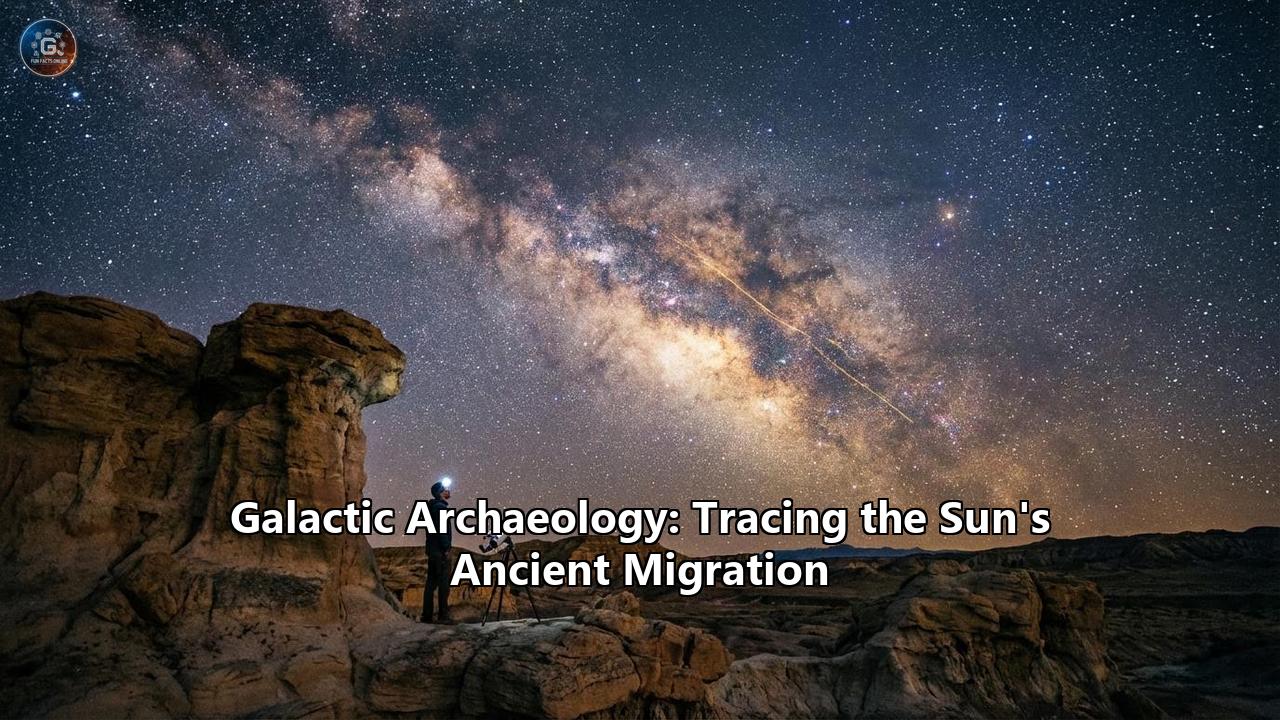
When we gaze up at the night sky, the stars appear as fixed pinpricks of light, eternally anchored to their celestial tapestry. Ancient civilizations built entire mythologies around this perceived permanence, mapping out constellations that seemed as enduring as the mountains beneath them. But modern astrophysics has revealed a profound truth that shatters this illusion of stillness: the Milky Way is not a static vault, but a swirling, turbulent fluid of gas, dust, and stars. Within this grand cosmic choreography, our own Sun is not a stationary observer. It is, in fact, a cosmic refugee.
Around 4.6 billion years ago, our star ignited in a violent, radiation-blasted neighborhood deeply embedded within the inner Milky Way, roughly 10,000 light-years closer to the galactic center than its current location. Today, the Sun resides in the quiet, sparse suburbs of the Orion Cygnus arm, presiding over a planetary system where fragile, biological life has flourished for eons. The question of how the Sun crossed that vast, treacherous distance has stood as one of the great enigmas of modern astronomy. How did our solar system navigate the gravitational perils of the galaxy to find a safe haven?
The answer lies in a rapidly expanding field of study known as Galactic Archaeology. Through unprecedentedly detailed surveys of stellar movements and chemical compositions, scientists have begun to reconstruct the evolutionary history of the Milky Way. In doing so, they have uncovered a story far more dramatic than a solitary star drifting through the void. Recent breakthroughs, powered by next-generation space telescopes, have revealed that the Sun did not travel alone. It was part of a synchronized wave, a mass stellar exodus of thousands of stars fleeing the turbulent galactic core. This grand migration not only rewrites the biography of our Sun but suggests that our very existence on Earth may be the direct result of a monumental galactic reshuffling.
To truly understand this ancient migration, we must first understand how astronomers read the history of the galaxy. On Earth, terrestrial archaeologists dig through layers of soil and rock, searching for pottery shards, fossilized bones, and the ruined foundations of lost cities to piece together the narrative of human history. In space, the artifacts are the stars themselves, and the strata are written in light, motion, and chemistry.
Galactic Archaeology operates on a fundamental principle: a star’s current physical and chemical properties serve as a fossilized record of the time and place of its birth. When a cloud of interstellar gas and dust collapses to form a stellar nursery, the stars born within that cluster inherit the specific chemical fingerprint of that cloud. In astrophysics, any element heavier than hydrogen and helium is referred to as a "metal." The early universe contained almost no metals; they were forged later in the nuclear furnaces of the very first stars and scattered across space by titanic supernova explosions. Because the inner regions of the Milky Way have experienced a much higher rate of star formation and death over the eons, the gas clouds closer to the galactic center are heavily enriched with these complex elements.
Our Sun is remarkably metal-rich. It contains elevated levels of heavy elements like iron, silicon, and magnesium—abundances that are uncharacteristically high for stars born in our current, relatively pristine galactic neighborhood. For decades, this chemical anomaly puzzled astronomers. The Sun's "DNA" simply did not match the environment in which it currently resides. It was as if a marine biologist had found a deep-sea anglerfish swimming in a shallow, sunlit coral reef. The Sun’s chemical composition strongly suggested it was born much deeper in the galaxy, in a dense, metal-rich stellar incubator. But escaping the immense gravitational pull of the inner galaxy is no easy feat. To understand how the Sun managed this escape, scientists needed to map the movements of billions of stars.
Enter the European Space Agency’s (ESA) Gaia mission, arguably the most important astronomical undertaking of the 21st century for understanding our home galaxy. Launched in 2013, Gaia is an astrometric observatory stationed at the Lagrange 2 (L2) point, a million miles from Earth. Its mission is as simple in concept as it is staggering in execution: to create the most precise three-dimensional map of the Milky Way ever attempted. By continuously scanning the sky, Gaia measures the exact positions, distances, and motions of over two billion stars. It tracks not only how stars move across the plane of the sky (proper motion) but also how fast they are moving toward or away from us (radial velocity).
Furthermore, Gaia's onboard spectrometers analyze the light emitted by these stars, breaking it down into its constituent colors to reveal the chemical absorption lines hidden within. This allows astronomers to determine the exact temperature, surface gravity, and chemical makeup of millions of stars simultaneously. Gaia has effectively transformed the Milky Way from a static image into a dynamic, multi-dimensional movie playing out over billions of years.
Armed with this treasure trove of data, an international community of galactic archaeologists set out to find the Sun's long-lost relatives. In March 2026, a groundbreaking study published in the journal Astronomy & Astrophysics by researchers from Tokyo Metropolitan University and the National Astronomical Observatory of Japan (NAOJ) blew the doors off the mystery of the Sun's origins. Led by astrophysicists Daisuke Taniguchi and Takuji Tsujimoto, the team combed through the massive Gaia GSP-Spec dataset searching for "solar twins"—stars that are practically indistinguishable from our Sun in terms of mass, temperature, surface gravity, and chemical metallicity.
Out of billions of observed stars, the researchers isolated an exceptionally pure catalog of 6,594 exact solar twins residing within our general neighborhood (about 27,000 light-years from the galactic center). But they didn't stop at categorizing them; they utilized advanced theoretical isochrones to calculate the precise ages of these stars.
What they found defied expectations. When they mapped out the age distribution of these solar twins, a striking pattern emerged. Rather than a random assortment of ages, there was a massive, concentrated spike of stars between 4 billion and 6 billion years old. Our Sun, at 4.6 billion years old, sits squarely in the middle of this demographic boom. The discovery of thousands of chemically identical, age-matched stars occupying roughly the same orbital distance from the galactic center pointed to a staggering conclusion: the Sun’s presence in the galactic suburbs was not a fluke, nor was it a solitary wanderer.
The Sun and its thousands of stellar twins had undertaken a mass migration. Born in the dense, volatile inner galaxy, they had somehow surfed a gravitational wave outward, traveling over 10,000 light-years across the galactic disk to settle in their current, peaceful orbits. But how does a star, let alone a massive fleet of them, change its orbit so drastically?
In the classical models of galactic dynamics, stars were thought to follow relatively stable, circular orbits around the galactic center, much like planets orbiting a star. In this rigid view, a star born at a radius of 15,000 light-years from the core would spend its entire multi-billion-year lifespan at that exact distance. However, modern astrophysics has uncovered a phenomenon known as "radial migration," a complex gravitational dance that allows stars to drastically alter their orbital radii over time.
Radial migration is driven by two primary mechanisms: "blurring" and "churning." Blurring occurs when a star's orbit becomes highly elliptical due to gravitational encounters with massive objects like giant molecular clouds. An elliptical orbit means the star will naturally swing closer to and further from the galactic center during its revolution. However, blurring does not change the star’s overall orbital energy; it merely stretches the path.
Churning, on the other hand, is the true engine of large-scale galactic migration. It involves a permanent transfer of angular momentum. The Milky Way is a spiral galaxy, featuring massive, sweeping arms of higher density gas and stars. These spiral arms are not solid structures; they are density waves, much like traffic jams on a highway, where material slows down and bunches up as it passes through. When a star's orbit happens to match the rotational speed of a spiral arm—a phenomenon known as a corotation resonance—the star can be caught in the arm's gravitational grip. Like a surfer catching a massive ocean wave, the star is accelerated, gaining angular momentum and being pushed outward to a permanently wider orbit. Conversely, a star falling behind the wave can lose momentum and drop closer to the galactic center.
However, churning alone struggles to explain the sheer volume and distance of the Sun's 10,000-light-year exodus. There is another, much larger gravitational structure at play: the Milky Way’s central bar.
If you could view the Milky Way from above, you would not see a simple, spherical core at the center of the spiral arms. Instead, you would see a massive, elongated structure made of billions of densely packed stars, resembling a glowing cosmic baton. This is the Galactic Bar.
The bar acts as a colossal gravitational engine, dictating the dynamical flow of the inner galaxy. In its current, stable state, the galactic bar creates a powerful gravitational boundary known as the "corotation barrier". This barrier functions almost like a cosmic moat, effectively trapping stars within the inner galaxy and preventing them from migrating to the outer disk. If this barrier has always been there, the mass migration of the Sun and its 6,000 twins should have been impossible.
The 2026 NAOJ study provided the missing piece of the puzzle by linking the Sun's migration to the violent birth of the galactic bar itself. Astronomers believe that the Milky Way's bar structure is not a primordial feature but one that coalesced and formed roughly 6 to 7 billion years ago. During this epoch of intense galactic structural upheaval, the inner Milky Way was thrown into dynamical chaos.
As the central bar violently assembled itself, its gravitational influence was erratic and unfocused. Instead of acting as a barrier, the forming bar acted as an immense gravitational slingshot. The turbulent assembly of the bar compressed vast clouds of interstellar gas, triggering a massive burst of star formation—the very burst that birthed the Sun and its thousands of twins. Almost immediately after they ignited, the rapidly shifting gravitational gradients of the newborn bar captured these infant stars, diffused their angular momentum, and flung them outward across the galactic disk.
Because the corotation barrier had not yet stabilized into its modern form, the doors of the inner galaxy were temporarily thrown wide open. The Sun, along with a vast armada of sibling and twin stars, rode this wave of gravitational turbulence outward, traversing the treacherous expanse of the disk. By the time the central bar stabilized and the corotation barrier slammed shut, sealing off the inner galaxy, the Sun was already safely established in the tranquil galactic suburbs.
The implications of this epic journey are difficult to overstate, particularly when we consider the fragile, pale blue dot orbiting our Sun. If the Sun had not migrated—if it had been trapped by the corotation barrier and forced to live out its days in the inner galaxy—it is highly probable that you would not be here to read this.
Astrobiologists often speak of the "Circumstellar Habitable Zone" or the "Goldilocks Zone"—the narrow band around a star where temperatures are just right for liquid water to exist on a planet's surface. But there is a macro-scale equivalent to this concept known as the "Galactic Habitable Zone." Just as a planet must be at the right distance from its star, a star system must be at the right distance from the galactic center to support complex life.
The inner Milky Way is a spectacular, yet incredibly hostile environment. Star densities are incredibly high, meaning close encounters between stars are common. If a passing star were to wander too close to our solar system, its gravity could easily destabilize the Oort Cloud—the icy shell of debris at the edge of our system—sending a catastrophic rain of extinction-level comets hurtling toward Earth. Worse yet, it could perturb the orbits of the planets themselves, potentially flinging Earth out into the freezing void of interstellar space or plunging it into the Sun.
Beyond the gravitational dangers, the inner galaxy is a zone of intense, lethal radiation. The high rate of massive star formation in the core means an equally high rate of stellar deaths in the form of supernovae. A supernova detonating within a few dozen light-years of Earth would bathe our planet in high-energy gamma rays and cosmic rays, stripping away the ozone layer and exposing the surface to sterilizing ultraviolet radiation from the Sun. In the inner galaxy, these cataclysmic explosions happen with alarming frequency. Additionally, the supermassive black hole at the center of the galaxy, Sagittarius A*, occasionally flares to life, emitting searing bursts of radiation.
By being born in the nutrient-rich, heavy-metal environment of the inner galaxy, the Sun acquired the necessary building blocks to form rocky terrestrial planets like Earth, with iron cores capable of generating protective magnetic fields. But by immediately migrating outward to the sparse, quiet suburbs of the Orion Cygnus arm, the solar system escaped the deadly radiation and gravitational chaos that would have repeatedly sterilized our world. Our existence relies entirely on this cosmic paradox: we needed the chaotic forge of the inner galaxy to create the Earth, but we needed the tranquility of the outer galaxy to allow life to survive. The mass migration driven by the forming galactic bar provided exactly that—an escape pod to the suburbs.
While we now know the Sun migrated alongside thousands of solar twins, it is vital to distinguish between "twins" and "siblings." The 6,594 stars identified by the recent Gaia studies are solar twins—stars with the same mass, age, and chemical makeup, which were swept up in the same grand migration. However, astronomers are engaged in an even more highly specific hunt: the search for the true Solar Siblings.
A solar sibling is a star that was born from the exact same collapsing giant molecular cloud as the Sun. When the Sun formed 4.6 billion years ago, it did not form alone in a vacuum. It was born in a dense, crowded open cluster containing anywhere from hundreds to thousands of sibling stars, all condensing from the same vast nebula. In its youth, our Sun would have shared its sky with brilliant, massive siblings, a spectacular stellar nursery resembling the modern-day Orion Nebula.
However, open clusters are gravitationally fragile. As the cluster orbited the galaxy, the tidal forces of the Milky Way, encounters with passing molecular clouds, and the explosive deaths of the cluster's most massive stars gradually tore the family apart. Over billions of years of radial migration, the Sun’s birth cluster was completely dispersed. Today, the Sun’s true biological siblings are scattered to the winds, scattered across completely different azimuths and orbital radii of the galactic disk.
Finding them is the ultimate needle-in-a-haystack problem. Because of the chaotic nature of radial migration, calculating the orbits of stars backward in time over 4.6 billion years to find a single intersection point is incredibly difficult. Even with Gaia's precision, gravitational encounters blur the historical trajectories. To identify a true sibling, astronomers look for hyper-specific chemical tagging. While twins have a similar overall metallicity, true siblings must have an absolutely identical, highly detailed chemical abundance pattern down to the rarest trace isotopes, such as barium, yttrium, and europium.
Several candidates for solar siblings have been identified in recent years, such as the star HD 162826 in the constellation Hercules, and HD 186302 in the constellation Pavo. These stars not only share the Sun’s exact chemical DNA but have kinematic histories that suggest they could have crossed paths with the Sun billions of years ago. The discovery of the 2026 mass migration framework provides a critical new roadmap for this search. By understanding the specific dynamics of the outward wave triggered by the galactic bar, scientists can better model the dispersal of the Sun’s birth cluster, narrowing the search parameters for future observations.
The revelations of Galactic Archaeology have fundamentally shifted humanity's perspective of its place in the universe. We are no longer observing a static cosmos; we are riding a dynamic, fluid wave. The ground beneath our feet is made of elements forged in ancient stars, assembled in a chaotic inner-galactic nursery, and ferried across ten thousand light-years of dangerous cosmic real estate to a quiet harbor.
As technology advances, our understanding of this epic history will only deepen. Future data releases from the Gaia mission will continue to refine the precision of stellar motions and chemical abundances. Simultaneously, upcoming observatories like NASA’s Nancy Grace Roman Space Telescope will peer through the obscuring dust of the galactic plane, mapping the inner galaxy with unprecedented infrared clarity. The Japan Aerospace Exploration Agency (JAXA) and NAOJ are also developing the JASMINE (Japan Astrometry Satellite Mission for INfrared Exploration) satellite. Launching in the coming years, JASMINE is specifically designed to perform ultra-precise astrometry in the infrared spectrum, allowing it to look directly into the hidden, dust-choked core of the Milky Way—the exact region where the Sun's grand journey began. By mapping the kinematics of stars still trapped near the central bar, JASMINE will provide the final pieces to the puzzle of the 6-billion-year-old gravitational slingshot.
We often look to the stars with a sense of wonder at their vast, unreachable distances. But the story of Galactic Archaeology tells us that those distances are not insurmountable, because our own star has already traversed them. The history of the Milky Way is written in the orbital paths and chemical bloodlines of its stars, and our Sun's biography is one of the most thrilling chapters. It is a story of a violent birth, a fortuitous escape, a long migration, and ultimately, the blossoming of life. We are the children of a migrant star, drifting through the suburbs of a galaxy whose grand, turbulent history made our quiet existence possible.
Reference:
- https://earthsky.org/space/sun-might-be-a-migrant-inner-milky-way-bar/
- https://scitechdaily.com/our-sun-may-have-escaped-the-milky-ways-dangerous-center-billions-of-years-ago/
- https://www.astronomy.com/science/the-suns-galactic-migration-may-have-made-life-on-earth-possible/
- https://www.thebrighterside.news/post/the-sun-could-be-one-of-thousands-of-solar-twins-moving-through-the-milky-way/
- https://www.zmescience.com/space/sun-formed-galactic-center-mass-migration/
- https://jasmine.nao.ac.jp/en/release/2026/0313/
- https://www.sciencedaily.com/releases/2026/03/260313062543.htm
- https://www.nao.ac.jp/en/news/science/2026/20260313-jasmine.html
- https://www.livescience.com/space/a-mass-migration-of-stars-from-the-milky-ways-center-could-explain-why-theres-life-in-our-solar-system
- https://academic.oup.com/mnras/article/457/1/1062/989519
- https://www.researchgate.net/publication/271855435_The_solar_siblings_in_the_Gaia_era