
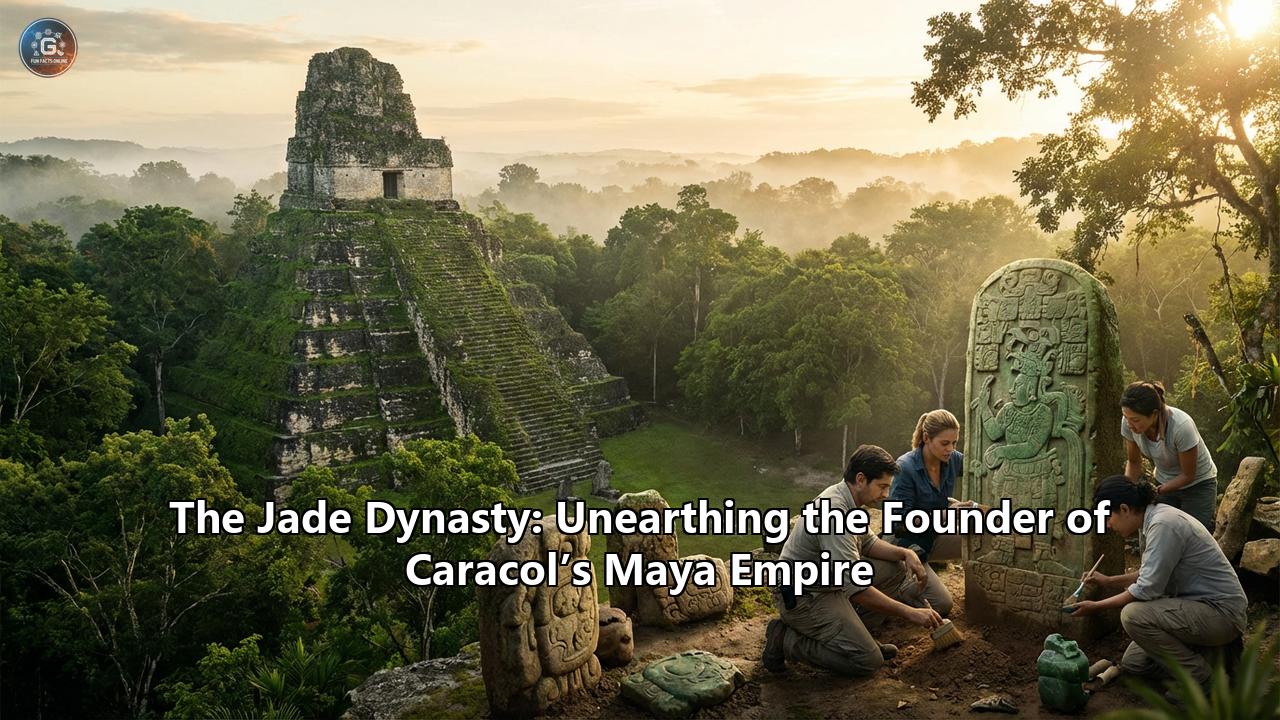
The jungle breathes. It is a living, heaving entity of emerald and mist, a canopy that has guarded its secrets for nearly two millennia. Deep within the Chiquibul Forest of Belize, the ancient city of Caracol has long stood as a testament to Maya resilience, a sprawling metropolis that once rivaled Tikal in power and prestige. For decades, archaeologists have mapped its causeways, climbed its sky-piercing pyramid, Caana, and deciphered the stelae that chronicle its wars and alliances. Yet, the true origin of its power—the spark that ignited this imperial fire—remained shrouded in the shadows of the Early Classic period.
That shadow has now been lifted.
In a discovery that has sent shockwaves through the world of Mesoamerican archaeology, the tomb of the dynasty’s founder has finally been unearthed. We now look into the face of the man who started it all, not through a crumbling skull, but through a visage of eternal green. The recent excavation of the tomb of Te’ K’ab Chaak—the "Tree Branch Rain God"—has revealed a ruler adorned in an unprecedented wealth of jade, fundamentally altering our understanding of Caracol’s rise. This was not merely a political founding; it was the birth of a "Jade Dynasty," a lineage that would leverage sacred wealth, military might, and spiritual authority to forge one of the greatest empires of the ancient Americas.
The Ghost in the Glyphs
For years, Te’ K’ab Chaak was little more than a phantom—a name etched onto the back of later monuments, a spectral ancestor invoked by descendants to legitimize their rule. The hieroglyphic record was clear but scant: on a specific day in 331 AD (8.14.13.10.4 in the Maya Long Count), a lord named Te’ K’ab Chaak "took the K’awiil," a metaphor for grasping the scepter of kingship.
Historians knew he existed. They knew he was the progenitor, the trunk from which the royal family tree extended. But without a physical body, without a contemporary tomb, he remained an abstraction. Was he a local chieftain who got lucky? A foreigner from the west establishing a new order? Or perhaps a mythologized figure, invented by later kings to give their dynasty a divine pedigree?
The answers lay buried beneath the Northeast Acropolis, a ceremonial complex that had been built over and modified for centuries. It was here, beneath the layered history of his successors, that the founder waited.
The Discovery: Unlocking the Earth
The breakthrough came in July 2025, led by the veteran archaeological team from the University of Houston, Arlen and Diane Chase, who have dedicated over four decades to understanding Caracol’s urban sprawl. Their target was a modest-looking structure in the Northeast Acropolis, an area associated with elite residences and ritual activity.
Excavation is a game of patience, peeling back time layer by layer. As the team dug beneath a later Classic-period shrine, they encountered the tell-tale red earth—cinnabar. To the Maya, cinnabar was the color of blood, of the rising sun, of life force itself. Its presence is a neon sign to archaeologists: Royalty lies here.
Breaking through the capstones, the team peered into a chamber that had not seen the light of day since the 4th century. The air inside was heavy, not just with age, but with the weight of history. There, laid out on a stone bench, was the founder.
He was a man of advanced age for his time, likely in his 60s, standing about five foot seven. But it was not his bones that caught the light of the headlamps. It was the green.
The Jade Visage
Covering the ruler’s face was a masterpiece of Early Classic art: a jadeite mosaic death mask.
To understand the magnitude of this find, one must understand what jade meant to the Maya. It was not merely a precious stone; it was the physical embodiment of the breath-soul, the essence of life, the color of maize and water. A jade mask was not a decoration; it was a mechanism of resurrection. It transformed the dead ruler into the Maize God, ensuring his rebirth and, by extension, the agricultural prosperity of his people.
This mask was unique. Composed of dozens of tessellated jadeite pieces, it portrayed the founder with a realism and intensity that is rare for the period. The eyes, inlaid with shell and obsidian, seemed to stare back across the centuries with an imperious, unblinking gaze.
But the wealth did not end at the mask. The tomb was a treasury of the Early Classic world:
- Three sets of jade earflares: Massive, heavy spools that would have stretched the lobes, marking the wearer as a listener to the gods. Finding three sets in a single burial is unheard of, suggesting a surplus of wealth that challenges our previous notions of Caracol’s early economy.
- A Necklace of Spondylus Shell: The "thorny oyster" of the Pacific, imported over vast trade networks, symbolizing the watery underworld.
- Ceramic Masterpieces: Eleven pottery vessels surrounded the body. Some depicted scenes of rulership, while others bore the image of Ek Chuah, the merchant deity, highlighting the economic foundations of his power. One vessel featured a lid handle modeled as a coatimundi (a raccoon-like creature), a play on the name of a later ruler, hinting at the deep continuity of this dynastic symbol.
This was not the grave of a tentative local chief. This was the tomb of a "Holy Lord" (K’uhul Ajaw) who commanded vast resources, possessed far-reaching trade connections, and held absolute spiritual authority.
The "Jade Dynasty" and the Teotihuacán Connection
The unearthing of Te’ K’ab Chaak forces a rewrite of the political map of the 4th century. The sheer volume of jade and the specific artistic styles found in the tomb point to a fascinating possibility: a connection to Teotihuacán, the great imperial metropolis in central Mexico, over a thousand kilometers away.
The 4th century was a time of "New Order" in the Maya Lowlands. In 378 AD, a few decades after Te’ K’ab Chaak’s accession, a warlord named Siyaj K’ak’ ("Fire is Born") arrived from the west, overthrowing the dynasty of Tikal and installing a new line connected to Teotihuacán.
The artifacts in Te’ K’ab Chaak’s tomb—specifically the style of the jade work and certain ceramic forms—suggest that Caracol was already plugged into this "international" network before the Tikal overhaul. The "Jade Dynasty" may have risen precisely because Te’ K’ab Chaak was a savvy operator on this new trade superhighway, controlling the flow of precious commodities through the Maya Mountains.
The jade itself tells a story of geology and power. Sourced from the Motagua River valley in modern-day Guatemala, this stone had to pass through potentially hostile territories to reach Caracol. That the founder could bury so much of it suggests he had already consolidated a military and economic stranglehold on the region’s southern trade routes.
The Legacy of the Founder
Te’ K’ab Chaak did not just leave behind a tomb of treasure; he left behind a blueprint for empire. The dynasty he founded in 331 AD would endure for over 460 years, surviving the turbulent "Star Wars" and the collapse of neighboring states.
The "DNA" of his reign is visible in the actions of his most famous descendants:
- Yajaw Te’ K’inich II (Lord Water): Ruling in the mid-6th century, he would honor his ancestor’s legacy by daring to challenge the superpower of Tikal. In 562 AD, he orchestrated a "Star War" defeat of Tikal, plunging that rival city into a 130-year dark age (the "Hiatus") and elevating Caracol to supreme power.
- K’an II: The great expander who reigned in the 7th century, he referenced Te’ K’ab Chaak in his texts, linking his own military victories back to the "foundation" laid by the ancestor.
The discovery of the founder’s tomb provides the physical anchor for these later claims. When K’an II boasted of his lineage, he wasn't inventing a glorious past; he was referencing the literal wealth and power buried beneath the temple floors he walked upon.
A Window into the Soul of the Maya
Beyond the politics and the economics, the tomb of Te’ K’ab Chaak offers a poignant look at the human side of this ancient civilization. The analysis of his skeleton revealed a man who had lost all his teeth before he died, a ruler who lived to a ripe old age, likely sustained by a soft diet of maize gruel and cacao—the food of the gods.
The care with which he was buried—the dusting of cinnabar, the careful placement of the jade mask to ensure his spiritual integrity—speaks of a people who deeply loved and feared their leader. They were not just burying a king; they were planting a seed. They believed that by encasing him in the enduring green stone, they were ensuring that the "tree" of the dynasty would never wither.
The Enduring Green
Caracol today is a place of quiet majesty. The screams of the howler monkeys replace the chants of priests, and the roots of ceiba trees twist through the limestone masonry. But the discovery of Te’ K’ab Chaak has breathed new life into these ruins.
We now know that the "Jade Dynasty" was real. It began in 331 AD with a man who understood that power was built on more than just stone—it was built on the control of the sacred, the accumulation of the precious, and the projection of an image that would outlast death itself.
As we stare into the jade eyes of the founder, we are reminded that for the Maya, the past was never truly gone. It was buried, waiting, like a seed in the dark earth, ready to sprout again when the time was right. The Jade Dynasty has risen once more, not to rule the jungle, but to rule our imagination and deepen our understanding of the complex, vibrant tapestry of human history.
Reference:
- https://en.wikipedia.org/wiki/Caracol
- https://www.smithsonianmag.com/smart-news/archaeologists-unearth-treasure-filled-tomb-belonging-to-the-first-known-ruler-of-a-maya-city-in-belize-180986972/
- https://archaeologymag.com/2025/07/1600-year-old-tomb-of-caracols-king-te-kab-chaak/
- https://www.uh.edu/news-events/stories/2025/july/07102025-caracol-chase-discovery-maya-ruler.php
- https://www.spanish.academy/blog/the-history-and-significance-of-guatemalan-jade/
- https://phys.org/visualstories/2025-07-archaeologists-uncover-tomb-te-kab.amp