
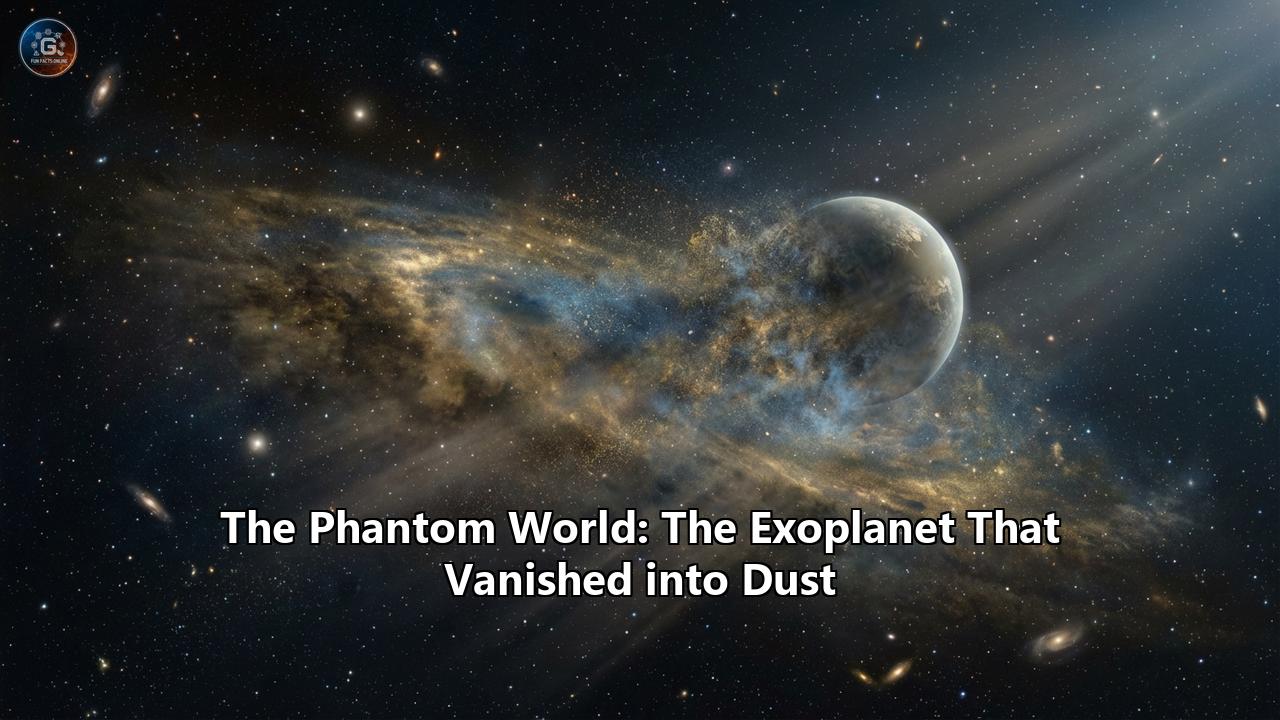
In the deep southern sky, in a constellation known to the ancients as the Southern Fish, burns a solitary beacon. To the casual observer standing in a dark field in late autumn, it is a lonely spark of white fire low on the horizon, far removed from the gregarious clusters of the Milky Way. This is Fomalhaut, the "Mouth of the Fish," a star that has captivated human imagination for millennia. It is a young, energetic A-type star, burning with a ferocity that belies its isolation. But for a brief, electrifying moment in the history of astronomy, Fomalhaut was not known for its solitude. It was known for its companion.
In 2008, the world of astronomy was shaken by an image that seemed to promise a new era of exploration. There, suspended in the ink-black void next to the blinding glare of the star, was a tiny, distinct point of light. It was not a graph, not a wobble in a data set, not a dip in brightness. It was a picture. For the first time in human history, it appeared that we had taken a direct photograph of a planet orbiting another star in visible light. It was named Fomalhaut b. It was hailed as a triumph, a "Science Photo of the Year," and a harbinger of the future where we would map the continents of distant worlds.
But Fomalhaut b was not what it seemed. It was a ghost.
Over the next decade, this celebrated world would behave in ways that baffled the greatest minds in astrophysics. It would drift where it shouldn't drift. It would glow with a light that violated the laws of thermal physics. And then, slowly, agonizingly, it would fade. By 2014, the planet had vanished completely. It had not moved behind the star; it had not been eclipsed. It had simply dissolved.
The story of Fomalhaut b is not a story of failure. It is one of the most remarkable detective stories in the annals of science. It is a tale that takes us from the ancient temples of Eleusis to the high-tech mirrors of the James Webb Space Telescope. It is a story about the violent, chaotic, and beautiful process of building worlds—and the equally violent process of destroying them. This is the chronicle of the planet that never was, and the spectacular phantom it left behind.
Part I: The Solitary Watcher
To understand the phantom, one must first understand the stage upon which it appeared. Fomalhaut is no ordinary star. Located approximately 25 light-years from Earth, it is effectively a cosmic neighbor. In the vast scale of the galaxy, it is right next door, shining with a visual magnitude of 1.16, making it the 18th brightest star in the night sky.
Throughout history, Fomalhaut has held a position of prestige. To the Persians, it was Hastorang, one of the four "Royal Stars" that guarded the heavens and marked the solstices and equinoxes. In 2500 BCE, it marked the winter solstice, a sentinel of the changing seasons. To the Arabs, it was Fum al-Hut, the literal "Mouth of the Whale" or fish, swallowing the stream of water poured by the constellation Aquarius. In the lore of the Cthulhu Mythos, writer August Derleth associated it with Cthugha, a Great Old One, perhaps sensing the chaotic energy that we now know surrounds it.
Physically, Fomalhaut is a beast compared to our Sun. It is roughly twice as massive and nearly twenty times as luminous. It burns hotter, appearing a stark, piercing white. But its most defining characteristic is its youth. Our Sun is a middle-aged star, a stable 4.6 billion years old. Fomalhaut is a toddler, estimated to be only about 440 million years old. It is in the violent throes of adolescence, a period of stellar life that is messy, energetic, and filled with debris.
This youth is the key to the mystery. In the 1980s, the Infrared Astronomical Satellite (IRAS) scanned the sky and found something peculiar about Fomalhaut. The star was emitting far more infrared radiation than it should have been. A pure star acts like a blackbody radiator; its light output follows a predictable curve based on its temperature. Fomalhaut showed an "infrared excess"—a glut of heat.
Astronomers quickly realized the implication: Fomalhaut was not alone. It was surrounded by dust. A massive amount of it. This dust was absorbing the star's blinding visible light and re-radiating it as faint heat. This was the first hint of the "Fomalhaut Debris Disk," a vast, ring-like structure of ice, rock, and dust circling the star. It was a signpost saying, "Planets are being born here."
In 2004, the Hubble Space Telescope turned its High Resolution Camera toward Fomalhaut, equipped with a coronagraph—a device designed to block out the blinding glare of the central star to reveal the faint structures around it. The resulting images were breathtaking. They revealed a sharp, eccentric ring of debris, looking for all the world like the Eye of Sauron. The ring was off-center, its geometric center displaced from the star by 1.4 billion miles.
In orbital mechanics, offsets don't happen by accident. If a ring of dust is off-center, or if it has a razor-sharp inner edge, something gravitational must be maintaining it. Something massive. Something like a planet.
The stage was set. The trap was laid. The astronomical community looked at that sharp, offset ring and collectively thought: There is a shepherd in the dark.
Part II: The Ghost in the Machine
The hunt for exoplanets—planets orbiting stars other than our Sun—has historically been a game of shadows. For decades, we found them only by inference. We watched a star and waited for it to wobble, tugged by the gravity of an unseen companion (the Radial Velocity method). Or we stared unblinking at a star, waiting for its light to dip by a fraction of a percent as a planet passed in front of it (the Transit method).
These methods are brilliant, but they are indirect. They give us graphs, charts, and mathematical probabilities. They do not give us pictures. To see a planet directly is an optical nightmare. A star like Fomalhaut is billions of times brighter than any planet orbiting it. Trying to see a planet next to a star is like standing in Boston and trying to see a firefly hovering next to a searchlight in New York City.
But Paul Kalas, an astronomer at the University of California, Berkeley, was determined. He had the Hubble data from 2004, and he returned to the telescope in 2006 for a second look. He was looking for the "shepherd," the gravitational architect responsible for the sharp inner edge of Fomalhaut’s debris ring.
When Kalas and his team aligned the images from 2004 and 2006, blinking them back and forth, they saw it.
Nestled just inside the inner edge of the massive dust ring, a tiny dot of light had moved. It wasn't a background star (which would remain stationary relative to the distant universe while Fomalhaut moved). It wasn't noise. It was a distinct object, moving in an arc that perfectly tracked the orbit one would expect for a planet at that distance.
The announcement in November 2008 was a media sensation. NASA released the image: the terrifyingly beautiful "Eye" of the debris ring, with a small inset box showing the tiny dot. "Fomalhaut b," they called it. It was estimated to be roughly the mass of Jupiter, perhaps up to three times larger. It was 115 astronomical units (AU) from its star, taking nearly 900 years to complete a single lonely orbit.
It was the Holy Grail. We had finally taken a family portrait of another solar system. We could point to that dot and say, "That is a world."
But almost immediately, the whispers began.
Part III: The Impossible Planet
Science is a ruthless editor. No sooner had the champagne corks popped than the anomalies began to pile up. Fomalhaut b was, to put it mildly, behaving badly.
The first problem was the light. When astronomers looked at the object through visible light filters (the light our eyes can see), Fomalhaut b was surprisingly bright. For a planet to shine that brightly in visible light, it must be reflecting a colossal amount of starlight. But a planet 115 AU from its star is in the eternal twilight. To be that bright, it would need to be huge—much larger than Jupiter—and have an incredibly reflective atmosphere.
The second problem was the heat. Or rather, the lack of it.
If Fomalhaut b were a massive young planet, it should still be glowing with the heat of its formation. Gas giants form by the gravitational collapse of hydrogen and helium. This process generates immense heat. A planet three times the mass of Jupiter, only 400 million years old, should be glowing like a hot ember in the infrared spectrum.
Astronomers turned the Spitzer Space Telescope, an infrared observatory, toward the dot. They expected to see a glowing beacon of heat. They saw nothing. The spot was dark in the infrared.
This was a profound contradiction. How could an object be bright enough to be seen in visible light but cold enough to be invisible in infrared? A massive planet should be hot. A small planet shouldn't be bright enough to see.
The theories began to spiral.
"Perhaps," some argued, "it is a smaller planet, maybe the size of Neptune, but it has a massive ring system." This became a popular theory. If the planet had rings dwarfing those of Saturn—ice rings wide enough to reflect vast amounts of starlight—it could explain the visible brightness. The planet itself could be small and cool, explaining the lack of infrared.
Others went further. "What if it's a 'neutron star' planet?" No, that didn't make sense. "What if it's a background galaxy?" No, the motion was too precise.
Then there was the orbit. As more data points were collected in 2010 and 2012, the trajectory of Fomalhaut b was refined. It wasn't following a nice, circular path shepherding the ring. It appeared to be on a highly elliptical orbit, one that would plunge it through the debris disk. A planet of that mass crashing through a debris disk would be a bull in a china shop. It would disrupt the very ring it was supposed to be shepherding. The sheer elegance of the "shepherd" theory was crumbling.
The astronomical community split into camps. There were the "Believers," who argued that the detection was robust and that our models of planetary atmospheres were simply incomplete. Maybe young planets had strange cloud layers we didn't understand. Then there were the "Skeptics," who argued that the physics didn't add up. They coined terms like "Zombie Planet"—a thing that looked like a planet but didn't have the heartbeat of one.
And then, the zombie started to rot.
Part IV: The Vanishing
The final nail in the coffin did not come from a new theory, but from the object itself. It simply gave up the ghost.
In 2014, Hubble looked again. The dot was fainter.
In subsequent checks, it was fainter still.
Eventually, it was gone.
Planets do not fade. They might vary slightly in brightness due to weather or seasons, but a Jupiter-sized world does not simply turn down its dimmer switch and vanish into the black. Furthermore, the object was expanding. The tight, point-like source of light seen in 2004 was spreading out, becoming fuzzy and diffuse.
In 2020, a team of astronomers led by András Gáspár and George Rieke of the University of Arizona published a paper in the Proceedings of the National Academy of Sciences that solved the mystery. Their conclusion was as dramatic as it was definitive: Fomalhaut b was never a planet.
We had been watching a car crash in slow motion.
The "planet," they proposed, was actually an expanding cloud of dust. A massive, dispersing plume of fine particles created by a titanic collision between two asteroids.
Here is the scenario they reconstructed: Sometime shortly before the 2004 observation, two icy planetesimals—think of them as super-comets or asteroids, each about 200 kilometers (125 miles) in diameter—slammed into each other.
To visualize this, imagine an object the size of the state of Massachusetts. Now imagine another one. Now imagine them colliding at speeds of thousands of miles per hour.
The energy released in such a collision is catastrophic. The bodies would have been instantly pulverized, vaporizing rock and ice and blasting a cloud of fine dust into space. This cloud, initially tight and dense, would reflect starlight brilliantly, mimicking the appearance of a solid planet. This was the "dot" Hubble saw in 2004 and 2006.
But unlike a planet, a dust cloud is not held together by self-gravity. It is at the mercy of the star. The intense radiation pressure from Fomalhaut—the physical push of photons hitting the dust grains—began to blow the cloud apart. As the dust spread out, the surface area increased, but the density dropped. The cloud expanded, becoming larger and more diffuse. Eventually, the particles spread so thin that they dropped below the detection threshold of the Hubble Space Telescope.
Fomalhaut b had not disappeared into another dimension. It had simply blown away in the stellar wind.
The "orbit" that had puzzled astronomers was not a planetary orbit at all. It was the escape trajectory of the debris cloud, pushed by the radiation pressure of the star. The "visible brightness" was the reflection off trillions of microscopic shards of ice and rock. The "lack of infrared heat" was because there was no massive planetary core generating warmth—just cold dust.
The Ghost World was real, in a sense. It was a real event. It was a cataclysm of biblical proportions, an explosion that would have wiped out life on any nearby world. We just happened to look at the exact right moment to see the fireball before it faded.
Part V: The Resurrection of the System
The realization that Fomalhaut b was a dust cloud was bittersweet. We had lost a planet, but we had gained something arguably more precious: a dynamic, moving picture of a solar system in action.
In astronomy, timescales are usually measured in millions or billions of years. To see a system change in human time—to watch a collision happen and the debris clear over the course of a decade—is unprecedented. It transformed Fomalhaut from a static picture into a movie.
But the story didn't end with the death of Fomalhaut b. The questions that led to its discovery remained. If Fomalhaut b wasn't the "shepherd" keeping that massive outer dust ring in place, then what was? The ring is still there. It still has a sharp inner edge. The physics still demand a gravitational influence.
Enter the James Webb Space Telescope (JWST).
Launched in 2021, JWST is the successor to Hubble, designed to see the universe in infrared with unprecedented clarity. While Hubble saw the "visible" ghost, JWST was built to see the "heat" of the dust itself. In 2023, astronomers trained the golden mirrors of JWST on Fomalhaut.
What they found was shocking. They expected to see the outer ring (the "Kuiper Belt analog") in better detail. They did. But they also found that the Fomalhaut system is far more complex than a simple star and a ring.
JWST revealed a Russian-nesting-doll structure of debris.
- The Inner Disk: An asteroid belt close to the star, swarming with warm dust.
- The Intermediate Belt: A second, previously unknown ring of debris, tilted at a jaunty 23-degree angle relative to the outer ring.
- The Outer Ring: The massive, famous "Eye of Sauron" ring we knew about.
This architecture is screaming "Planets!" You don't get three distinct, nested, misaligned rings of debris without massive objects carving them out. The gaps between these rings are likely the orbital paths of actual planets—true worlds that are shepherding the dust, just as we originally thought Fomalhaut b was doing.
We haven't seen these planets yet. They are likely smaller or cooler than Fomalhaut b was thought to be, or perhaps they are hidden in the glare. But the geometry of the system is a dead giveaway. The tilted intermediate belt, in particular, suggests a chaotic history. Perhaps a planet on a wild, inclined orbit is disrupting the system, scattering asteroids and creating the misalignment.
Furthermore, JWST found another "blob" in the outer ring. Dubbed the "Great Dust Cloud," it appears to be another evidence of a collision, though different from the Fomalhaut b event. This suggests that the Fomalhaut system is a shooting gallery. It is in a state of "Late Heavy Bombardment," similar to what our own Solar System went through 4 billion years ago.
In that era, Earth was pummeled by asteroids, likely delivering our water and organic compounds. Looking at Fomalhaut is like looking at a time machine. We are watching the violent assembly of a planetary system. The "disappearing planet" was just one casualty in a war of gravity and rock that has been raging for millions of years.
Part VI: The Lesson of the Phantom
The saga of Fomalhaut b teaches us a profound lesson about the limits of human perception and the dangers of confirmation bias.
When we saw a dot moving near a star, we wanted it to be a planet. We needed it to be a planet. The "shepherd" theory fit so perfectly that we interpreted the data through that lens. We assumed the light was reflection from a surface or an atmosphere. We assumed the orbit was Keplerian. We assumed stability.
But the universe is often far more creative and violent than our assumptions allow. It created a "fake planet" out of a cloud of shrapnel just to confuse us.
This phenomenon—"False Positives"—is one of the greatest challenges in the hunt for life. As we build bigger telescopes like the future Habitable Worlds Observatory, we will see more faint dots. Some will be planets. Some will be dust clouds. Some might be background stars. Some might be tricks of the light caused by the optics of the telescope itself (speckles).
The case of Fomalhaut b has sharpened our tools. We now know that "brightness in visible light" + "darkness in infrared" = "dust cloud." We have better models for how debris expands. We are more cautious, more rigorous. Fomalhaut b, by fooling us, made us better astronomers.
It also highlighted the concept of the "Zombie Planet" in a broader context. We have found other worlds that shouldn't exist, or that disappear.
- Kepler-1649b: Once thought to be a false positive, then "resurrected" as a real Earth-sized planet.
- Alpha Centauri Bb: A planet announced with great fanfare in 2012, only to be debunked later as a ghost signal in the data analysis.
- HD 131399Ab: Direct imaged as a planet in a triple star system, later reclassified as a background star that just happened to be passing by.
These ghosts are the growing pains of a species learning to see in the dark.
Part VII: The Future of the Fish's Mouth
Fomalhaut remains a priority target for every major telescope. The Roman Space Telescope, set to launch later this decade, will have a coronagraph even more advanced than Hubble's. It may be able to spot the real planets hiding in the gaps of the rings revealed by JWST.
Astronomers are now looking for the "shepherds" of the intermediate belt. What kind of planet tilts a debris ring by 23 degrees? A scattered ice giant? A rogue super-Earth?
And what of the dust cloud formerly known as Fomalhaut b? It is still expanding. In a few decades, it will be so diffuse it will be indistinguishable from the background dust of the galaxy. The atoms that made up those two colliding asteroids will drift through the void. perhaps one day to be swept up by another forming world, or to seed the atmosphere of a gas giant.
The Fomalhaut system is a dynamic, living laboratory. It reminds us that solar systems are not clockwork mechanisms of brass and gears, set in motion and left to tick eternally. They are messy, evolving, organic entities. They digest themselves. They smash things together. They create illusions.
When you look at Fomalhaut tonight, blinking low in the southern sky, don't think of it as a lonely star. Think of it as a chaotic construction site. Think of the Great Dust Cloud. Think of the tilted rings. And spare a thought for Fomalhaut b, the phantom world that vanished into dust. It may not have been a planet, but it was real. It was a witness to the violence of creation, a fleeting spark in the dark that told us more about the universe than a thousand stable worlds ever could.
We went looking for a world, and we found a catastrophe. And in science, a catastrophe is often far more interesting. The phantom has faded, but the hunt has just begun.
Chapter 8: The Physics of the Vanishing Act
To truly appreciate the "magic trick" of Fomalhaut b’s disappearance, one must delve into the physics of light and dust. It is a masterclass in how scale and composition dictate reality in the cosmos.
The core of the mystery lay in the size of the particles. When the two asteroids collided, they didn't just break into pebbles; they were pulverized into micron-sized dust grains. To put this in perspective, a micron is one-millionth of a meter. A human hair is roughly 70 microns wide. The cloud that mimicked a planet was composed of particles as fine as smoke.
This specific size is crucial. Dust grains of this size are incredibly efficient at scattering visible light. This is why a relatively small amount of mass—roughly the mass of an asteroid—could create a cloud with enough surface area to reflect as much light as a Jupiter-sized planet. It’s the difference between a block of ice and a snowstorm. A solid block of ice reflects some light, but if you shave that ice into snow and blow it into a cloud, it becomes a blinding white wall. The surface area explodes exponentially.
However, this same "smoke" has a weakness: it cannot hold onto heat. A massive planet has a core, a reservoir of thermal energy. It radiates in the infrared because it is warm. A cloud of micron-dust has no thermal mass. It cools instantly to the temperature of deep space, warmed only slightly by the distant starlight. This explained the paradox that stumped astronomers for a decade: the object was a "snowstorm" (bright in visible light) rather than a "hot rock" (bright in infrared).
But the final act—the disappearance—was driven by radiation pressure. Light carries momentum. When photons from a star as luminous as Fomalhaut hit a dust grain, they exert a tiny physical push. For a large object like a planet or even a pebble, this push is negligible. But for a micron-sized grain, the force of the starlight is stronger than the gravitational pull of the star.
Imagine standing in a hurricane. If you hold a bowling ball (a planet), the wind (starlight) won't move it. If you throw a handful of flour (the dust cloud) into the air, the wind seizes it instantly.
The "orbit" we saw Fomalhaut b following was not an orbit at all; it was the trajectory of the dust being blown out of the system. The cloud was effectively "evaporating" into the interstellar medium. As the cloud expanded, the space between the grains grew. The "white wall" of the snowstorm became a thin fog, and then a clear mist, until finally, the telescope looked right through it.
Chapter 9: The Shepherds in the Shadows
While Fomalhaut b is gone, the evidence for other planets in the system is now stronger than ever, ironically reinforced by the very JWST observations that confirmed Fomalhaut b's demise.
The sheer complexity of the debris rings is the smoking gun. In the 1980s, we thought debris disks were simple, broad doughnuts of dust. Fomalhaut has proven they are intricate precision instruments.
The "gap" between the newly discovered inner asteroid belt and the tilted intermediate belt is about 70 astronomical units wide. Gaps in dust disks are rarely empty. Nature abhors a vacuum. If there is a gap, it is usually because something has cleared it. A planet, orbiting in that dark lane, would sweep up the dust, eating it or flinging it away with its gravity.
This hypothetical planet—let's call it "Fomalhaut c" for now—would be the true shepherd. It would need to be massive enough to carve the gap but not so massive that it disrupts the entire system. The tilt of the intermediate belt (23 degrees) offers a clue. It suggests that "Fomalhaut c" might have had a violent history itself, perhaps undergoing a scattering event with another planet that kicked it onto an inclined orbit.
We are seeing the architectural blueprints of a solar system, but the architects themselves are hiding in the dark. Finding them will require the next generation of direct imaging technology. We need to block the starlight even more effectively, or look for the faint thermal glow of these smaller planets against the background of the dust.
Chapter 10: The Cosmic Mirror
Ultimately, Fomalhaut holds up a mirror to our own origins. We live in a quiet, stable solar system. Our planets move like clockwork; our asteroid belt is a thin, harmless ribbon of rock; our zodiacal dust is a faint glow. It is easy to think this is how it always was.
Fomalhaut shows us the truth. It shows us the terror of our own youth.
Four billion years ago, the Solar System looked like Fomalhaut. Jupiter and Saturn were likely migrating, shifting their orbits. Their movement destabilized the Kuiper Belt, sending showers of asteroids and comets raining down into the inner solar system. This was the Late Heavy Bombardment. If an alien astronomer had looked at our Sun 4 billion years ago, they would have seen a massive, bright debris disk. They might have seen "expanding dust clouds" from collisions where the Earth and Moon were being formed or pummeled.
They might have seen a "Fomalhaut b" here—a phantom cloud from two protoplanets destroying each other to make way for the Earth.
We study Fomalhaut not just to find new worlds, but to remember how we got here. We are the survivors of the dust. The phantom world of Fomalhaut b is a ghost of our own past, a fleeting reminder that the universe is built on the wreckage of collisions.
The dot is gone. The mystery is solved. But the wonder remains, burning bright in the mouth of the Southern Fish.
Reference:
- https://kids.britannica.com/students/article/Fomalhaut/311283
- https://www.cnet.com/science/astronomers-solve-mystery-of-the-vanishing-planet-with-new-nasa-data/
- https://www.sci.news/astronomy/fomalhaut-b-planetesimal-collision-08347.html
- https://www.nasa.gov/universe/new-study-brings-a-doubted-exoplanet-back-from-the-dead/
- https://en.wikipedia.org/wiki/Fomalhaut
- https://skyandtelescope.org/astronomy-news/meet-fomalhaut-the-autumn-star/
- https://www.academicsresearchclub.com/literature/the-eunolia-club-fomalhaut-the-star
- https://www.gizmochina.com/2023/05/09/jwst-asteroid-belt-fomalhaut-discovery/
- https://www.sci.news/astronomy/webb-three-debris-belts-fomalhaut-a-11899.html
- https://astrobiology.com/2023/05/webb-space-telescope-reveals-the-complexity-of-fomalhauts-evolving-asteroid-belt.html
- https://www.vaticanobservatory.org/sacred-space-astronomy/webb-finds-two-additional-asteroid-belts-around-the-young-star-fomalhaut/
- https://biz.chosun.com/en/en-science/2025/12/20/VIHBOYYDYFACPD2ZLVU445ZWKI/
- https://thedebrief.org/this-is-a-new-phenomenon-massive-collisions-occurring-around-fomalhaut-are-challenging-models-of-planet-formation/
- https://en.wikipedia.org/wiki/List_of_directly_imaged_exoplanets
- https://news.arizona.edu/news/nearby-planetary-system-seen-breathtaking-detail
- https://en.wikipedia.org/wiki/List_of_potentially_habitable_exoplanets