
In the hushed, sterile air of a modern laboratory, a ghost was summoned. It did not arrive with a rattle of chains or a spectral moan, but with a whisper of scent—a complex, resinous breath that had been held in the darkness of a limestone canopic jar for over three and a half millennia. This was the "Scent of Eternity," the olfactory soul of the noblewoman Senetnay, released from the silence of the Valley of the Kings to speak to the living once more.
For centuries, our understanding of Ancient Egypt has been dominated by the visual: the golden mask of Tutankhamun, the colossal statues of Rameses, the precise geometry of the Pyramids. We gaze upon their history, separated by the glass of museum cases and the insurmountable wall of time. But a groundbreaking collaboration between the Max Planck Institute of Geoanthropology and the University of Hawaii has shattered that glass wall. By decoding the molecular fingerprints of ancient balms, they have allowed us to do something previous generations of Egyptologists could only dream of: we can now inhale the past.
This article invites you on a sensory odyssey into the heart of the ancient world. We will travel from the high-tech chromatography labs of Germany to the sun-drenched trade routes of the Bronze Age, from the sacred embalming workshops of Thebes to the rain-soaked jungles of Southeast Asia. We will decode the chemical secrets of immortality, explore the spiritual theology of smell, and uncover how a single jar of balm rewrote the history of global trade. This is the story of the smell of eternity.
Part I: The Noblewoman in the Valley
To understand the scent, we must first understand the woman who wore it. Her name was Senetnay, and while she was not a queen by blood, she held a position of intimacy and influence that rivaled the royal family. Living around 1450 BCE, during the height of the 18th Dynasty, Senetnay was the wet nurse to the future Pharaoh Amenhotep II.
In the hierarchical world of the Egyptian court, the role of "Royal Wet Nurse" was far more than domestic service; it was a bond of milk and blood that elevated a family to the highest echelons of power. Senetnay was the woman who held a god-king at her breast. Her milk nourished the body that would one day sit upon the throne of the Two Lands. Because of this sacred bond, she was granted the title "Ornament of the King" and accorded a privilege rarely given to non-royals: burial in the Valley of the Kings.
Her tomb, KV42, was discovered in 1900 by Howard Carter, decades before his world-changing discovery of Tutankhamun. But unlike the boy king’s tomb, KV42 had been heavily looted. The golden masks and jeweled amulets were gone. What remained, ignored by treasure hunters but priceless to science, were the canopic jars—the limestone vessels carved with the heads of gods, designed to hold the visceral organs of the deceased for eternity.
Inside these jars, protecting Senetnay’s lungs and liver, lay the remnants of the embalming balms. For over a century, these jars sat in the Museum August Kestner in Hanover, Germany, their contents drying into black, nondescript sludge. It was not until 2023 that a team led by Barbara Huber decided to subject this sludge to the full force of modern forensic science. What they found was not just a preservative; it was a masterpiece of chemical engineering and a testament to the sheer wealth of Senetnay’s station.
Part II: The Science of Resurrection
How do you smell a ghost? The process is known as "olfactory archaeology," a discipline that marries the romance of history with the rigorous precision of analytical chemistry.
The team used a technique called Gas Chromatography-Mass Spectrometry (GC-MS). To imagine how this works, picture the ancient balm as a complex choir of thousands of singers, all humming different notes at once. Our nose hears the whole choir as a single smell. GC-MS acts like a strict conductor who separates every single singer, lining them up one by one and demanding they identify themselves.
The researchers took microscopic samples from the residues in Senetnay’s jars. These samples were heated until they vaporized, releasing the volatile organic compounds—the molecules responsible for smell—that had been trapped in the balm’s matrix for 3,500 years. As these molecules traveled through the gas chromatograph, they separated based on their size and chemical properties. The mass spectrometer then bombarded them with electrons, breaking them into fragments that created a unique "fingerprint" for each substance.
The results were staggering. The balm was not a simple mixture of fat and oil. It was a sophisticated, multi-ingredient concoction that showed a profound understanding of preservation and perfumery. The analysis revealed a blend of:
- Beeswax: The base of the balm, used for its sealing properties and antibacterial nature.
- Bitumen: A black, tar-like substance often sourced from the Dead Sea, used to waterproof and seal the body.
- Plant Oils: Likely sesame or castor oil, serving as a carrier for the fragrances.
- Animal Fats: Providing body and richness to the unguent.
- Coniferous Resins: Specifically from the Larch tree and the genus Pinus, which are potent antiseptics.
- Dammar or Pistacia Resin: The "smoking gun" ingredient that stunned the scientific community.
- Coumarin and Vanillic Acid: Chemical compounds that give scents of sweet grass, vanilla, and cinnamon.
This was not merely a preservative; it was a perfume of immense complexity. It was designed to ensure that Senetnay entered the afterlife not as a rotting corpse, but as a fragrant, divine being.
Part III: Deconstructing the Scent of Eternity
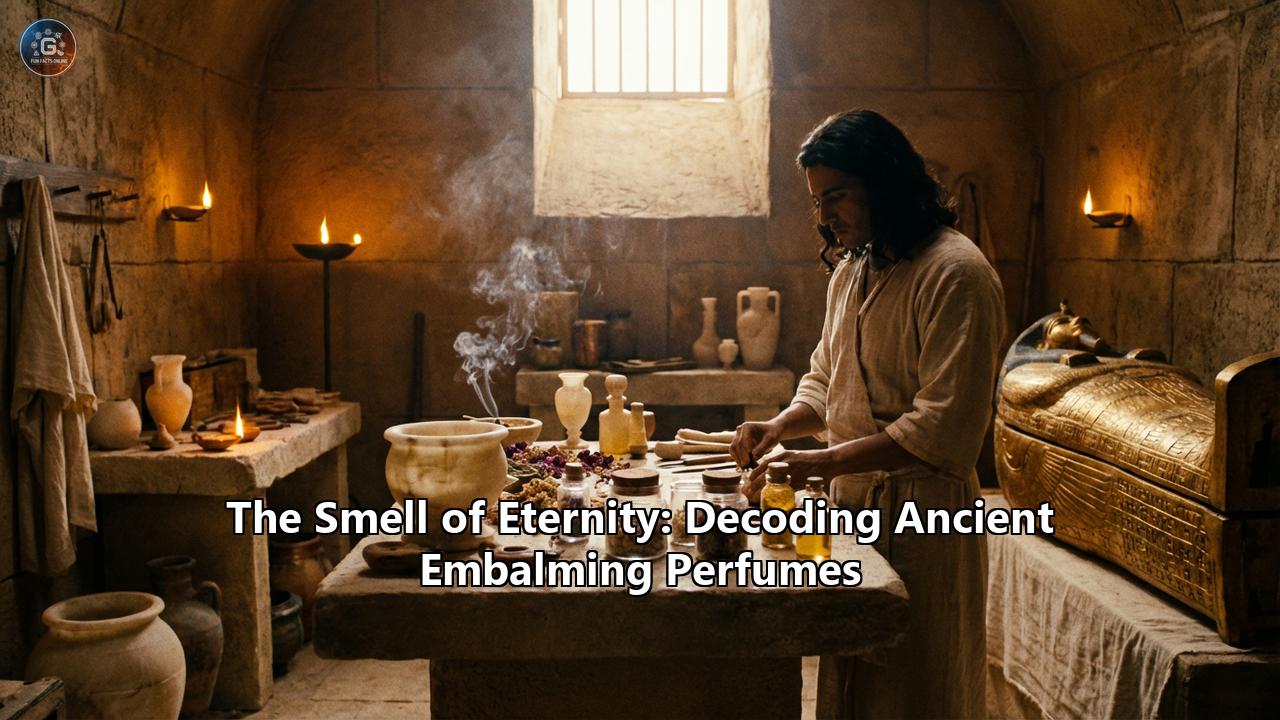
Let us close our eyes and reconstruct this scent, layer by layer, as if we were the master embalmers of Thebes mixing it in the cool shade of the workshop.
The Base Notes: The Earthy FoundationThe foundation of the scent was bitumen and beeswax. Bitumen, naturally occurring crude oil, has a heavy, sulfurous, tar-like smell. To the modern nose, it smells like fresh asphalt or a hot road in summer. However, in the balm, this harshness was tempered by the warm, honeyed, animalic scent of beeswax. This combination created a dark, sticky, grounding aroma—the smell of the earth itself, rich and sealing.
The Heart Notes: The Forest and the SeaRising from this dark base were the coniferous resins. The analysis identified Larch resin, which has a strong, turpentine-like, green, and woody scent. It smells of pine needles crushed between fingers, of clean mountain air. This was the scent of purification. Unlike the hot, dusty air of Egypt, these resins carried the fresh, sharp scent of northern forests, a smell that must have seemed exotic and cooling to the inhabitants of the Nile Valley.
The Top Notes: The Sweetness of LifeFloating above the heavy resins were the lighter, sweeter aromatics. The presence of coumarin and vanillic acid suggests the use of ingredients that degrade into these sweet, hay-like, and vanilla-scented compounds. This could have come from specific grasses, barks, or the degradation of the wood resins themselves. This added a layer of comfort and luxury, a "gourmand" quality that softened the medicinal sharpness of the pine and the heavy tar of the bitumen.
The Exotic Twist: The Mystery of DammarThe most fascinating note in the perfume comes from the resin that is likely Dammar. Dammar resin has a light, fresh, citrusy scent, often described as lemony and clean. It lifts the entire composition, adding a brightness that signifies "life" amidst the heavy scents of preservation.
The Olfactory ProfileWhen combined, the "Scent of Eternity" would have been a powerful, overwhelming sensory experience. It was resinous, warm, woody, slightly medicinal, with an undercurrent of sweet vanilla and tar. It was not a delicate floral perfume like a modern Chanel; it was a thick, heavy, protective scent. It smelled of sacred ritual, of temples, of safety. It was the smell of a barrier being erected between the fragile body and the ravages of decay.
Part IV: The Global Trade Network – The Scent of Globalization
The discovery of Dammar resin in Senetnay’s balm dropped a bombshell on the archaeological world. Why? Because the trees that produce Dammar (of the family Dipterocarpaceae) do not grow in Egypt. They do not grow in the Near East. They do not grow in Africa.
They grow in the tropical rainforests of Southeast Asia—in modern-day Indonesia, Malaysia, and the Philippines.
For decades, we believed that Egyptian trade routes were largely regional, stretching perhaps as far as Mesopotamia, Crete, and the land of Punt (likely Eritrea/Somalia). The presence of Dammar resin in a jar from 1450 BCE implies that long before the Silk Road, long before the Roman Empire, there was a "Proto-Global" trade network connecting the jungles of Borneo to the tombs of Thebes.
Imagine the journey of that resin. It was tapped from a towering tree in a Southeast Asian rainforest by a harvester who would never know of Egypt. It was carried on small boats through the Indonesian archipelago, traded in the ports of India, carried across the Indian Ocean by dhows riding the monsoon winds, offloaded in the ports of the Red Sea or the Persian Gulf, carried by camel caravan across the burning deserts, and finally sold in the bustling markets of Thebes.
By the time it reached the embalmer’s workshop, this resin was more precious than gold. It had traveled thousands of miles. The Egyptians may not have known exactly where it came from—calling it perhaps "resin of the God's Land"—but they knew it was rare, exotic, and possessed powerful preservative qualities.
The inclusion of such a rare ingredient in Senetnay’s balm speaks volumes about her status. The Pharaoh Amenhotep II spared no expense for his beloved wet nurse. He wrapped her not just in linen, but in the fruits of the entire known world. Her body became a microcosm of global trade, a repository of the world’s most precious substances.
Part V: The Art of Embalming – Survival of the Scent
To the ancient Egyptians, the preservation of the body was not just about keeping the flesh intact; it was about transfiguring the corpse into a divine statue, an Sah. The word for "to embalm" (wt) was closely related to the word for "statue" or "dignity."
The process took 70 days, a period mirroring the time the star Sirius disappeared from the sky before rising again—a celestial cycle of death and rebirth.
- Purification (Days 1-15): The body was washed with Nile water and palm wine. The brain was removed (usually through the nose), and the internal organs were extracted through an incision in the flank. These organs were washed, treated with natron, and embalmed separately—this is where Senetnay’s scented lungs and liver were placed into her canopic jars.
- Desiccation (Days 16-55): The body was packed in dry natron (a natural salt mixture found in wadis). This was the most crucial biological step. The salt drew all moisture from the flesh, stopping bacteria from rotting the tissue. But natron also dried out the skin, leaving it brittle and grey.
- Anointing and Wrapping (Days 56-70): This is where the "Scent of Eternity" came into play. The desiccated body was now a shell. To make it "live" again, the embalmers had to restore its suppleness and, crucially, its scent.
The embalmers massaged the body with the sacred oils and resins we identified earlier. This was not just moisturizing; it was a ritual act of sealing the body against the forces of chaos (decay). The heated resins—liquid and golden—were poured into the body cavity and over the skin. As they cooled, they hardened into a glass-like shell (biomolecular glass), physically blocking bacteria and sealing the scent inside.
The priests whispered spells as they worked, identifying each oil with a god. "I give you the Eye of Horus to scent your face," they might chant as they applied the resin. The bandages were dipped in the balm, layer after layer, creating a fragrant cocoon.
When Senetnay was finally lowered into her tomb, she did not smell of death. She smelled of the forest, the earth, and the exotic east. She was an olfactory masterpiece, prepared to meet Osiris.
Part VI: Sacred Scents & The Theology of Smell
Why were the Egyptians so obsessed with scent? In our modern world, we view perfume as a cosmetic, a way to attract a partner or mask body odor. In Ancient Egypt, scent was theological.
The Breath of LifeThe Egyptians observed that living things smelled sweet or neutral, while dead things smelled putrid. Therefore, foul odors were the smell of chaos (Isfet), of breakdown, of death. Sweet smells were the smell of order (Ma’at), of life, of the divine. To smell good was to be alive. To smell divine was to be a god.
In the Hall of Judgment, where the heart was weighed against the feather of truth, the deceased had to be pure. A rotting body was a sign of impurity. By saturating the body in antibacterial, fragrant resins, the embalmers were literally halting the process of chaos. They were freezing the body in a state of "sweetness" so that the gods would recognize the deceased as one of their own.
Nefertem: The God of PerfumeThe patron deity of this fragrant world was Nefertem, often depicted as a beautiful young man with a blue lotus flower on his head. Nefertem was the "Lord of Perfume." Myth says that he rose from the primordial waters at the dawn of creation as a blue water lily. When the petals opened, the sun god Ra emerged, and the sweet scent of the flower was the first thing to exist in the universe.
Thus, perfume was not made; it was the original state of creation. To apply perfume was to participate in the act of creation itself.
The Nostrils of the GodsStatues of gods in temples were not just stone idols; they were considered living vessels for the divine spirit. But a spirit would not inhabit a dirty or odorless vessel. Every morning, the high priest would break the seal of the shrine and perform the "Toilet of the God." This involved washing the statue and anointing it with the "Seven Sacred Oils." Incense was burned constantly. The Egyptians believed the gods had "beautiful nostrils" and fed upon the scent of incense. The smoke rising from the altar was a physical bridge connecting the earth to the heavens—a stairway of scent for prayers to ascend.
Part VII: Kyphi – The Smoke of the Gods
While Senetnay’s balm was for the dead, the living world of Egypt was equally saturated with scent. The most famous of all ancient perfumes was Kyphi (or Kapet in Egyptian).
Kyphi was not just an incense; it was a medicine, a relaxant, and a holy offering. It was burnt in the temples at dusk. The daily ritual of the sun god Ra was marked by three scents:
- Morning: Frankincense (to awaken and purify).
- Noon: Myrrh (to connect to the heat of the sun).
- Evening: Kyphi (to lull the god to sleep and ensure a safe journey through the underworld).
We have recipes for Kyphi inscribed on the walls of the temples at Edfu and Philae. It was a labor-intensive process that took weeks to complete. It was less like making perfume and more like alchemy.
The ingredients (often 16 in total) included:
- Honey and Wine (the liquid base).
- Raisins (for sweetness and fermentation).
- Frankincense and Myrrh.
- Sweet Flag (Calamus) and Lemon Grass.
- Cinnamon and Cassia bark.
- Juniper berries.
- Mastic and Pine resin.
These ingredients were ground, soaked in wine, cooked with honey, and left to ferment and mature. The result was a sticky, black paste that was rolled into pellets. When placed on hot charcoal, Kyphi released a heavy, sweet, spicy, and narcotic smoke. Greek writers like Plutarch praised Kyphi, claiming it could "lull one to sleep, allay anxieties, and brighten dreams." It was the Xanax of the ancient world, a spiritual sedative that cleansed the home and the mind.
Part VIII: The Smellscape of Ancient Egypt
If we could walk the streets of Thebes in 1450 BCE, what would we smell?
History is often sanitized, but the "smellscape" of an ancient city was a landscape of extremes.
- The River: The Nile would smell of mud, fish, and wet reeds—a fertile, heavy scent.
- The City: Narrow streets would assault the nose with the smells of roasting meat, baking bread, animal dung, and human waste. Hygiene was valued, but sewage systems were primitive.
- The People: To combat the smells of the heat and the city, the Egyptians became the cleanest people of the ancient world. They bathed daily, shaved their bodies to prevent lice and odor, and applied deodorizing oils.
One of the most iconic images of Ancient Egyptian art shows men and women at banquets with white cones perched on top of their wigs. For years, scholars debated what these were. The prevailing theory is that they were cones of scented animal fat (tallow) and beeswax, infused with myrrh or flowers. As the party went on and the room grew hot, the wax would slowly melt, dripping perfumed oil down the guests’ wigs and over their shoulders, surrounding them in a cooling, fragrant aura and keeping their linen clothes smelling sweet.
Scent was a class marker. The poor smelled of sweat, fish, and onions. The rich smelled of lilies, cardamom, and exotic resins. To smell Senetnay walking by would be to smell the scent of power.
Part IX: Olfactory Archaeology – The Future of History
The recreation of Senetnay’s scent is part of a revolution in how we experience history. For too long, museums have been "ocularcentric"—focused only on the eyes. We look at a vase, we read a placard. But this is a passive, detached experience.
Smell is different. It is the only sense that bypasses the thalamus and goes directly to the amygdala and hippocampus—the parts of the brain responsible for emotion and memory. This is why the smell of crayons instantly takes you back to kindergarten, or the smell of a specific perfume reminds you of a lost love. Smell is an emotional time machine.
The Museum ExperienceAt the Moesgaard Museum in Denmark, where the "Scent of Eternity" was first exhibited, visitors didn't just look at Senetnay’s jar. They walked into a room and inhaled her presence. Reactions were visceral. Some found the scent comforting and warm, reminding them of old churches or forests. Others found the bituminous note unsettling, a reminder of mortality. But no one was indifferent.
By recreating these scents, scientists like Barbara Huber are giving us a "sensory bridge." They are transforming the dry figures of history books into living, breathing humans who cared about how they smelled, who loved luxury, who feared decay.
This field is expanding. Scientists are now swabbing the teeth of skulls to determine the diet (and breath) of ancient people. They are analyzing the air trapped in sealed tombs. They are reconstructing the smell of the Battle of Waterloo (gunpowder, mud, sweat, and horses) and the smell of Victorian London. We are entering an era where we will be able to smell the past as clearly as we can see it.
Part X: Conclusion – The Immortal Scent
Senetnay died 3,500 years ago. Her body, though carefully mummified, has likely been ravaged by time and looters. Her name was almost forgotten, a footnote in the history of the 18th Dynasty.
But the ancient Egyptians believed that "to speak the name of the dead is to make them live again." Today, we have done more than speak her name. We have breathed her air.
The embalmers of KV42 succeeded in their mission, though perhaps not in the way they intended. They did not preserve her flesh for eternity, but they preserved her essence. The complex chemistry of the balm—the bees that gathered the wax, the trees that bled the resin in the humidity of Borneo, the traders who walked the desert sands—all of it was captured in that limestone jar, waiting for us to find it.
When we smell the "Scent of Eternity," we are not smelling a chemical recreation. We are smelling the love of a Pharaoh for his wet nurse. We are smelling the fear of death and the hope for rebirth. We are smelling the smoke of the temples and the sap of the forest. We are inhaling the very breath of the ancient world, proving that while stone may crumble and gold may be stolen, scent—elusive, invisible, fragile scent—can truly last forever.
Reference:
- https://magmaperfumes.com/blogs/scent-stories-fragrance-journey-magma-perfumes/ancient-perfume-making-techniques-magma-perfumes
- https://www.kemetspiritualjourneys.com/our-blogs-and-videos/sacred-scents-perfume-incense-and-aromatic-rituals-in-ancient-egypt
- https://ancientegyptonline.co.uk/nefertum/
- https://www.atlasobscura.com/articles/perfume-of-ancient-egyptian-death
- https://en.wikipedia.org/wiki/Nefertem
- https://drvictorbodo.com/2024/08/10/nefertem-the-egyptian-god-of-lotuses-and-perfumes/
- https://www.teachers-academy.org/blog/nefertum-god-of-perfumers
- https://kids.britannica.com/students/article/Nefertem/312663
- https://www.kitchenwitchhearth.net/post/kyphi-incense-by-rachel-patterson
- https://ancientegyptonline.co.uk/kyphi/
- https://www.egyptian-botanicals.com/blogs/blogs/egyptian-musk-and-the-ancient-art-of-perfumery
- https://en.wikipedia.org/wiki/Kyphi