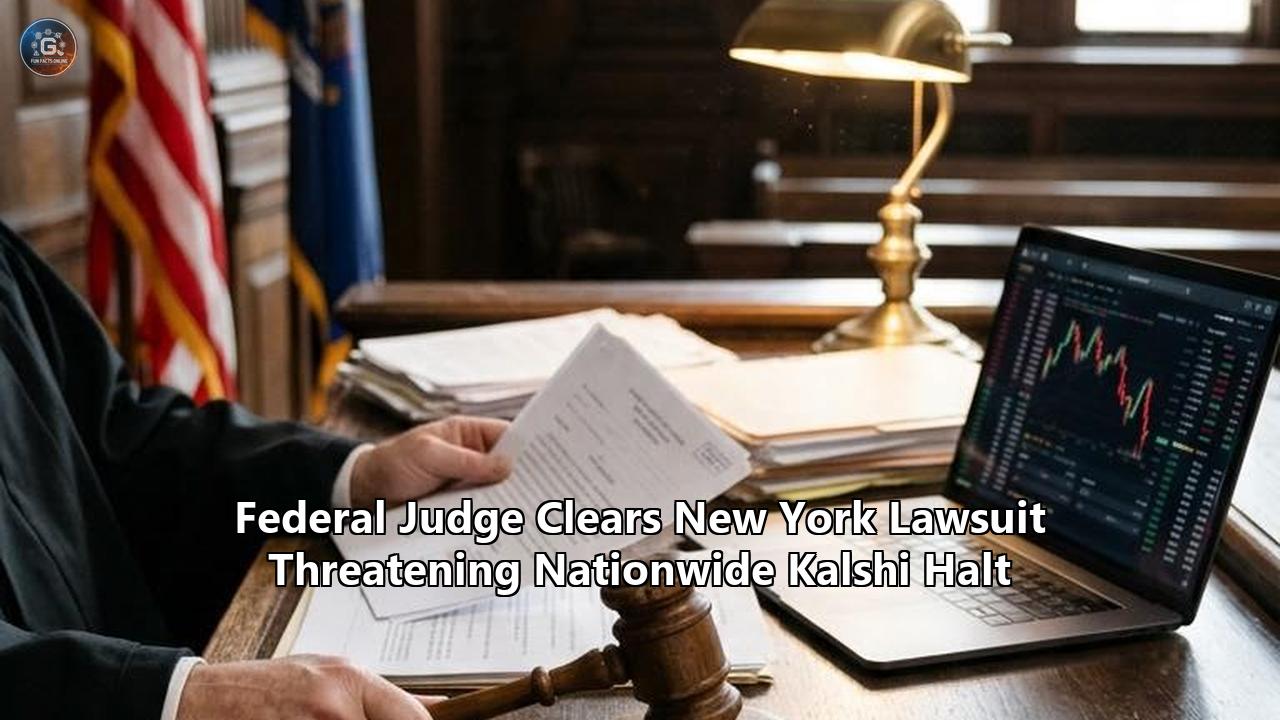
Late Friday afternoon in Manhattan, a federal judge dismantled the legal barricade that prediction market operator KalshiEX LLC and federal commodities regulators spent months constructing. By rejecting an emergency plea from the Commodity Futures Trading Commission (CFTC) to halt New York’s state-level enforcement action, U.S. District Judge Lorna Schofield sent the dispute back into state court, positioning the company at the precipice of an operational shutdown that could freeze its exchange nationwide.
The ruling capped 48 hours of rapid procedural maneuvers inside the U.S. District Court for the Southern District of New York. On Thursday, U.S. District Judge Vernon Broderick granted New York Attorney General Letitia James’s motion to remand her $36 billion enforcement lawsuit against Kalshi back to the New York County Supreme Court, concluding that federal courts lacked subject-matter jurisdiction over the state's claims. The CFTC, intervening to protect what it considers its exclusive regulatory domain over domestic derivatives, requested an emergency hearing at 5:00 p.m. on Friday to secure a temporary restraining order (TRO) against the state.
Judge Schofield denied the CFTC’s motion from the bench. In her ruling, Schofield determined that the federal regulatory agency had "not established a likelihood of success on the merits" regarding its primary legal theory: that the federal Commodity Exchange Act (CEA) preempts states from enforcing their own gaming, licensing, and consumer protection laws against federally registered event-contract exchanges.
The immediate consequence of Schofield’s decision shifts the battlefield to Manhattan Supreme Court Justice Melissa Crane. The New York Attorney General's Office is petitioning Justice Crane for an emergency order enjoining Kalshi from offering or operating its exchange "within or from New York".
Because Kalshi is headquartered in New York City and runs a unified, centralized clearing model, company counsel warned that state-level language prohibiting operations from New York would mandate a nationwide blackout. In a letter to Justice Crane, Milbank partner Sean Murphy, representing Kalshi, cautioned that granting New York's requested relief "would likely force the liquidation of all open positions, disrupting markets far beyond this State" and "shut down a federally regulated exchange for every customer, everywhere".
CFTC attorney Andrew Weisberg echoed those stakes during the emergency federal hearing, warning Judge Schofield that "the temporary restraining order New York seeks would completely shut down Kalshi's operations nationwide. There is no greater irreparable harm than one of our regulated markets being completely disrupted".
This confrontation is more than an isolated fight over sports wagers and political forecasts; it is a defining case study in jurisdictional friction between federal administrative agencies and state police powers. By treating this ruling as a lens into regulatory federalism, corporate architecture, and administrative overreach, market participants and legal analysts can extract structural principles that explain why fintech innovators repeatedly find their federal regulatory shields vulnerable to state-level prosecution.
Dissecting the Conflict: Swaps vs. Wagers
At the center of the dispute between Kalshi and the State of New York lies a statutory collision between financial market regulation and traditional gambling prohibitions. The legal debate turns on whether trading event contracts constitutes the execution of financial derivatives or the placement of unlicensed bets.
                     JURISDICTIONAL DIVIDE

       FEDERAL OVERSIGHT                    STATE REGULATION
   (Commodity Exchange Act)             (State Police Powers)
              │                                   │
              ▼                                   ▼
┌───────────────────────────┐       ┌───────────────────────────┐
│     CFTC Jurisdiction     │       │ State Gaming Commissions  │
│  • Exclusive authority    │       │  • Criminal gambling laws │
│    over "swaps" & DCMs    │       │  • Age restrictions (21+) │
│  • CEA Section 2(a)(1)(A) │       │  • Consumer protection    │
│  • Promotes price discovery│      │  • Local tax generation   │
└─────────────┬─────────────┘       └─────────────┬─────────────┘
              │                                   │
              └───► [ EVENT-BASED CONTRACTS ] ◄───┘
                    Binary Payoff: $0.00 or $1.00
                    Underlying: Real-World Events
Kalshi’s legal defense relies on its designation as a Designated Contract Market (DCM), approved by the CFTC in November 2020. Under Section 2(a)(1)(A) of the Commodity Exchange Act (7 U.S.C. § 2(a)(1)(A)), Congress vested the CFTC with "exclusive jurisdiction" over accounts, agreements, and transactions involving contracts of sale of a commodity for future delivery and swaps. Following the 2010 Dodd-Frank Wall Street Reform and Consumer Protection Act, the statutory definition of a "swap" was expanded to include any agreement, contract, or transaction that provides for a purchase, sale, payment, or delivery dependent on the occurrence, nonoccurrence, or an extent of an occurrence of an event or contingency.
Kalshi, backed by the CFTC’s litigation posture, contends that binary event contracts—where payout is pegged at $1.00 if an event occurs and $0.00 if it does not—are statutory swaps traded on a federally licensed board of trade. Consequently, Kalshi argues, any state law attempting to license, restrict, or prohibit these instruments is preempted under the Supremacy Clause of the U.S. Constitution.
New York Attorney General Letitia James, joined by Governor Kathy Hochul, advances a contrasting interpretation rooted in centuries-old state police powers. In her July 31 complaint, James argues that labeling a bet an "event contract" does not alter its legal substance. Under New York Penal Law § 225.00, gambling is defined as risking something of value upon the outcome of a contest of chance or a future contingent event not under the bettor's control.
The Attorney General’s complaint focuses on three core violations:
- Operating Without a License: Kalshi offers sports wagering and event trading without seeking or receiving a license from the New York State Gaming Commission, bypassing state regulatory oversight and statutory tax liabilities that fund public education and problem-gambling programs.
- Underage Participation: Kalshi permits individuals aged 18 to 20 to deposit capital and trade contracts, violating New York’s legal gambling age threshold of 21 for mobile sports wagering.
- Prohibited Wagering Categories: Kalshi lists and settles contracts on games involving New York collegiate sports teams, a category explicitly banned under New York Racing, Pari-Mutuel Wagering and Breeding Law § 1367 to protect amateur athletes from tampering and exploitation.
The monetary exposure sought by New York is substantial. The enforcement action, filed under New York Executive Law § 63(12), seeks up to $36 billion in restitution, disgorgement of gross revenues, and statutory treble damages. That figure exceeds Kalshi’s private valuation, which ranged between $22 billion and $65 billion as trading volumes surged past $100 billion monthly in late 2026.
The SDNY Decisions: A Critical Kalshi Lawsuit Update
To evaluate this case study, one must trace the procedural mechanics of the two back-to-back rulings issued by the Southern District of New York. The decisions illustrate how federal courts resolve state enforcement claims involving federal preemption arguments.
                    CHRONOLOGY OF SDNY PROCEEDINGS

  July 31, 2026       New York AG Letitia James files $36B enforcement
                      action in Manhattan Supreme Court.
                            │
                            ▼
  August–Nov. 2026    Kalshi removes case to federal court (SDNY);
                      parallel federal challenges are argued.
                            │
                            ▼
  Nov. 19, 2026       Judge Vernon Broderick remands case to state
                      court for lack of subject-matter jurisdiction.
                            │
                            ▼
  Nov. 20, 2026       CFTC files emergency request for TRO; Judge
                      Lorna Schofield denies motion from the bench.
                            │
                            ▼
  Nov. 23, 2026       Manhattan Supreme Court Justice Melissa Crane
                      hears state request for operational halt.
In the first step of this Kalshi lawsuit update, Judge Vernon Broderick tackled the issue of removal. When Attorney General James filed suit in New York County Supreme Court, Kalshi removed the case to federal district court under the federal officer removal statute (28 U.S.C. § 1442(a)(2)) and the federal question doctrine (28 U.S.C. § 1331). Kalshi argued that as a federally supervised DCM complying with CFTC mandates, its operational conduct arose under federal law.
Judge Broderick rejected both arguments. Under the well-pleaded complaint rule, a defendant cannot create federal subject-matter jurisdiction simply by raising a federal preemption defense against a state-law cause of action. The state’s complaint asserted claims under New York Executive Law § 63(12), the state constitution, and local penal laws.
Broderick determined that although the complaint touched upon federal statutes like the Wire Act, it did not challenge the validity of the Commodity Exchange Act itself. Furthermore, Broderick observed that resolving the state's gambling claims in federal court would disrupt the balance of federal and state judicial responsibilities authorized by Congress, necessitating an order of remand.
Hours after the remand order, the CFTC intervened directly. Recognizing that the case had returned to state court—where federal preemption defenses face a state judiciary traditionally protective of local police powers—the agency filed an emergency motion before Judge Lorna Schofield seeking to enjoin New York from pursuing its enforcement action.
The CFTC argued that state intervention constituted an unconstitutional assault on an active, federally regulated trading exchange. The regulator pointed to an administrative emergency order it issued on August 11, which directed Kalshi to maintain its market operations and continue listing sports and event contracts.
Judge Schofield refused to issue the injunction. In denying the CFTC’s application, Schofield concluded that the agency had failed to demonstrate the foundational requirement for preliminary equitable relief: a clear likelihood of success on the merits.
Schofield observed that federal courts across the country have fragmented over whether prediction markets are governed by federal commodities law or state gaming frameworks. Given that deep judicial disagreement, the CFTC could not establish that its claim of total federal preemption was sufficiently clear to justify stripping a sovereign state of its authority to police commercial gambling within its borders.
The Circuit Split: An Unstable Judicial Chessboard
Judge Schofield’s refusal to enjoin New York reflects a wider, irreconcilable division across the federal judiciary. The legal conflict over event contracts has generated competing rulings across four federal circuit courts of appeals, creating an unstable regulatory environment for financial exchanges.
               THE NATIONWIDE APPELLATE LANDSCAPE

      ┌──────────────────────────────────────────────────┐
      │             U.S. SUPREME COURT                   │
      │         (Likely Certiorari Destination)         │
      └─────────────────────────┬────────────────────────┘
                                │
        ┌───────────────────────┴───────────────────────┐
        ▼                                               ▼
┌───────────────────────────────┐       ┌───────────────────────────────┐
│     THIRD CIRCUIT (PRO-DCM)   │       │  FOURTH, SIXTH, NINTH CIRCUITS│
│                               │       │       (PRO-STATE POWER)       │
│ • Affirmed preliminary        │       │                               │
│   injunction against NJ       │       │ • Fourth Circuit: 2-1 against │
│ • Holds event contracts are   │       │   Kalshi in Maryland          │
│   swaps within exclusive      │       │ • Rejects complete preemption │
│   CFTC jurisdiction           │       │ • Classifies sports contracts │
│ • Validates federal passport  │       │   as commercial gambling      │
└───────────────────────────────┘       └───────────────────────────────┘
The lone federal appellate victory for the prediction market industry occurred in the Third Circuit Court of Appeals. Affirming a lower court injunction against New Jersey gaming regulators, a 2-1 Third Circuit panel held that sports and event contracts satisfy the CEA’s statutory definition of swaps. Under the Third Circuit's analysis, Congress's explicit grant of exclusive jurisdiction to the CFTC over the trading of swaps on registered exchanges forecloses state efforts to impose collateral licensing regimes.
Elsewhere, however, federal courts have rejected that reasoning:
The Fourth Circuit (Maryland)
In a 2-1 decision, the Fourth Circuit denied Kalshi’s request to block Maryland state regulators. The two judges in the majority arrived at that conclusion through distinct rationales. Judge Roger Gregory wrote that even if Kalshi’s event contracts fall within the technical definition of swaps under the CEA, federal law lacks an explicit preemption clause addressing traditional state gambling prohibitions. Consequently, the historic presumption against federal preemption in areas of traditional state police power controls.
Concurring in the judgment, Judge Stephanie Thacker rejected the premise that the instruments are derivatives, writing: "What is happening here is sports betting".
The Sixth and Ninth Circuits
Federal appeals courts in the Sixth and Ninth Circuits have similarly declined to strip state authorities of their enforcement mechanisms. These courts have ruled that federal registration as a contract market does not immunize a company from local gaming laws when the underlying asset or contingency is an athletic contest or political race.
State and Tribal Enforcements
Outside the federal circuits, enforcement actions are multiplying. State attorneys general and gaming boards in Nevada, Massachusetts, and Ohio have secured adverse rulings or launched actions against prediction market operators. In Utah, state prosecutors pursued criminal charges against Kalshi and its co-founders, Tarek Mansour and Luana Lopes Lara.
Concurrently, tribal authorities, including four sovereign nations in New Mexico, have initiated litigation arguing that online prediction platforms violate federally protected tribal gaming exclusivity compacts.
This split leaves a patchwork of conflicting rules: in Philadelphia, an event contract is a federally protected swap; across the river in Manhattan, the same contract is an illegal, unlicensed wager. When a split becomes this pronounced, resolution typically requires intervention by the U.S. Supreme Court.
Principle 1: The Vulnerability of Federal 'Regulatory Passports'
The initial analytical lesson to extract from this news event concerns the limits of a federal regulatory passport. Technology and financial companies often operate on the assumption that securing registration from a major federal agency—such as the CFTC, the SEC, or the OCC—acts as a comprehensive preemption shield against state regulation.
The SDNY rulings demonstrate that this assumption can fail when the underlying economic activity overlaps with fields historically occupied by the states.
┌────────────────────────────────────────────────────────────────────────┐
│                   THE THREE PILLARS OF PREEMPTION                      │
├───────────────────┬────────────────────────────────────────────────────┤
│ EXPRESS           │ Congress writes an explicit statutory clause       │
│ PREEMPTION        │ barring state involvement (Absorbed narrowly).     │
├───────────────────┼────────────────────────────────────────────────────┤
│ FIELD             │ Federal regulation is so pervasive that Congress   │
│ PREEMPTION        │ left no room for states to supplement it.          │
├───────────────────┼────────────────────────────────────────────────────┤
│ CONFLICT /        │ Compliance with both state and federal law is      │
│ OBSTACLE          │ impossible, or state law frustrates federal goals. │
└───────────────────┴────────────────────────────────────────────────────┘
Under American constitutional jurisprudence, courts analyzing preemption apply the doctrine established in cases like Rice v. Santa Fe Elevator Corp.: when Congress legislates in an area traditionally governed by state police powers—such as public health, safety, and gambling—the judiciary presumes that state authority is preserved unless Congress makes its intent to preempt clear and manifest.
Section 2(a)(1)(A) of the CEA provides the CFTC with exclusive authority over "transactions involving swaps". However, Section 12(e)(2)(B) of the same statute specifies that the CEA does not limit the application of any state law regarding the validity or enforcement of contracts, except where those laws conflict directly with CFTC rules.
Furthermore, historical federal gambling legislation, including the Interstate Wire Act of 1961 (18 U.S.C. § 1084) and the Unlawful Internet Gambling Enforcement Act of 2006 (UIGEA, 31 U.S.C. § 5361 et seq.), explicitly preserves state authority to define and prohibit unlawful betting.
By expanding its catalog from economic index futures (e.g., consumer price indices, interest rates) into sports competitions and election outcomes, Kalshi crossed out of established capital markets territory and into an area governed by state gaming laws.
| Feature | Established Financial Derivatives | Prediction Market Event Contracts | Traditional Mobile Sportsbooks |
|---|---|---|---|
| Primary Economic Function | Commercial risk hedging, asset price discovery | Speculation, event probability forecasting | Entertainment, directional wagering |
| Underlying Assets | Commodities, interest rates, equity indices, currencies | Political outcomes, sports scores, cultural awards | Game outcomes, player propositions, point spreads |
| Primary Federal Oversight | CFTC / SEC (Exclusive statutory authority) | Contested: CFTC claiming DCM authority | Limited federal role; Wire Act, Sports Betting Integrity |
| State Regulatory Exposure | Preempted under federal securities & commodities acts | Vulnerable to state penal and gaming enforcement | Strict licensing by state gaming commissions |
| Tax Structure | Capital gains (Section 1256 contracts) | Ambiguous tax classification | State gross gaming revenue (GGR) excise taxes (up to 51%) |
| Age Requirement | 18 (Standard contractual capacity) | 18 (Exchange rule) | 21 (Mandatory in most state sports betting statutes) |
When an enterprise utilizes a federal financial wrapper to offer an activity identical in function to an existing state-licensed market, states will treat that platform as an evasive competitor rather than a financial exchange. For New York, which taxes mobile sports wagering gross gaming revenues at 51%, Kalshi's operations are viewed not merely as a jurisdictional challenge, but as an unlicensed enterprise diverting tax revenue meant for public services.
Principle 2: Geographic Nexus and Single-Point Architectural Vulnerability
The second structural lesson centers on the geography of centralized market architecture. The ongoing Kalshi lawsuit update highlights how a local court order can disrupt an entire nationwide service.
In corporate litigation, companies often defend against state enforcement actions by implementing geofencing software. If New Jersey or Ohio objects to a mobile application, the developer draws a virtual boundary around those jurisdictions, blocking local IP addresses and GPS coordinates while serving users in the remaining 48 states.
This regional containment strategy collapsed for Kalshi due to the phrasing of New York’s requested injunction and the centralized structure of its technical infrastructure.
                     CENTRALIZED CLEARING HAZARD

   National Traders (49 States)               New York Core Engine
   ┌───────────────────────────┐             ┌────────────────────┐
   │ CA, TX, FL, IL Traders    │───Orders───►│ KalshiEX LLC       │
   │ Deposit & Trade Contracts │             │ NYC Headquarters   │
   └───────────────────────────┘             │ Central Matching   │
                                             │ Core Clearing      │
                                             └─────────┬──────────┘
                                                       │
                                                 Subject to:
                                        "Within OR FROM New York"
                                                       │
                                                       ▼
                                             Complete Cessation of
                                             National Order Book
Attorney General James drafted her requested temporary restraining order to prohibit Kalshi from operating an unlicensed gambling exchange "within or from New York or to persons in New York".
Because Kalshi chose to establish its legal corporate headquarters, executive decision-making, and administrative operations in New York City, an injunction barring operations from New York applies directly to the enterprise itself.
A centralized Designated Contract Market requires continuous operation:
- It maintains a single, central limit order book where orders across the country are matched against one another.
- It operates as a regulated derivatives clearing organization (DCO) or works alongside a single clearing house to balance margin requirements, hold collateral, and settle contracts at expiration.
- It requires technical and compliance staff operating at its principal place of business to execute market surveillance, monitor trade anomalies, and fulfill self-regulatory obligations.
As Milbank’s Sean Murphy stated in his letter to Justice Crane, Kalshi cannot isolate New York users and maintain the exchange if the company’s home offices are enjoined from running the matching engine and processing transactions. If an order forbids operations from New York, the exchange must either halt, transfer operational control to another jurisdiction, or risk contempt of court.
This dynamic reveals an operational vulnerability for fintech firms: scaling a national exchange within an aggressive enforcement jurisdiction creates enterprise-level risk. An operational model with distributed nodes, mirrored entities, or an operational base situated outside restrictive legal environments provides a defense that centralized headquarters cannot.
Principle 3: The Danger of Agency 'Collusion' in Administrative Preemption
The third lesson addresses administrative law and the relationship between an agency and its regulated entities. Throughout 2025 and 2026, the CFTC shifted from an independent oversight board to an active co-litigant defending prediction markets. This posture generated sharp judicial pushback in the Southern District of New York.
                   THE ADMINISTRATIVE REVERSAL

  TRADITIONAL FRAMEWORK                   PREDICTION MARKET POSTURE
  (Adversarial Oversight)                 (Regulatory Co-Litigant)

  ┌───────────────────────┐               ┌───────────────────────┐
  │         CFTC          │               │      CFTC / DCM       │
  └───────────┬───────────┘               └───────────┬───────────┘
              │ Imposes Regulations                   │ Mount Joint Preemption
              │ Demands Compliance                    │ Defense Against States
              ▼                                       ▼
  ┌───────────────────────┐               ┌───────────────────────┐
  │      Regulated        │               │      Independent      │
  │      Exchanges        │               │     State Police      │
  └───────────────────────┘               │        Powers         │
                                          └───────────────────────┘
The agency's protective posture reached an apex on August 11, 2026, when the CFTC issued an emergency order directing Kalshi to maintain uninterrupted operations and continue offering its event-contract markets. The agency designed that directive to manufacture an operational conflict: by ordering Kalshi to stay open, the CFTC argued that any state enforcement action forcing a shutdown would create an irreconcilable conflict with federal policy, thereby triggering conflict preemption.
Federal judges saw through the tactic. In a related ruling addressing the CFTC's intervention, U.S. District Judge Colleen McMahon observed that the agency's August order "smacks of a collusive effort between a regulator and regulatee to generate a claim for conflict preemption".
This dynamic illustrates the risk an enterprise runs when over-relying on an agency ally:
- Loss of Judicial Deference: Following the U.S. Supreme Court’s decision in Loper Bright Enterprises v. Raimondo, federal courts no longer grant Chevron deference to an agency's interpretation of its own statutory jurisdiction. Courts evaluate the Commodity Exchange Act de novo. When an agency asserts sweeping, field-clearing preemption that encroaches on state police powers without explicit statutory text, judges are increasingly skeptical.
- Perception of Agency Capture: When an agency uses its administrative powers to manufacture federal jurisdiction or shield a target from state law, the judiciary often views the agency as captured by the industry it regulates. This perception undermines the agency's credibility during emergency hearings.
- Fragility of Administrative Decrees: An administrative order directing an exchange to trade cannot override state criminal statutes or consumer protection laws unless backed by clear congressional authority. When the SDNY rejected the CFTC’s arguments, Kalshi was left exposed in state court without a viable federal shield.
Financial Implications and Corporate Contagion
For institutional investors, market makers, and trading desks monitoring this Kalshi lawsuit update, the financial stakes extend beyond regulatory theory. An operational halt carries direct implications for liquidity, capital valuation, and counterparty credit across the prediction market sector.
                    MARKET STRESS PROPAGATION

               ┌─────────────────────────────────┐
               │    Injunction / Forced Freeze   │
               └────────────────┬────────────────┘
                                │
        ┌───────────────────────┴───────────────────────┐
        ▼                                               ▼
┌───────────────────────────────┐       ┌───────────────────────────────┐
│     LIQUIDITY & TRADING       │       │    CORPORATE VALUATION        │
│                               │       │                               │
│ • Forced liquidation of open  │       │ • Asymmetry: $36B fine vs.    │
│   positions                   │       │   $22B–$65B valuation         │
│ • Spread blowout & settlement │       │ • Contagion across Robinhood, │
│   uncertainties               │       │   Interactive Brokers, etc.   │
│ • Retail capital access frozen│       │ • IPO schedules deferred past │
│   during litigation           │       │   2027 horizons               │
└───────────────────────────────┘       └───────────────────────────────┘
The first concern is the risk of forced liquidation. If Justice Crane issues an order barring Kalshi from operating from New York, the exchange may be forced to unwind its active contract positions.
Unlike traditional financial futures—where underlying contracts in crude oil, foreign exchange, or equity indices can be transferred to alternative boards of trade like the Chicago Mercantile Exchange (CME)—Kalshi’s event contracts are proprietary instruments cleared on its own books. There is no alternative clearing facility capable of absorbing and settling Kalshi’s contract inventory.
A sudden, court-mandated liquidation would create market disruptions:
- Pricing Inefficiencies: Unwinding positions outside standard expiration creates price distortions for open contracts, resulting in capital losses for hedgers and institutional desks.
- Capital Lockup: Customers' margin deposits could become caught in escrow or judicial holds pending the resolution of New York's restitution and disgorgement claims.
- Brokerage Fallout: Third-party retail brokerages that distribute Kalshi's event-trading products to their user bases would face service interruptions and potential regulatory scrutiny.
The second concern is the financial asymmetry of the litigation. The New York Attorney General’s demand for up to $36 billion in restitution, civil penalties, and disgorgement poses an existential threat to the company’s balance sheet.
Even if Kalshi negotiates a settlement, the sheer scale of the statutory claims impacts its operational capital. Venture investors who priced Kalshi at tens of billions of dollars face the reality that a state-level enforcement action can impair a company's enterprise value overnight.
Finally, the New York action establishes an enforcement blueprint for other states. If Attorney General James secures an operational halt or a substantial financial penalty, attorneys general in other jurisdictions with restrictive gaming laws—such as California, Florida, or Illinois—could file copycat enforcement actions.
A regulatory landscape fragmented by fifty distinct state actions destroys the economies of scale that digital exchanges rely on, shifting capital back to offshore, decentralized platforms that operate outside state and federal jurisdiction.
Strategic Pathways: What to Watch Next
As Manhattan Supreme Court Justice Melissa Crane convenes the state court hearing, several procedural developments will signal the direction of the prediction markets industry.
                     IMMEDIATE DECISION TREE

                 Justice Melissa Crane Hearing
                 (Manhattan Supreme Court)
                            │
            ┌───────────────┴───────────────┐
            ▼                               ▼
    [ ENTERS BROAD TRO ]          [ DENIES OR NARROWS TRO ]
    • Injunction includes         • Carves out out-of-state users
      "FROM New York"             • Requires expedited briefing
    • Triggers nationwide         • Grants Kalshi an operational
      market freeze                 reprieve
            │                               │
            ▼                               ▼
    Emergency Interlocutory        Merits Litigation Over
    Appeal to First Department     Wire Act / CEA Preemption
            │                               │
            └───────────────┬───────────────┘
                            │
                            ▼
              U.S. SUPREME COURT CERTIORARI
              (Resolution of 3rd/4th Circuit Split)
The Scope of the Temporary Restraining Order
The primary operational signal is how Justice Crane addresses the geographic language of New York’s proposed order. If the court enters a broad order preventing Kalshi from operating "within or from" New York, Kalshi must either implement an emergency operational migration or halt trading.
Conversely, if Justice Crane narrows the temporary relief to standard geofencing—barring New York residents and prohibiting the listing of New York college athletic contracts—Kalshi will maintain a path to continue operations across the rest of the country while the litigation proceeds.
Emergency Interlocutory Appeals
If an adverse order is entered, Kalshi's defense team will seek an immediate stay and interlocutory appeal before the New York Supreme Court, Appellate Division, First Department. Kalshi would argue that an extraterritorial injunction shuttering a federally regulated derivatives market exceeds the jurisdictional limits of a single state judge and violates the Dormant Commerce Clause by disrupting interstate financial markets.
The Supreme Court Trajectory
Regardless of the outcome before Justice Melissa Crane, the underlying legal question is destined for the U.S. Supreme Court. With the Third Circuit ruling that event contracts are preemptive swaps, and the Fourth, Sixth, and Ninth Circuits holding that states retain the authority to police event speculation under their gambling laws, this circuit split leaves federal law hopelessly fractured.
The dispute over Kalshi’s New York operations has stripped away the ambiguity surrounding online event contracts. A digital financial exchange cannot bypass state-level police powers simply by securing registration from a sympathetic federal agency.
As the battle shifts to the state judiciary, the outcome will determine whether prediction markets can function as a uniform national asset class, or whether the historic authority of individual states to regulate gambling will close the door on event-contract trading in America.
Reference:
- https://www.investing.com/news/stock-market-news/us-judge-rejects-cftc-emergency-bid-to-block-new-york-from-policing-kalshi-5042918
- https://www.theblock.co/news/regulation/2026-11-21-kalshi-faces-monday-hearing-on-new-york-order-it-says-would-shut-down-its-exchange-nationwide-444813
- https://www.inc.com/kevin-haynes/kalshi-warns-new-york-lawsuit-could-force-it-to-shut-down-across-the-u-s/91441026
- https://finance.biggo.com/news/69d78e93-5a53-48ed-8da5-4d142369c39b
- https://www.vitallaw.com/news/federal-preemption-s-d-n-y-federal-court-sends-kalshi-gambling-enforcement-back-to-new-york-state-court/sld01dee2c6522274460295a7674448e4ce45
- https://cryptobriefing.com/kalshi-new-york-hearing-shutdown-order/
- https://startupfortune.com/kalshi-faces-a-new-york-judge-on-monday-in-a-fight-that-could-end-its-exchange/
- https://iclg.com/news/new-york-sues-kalshi-in-latest-legal-battle-over-prediction-market/
- https://ag.ny.gov/press-release/2026/governor-hochul-and-attorney-general-james-announce-new-york-has-sued-kalshi
- https://www.theguardian.com/us-news/2026/jul/31/new-york-sues-kalshi-gambling
- https://financefeeds.com/federal-judge-rejects-cftcs-second-bid-to-block-new-yorks-kalshi-lawsuit/
- https://www.forbes.com/sites/zennonkapron/2026/08/04/new-york-wants-36-billion-from-kalshi-a-federal-judge-next-door-just-shielded-it/
- https://gizmodo.com/kalshi-claims-new-yorks-lawsuit-could-shut-it-down-everywhere-2000843395