
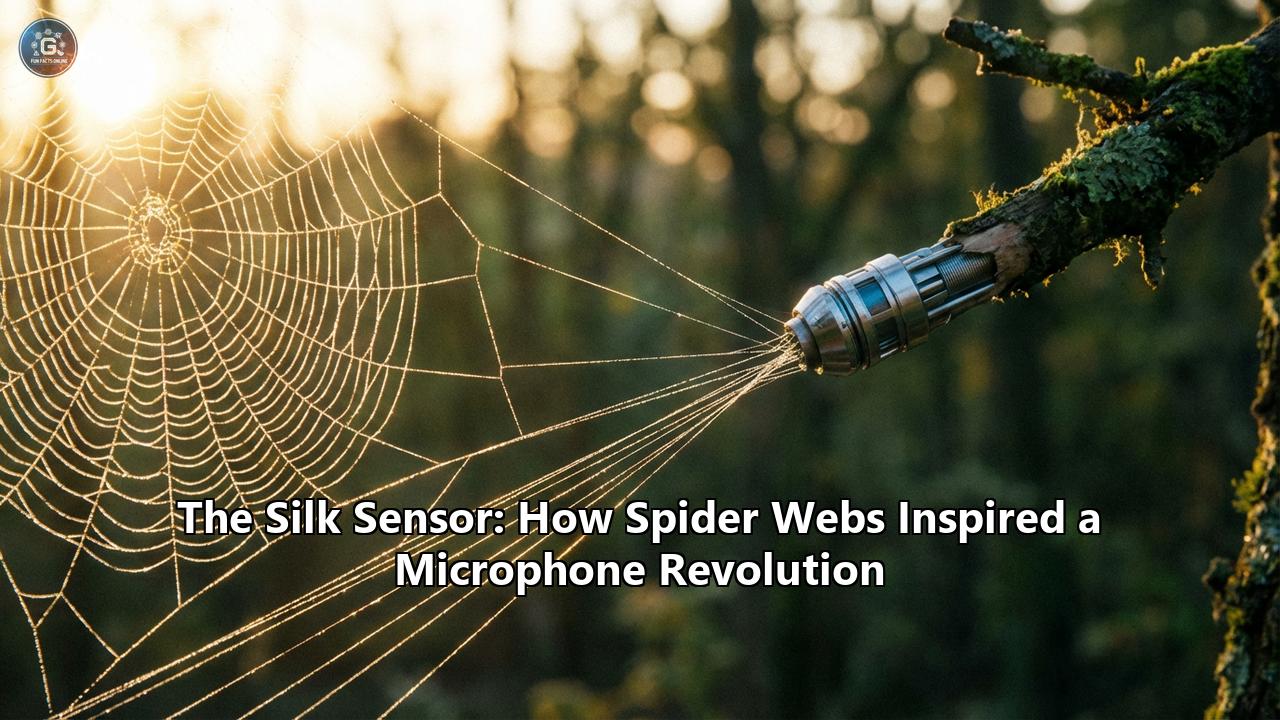
In the hushed corners of a university laboratory, a bridge spider (Larinioides sclopetarius) sits motionless at the center of its orb web. To the casual observer, it is simply waiting for a fly to blunder into its sticky trap. But to Professor Ron Miles and his team at Binghamton University, this spider is doing something far more profound: it is listening. It is not listening with ears, for it has none. It is listening with the web itself, a sprawling, externalized auditory system that detects the world not by the pressure of sound waves, but by the flow of air they create.
This subtle biological marvel—a creature "outsourcing" its hearing to a silk antenna—has sparked one of the most significant shifts in audio technology since the invention of the microphone. It is a discovery that challenges 150 years of acoustic engineering dogma and promises to revolutionize everything from the smartphone in your pocket to the hearing aid in your ear. This is the story of the "Silk Sensor," a journey from the chaotic noise of nature to the silicon heart of the next technological frontier.
Part I: The Stagnation of Sound
To understand the magnitude of this revolution, we must first understand the technology it seeks to replace. For nearly a century, humanity has been stuck in a "pressure trap."
The Tyranny of the DiaphragmWalk into a high-end recording studio, a radio station, or look at the bottom of your smartphone, and you are looking at essentially the same technology. Whether it is the carbon microphones of the late 19th century, the dynamic microphones of the rock-and-roll era, or the microscopic MEMS (Micro-Electro-Mechanical Systems) chips in modern devices, they all operate on a single, shared principle: Sound Pressure.
In this traditional model, sound is treated like a series of invisible hammer blows. A sound wave travels through the air as a fluctuation in pressure—compressing and decompressing air molecules. A microphone catches these fluctuations using a diaphragm, a thin membrane stretched tight like a drumhead. When pressure hits the diaphragm, it bends. That mechanical bending is converted into an electrical signal.
It is a system modeled after the human ear, which also uses a pressure-sensing tympanic membrane (eardrum). And for a long time, it worked well enough. But pressure has a fatal flaw: it is a scalar quantity. In physics terms, this means it has magnitude (loudness) but no direction. When a traditional microphone hears a sound, it knows how loud it is, but it has no inherent idea where it came from.
The Cocktail Party ProblemThis limitation leads to the "Cocktail Party Problem." Imagine you are at a noisy gathering. Your brain can tune out the clatter of dishes and the chatter of fifty other people to focus on the single person speaking to you. It does this by processing complex time delays and intensity differences between your two ears.
A traditional microphone cannot do this easily. To a smartphone or a hearing aid, the background noise is just as "real" and "important" as the voice you want to hear. Audio engineers have spent decades trying to band-aid this problem. They use "arrays"—clusters of multiple microphones that work together, comparing their signals to mathematically guess where a sound is coming from. It is a brute-force solution that requires heavy digital processing, consumes battery life, and often results in the "muddy" audio quality we associate with speakerphone calls.
We needed a new way to listen. As it turned out, the solution had been hanging in our window frames for millions of years.
Part II: The Whispering Web
Professor Ron Miles, a distinguished engineer at Binghamton University, had spent years looking for a better microphone. He suspected the answer lay in the insect world. While humans are large mammals who can afford to carry around heavy, fluid-filled ears to detect pressure, insects are tiny. For a gnat or a fly, the pressure difference across their tiny bodies is negligible. They had to evolve a different way to hear.
The Velocity of SoundSound does not just create pressure; it also creates flow. When a sound wave moves through the air, it physically pushes air particles back and forth. This is called particle velocity. Unlike pressure, velocity is a vector quantity—it has both speed and direction.
If you could build a sensor that rode these air currents like a surfer rides a wave, rather than just getting pummeled by the pressure like a seawall, you would essentially have "perfect" hearing. You would instantly know exactly where a sound came from and could ignore everything else.
But there was a physics problem. To ride the air currents of a sound wave, a sensor has to be incredibly light. If it’s too heavy, inertia keeps it still while the air rushes past it. It needs to be lighter than the air it displaces.
Enter the SpiderMiles and his graduate student, Jian Zhou, turned their attention to orb-weaving spiders. They noticed that these spiders, despite lacking ears, could react to sound with startling speed. When a fly buzzed nearby, the spider didn't just wait for the web to vibrate from impact; it seemed to "hear" the airborne sound of the wings.
In a landmark study, the team gathered Larinioides sclopetarius—the bridge spider—and placed them in an anechoic chamber (a room designed to absorb all sound reflections). They played sounds ranging from the deep rumble of 1 Hz to the ultrasonic squeak of 50 kHz.
Using a laser vibrometer to measure the microscopic movements of the web, they saw something impossible. The spider silk didn't just vibrate; it moved in perfect lockstep with the air particles. The silk was so fine—nanometers thick—and so lightweight that the air didn't flow around it; the air took the silk with it.
The web wasn't just a trap for flies. It was a gigantic, externalized acoustic antenna. By crouching in the center of the web, the spider could feel the "velocity" of the sound through its legs. It had effectively outsourced its hearing to a structure 10,000 times larger than its own body, achieving a sensitivity that biological ears could never match.
Part III: From Biology to Silicon
The discovery was groundbreaking, but you cannot put a live spider inside a smartphone. The challenge was to translate this biological principle—sensing flow via ultra-light fibers—into a manufacturable electronic component.
The Nanophone ConceptThe team began developing a "biomimetic" microphone. They couldn't use actual spider silk, as it creates manufacturing and durability issues. Instead, they turned to silicon nitride, a material commonly used in microchip fabrication.
The goal was to create a structure that acted like the silk: incredibly thin, incredibly light, and free to move with the air. Traditional microphones trap air behind a diaphragm, creating a "stiffness" that resists motion. The Binghamton team, and later the spinoff company Soundskrit, developed a new architecture.
They etched microscopic beams into silicon wafers. These beams were designed to be so porous and lightweight that they offered almost no resistance to the air. Instead of a solid wall that sound crashes into (pressure), they built a "screen door" that the sound wind blows through (flow).
The "Impossible" SpecsThe resulting device, often referred to in early research as the "Nanophone," boasted specifications that made audio engineers weep with joy:
- Flat Frequency Response: From 1 Hz (infrasound, lower than human hearing) to 50 kHz (ultrasound). Most mics struggle to stay consistent across even the human range (20 Hz - 20 kHz).
- True Directionality: Because it measures velocity (a vector), the microphone is inherently directional. It creates a "figure-8" pickup pattern, hearing perfectly in front and behind while being completely deaf to noise coming from the sides.
- Noise Floor: By eliminating the trapped air behind the diaphragm, they removed a major source of thermal noise, creating a clearer signal.
Part IV: Commercialization and Soundskrit
Research papers are one thing; shipping products is another. The technology was spun out into a Canadian startup called Soundskrit.
The company faced the "Valley of Death" for hardware startups: taking a delicate lab prototype and making it rugged enough to survive being dropped in a toilet or baked in a hot car. They succeeded by moving away from literal floating fibers to a MEMS (Micro-Electro-Mechanical Systems) architecture that mimicked the physics of the spider silk without requiring the fragility of a nanostrand.
The SKR0400 and SKR0600Soundskrit’s flagship products, the SKR0400 and the newer SKR0600, look like standard computer chips to the naked eye. But inside, they are fundamentally different.
- The Hardware Difference: A standard MEMS mic has a backplate that traps air. Soundskrit’s chip is open. It allows sound to flow through the sensor.
- The Software Magic: Because the microphone provides directional data at the hardware level, the software doesn't have to guess. It can mathematically subtract background noise with incredible precision.
Imagine a user holding a smartphone in a busy cafe. With a standard phone, the mic picks up the barista, the music, and the traffic outside. The phone's processor burns battery life trying to filter this out AI algorithms, often making the user's voice sound robotic.
With the "spider-inspired" mic, the phone simply "ignores" sound coming from the sides (the cafe noise) and listens only to the sound coming from the front (the user's mouth). The clarity is instant, physical, and requires a fraction of the computing power.
Part V: The Future of Listening
The implications of the "Silk Sensor" extend far beyond clearer phone calls. This technology opens doors to applications that were previously science fiction.
1. The End of the Hearing Aid StigmaCurrent hearing aids amplify everything. In a noisy restaurant, this is a nightmare—the clattering silverware becomes deafening. Directional hearing aids exist, but they are bulky and power-hungry. The spider-silk tech allows for miniature, ultra-low-power microphones that can laser-focus on a conversation partner, potentially solving the "Cocktail Party Problem" for the hearing impaired.
2. Infrasound and Disaster PredictionBecause the silk-inspired sensor can detect frequencies down to 1 Hz with a flat response, it acts as a seismometer for the air. Tornadoes, earthquakes, and volcanic eruptions generate massive "infrasound" waves long before they are visible or audible to humans. A network of these sensors could provide early warning systems for natural disasters with unprecedented accuracy.
3. Acoustic Surveillance and EcologyBiologists often struggle to record specific animals in a noisy rainforest. A velocity-based microphone could be "pointed" electronically to isolate the call of a specific bird or insect, filtering out the wind and other species. Similarly, in security, voice recognition systems in smart homes would no longer be confused by the TV playing in the background.
4. The Stealth RevolutionTraditional pressure microphones are easy to jam with loud noise. Velocity microphones, by their nature, can be oriented to "null out" jamming frequencies coming from specific directions. This has obvious applications in military and secure communications.
Conclusion: The Wisdom of the Weaver
For centuries, we built machines in our own image. We built cameras that work like eyes and microphones that work like ears. But nature is vast, and our mammalian biology is just one of many solutions to the physics of survival.
The spider, a creature often feared and reviled, solved the problem of acoustic sensing hundreds of millions of years ago. It understood, through the blind trial-and-error of evolution, that the best way to listen isn't to build a wall and measure the impact, but to weave a web and feel the flow.
As Soundskrit and researchers at Binghamton University continue to refine this technology, we are moving toward a world of "audio augmented reality"—where we can choose what we hear and what we ignore, where our devices listen with the precision of a predator, and where the barrier between signal and noise is finally broken. The next time you see a spider web trembling in the breeze, remember: it’s not just catching the wind. It’s capturing the world.
Reference:
- https://pmc.ncbi.nlm.nih.gov/articles/PMC9169088/
- https://www.pnas.org/doi/10.1073/pnas.2122789119
- https://vanwyk.consulting/blogs/f/the-evolution-of-microphones-from-carbon-to-mems-technology
- https://www.iflscience.com/spiders-webs-may-act-as-highly-sensitive-external-eardrums-62622
- https://www.sciencedaily.com/releases/2022/03/220329114714.htm
- https://charlesinsights.com/microphone-history
- https://www.youtube.com/watch?v=9PlyZ448Qgo
- https://www.thoughtco.com/history-of-microphones-1992144
- https://www.youtube.com/watch?v=PPRKyVtAIzU