
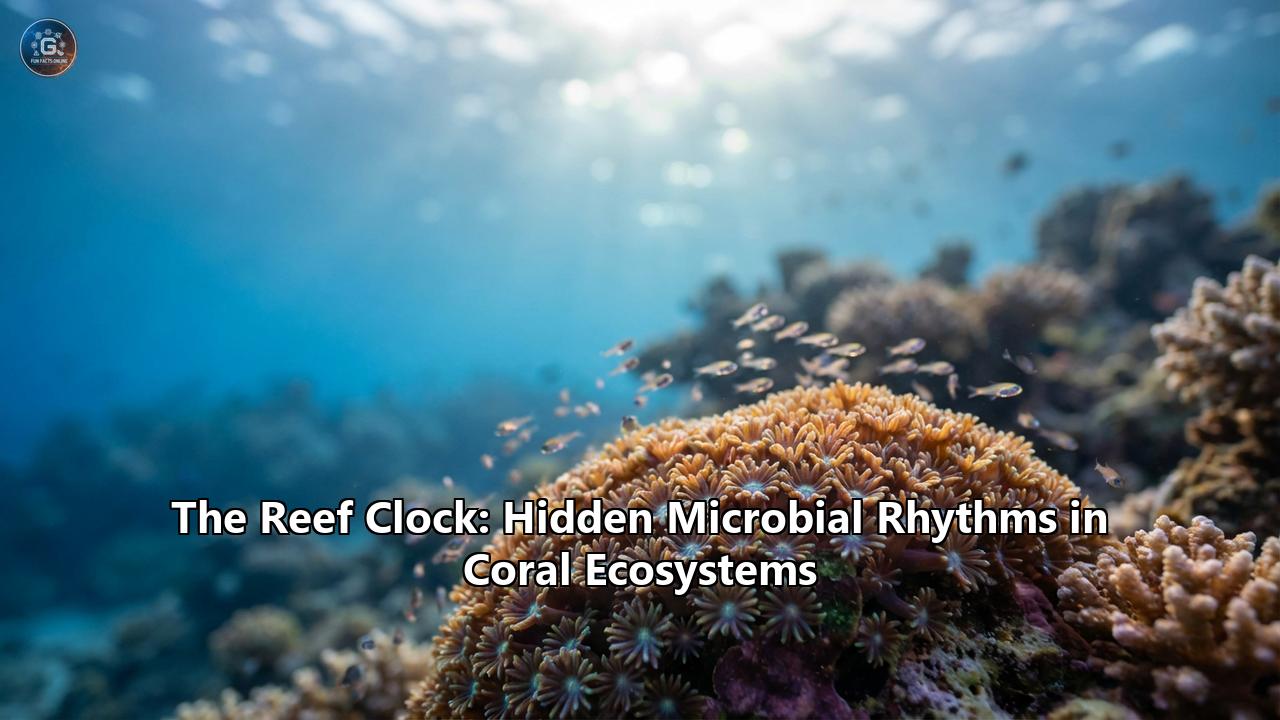
To the human eye, a coral reef is a cathedral of calcium and color, a static metropolis teeming with visible life. We see the slow growth of branching Acropora, the darting colors of parrotfish, and the lazy drift of sea turtles. We perceive the reef as a place defined by space—by the three-dimensional complexity of rugosity and shelter. But to the true architects of this ecosystem—the trillions of bacteria, archaea, viruses, and protists that coat every surface and saturate every drop of water—the reef is not defined by space. It is defined by time.
Beneath the visible grandeur of the coral colonies lies a hidden, relentless engine: the "Reef Clock." Recent scientific breakthroughs have revealed that coral reefs are not merely passive structures hosting microbial life; they are active timekeepers. They orchestrate a complex, synchronized ballet of microbial appearance, disappearance, bloom, and bust that ticks with the precision of a Swiss watch. This invisible rhythm dictates the flow of energy, the recycling of nutrients, and the very health of the ocean’s most diverse ecosystem.
When we dive on a reef at noon, we are swimming through a fundamentally different biological world than the one that exists at midnight. The cast of characters changes, the chemical landscape inverts, and the biological imperatives shift from harvest to hunt, from production to regeneration. Understanding this "Reef Clock" is no longer just an academic curiosity; it is becoming the central key to saving these ecosystems from the stressors of the Anthropocene.
Part I: The Morning Shift (06:00 – 12:00) The Great Drawdown and the Oxygen SpikeAs the first photons of sunlight pierce the water column, the reef undergoes a metabolic seizure. For the last twelve hours, the ecosystem has been effectively holding its breath, consuming oxygen and releasing carbon dioxide. Now, the machinery reverses.
The Photosynthetic IgnitionThe primary drivers of the morning shift are the Symbiodiniaceae, the dinoflagellate symbionts living within the coral tissue. Recent transcriptomic studies have shown that genetic signals from these symbionts peak with remarkable consistency around midday. As solar irradiance climbs, these algal cells kickstart their photosystems, stripping electrons from water and pumping out molecular oxygen.
Within minutes, the "diffusive boundary layer"—the millimeter-thick film of water clinging to the coral surface—shifts from a hypoxic (low oxygen) state to a hyperoxic one. By mid-morning, corals can be enveloped in a skin of water where oxygen levels reach 200% to 300% of air saturation. This creates a highly specific, oxidative environment that acts as a gatekeeper for the microbial community. Anaerobic bacteria, which thrived in the nooks and crannies during the dark, are forced deep into the coral skeleton or sediment, retreating from the toxic flush of oxygen.
The "Active Removal" PhenomenonOne of the most startling discoveries of the last few years, particularly from research in the Red Sea's Gulf of Aqaba, is the phenomenon of "active removal." Scientists have long known that reef waters are clearer than the open ocean, but they assumed this was due to nutrient poverty. We now know that the reef is a giant, living filter.
From sunrise to noon, the counts of free-living bacteria and microalgae in the water column above the reef drop precipitously—often by 20% to 60% compared to the open ocean. The reef is "eating" the plankton. Sponges, tunicates, and the corals themselves ramp up their filtration rates. This "drawdown" creates a zone of depletion, a halo of clear water that maximizes light penetration for the photosynthetic symbionts.
*The Bacterial Shift: Psychrobacter’s Retreat
The composition of the surviving bacterial community shifts dramatically. Fast-growing "copiotrophs" (nutrient-loving bacteria) that might have bloomed overnight on coral exudates are cropped down. In their place, we see the persistence of specific oligotrophic (low-nutrient) lineages.
Notably, recent metagenomic studies have highlighted the behavior of Psychrobacter, a genus of bacteria that can dominate reef assemblages. In some Pacific reefs, Psychrobacter makes up 40-70% of the community during the day but virtually vanishes at night—a 100-fold decrease. This specific "day crew" is likely specialized to tolerate the high UV radiation and oxidative stress of the sunlit reef, processing the photosynthetic byproducts (like glycolic acid) that leak from the coral host.
Part II: High Noon (12:00 – 18:00)The Mucus Factory and the Forest of Glycoproteins
As the sun passes its zenith, the coral host faces a challenge: it is producing more energy than it can immediately use, and it is in danger of sunburn. The solution is mucus—a lot of it.
The Mucus SphereCoral mucus is not just slime; it is a chemically complex hydrogel rich in glycoproteins, lipids, and polysaccharides. It serves as a sunscreen, a desiccation shield (for intertidal corals), and a sediment trap. But biologically, it is a "farm" for microbes.
During the high-energy afternoon hours, corals exude "aged" mucus—sheets of organic matter that have been colonized by bacteria. This mucus layer hosts a microbiome distinct from both the coral tissue and the surrounding seawater. It is dominated by Verrucomicrobiaceae, Vibrionaceae, and Flavobacteriaceae.
The "Farming" HypothesisThis mucus release is part of the clockwork. By shedding mucus, the coral is essentially taking out the trash and planting a garden simultaneously. The mucus traps viral particles and potential pathogens, moving them away from the tissue. But it also feeds the reef. As this mucus sloughs off into the water column, it triggers localized bacterial blooms.
This release is timed. If corals released this energy-rich mucus at night, it might fuel oxygen-starved pathogens that could attack the coral tissue. By releasing it during the oxygen-rich day, the coral promotes the growth of aerobic, heterotrophic bacteria that are rapidly consumed by the reef’s filter feeders—recycling the energy back into the host.
Part III: The Twilight Transition (18:00 – 20:00)The Changing of the Guard
Twilight on the reef is a period of chaotic beauty. The "Reef Clock" strikes a distinct chime as the light fades.
The Polyp ExpansionAs the risk of UV damage and visual predation by fish decreases, the coral polyps emerge. Tentacles that were retracted for twelve hours unfurl, transforming the reef from a photosynthetic solar panel into a carnivorous forest. This physical change alters the hydrodynamics of the reef, increasing surface roughness and turbulent mixing, which helps capture plankton.
The Viral Switch?This transition period is critical for viral dynamics. The "Piggyback-the-Winner" and "Kill-the-Winner" hypotheses suggest that viral activity (lysis) is linked to host density and metabolic state. As bacterial populations shift from the "day crew" to the "night crew," phages (viruses that infect bacteria) likely undergo a synchronization event.
There is evidence to suggest a spike in lytic activity (viruses bursting their host cells) during this transition. This "viral shunt" releases dissolved organic carbon (DOC) and nutrients (nitrogen and phosphorus) back into the water right when the coral host needs them most to support its night-time metabolism.
Part IV: The Night Shift (20:00 – 06:00)Hypoxia, Hunters, and the Nitrogen Paradox
When darkness falls, the reef undergoes its most radical transformation. The oxygen pumps turn off, and the consumption begins.
The Oxygen Crash: Sleeping on EverestWithout photosynthesis, every organism on the reef—coral, fish, bacteria, algae—is respiring. They are inhaling oxygen and exhaling carbon dioxide.
In the open water, oxygen levels drop slightly. But within the "diffusive boundary layer" on the coral surface, the drop is catastrophic. Oxygen levels can plummet to near zero within minutes of sunset. The coral tissue effectively experiences hypoxia (low oxygen) every single night.
Researchers have likened this to a human spending their days at sea level and their nights on the summit of Mount Everest. This nightly hypoxia is a critical filter. It prevents strict aerobes from colonizing the coral surface, but it opens the door for other players.
The Protist SurgeWith the lights out, the hunters emerge. Not just sharks and eels, but microscopic hunters. Heterotrophic protists—tiny eukaryotic predators—surge in abundance, increasing by up to 80% in reef waters at night.
These protists are the wolves of the microbial world. They hunt the bacteria that are blooming on the coral mucus and in the water column. This "grazing pressure" is a vital check on bacterial overgrowth. Without these nightly hunters, bacteria could overrun the coral, consuming all available oxygen and suffocating the polyps. The protists keep the bacterial population lean and efficient.
The Nitrogen Fixers (Diazotrophs)The night shift is also the time for nutrient regeneration. Corals live in nutrient deserts; they need nitrogen to build proteins and DNA. However, the enzyme required to fix nitrogen gas (nitrogenase) is irreversibly destroyed by oxygen.
This creates a paradox: How do you fix nitrogen in an oxygen-rich coral? The answer is the "Reef Clock."
Many coral-associated diazotrophs (nitrogen-fixing bacteria) wait for the night. As the coral consumes oxygen and the boundary layer goes hypoxic, these bacteria activate their nitrogenase enzymes. Hidden in the skeleton (endolithic layer) or deep in the gastric cavity, they turn inert nitrogen gas into ammonia, which the coral can then use. This transfer of fertilizer happens almost exclusively in the dark.
Part V: When the Clock BreaksDysbiosis and the Modern Ocean
The "Reef Clock" has ticked faithfully for millions of years. But today, it is being disrupted. The consequences of a "broken clock" are visible in the rise of coral diseases and the decline of reef resilience.
Black Band Disease: A Rhythm Gone RogueBlack Band Disease (BBD) is a terrifying example of microbial rhythms weaponized against the host. BBD is a consortium of cyanobacteria, sulfate-reducing bacteria, and sulfide-oxidizing bacteria that forms a black mat moving across the coral.
This disease has its own clock. During the day, the cyanobacteria in the mat photosynthesize, producing oxygen and sugars that fuel the migration of the band. They drag the killing zone forward. At night, the mat goes anoxic. The sulfate-reducing bacteria at the base of the mat churn out hydrogen sulfide—a potent toxin that smells like rotten eggs. This sulfide accumulates in the dark, liquifying the coral tissue.
The BBD consortium uses the day to move and the night to kill. Warmer oceans accelerate this clock, making the disease progress faster.
Artificial Light at Night (ALAN)Coastal development has brought streetlights, resorts, and ships to the reef edge. We are learning that this artificial light is disastrous for the Reef Clock.
Corals rely on moonlight cues to synchronize their spawning—the one night a year they reproduce. Light pollution masks these cues, leading to "reproductive failure" where eggs and sperm are released asynchronously and die unfertilized.
Furthermore, ALAN disrupts the microbial cycle. If the reef never gets truly dark, the "night shift" of nitrogen fixers may never activate. The oxidative stress on the coral never fully dissipates. The protist hunters may be confused or exposed to visual predators. The entire metabolic exchange of the holobiont is desynchronized.
The Suffocating HeatClimate change acts as a force multiplier for the night-time danger. Warmer water holds less oxygen. As oceans warm, the nightly dip in oxygen becomes a plunge. "Sleeping on Everest" becomes "Sleeping in the Death Zone."
When water temperatures rise, the coral's metabolism speeds up, demanding more oxygen exactly when the water holds less. This can lead to "nocturnal anoxia events," where the coral suffocates in its sleep, leading to rapid tissue necrosis even without visible bleaching.
Conclusion: The Future of TimeThe "Reef Clock" is a testament to the intricate, invisible connectivity of nature. It reminds us that a coral reef is not a collection of independent species, but a singular, pulsating entity synchronized by the rising and setting of the sun.
Protecting reefs requires more than just drawing lines on a map to stop fishing. It requires protecting the integrity of time*. It means managing coastal light pollution to preserve the darkness. It means monitoring oxygen dynamics, not just temperature. It means understanding that when we disrupt the climate, we are not just heating the water; we are breaking the delicate biological watch-springs that keep the ecosystem winding forward.
As we look to the future of conservation, we must learn to see the reef not just as a place of beauty, but as a living clock, counting down the moments of our own stewardship.
Reference:
- https://www.earth.com/news/coral-reef-microbes-day-night-rhythms/
- https://seaweedecologylab.ucsd.edu/wp-content/uploads/sites/439/2010/09/nature17193.pdf
- https://www.sciencedaily.com/releases/2026/01/260101160854.htm
- https://www.researchgate.net/publication/399338280_Microbial_dynamics_in_coral_reef_waters_Diel_cycles_in_contrasting_seasons
- https://pmc.ncbi.nlm.nih.gov/articles/PMC3518071/
- https://scope.soest.hawaii.edu/pubs/2017Aylward_PNAS.pdf
- https://pmc.ncbi.nlm.nih.gov/articles/PMC6046197/
- https://cdhc.noaa.gov/coral-disease/characterized-diseases/black-band-disease/