
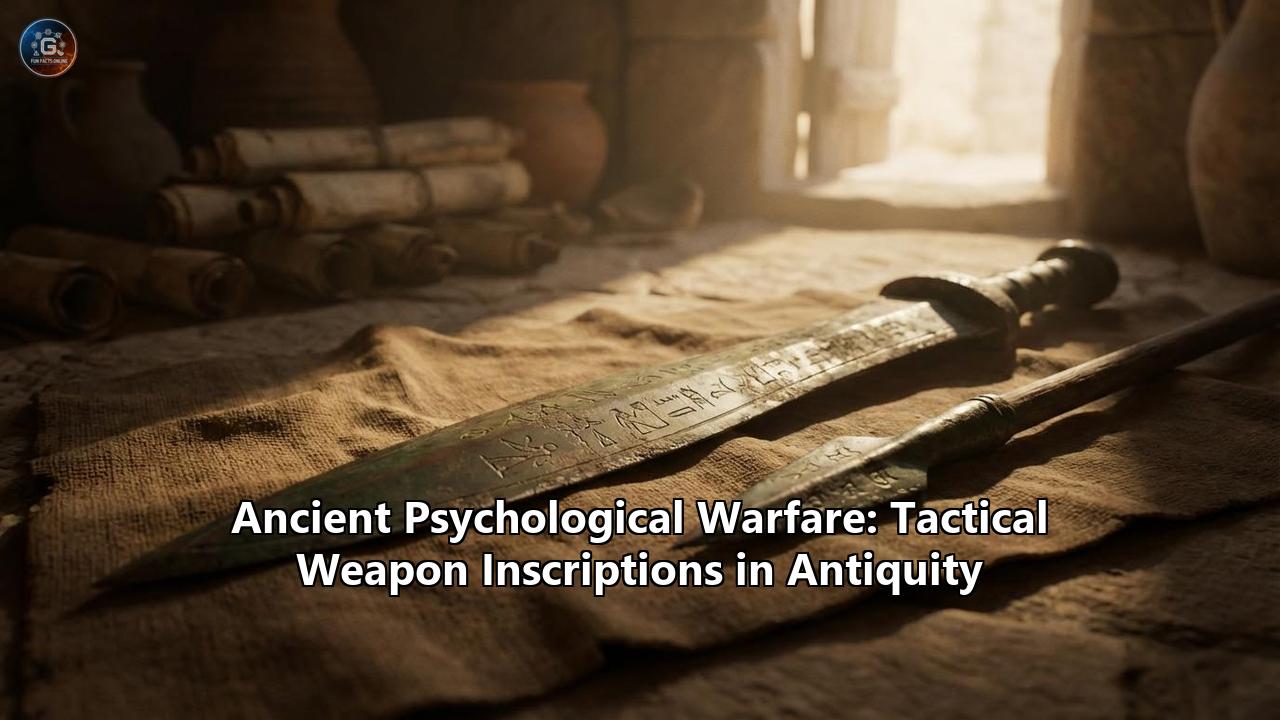
Long before the advent of digital propaganda, radio broadcasts, or the psychological operations of modern militaries, the battlefields of antiquity were already a theater for a deeply sophisticated form of psychological warfare. When we imagine ancient combat, the mind typically drifts to the clash of bronze and iron, the thunderous charge of cavalry, or the geometric discipline of a Macedonian phalanx. War is often viewed through the lens of its sheer physical brutality. Yet, the soldiers who fought these wars were entirely human, subject to the same fears, frustrations, and dark humor as any modern infantryman. To bridge the terrifying gap between themselves and their enemies, ancient warriors weaponized language itself. They did not just hurl stones and spears; they hurled curses, jokes, and grim promises of death, inscribed directly onto the ammunition they fired.
The medium for this ancient psychological warfare was the lead sling bullet. Small, unassuming, and immensely lethal, these projectiles have been unearthed by archaeologists across the Mediterranean world, from the rugged hills of Greece to the ruined fortresses of Italy and the deserts of the Levant. Covered in brief, punchy inscriptions, these artifacts offer a visceral, unvarnished glimpse into the minds of ancient soldiers. They prove that the instinct to mock, intimidate, and mentally dismantle an opponent is as old as war itself.
To understand the impact of an inscribed sling bullet, one must first understand the devastating reality of the weapon that delivered it. In modern pop culture, the sling is often relegated to the status of a shepherd’s tool or a child’s toy, famously associated with the biblical story of David and Goliath. In ancient military terms, however, the sling was a weapon of mass trauma, often favored over the bow and arrow.
The ancient sling typically consisted of a pouch attached to two cords. A slinger would place a projectile in the pouch, whirl the cords to build tremendous centrifugal force, and release one cord at the precise microsecond needed to send the missile flying toward the enemy lines. Elite slingers, such as the famous mercenaries from the Balearic Islands or the island of Rhodes, trained from childhood. Ancient historical accounts suggest that a skilled slinger could hit targets at distances exceeding 300 meters, outranging many archers of the era.
Initially, slingers used smooth river stones. However, around the 5th century BC, the Greeks revolutionized the technology by casting projectiles out of lead. These lead bullets—known to the Greeks as molybdainai (leaden balls) and to the Romans as glandes (acorns, due to their almond-like shape)—were game-changers. Lead was much denser than stone. A lead bullet the size of a modern golf ball could weigh upwards of 40 to 100 grams. Because of its smaller volume and aerodynamic shape, a lead bullet experienced less air resistance, flying faster, further, and hitting with the concussive force of a modern handgun bullet. The Roman poet Ovid and the philosopher Lucretius even perpetuated a popular myth that these bullets flew with such blistering speed that they melted in mid-air. While scientifically inaccurate, the poetry underscores the sheer terror these invisible, whistling projectiles inspired.
But the shift to lead offered another crucial advantage: it required casting in clay or bronze molds. Enterprising commanders and bored soldiers quickly realized that if you carve a message backward into the mold, every bullet produced would bear a raised, highly legible inscription. Ammunition was transformed into a mass communication network.
The Greeks were the pioneers of weaponized wit. Their inscriptions were typically characterized by a dark, laconic humor. For a Greek hoplite or light infantryman standing in a shield wall, the sudden impact of a lead bullet was a terrifying prospect. The projectiles were too small and fast to see coming; the only warning was a high-pitched hum in the air just before the bone-shattering strike. The inscriptions played heavily on this sudden violence.
Perhaps the most famous example of this ancient trash-talk is a 4th-century BC lead sling bullet excavated in Athens and now housed in the British Museum. Cast in high relief on one side is the image of a winged thunderbolt, a symbol of Zeus. On the other side is a single Greek word: "ΔΕΞΑΙ" (Dexai).
Translated, Dexai means "Catch!" or "Take that!".
There is a profound, almost modern sense of sarcasm in this single word. The slinger is inviting the enemy to play a deadly game of catch, fully aware that "catching" this supersonic piece of lead would mean shattered ribs, a crushed skull, or a broken shield. It is the ancient equivalent of an action movie one-liner, delivered with lethal force. Other Greek bullets from various battlefields have been found bearing similarly pithy insults and warnings. Some read "Ouch!"—a dark premonition of the target's impending reaction. Others found near Argos read "Bite it in vain," a mocking reference to a dying soldier biting the dirt in agony.
Recent archaeological excavations continue to expand our understanding of this phenomenon. Near the Sea of Galilee, at the ancient city of Hippos (Sussita), archaeologists unearthed a 2,000-year-old sling bullet fired during the Hellenistic period. Measuring just over an inch long, it bears the five-letter Greek inscription: "ΜΑΘΟΥ" (Mathou).
Mathou translates roughly to "Learn!" or "Learn your lesson!". The defenders of the city were not merely trying to kill the advancing enemy; they were adopting the patronizing tone of a strict schoolmaster. The psychological implication is clear: the attackers were ignorant fools for daring to approach the city walls, and the lead bullet was the harsh, physical education they were about to receive.While the Greeks perfected the sarcastic taunt, the Romans turned weapon inscriptions into a brutal, highly organized campaign of psychological dominance, political propaganda, and sexual humiliation. To the Roman mind, warfare was intimately connected with concepts of masculinity, dominance, and submission. If you could emasculate your enemy—proving that you possessed the power to penetrate their defenses in both a literal and figurative sense—you had already won the psychological battle.
Nowhere in ancient history is this more evident than in the Perusine War (41–40 BC). Following the assassination of Julius Caesar, the Roman Republic collapsed into a series of bloody civil wars. During this specific conflict, Gaius Octavian (the future Emperor Augustus) laid siege to the city of Perusia (modern Perugia, Italy), where Lucius Antonius and Fulvia (the brother and wife of Octavian's rival, Mark Antony) had holed up.
The siege devolved into a bitter, protracted stalemate. With both armies dug into trenches and fortifications, boredom and hatred festered. The result was an unprecedented exchange of what historians now call the Glandes Perusinae—the "Acorns of Perugia". Thousands of inscribed lead sling bullets were hurled back and forth over the city walls, and the messages they carried were staggeringly profane.
Octavian’s soldiers explicitly targeted the leadership of the opposing faction, leaning heavily into extreme vulgarity to break the enemy's morale. The insults were deeply personal and graphic. One bullet found at the site famously reads: "Peto Octaviani culum" (I'm aiming for Octavian's anus). Others commanded Octavian to "sit down" on the bullet. The defenders were equally vicious in return, mocking Octavian's appearance and masculinity.
In retaliation, Octavian’s men targeted Lucius and Fulvia. Bullets have been recovered reading, "You're done for, Lucius Antonius, you baldy," and "I seek Fulvia's clitoris". Another chillingly blunt projectile simply commanded the opposing leaders to "Culum pandite" (Open your anuses).
To the modern reader, these inscriptions might seem like the crude graffiti one would find scrawled on the wall of a public restroom. But in the context of Roman culture, these were highly calculated psychological strikes. Roman societal hierarchy was rigidly defined by who held the active, dominant role in any dynamic. By threatening their enemies with sexual penetration via a projectile, the slingers were asserting ultimate dominance. They were stripping their foes of their dignity, reducing proud commanders and noblewomen to passive, humiliated victims. It was a systematic attempt to break the spirit of the besieged city, a physical manifestation of the hatred boiling outside their walls.
When the city eventually surrendered due to starvation, the psychological warfare had taken its toll. Octavian spared Lucius and Fulvia, but in a brutal display of the dominance his slingers had promised, he slaughtered the city's councilors and handed the territory over to his veterans.
Not all inscriptions were designed as jokes or crude insults. A significant portion of inscribed ammunition served a darker, more mystical purpose. In the ancient world, the line between warfare and magic was profoundly blurred. A weapon was not merely an inanimate tool of physics; it was a vessel that could be imbued with spiritual power.
Many ancient projectiles were inscribed with the names of specific individuals, commanders, or entire enemy legions. By writing a name on a bullet, ancient soldiers were engaging in a form of sympathetic magic. They believed that by invoking the target's name, the bullet would be supernaturally guided to them, functioning like an ancient, magically-guided smart bomb. It was a localized curse, cast through the air at high velocity.
Other bullets invoked the deities of the underworld, effectively consecrating the enemy's soul to death before they had even been struck. A fascinating lead bullet found among the ruins of Eryx in Sicily carries a chilling imprecation that translates to: "Your heart for Cerberus". By firing this bullet, the slinger was making a direct offering of the enemy's vital organs to the three-headed hound that guarded the gates of the Greek and Roman hell.
Similarly, Latin inscriptions from various battlefields take on the tone of an inescapable divine judgment. Bullets have been found reading "Fugitivi peritis" (Ye perish in your flight) and simply "Feri" (Strike!). These commands were not meant for the enemy to read. They were commands given to the bullet itself. The lead object was animated through language, given a singular, murderous objective that it was expected to carry out without fail. In an era where sudden death on the battlefield felt arbitrary and governed by the whims of the Fates, taking a stylus and cursing a bullet gave a soldier a fleeting sense of agency and control over the chaos of war.
Bureaucracy also played a part in this psychological warfare. It was common for Roman legions to cast their unit designations into their ammunition. Bullets reading "L. XII" (Legion Twelve) or highlighting the names of specific centurions, such as "Scaeva," functioned as a terrifying brand identity. When a besieged populace was suddenly hailed by hundreds of bullets bearing the insignia of Caesar's most battle-hardened veterans, the psychological impact was immediate. It was a way of saying, We are here, we are the best, and you cannot escape us. It shattered the anonymity of the attacker and replaced it with a legendary, looming threat.
When we examine these ancient artifacts, it is impossible not to draw a direct line to the military traditions of the modern era. The technology of war has evolved from leather slings and cast lead to precision-guided munitions, supersonic jets, and artillery that can strike from miles away, but the psychology of the soldier remains remarkably untouched by time.
During World War II, it became a common practice for Allied soldiers and airmen to write messages in chalk on the sides of bombs destined for Axis targets. Some were humorous, some were deeply personal, and others were stark expressions of anger. The atomic bomb "Fat Man," dropped on Nagasaki in 1945, was covered in signatures and messages from the engineers and military personnel who assembled it, including the darkly ironic, "Here's to you".
This tradition has continued uninterrupted into the 21st century. During the Global War on Terror, U.S. military personnel were frequently photographed writing messages, jokes, and the names of fallen comrades on artillery shells and 2,000-pound Joint Direct Attack Munitions (JDAMs). In contemporary conflicts, such as the war in Ukraine, artillerymen routinely use markers to scrawl political messages, dark jokes, and defiant slogans onto the sides of howitzer shells before firing them at enemy positions.
Psychologists and military historians note that this personalization of ordnance serves a vital psychological function. For the modern soldier, just as for the ancient Greek slinger, writing on a weapon creates a psychological buffer against the immense stress of combat. It builds camaraderie among the unit. It asserts a sense of control over the terrifying, mechanized indifference of warfare. And, fundamentally, it satisfies a deep, human urge to have the last word.
The inscribed sling bullets of antiquity pull back the curtain on the ancient battlefield, stripping away the sanitized, marble-statue grandeur of history. They remind us that the soldiers of Rome, Athens, and the Hellenistic kingdoms were not unfeeling automatons of state power. They were young men standing in the mud, far from home, experiencing alternating periods of crushing boredom and abject terror.
When an ancient soldier carved "Catch!" or a graphic insult into a piece of lead, they were doing exactly what human beings have always done in the face of conflict. They were using humor as a shield, anger as a weapon, and language to bridge the distance between life and death. The glandes they left behind—sleeping in the soil for millennia until uncovered by archaeologists—are tiny, heavy testaments to the unchanging nature of the human spirit in war. They are a voice from the ancient front lines, still whistling through the air, demanding to be heard.
Reference:
- https://arkeonews.net/archaeologists-discover-2000-year-old-sling-bullet-with-sarcastic-message-to-the-enemy/
- https://www.res-bellica.com/en/shop/lead-sling-bullet-dexai/
- https://slinging.org/30.html
- https://www.britishmuseum.org/collection/object/G_1851-0507-11
- https://www.heritagedaily.com/2013/11/ancient-greeks-carved-out-catch-in-projectiles/100226
- https://news.defcros.com/bombs-targeting-iran-in-operation-epic-fury-inscribed-with-names-of-us-sailors/
- https://archaeotrasimeno.wordpress.com/tag/sling-stones/
- https://imperiumromanum.pl/en/curiosities/messages-on-missiles-to-sling/amp/
- https://www.reddit.com/r/todayilearned/comments/1s0g75/til_that_sling_bullets_from_the_siege_of_perusia/
- https://en.wikisource.org/wiki/On_Inscribed_Sling-bullets