
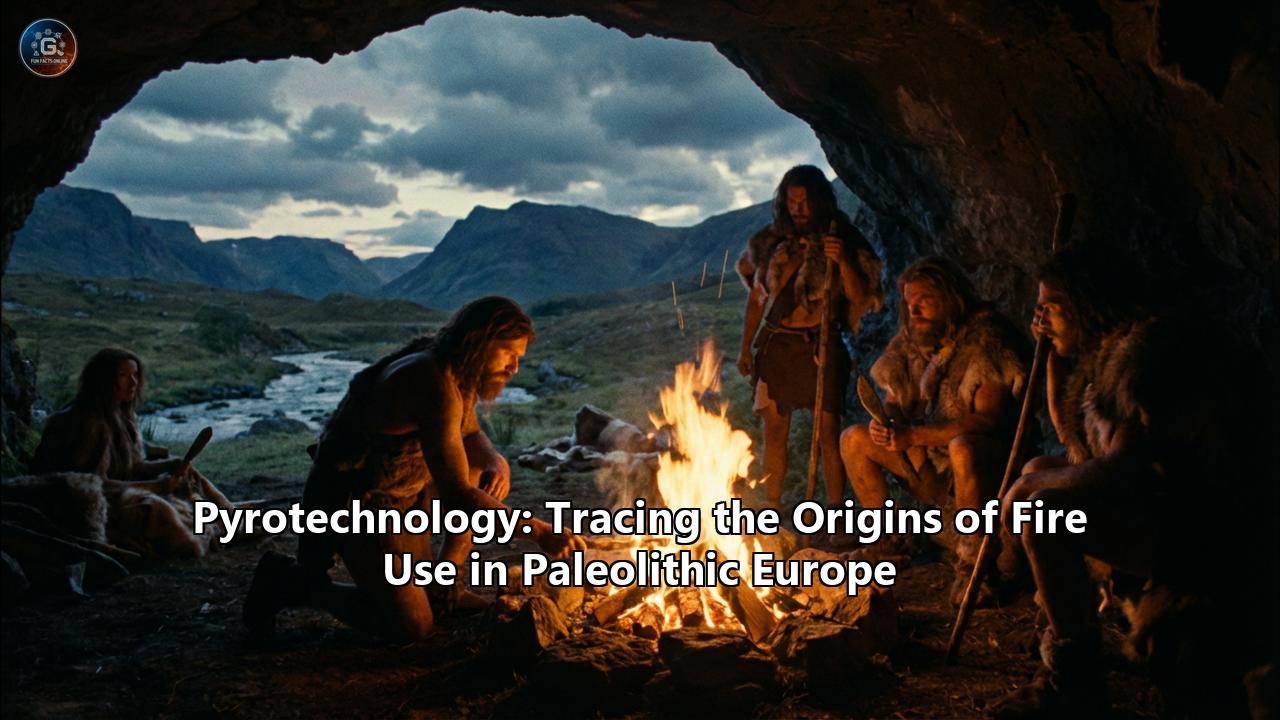
The wind howls across the steppe, biting and relentless, carrying with it the scent of looming snow. It is the Middle Pleistocene in what is now Suffolk, England. The year—if it were numbered—would be roughly 400,000 BC. In a small, sheltered depression of the landscape, a group of Homo heidelbergensis huddles together. But they are not merely enduring the cold; they are defying it. At the center of their circle dances a captive spirit: a fire, fed by carefully selected pine branches, crackling with a warmth that separates life from death, culture from nature.
This is not a scene of accidental scavenging from a lightning strike. This is Pyrotechnology.
For decades, the story of early human fire use was simple: we found it, we used it, eventually we learned to make it. But recent archaeological breakthroughs in Europe have shattered this primitive narrative, revealing a far more complex reality. From the chemically complex adhesives of Neanderthals to the organized "living rooms" of their ancestors, the mastery of fire was not just a survival skill—it was the cognitive spark that ignited humanity.
Part I: The Spark of Innovation — Taming the Wild Flame
The journey begins not with a invention, but with a relationship. Fire is a fickle beast; it consumes, it spreads, and it dies. For early hominins migrating out of the warmth of Africa into the seasonal brutality of Europe, fire was not a luxury. It was an existential necessity.
The Great Debate: Habitual vs. Opportunistic
Archaeologists have long fought over a single question: When did we stop using fire and start controlling it?
- The Opportunists: One camp argues that for nearly a million years, humans were merely "fire followers," collecting embers from natural wildfires caused by lightning.
- The Pyro-Engineers: The opposing view, bolstered by recent evidence, suggests that by the time humans settled in Europe's northern latitudes, they were already masters of ignition.
The evidence for the latter has emerged from the shadows of deep time. At Beeches Pit in England, dating back 400,000 years, the arrangement of burnt flint and sediment tells a deliberate story. These were not random scorch marks. The hearths were located specifically to optimize warmth and smoke clearance. The sediments reveal that fires burned at temperatures exceeding 400°C—hot enough to cook, harden wood, and fracture stone. This was a "home base" in the truest sense, a place where fire was a permanent member of the community.
Further south, at Valdocarros II in Spain (approx. 245,000 years ago), the picture sharpens. Here, archaeologists have found organized hearths that were likely used for cooking. Chemical analysis of the sediments reveals the degradation products of pine wood and fungus, suggesting that these early humans were not just throwing anything on the flames—they were selecting specific fuels, perhaps even rotting wood, to maintain the perfect "cooking sweet spot" between 280°C and 350°C.
Part II: The First Industrial Revolution — Neanderthal Chemistry
If Homo heidelbergensis were the pioneers of the hearth, their descendants, the Neanderthals, were the first industrial chemists. This claim might seem bold for a species long dismissed as "brutish," but the evidence lies in a sticky, black substance found on their tools: Birch Bark Pitch.
The Mystery of the Black Glue
Birch bark pitch is the world's oldest synthetic material. It does not exist in nature. To create it, one must transform the white, papery bark of the birch tree into a black, sticky adhesive through a process called dry distillation. This involves heating the bark to about 340°C in an oxygen-free environment. If oxygen gets in, the bark simply burns to ash. If the temperature is too low, nothing happens.
For years, scientists believed this required complex underground ovens and ceramic containers—technology Neanderthals supposedly lacked. However, recent experimental archaeology has shown that Neanderthals could achieve this with ingenious simplicity.
- The Ash Mound Technique: By burying tight rolls of birch bark under a mound of hot embers and ash, Neanderthals could create an anoxic (oxygen-free) environment.
- The Condensation Method: Simpler methods involve letting the pitch condense on stones.
Yet, a 2019 study and subsequent finds at Vanguard Cave in Gibraltar suggest they didn't just use the "simple" methods. They likely engineered specific pits, sealed with distinct layers of sand and guano to strictly control the thermodynamics. This implies a level of "forward planning" and understanding of material properties that rivals modern craftsmanship. They weren't just cooking; they were engineering materials to create complex, multi-part tools (hafting stone points to wooden shafts) that were durable and lethal.
Part III: The Weaponry of Heat — The Schöningen Spears
In the 1990s, a coal mine in Schöningen, Germany, yielded a discovery that stunned the world: eight perfectly preserved wooden spears, dated to roughly 300,000 years ago. Balanced like modern javelins, they shattered the image of early humans as scavengers. They were top-tier predators hunting wild horses.
But were they fire-hardened?
- The "Fire Hardening" Myth: It has long been assumed that early humans charred the tips of their spears to make them harder.
- The Scientific Reality: Modern experiments, such as those by Ennos and Chan (2016), have challenged this. They found that while charring increases hardness slightly, it makes the wood significantly more brittle and prone to snapping.
- The Nuance: The true genius of Schöningen was likely "Fire Shaping." The spruce wood used for the spears is incredibly hard to work with stone tools. By heating the wood over a fire, the resin softens, and the cellulose structure relaxes, allowing the woodworker to straighten the shaft and carve the tip with greater precision. Once cooled, the wood retains its new shape. The fire wasn't just for hardening; it was a lathe, a sandpaper, and a vice all in one.
Part IV: The Social Brain — Light in the Dark
The impact of fire extended far beyond tools and diet. It fundamentally rewired the human experience.
The conquest of the Night
Before fire, the human day ended with the sun. The night was the domain of predators—cave lions and hyenas. With the hearth, humans colonized the night.
- Circadian Rhythms: Firelight emits a spectrum that affects melatonin production, potentially altering sleep cycles. This "extended day" created a new niche: The Social Night.
- The Storytelling Hearth: Anthropologist Polly Wiessner has studied the conversations of modern hunter-gatherers. By day, talk is functional—about food, travel, and trade. By night, around the fire, talk shifts to singing, dancing, and storytelling. It is here, in the flickering light, that culture, mythology, and social bonds are forged.
- The Expensive Tissue Hypothesis: The "Cooking Hypothesis" championed by Richard Wrangham suggests that cooking food (pre-digesting it with heat) allowed our guts to shrink and our brains to grow. While the timing is debated (did it start 1.8 million years ago or 400,000?), there is no doubt that by the time of the Neanderthals, cooking was unlocking caloric potential that fueled the massive brains of the Middle Paleolithic.
Part V: Making Fire — The Ultimate Pyrotechnology
Perhaps the most elusive evidence has been the mechanism of ignition. Did they carry embers from camp to camp, terrified of letting them die?
Recent discoveries at East Farm, Barnham (UK) and other sites have provided the "smoking gun" of fire production: Iron Pyrite.
When struck against flint, pyrite produces a dull, long-lasting spark—ideal for catching tinder. Archaeologists have found nodules of pyrite with distinctive "strike marks" alongside bifacial tools. This confirms that by 400,000 years ago, humans were not slaves to nature's lightning. They carried the potential for fire in their pockets. They had liberated themselves from the environment.
Conclusion: The Promethean Legacy
To view the charcoal stained soil of a Paleolithic cave is to look at the remnants of a revolution. Pyrotechnology was the first time a species on Earth took a force of nature and bent it to their will. It gave us the warmth to conquer the Ice Age, the chemistry to build complex tools, the nutrition to fuel our expanding minds, and the safety to dream in the dark.
We are the children of that flame. Every time we flip a light switch, start an engine, or cook a meal, we are repeating the ancient ritual started by a Homo heidelbergensis on a cold, windswept steppe, shielding a small, precious spark from the wind.
Reference:
- https://www.theguardian.com/science/2023/may/18/scientists-find-oldest-known-evidence-of-humans-in-europe-using-fires-to-cook
- https://www.sciencealert.com/archaeologists-discover-earliest-evidence-of-humans-using-tools-to-make-fire
- https://scienceandculture.com/2023/06/researchers-neanderthals-invented-process-to-produce-birch-tar/
- https://pmc.ncbi.nlm.nih.gov/articles/PMC8086952/
- https://en.wikipedia.org/wiki/Sch%C3%B6ningen_spears
- https://pubmed.ncbi.nlm.nih.gov/27194289/
- https://grokipedia.com/page/Fire_hardening
- https://www.youtube.com/watch?v=Zjg93GzAqnk
- https://royalsocietypublishing.org/rstb/article/371/1696/20150164/22943/The-discovery-of-fire-by-humans-a-long-and
- https://pmc.ncbi.nlm.nih.gov/articles/PMC3069174/
- https://www.isita-org.com/jass/Contents/2015vol93/Attwell/Attwell.pdf