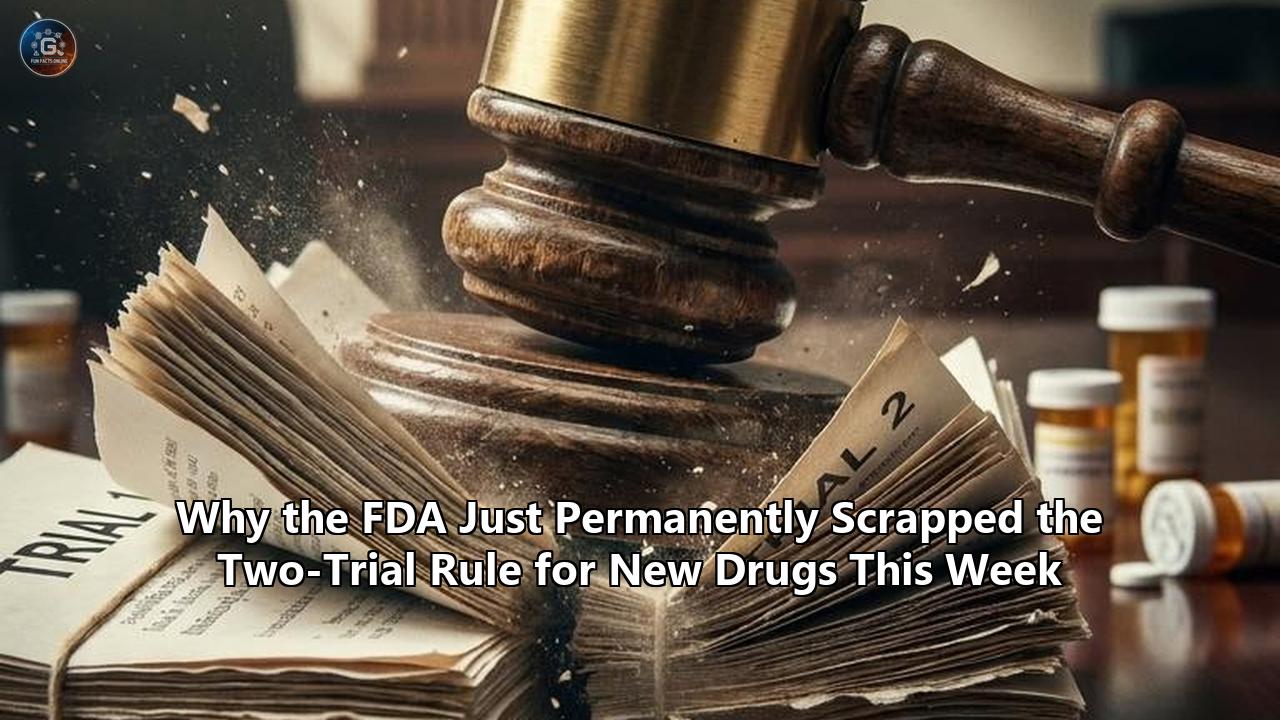
The United States Food and Drug Administration formally eliminated the longstanding requirement that pharmaceutical companies must conduct two separate, large-scale clinical trials to prove a new drug is effective. The final guidance, issued this week, permanently dismantles a regulatory framework that has governed American medicine for more than six decades.
Going forward, the agency’s default standard for drug approval will require only a single adequate and well-controlled pivotal trial, supported by secondary confirmatory evidence.
The immediate reaction across the pharmaceutical sector, patient advocacy groups, and Wall Street has been intense. Billions of dollars in research and development costs are suddenly unmoored. Development timelines for novel therapeutics could compress by years. Yet, the burden of proof has not necessarily been lowered; rather, it has been heavily concentrated. Clinical research executives are already warning that without the safety net of a second trial, the margin for error in clinical development has effectively dropped to zero.
To understand how this policy alters the future of medicine, we have to look past the immediate headlines. The FDA two-trial rule change finalized this week is not a sudden deregulation, but the culmination of a decades-long collision between mid-20th-century statistical philosophy and 21st-century biotechnology.
Here is the breakdown of why the two-trial mandate existed, the economic and scientific forces that finally broke it, and what happens to the global drug pipeline next.
The 1962 Origins of the "Two-Trial Dogma"
The regulatory architecture that died this week was born from tragedy. In the late 1950s and early 1960s, the sedative thalidomide was marketed widely in Europe and elsewhere as a treatment for morning sickness in pregnant women. It resulted in thousands of severe birth defects. While the FDA largely prevented thalidomide from reaching the US market—thanks to the vigilance of medical reviewer Dr. Frances Kelsey—the near-miss horrified the American public.
Congress responded with the Kefauver-Harris Amendments of 1962. For the first time, pharmaceutical companies were required by law to prove to the FDA not only that a drug was safe, but that it was actively effective for its intended use before it could be sold.
The statutory language demanded "adequate and well-controlled investigations." Bureaucrats and statisticians at the FDA had to figure out how to interpret the plural word "investigations." They leaned heavily on the dominant mathematical framework of the era: frequentist statistics.
In a standard clinical trial, a result is generally considered statistically significant if the p-value is less than 0.05. This means there is a 5 percent probability that the observed benefit was simply a fluke—a false positive, known in statistics as a Type I error. For a regulatory agency tasked with protecting the public, a 1-in-20 chance of approving an ineffective drug was unacceptably high.
If you require a pharmaceutical company to run two entirely independent trials, and both achieve a p-value of 0.05, you multiply the probabilities. The chance of two false positives occurring back-to-back drops to 0.0025, or 1 in 400.
This became the bedrock of FDA comfort. The requirement for two trials wasn't just a bureaucratic hurdle; it was a mathematical shield. It ensured that experimental bias, localized patient demographics, or sheer luck in a single trial could not easily result in a drug reaching the open market. For decades, the "two-trial dogma" remained the unchallenged gold standard of evidence-based medicine.
The 1997 Loophole and the Bureaucratic Wall
A frequent misconception is that the FDA was legally bound by Congress to require two trials until this week. That is false. The legal authority to approve drugs based on a single trial has existed for nearly thirty years.
In response to the HIV/AIDS epidemic and intense pressure from activists demanding faster access to experimental antivirals, Congress passed the FDA Modernization Act of 1997 (FDAMA). This legislation explicitly added language to Section 505(d) of the Food, Drug, and Cosmetic Act, granting the FDA the discretion to approve a drug based on data from "one adequate and well-controlled clinical investigation and confirmatory evidence".
Legally, the door was open. Culturally, the FDA refused to walk through it.
The agency utilized this single-trial authority heavily in oncology and ultra-rare genetic diseases, where running two massive trials was logistically impossible. But for primary care drugs—therapeutics aimed at cardiovascular disease, diabetes, obesity, psychiatry, and neurology—the review divisions maintained a fierce grip on the two-trial standard.
The rationale was defensive. FDA division directors face intense congressional scrutiny if a drug is approved and later causes harm or proves useless. Conversely, there are rarely congressional hearings held to investigate why an effective drug was delayed by an extra three years. The incentive structure within the agency heavily favored the cautious, redundant safety of the second trial.
The Makary-Prasad Pivot
The defensive posture held until late 2025, when the leadership dynamic at the FDA shifted. FDA Commissioner Dr. Marty Makary and Deputy Dr. Vinay Prasad began actively unwinding the two-trial expectation, culminating in a highly publicized February 2026 article in the New England Journal of Medicine.
The authors made a blunt argument: the science of drug development had advanced, but the agency’s statistical philosophy had stagnated. They declared that the two-trial mandate was rooted in an era of "limited biologic understanding" and formally announced that a single high-quality pivotal trial, supplemented by confirmatory evidence, would become the agency's new default.
The guidance finalized this week crystallizes that NEJM announcement into formal regulatory policy. It removes the ambiguity that plagued drug sponsors. Previously, a pharmaceutical company could attempt a single-trial submission for a broad-market drug, but doing so was a massive gamble. If the FDA review team arbitrarily decided they wanted a second trial after all, the sponsor would face a Complete Response Letter (CRL) and a multi-year delay.
By making the single trial the explicit default, the FDA has shifted the burden of justification. Reviewers must now articulate a specific, scientifically grounded reason for demanding a second trial, rather than relying on it as an automatic reflex.
The Staggering Economics of Redundancy
At the core of the FDA two-trial rule change is a redefinition of how capital is deployed in medical research. Developing a new drug is an exercise in extreme financial attrition. Industry estimates place the capitalized cost of bringing a single novel therapeutic to market at somewhere between $1.5 billion and $2.6 billion.
The vast majority of that capital is burned in Phase 3 clinical trials. A single, large-scale pivotal study can cost between $30 million and $150 million. For chronic conditions like Alzheimer’s disease or cardiovascular outcomes, where thousands of patients must be monitored for years, a single Phase 3 trial can easily exceed $300 million.
Requiring drug sponsors to run two of these trials simultaneously, or sequentially, created an immense financial moat. It effectively restricted the development of primary care drugs to a handful of mega-cap pharmaceutical conglomerates. A small, innovative biotech startup simply could not raise the $500 million necessary to run duplicate cardiovascular outcome trials. Their only option was to prove the concept in Phase 2, and then sell the asset to a giant like Pfizer, Merck, or Novartis.
By removing the requirement for the second Phase 3 trial, the FDA has drastically lowered the financial barrier to entry for late-stage drug development.
The time value of money also plays a critical role here. Pharmaceutical patents generally last 20 years from the time of filing, which usually happens long before clinical trials begin. Every year spent running a redundant second trial is a year of lost monopoly pricing power on the open market. By shaving two to three years off the development timeline, companies can launch their products earlier, potentially capturing billions in additional revenue before generic competition arrives.
Optimists argue this financial relief will translate into lower drug prices, as companies will not need to aggressively recoup the costs of duplicate trials. Skeptics counter that pharmaceutical pricing is determined by what the market will bear, not by R&D costs, and companies will simply absorb the savings as profit.
Defining "Confirmatory Evidence"
If the second trial is dead, what takes its place? The statute still requires "confirmatory evidence." The guidance released this week provides a highly detailed framework for what qualifies, and it relies heavily on modern biotechnology and data science.
The FDA will now accept several forms of non-traditional evidence to support a single pivotal trial:
1. Real-World Evidence (RWE) and Real-World Data (RWD)The digitization of global health records has created an unprecedented reservoir of data. If a drug shows strong efficacy in a single clinical trial, companies can now use anonymized Electronic Health Records (EHR), medical claims data, and patient registries to confirm the drug’s performance in the general population. If the real-world data aligns tightly with the clinical trial data, the agency will consider the efficacy confirmed.
2. Mechanistic Plausibility and BiomarkersIn the 1960s, doctors often didn’t know exactly how a drug worked; they only knew that patients taking it seemed to get better. Today, drug discovery is highly targeted. If a sponsor can provide exhaustive pharmacological data proving that a drug binds to a specific genetic target, and that binding definitively alters the disease pathway, this "biologic plausibility" can serve as confirmatory evidence.
3. External and Synthetic Control ArmsInstead of recruiting a live placebo group for a second trial, artificial intelligence and machine learning models are being used to generate "synthetic" control arms. By analyzing decades of historical patient data, algorithms can accurately predict how a specific demographic of patients would progress without the experimental drug. The FDA is increasingly willing to compare the live treatment group from Trial 1 against a rigorously matched historical or synthetic cohort.
4. Pharmacokinetic and Pharmacodynamic (PK/PD) DataData showing how the body processes the drug, and how the drug affects the body on a cellular level across different dosing regimens, can now carry the weight previously assigned to a secondary clinical readout.
The One-Trial Trap: A Warning to Clinical Operations
While biotech CEOs and venture capitalists celebrate the financial relief, clinical operations executives are bracing for a brutal new reality. The shift has birthed a concept industry insiders are calling the "One-Trial Trap" or the "Super-Pivotal Trial".
Under the old two-trial paradigm, pharmaceutical companies had a built-in safety net. Phase 3 trials are incredibly complex logistical operations spanning dozens of countries, hundreds of clinical sites, and thousands of medical professionals. Things inevitably go wrong. Patients drop out, data is miscoded, or a specific enrollment criterion inadvertently skews the results.
If the first Phase 3 trial resulted in messy, borderline data, the sponsor could learn from their mistakes. They could refine the inclusion criteria, adjust the clinical endpoints, and execute a flawless second trial to secure approval.
That luxury of a "do-over" is gone. When a sponsor only submits one trial, that trial must be operationally pristine.
Every single patient enrolled becomes a critical data point. If a clinical site protocol deviates even slightly, or if the statistical power drops due to unexpected patient attrition, the entire multi-hundred-million-dollar program could collapse. There is no backup trial to dilute the statistical noise.
This shifts immense pressure onto the earlier stages of drug development. Historically, Phase 2 trials were viewed as "learning" studies—smaller trials designed to figure out the optimal dose and get a rough idea of efficacy. Now, Phase 2 trials must be rigorously designed to ensure that the single Phase 3 trial is aimed with perfect precision. Companies will have to spend more time and money in Phase 2 to de-risk the single pivotal trial, somewhat offsetting the financial savings of the rule change.
The Ethics of Clinical Equipoise
Patient advocacy groups were among the strongest proponents of eliminating the two-trial mandate, driven by a profound ethical argument regarding the use of placebos.
The foundation of any randomized controlled trial is "clinical equipoise"—the ethical principle that there must be genuine uncertainty within the medical community about whether the experimental treatment is better than the standard of care. If a doctor knows a drug works, it is unethical to assign a patient to a placebo group.
Under the two-trial rule, this principle was routinely strained. Consider a scenario where an experimental drug for a severe neurodegenerative disease completes its first Phase 3 trial. The data is unblinded, and the results are spectacular. The drug clearly halts the progression of the disease with minimal side effects.
Under the 1962 framework, the FDA would still demand a second Phase 3 trial to achieve the 0.0025 p-value threshold. The drug company would be forced to recruit hundreds of new patients suffering from the disease, and deliberately assign half of them to receive a sugar pill for two years, simply to duplicate data that the medical community already knew was highly likely to be positive.
For patients with terminal or rapidly debilitating conditions, this was a death sentence mandated by statistical bureaucracy. Advocates argued that once a single, highly powered, well-controlled trial demonstrates overwhelming efficacy and safety, clinical equipoise is broken. Forcing further placebo-controlled trials under those circumstances violates the fundamental medical directive to do no harm.
The new guidance explicitly acknowledges this ethical friction. By allowing confirmatory evidence—such as mechanistic data or natural history models—to replace the second trial, the FDA is signaling that the statistical purity of duplicate placebo arms is no longer prioritized above the immediate welfare of the patients waiting for treatment.
Precision Medicine and the End of Broad Phenotypes
The scientific catalyst making this policy possible is the rise of precision medicine. The regulatory architecture of the past was built for drugs that treated broad, poorly understood phenotypes.
Thirty years ago, a pharmaceutical company might test a drug for "lung cancer." Lung cancer is not a single disease; it is a complex array of different malignancies. Because the drug was tested on a heterogeneous population, it might only work for 15 percent of the patients. To prove that the 15 percent response rate wasn't a statistical illusion, the FDA absolutely needed two massive trials.
Today, oncology and immunology are defined by genomics. A modern drug is not designed for general lung cancer; it is engineered specifically for non-small cell lung cancer expressing a precise KRAS G12C mutation.
When you target the specific genetic driver of a disease, the clinical effect size is often massive. The drug doesn't work a little bit in a lot of people; it works completely in a very specific subset of people. When the efficacy signal is that strong and loud, you do not need duplicate trials involving thousands of patients to hear it. The statistics of the single trial become undeniable.
This dynamic first forced the FDA’s hand in Cell and Gene Therapy (CGT). Treatments utilizing CRISPR base-editing or CAR-T cell mechanisms are often functional cures for ultra-rare diseases. If a genetic disease only affects 400 people globally, you cannot run two 100-person, placebo-controlled trials. It is mathematically and practically impossible. The FDA had to adapt to single-trial approvals for these modalities. The guidance issued this week takes the lessons learned from those cutting-edge genetic therapies and applies them to the broader pharmaceutical landscape.
A Seismic Shift in Venture Capital Strategy
For venture capitalists, the FDA two-trial rule change alters the fundamental calculus of biotech investing.
Historically, early-stage biotech funding operates on a rigid milestone system. Series A funding gets a company through pre-clinical animal testing. Series B funds Phase 1 safety trials. Series C funds Phase 2 efficacy trials.
At the end of Phase 2, biotech boards face a critical juncture. Funding two massive Phase 3 trials could require raising $300 million to $500 million. Doing so through public markets or private equity results in massive dilution for the original founders and early investors. Therefore, the standard playbook has been to sell the company or license the asset to a major pharmaceutical company right before Phase 3 begins.
The single-trial default rewrites this playbook. If an asset only requires one pivotal trial costing $80 million, a nimble biotech company can realistically raise that capital, retain full ownership of the intellectual property, and take the drug all the way through FDA approval themselves.
This threatens the traditional ecosystem where massive pharma companies act as commercialization engines for smaller innovators. If biotechs no longer need to sell out to fund redundant trials, large pharmaceutical companies may face a severe pipeline drought. We are likely to see aggressive shifts in M&A strategy, with large pharma companies being forced to acquire assets much earlier in development—during Phase 1 or Phase 2—before the startup realizes they can cross the finish line alone.
The Phase 4 Enforcement Pivot
Lowering the barrier to market entry invariably shifts the regulatory burden to post-market surveillance. If the FDA is going to approve drugs faster and with less pre-market clinical data, they must have a mechanism to aggressively pull those drugs off the market if they fail to perform in the real world.
This brings Phase 4—post-marketing commitments—into intense focus.
The FDA’s track record with enforcing post-market studies under the Accelerated Approval pathway has historically been weak. Drugs have languished on the market for years while sponsors dragged their feet on conducting confirmatory trials. The most infamous example is Makena, a drug approved to prevent preterm birth. It remained on the market for over a decade despite failing its post-market confirmatory trial, as the sponsor utilized every legal avenue to delay the withdrawal process.
To offset the risks of the new single-trial default, the FDA will have to flex its statutory muscle under recent legislative updates that grant the agency swifter withdrawal authority. Companies submitting a single trial will likely face strict, legally binding timelines for gathering real-world data and submitting continuous safety reports once the drug is commercialized.
The success or failure of this new era of drug approval will hinge entirely on the FDA’s willingness to act ruthlessly when a single-trial drug fails to live up to its promise in the general population. If the agency proves toothless in Phase 4 enforcement, the single-trial default will quickly be viewed as a massive compromise of public health.
Global Regulatory Dissonance: Will Europe Follow?
A major test for the FDA two-trial rule change will be how foreign regulators respond, particularly the European Medicines Agency (EMA) and Japan’s Pharmaceuticals and Medical Devices Agency (PMDA).
Drug development is a global enterprise. Pharmaceutical companies design clinical programs to satisfy regulatory agencies across multiple continents simultaneously to maximize their commercial footprint.
If the FDA drops its requirement to one trial, but the EMA strictly maintains the two-trial mandate, multi-national pharmaceutical companies will still be forced to run two trials. The savings and speed offered by the FDA’s policy change will be nullified by European bureaucracy.
Historically, the FDA has set the tempo for global regulatory standards. However, the EMA has recently taken a more conservative stance on data requirements, particularly concerning artificial intelligence and synthetic control arms. If Europe resists this shift, we could see an era of highly staggered global drug launches.
Sponsors might run a single trial, secure FDA approval, and launch the drug in the United States. They would then use the revenue generated from the US commercial launch, combined with the resulting real-world clinical data, to fund and satisfy the requirements for a subsequent European approval years later. This scenario would give American patients significantly earlier access to novel therapeutics, placing immense political pressure on European regulators to modernize their frameworks.
The Risk of the False Positive
Not everyone is celebrating. Critics of the new guidance emphasize that the mathematics of the 1962 mandate were not arbitrary.
When you run a clinical trial, you are testing a sample of the population, not the entire population. Statistical anomalies happen. A drug might appear highly effective in a 500-person trial simply because of an unrecognized demographic bias in the enrollment, an anomaly in how a specific clinical site measured endpoints, or pure statistical chance.
There is a vast graveyard of pharmaceutical assets that produced stellar, highly significant data in their first Phase 3 trial, only to fail spectacularly in the second.
Under the new framework, many of those drugs would be approved. The public would be exposed to therapeutics that provide no actual benefit, burdening the healthcare system with the cost of expensive, useless medications. Furthermore, if a patient is taking an ineffective drug, they are losing critical time that could have been spent taking a therapy that actually works.
Proponents of the change counter this by pointing to the "confirmatory evidence" requirement. The FDA is not accepting just one trial; they are demanding a mosaic of supporting data—mechanistic proof, biomarker validation, and real-world natural history models. The argument is that a drug that passes a rigorous Phase 3 trial and is supported by deep pharmacological and synthetic data is highly unlikely to be a statistical fluke.
Looking Ahead: The Immediate Transition
As the guidance takes immediate effect, chaos is unfolding in regulatory departments across the industry. Sponsors currently halfway through their second Phase 3 trials are urgently requesting meetings with FDA review divisions to see if they can halt enrollment, submit the data they have, and file for early approval.
Companies finalizing their Phase 3 protocols for late 2026 are tearing up their blueprints, shifting budgets away from clinical site recruitment and pouring money into data science firms capable of generating the required synthetic control arms and real-world evidence packages.
The ultimate legacy of the FDA two-trial rule change will not be known for years. It will be judged by the first wave of single-trial drugs that hit the market in 2027 and 2028. If those therapeutics perform as promised, proving that modern biotechnology and data science can effectively replace the brute-force redundancy of duplicate trials, the policy will be hailed as a triumph of regulatory modernization.
If, however, the agency is forced into a series of high-profile market withdrawals due to unforeseen safety signals or lack of real-world efficacy, the pendulum could aggressively swing back toward the statistical conservatism of the past.
For now, the 64-year-old safety net is gone. The FDA has fundamentally rewired the machinery of medical innovation, betting that the precision of modern science can protect the public just as well as the redundant mathematics of the past. The speed of drug development has permanently accelerated; now, the industry must prove it can handle the velocity.
Reference:
- https://friendsofcancerresearch.org/news/stat-fda-to-lower-number-of-trials-required-for-approval-of-drugs-other-medical-products/
- https://pharmacally.com/one-high-quality-trial-not-two-what-the-fda-changed-and-what-it-means/
- https://www.arnoldporter.com/en/perspectives/advisories/2026/02/fda-advances-a-plausible-mechanism-framework-for-rare-disease-drug-development-and-shifts-to
- https://www.discoveriesinhealthpolicy.com/2026/02/multiple-articles-fda-launches-plans.html
- https://www.fda.gov/apology_objects/abuse-detection-apology.html
- https://rwealliance.org/rwe-policy-developments/
- https://www.clinicalleader.com/doc/the-one-trial-trap-why-s-fda-efficiency-push-actually-doubles-your-operational-risk-0001