
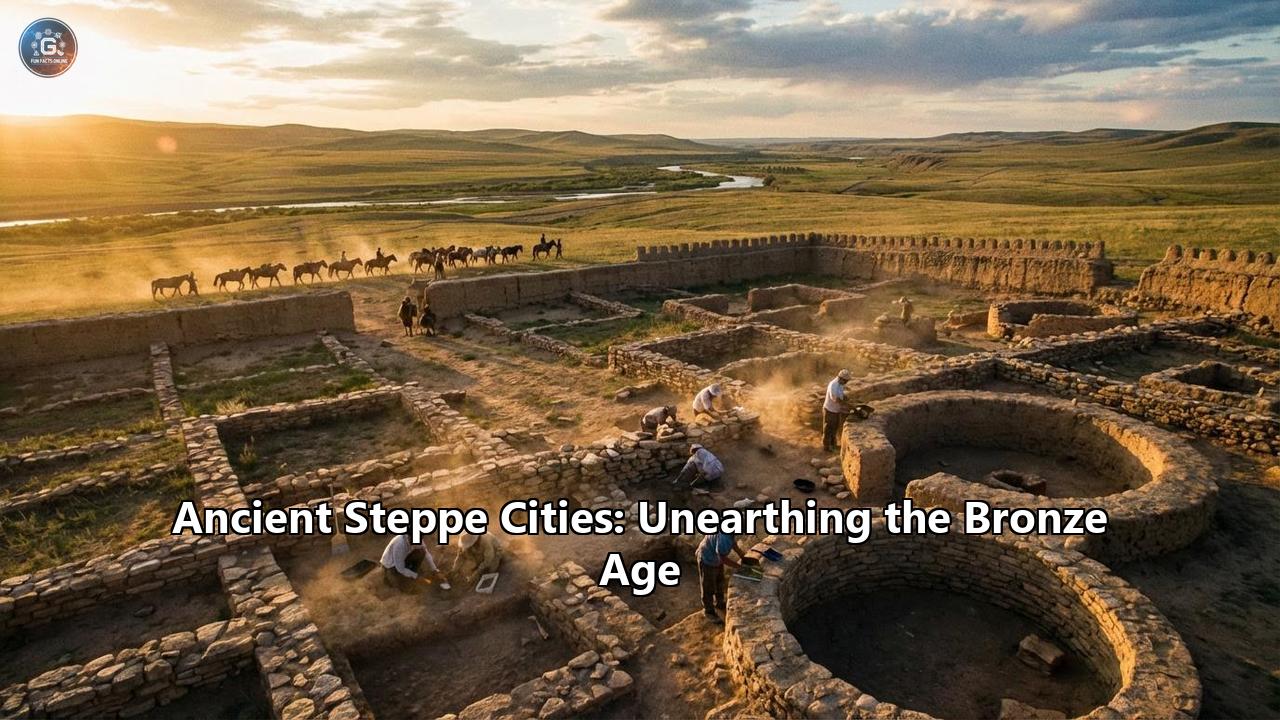
For centuries, the Eurasian Steppe has been painted with a singular, sweeping brushstroke in the minds of historians and the public alike: an endless, wind-swept ocean of grass, traversed solely by transient, horse-riding nomads. The popular imagination is filled with the thundering hooves of Scythian warriors, the vast mobile empires of the Mongols, and the nomadic pastoralists living in felt yurts, leaving little behind in the way of permanent architecture. In this traditional narrative, the steppe was a rugged periphery, an untamed wilderness that occasionally interacted with—or invaded—the "true" cradles of civilization in Mesopotamia, Egypt, the Indus Valley, and China. However, modern archaeological revolutions have thoroughly shattered this monolithic myth. Beneath the arid plains of Russia, Kazakhstan, and western China lie the remnants of sophisticated, meticulously planned, and industrially advanced urban centers dating back over four millennia.
The unearthing of these Bronze Age steppe cities represents a monumental paradigm shift in our understanding of human history. Far from being an empty void waiting to be crossed, the Eurasian Steppe was a dynamic crucible of innovation. It was here, in heavily fortified earthen towns, that humanity witnessed the birth of the spoked-wheel chariot, the perfection of horse domestication, and the execution of industrial-scale metallurgy that fueled continent-spanning trade networks. From the enigmatic circular fortresses of the "Country of Towns" in the Ural Mountains to the breathtaking recent discovery of massive industrial mega-sites in the Kazakh steppe, the archaeological record now reveals a world of fire, bronze, and architectural ingenuity. This is the story of the first urban pioneers of the steppe—societies that successfully married mobile pastoralism with settled, industrial urbanization, fundamentally altering the trajectory of the ancient world.
The "Country of Towns" and the Discovery of ArkaimTo understand the urban revolution of the Bronze Age steppe, one must first look to the southern Trans-Urals, a region straddling the modern borders of Russia and northern Kazakhstan. In the late 1980s, an archaeological team led by Gennady Zdanovich was surveying the Chelyabinsk region ahead of a planned reservoir project that would flood the valley. What they found from the air and on the ground completely upended Soviet and global archaeology. Lying on the steppe was the distinct imprint of a large, circular fortified settlement. This site, named Arkaim, was just the beginning.
Subsequent aerial photography and satellite imagery revealed an entire network of over twenty similar middle Bronze Age settlements tightly clustered within an area roughly 400 kilometers long and 150 kilometers wide. Dating primarily to the Sintashta culture (circa 2200–1800 BCE), this dense agglomeration of fortified communities was dubbed the "Country of Towns" (Strana Gorodov). While some archaeologists view the term as a metaphor and point out that similar sites blur the geographical boundaries of this exact zone, the sheer density and architectural complexity of these settlements cannot be overstated.
Arkaim remains the most famous and extensively excavated of these sites, largely because Zdanovich and his team successfully fought to halt the reservoir project and save the settlement from destruction. The architecture of Arkaim is a marvel of ancient urban planning. The settlement, roughly 140 to 150 meters in diameter, was constructed in a concentric circular layout. It was surrounded by massive, timber-reinforced earthen walls and deeply excavated V-shaped defensive moats that were as deep as a man's shoulders. Access to the town was highly controlled; the gateways featured complex, labyrinthine entrances designed to funnel potential attackers into narrow, easily defensible choke points.
Inside the walls, the layout was remarkably egalitarian yet highly structured. Dozens of multi-family dwellings were arranged like slices of a pie, radiating outward from a central unbuilt plaza. Each dwelling shared a common wall with its neighbor, demonstrating a high degree of communal cooperation and centralized planning. There were no obvious palaces or isolated elite compounds within the settlement itself, suggesting a society bound by intense communal ties and shared defensive responsibilities. But what were they defending against?
The emergence of the Sintashta culture and its heavily fortified towns occurred during a period of intense climatic and social instability. Around 2200 BCE, the climate in the steppe became colder and more arid. Pastures that once supported earlier, more mobile pastoralists began to shrink. Simultaneously, the demand for copper and bronze weapons was skyrocketing. The fortified towns were essentially armed strongholds designed to protect two incredibly valuable resources: deeply wintering herds of cattle and sheep, and the highly lucrative, localized production of bronze.
The Forge of Eurasia: Industrial-Scale MetallurgyMetal was the geopolitical currency of the Bronze Age, and the steppe cities were not mere consumers; they were the primary manufacturers. The Sintashta settlements were, in essence, fortified metallurgical industrial centers. In the excavations of Arkaim and the eponymous site of Sintashta, archaeologists made a startling discovery: nearly every single excavated house contained the physical remains of metallurgical activity. Smelting ovens, hearths, copper slag, and crucibles were integrated directly into the domestic living spaces. The production of metal was not relegated to a specialized caste living on the outskirts of town; it was the lifeblood of the entire community.
This localized, house-by-house production was highly effective, but recent discoveries have proven that steppe societies eventually scaled their operations to staggering, previously unimaginable heights. In November 2025, an international team of archaeologists from University College London (UCL), Durham University, and Kazakhstan's Toraighyrov University published findings that sent shockwaves through the archaeological community. They revealed the comprehensive survey of Semiyarka, a colossal Bronze Age settlement located on a promontory above the Irtysh River in the northeastern Kazakh Steppe.
Often referred to by its translated name, the "City of Seven Ravines," Semiyarka dates to around 1600 BCE and covers an astonishing 140 hectares (346 acres). To put this into perspective, Semiyarka is more than four times larger than contemporaneous villages in the region, making it the largest known planned ancient site of its kind in the steppe zone. What makes Semiyarka truly revolutionary, however, is not just its size, but its function.
On the southeast side of the city, researchers unearthed an expansive, dedicated "industrial zone" tailored specifically for the production of tin-bronze. Geophysical surveys and deep excavations revealed massive quantities of crucibles, slag, metal ores, and finished bronze artifacts, including a masterfully crafted bronze axe. According to Dr. Miljana Radivojević, the lead author of the study, this represents the first firm evidence that steppe metallurgists operated highly complex, industrial-level production systems rather than just small-scale domestic workshops.
The transition from the localized household ovens of the Sintashta culture to the massive industrial zoning of Semiyarka indicates a profound evolution in steppe society. Tin-bronze—an alloy of copper and tin—was a cornerstone of the Eurasian Bronze Age economy. It is significantly harder and holds a sharper edge than pure copper or arsenical bronze, making it highly sought after for weaponry and tools. The metal ores powering Semiyarka's forges likely originated from nearby deposits in the Altai Mountains, positioning the city as a strategic hub for trade and distribution across the continent. Today, the site features rows of neat, rectangular earthen mounds that trace the foundations of multi-room homes, arranged around a massive central structure twice the size of typical dwellings—perhaps a communal gathering place, an administrative center, or a ritual site.
This deep-rooted metallurgical prowess in the steppe and surrounding mountainous zones is further corroborated by discoveries extending even further east. In early 2025, Chinese archaeologists excavating Tomb Z1 at the Husita site in the Xinjiang Uygur Autonomous Region made a breakthrough discovery. Dating back to 2800–2600 BCE—making it the earliest Bronze Age structure yet uncovered in Xinjiang—the rectangular, stone-enclosed burial yielded an incredibly ancient tin-bronze knife. Recognized as one of the oldest tin-bronze items found on the Eurasian steppe, this artifact proves that the extraction and alloying of metals was a deep-seated tradition in the mobile and semi-settled communities of Inner Asia long before the grand cities of the second millennium BCE were built.
The Dawn of the Charioteers: Revolutionizing Warfare and MobilityThe wealth generated by this massive metallurgical output required defense, and the harsh realities of steppe competition birthed one of the most transformative military inventions in human history: the horse-drawn, spoked-wheel chariot. For much of the 20th century, historians and classicists assumed that the chariot was invented by the advanced civilizations of the Ancient Near East, perhaps in Mesopotamia or the Levant, before slowly filtering outward.
The excavations in the "Country of Towns" dismantled this theory entirely. In the funerary complexes situated just outside the walls of Sintashta and its sister settlements, archaeologists uncovered the remains of early chariots. Radiocarbon dating of these chariot burials at sites like Krivoe Ozero, Sintashta, and Kamennyj Ambar-5 firmly placed them around 2050 to 1900 BCE—making them the oldest known chariots in the world, predating their Near Eastern counterparts by centuries.
The engineering leap from solid, heavy wooden disc wheels (used in slow, ox-drawn carts by earlier Yamnaya and Catacomb cultures) to lightweight, spoked wheels was monumental. A spoked wheel requires complex carpentry, steam-bending of wood, and precise joinery to ensure the wheel does not shatter under the violent stress of galloping across uneven terrain. These vehicles were explicitly designed not for the transport of agricultural goods, but for the rapid transport of humans. They were instruments of speed, prestige, and warfare.
The chariot burials of the Sintashta culture are a testament to the rise of a powerful, aggrandizing military elite. When a prominent warrior died, a deep burial pit was excavated. The chariot was placed inside, with its wheels fitted into specially dug slots in the floor so the vehicle could rest level. Alongside the warrior, the community placed a staggering array of wealth and weaponry: bronze socketed spearheads, daggers, axes, and hundreds of intricate flint projectile points. Most strikingly, whole horses—the very engines of this new technology—were sacrificed and laid out symmetrically, leg-to-leg, alongside the chariot. Distinctive bone, disc-shaped cheekpieces found in these graves reveal the early development of complex harnessing and bitting technologies necessary to control a team of horses at high speeds.
The invention of the chariot forever altered the balance of power in Eurasia. In the context of the steppe, chariots allowed a warrior elite to patrol vast territories, rapidly intercept raiding parties aiming to steal cattle or bronze, and project power over competing tribes. This technological complex quickly radiated outward from the Ural Mountains. Within a few centuries, the chariot had swept across the ancient world, becoming the supreme weapon of the Bronze Age, utilized by the Pharaohs of Egypt, the Mycenaeans of Greece, the Hittites of Anatolia, and the Shang Dynasty of China.
The cultural footprint of this mobile elite is heavily imprinted on the landscape itself. Across the eastern Eurasian steppes, from the Russian Altai to Mongolia, petroglyphs depicting two-wheeled, horse-drawn chariots are etched into the rock faces. While dating rock art is notoriously difficult, recent technological advancements have confirmed their Bronze Age origins. In a study involving the early Scythian royal tomb of Tunnug 1 in the Tuva Republic, Siberia, researchers found a stone slab bearing a chariot petroglyph embedded in the tomb's foundational architecture. Wiggle-matching radiocarbon dating of the tomb's construction to between 833 and 800 BCE provided a firm terminus ante quem (the latest possible date), validating the stylistic dating that these chariot depictions belong squarely to the earlier Bronze Age steppe cultures.
Daily Life, Society, and Religion in the Steppe CitiesDespite the industrial scale of their bronze foundries and the martial prowess of their charioteers, the inhabitants of these ancient steppe cities were fundamentally pastoralists. The economy was tethered to the life cycles of their herds. Osteological evidence from the settlements shows that cattle, sheep, goats, and horses were the primary sources of sustenance. The settlements likely served as vital wintering hubs. During the brutal steppe winters, keeping herds alive is a matter of life and death; the proximity of the fortified towns allowed for the protection of livestock from both the freezing elements and rival raiders.
Living in a Sintashta town would have been an intense, sensory experience. Imagine a tightly packed, circular wooden fortress, its timber walls coated in clay to prevent fire. Inside, the air would be thick with the perpetual smoke of metallurgical hearths and smelting ovens, blending with the smells of livestock, manure, and roasting meat. The sounds of bronze being hammered, horses whinnying, and families living cheek-by-jowl would echo within the defensive perimeter. The massive scale of a city like Semiyarka—with its neatly aligned rectangular mounds and distinct industrial quarters—suggests an even more heavily organized civic life, requiring administrators, managers of the tin and copper supply chains, and complex social hierarchies to maintain order over 140 hectares of urban space.
Culturally and linguistically, these cities are vital puzzle pieces in human history. The Sintashta culture, and the broader Andronovo cultural horizon it birthed, are widely identified by linguists and archaeologists as the likely source of the Indo-Iranian language family. The material evidence excavated from these steppe towns bears a profound and uncanny resemblance to the rituals described in the Rig Veda (the foundational ancient Indian text) and the Avesta (the sacred texts of Zoroastrianism).
The mortuary rituals of the steppe provide the strongest links. The Rig Veda contains precise descriptions of chariot burials, horse sacrifices, and the geometric layout of ritual fires. At Sintashta, the physical manifestations of these exact rites are perfectly preserved in the earth. Some archaeologists, such as Gennady Zdanovich, have even interpreted certain large burial kurgans at Sintashta as elaborate "fire temples," reflecting the deep reverence for fire that became a hallmark of later Indo-Iranian religions. The ceremonial sacrifice of animals, the burial of warriors with their weapons, and the placement of wooden roofs over grave pits mirror the mythic geography and ancestral rites recorded by the Aryans as they migrated southward centuries later.
Crossroads of Continents: Trade and InteractionNo city exists in a vacuum, and the Bronze Age steppe was woven into a massive tapestry of transcontinental trade. As the successors of the Sintashta culture—known broadly as the Andronovo cultural complex—expanded their territory, they became the masters of the largest geographic cultural sphere in the ancient world, stretching from the Ural River to the borders of China.
Their expansion brought them into direct contact with entirely different forms of civilization, most notably the Bactria-Margiana Archaeological Complex (BMAC). The BMAC, peaking between 2300 and 1800 BCE, was a network of sedentary, oasis-based urban centers located in present-day Turkmenistan, Uzbekistan, and Afghanistan. Sites like Gonur Depe were sprawling desert metropolises featuring monumental mud-brick palaces, complex irrigation agriculture, and intricate artisan crafts.
The contrast between the timber-built, pastoral-industrial strongholds of the northern steppe and the mud-brick agricultural oases of the south was stark, but their interaction was mutually highly beneficial. The steppe communities commanded the immense mineral wealth of the Urals and the Altai, producing the bronze that the southern agriculturalists craved. In return, the BMAC offered agricultural surpluses, finely woven textiles, and exotic luxury goods like lapis lazuli and turquoise.
More importantly, the steppe pastoralists exported their greatest technological breakthroughs: the domesticated horse and the spoked-wheel chariot. The introduction of the chariot to the Near East and the Indian subcontinent was almost certainly facilitated through these complex interactions along the borders of the BMAC. This dynamic exchange of metals, animals, technology, and culture across Central Asia laid the earliest structural foundations for the network of trade routes that would, millennia later, be immortalized as the Silk Road.
The Transition: Why Did the Cities Vanish?By roughly 1600 to 1500 BCE, a curious transformation began to sweep across the Eurasian Steppe. The intense, nucleated urbanization that characterized the "Country of Towns" gradually faded. The massive defensive walls were allowed to decay, the deep moats filled with silt, and mega-sites like Semiyarka eventually saw their industrial-scale production disperse. If these cities were so technologically advanced and economically powerful, why were they abandoned?
The answer lies not in a catastrophic collapse, but in a successful adaptation. The walled cities were a brilliant, hyper-specialized response to specific environmental and social pressures—namely, the need to protect localized metallurgical monopolies and wintering herds during a period of climatic aridity and intense regional warfare. However, as the Late Bronze Age progressed, several factors made these dense fortresses obsolete.
First, the climate shifted once more, becoming slightly wetter and more accommodating to widespread grazing. Second, and perhaps more importantly, the very technologies incubated within the walls of Arkaim, Sintashta, and Semiyarka allowed the steppe peoples to master the open plains. Improvements in horse riding and the widespread availability of robust bronze weaponry meant that herds could be protected on the move. The population did not die out; they simply dispersed.
The subsequent Srubnaya (Timber-Grave) and Late Andronovo cultures opted for a more decentralized existence. They spread out into thousands of smaller, unfortified hamlets and open campsites across the steppe, engaging in highly mobile, year-round pastoralism. The necessity of huddling behind massive timber walls evaporated when you could effectively live, fight, and trade on horseback across a territory of millions of square miles. The centralized industrial zones of places like the "City of Seven Ravines" broke down into more widespread, localized crafting traditions, while the chariot eventually gave way to the supreme mobility of the mounted cavalry archer, foreshadowing the rise of the Scythians and Sarmatians in the Iron Age.
A Legacy Cast in BronzeFor generations, the narrative of human progress has been stubbornly tied to the cultivation of grain in river valleys. Civilization, we were told, meant mud-brick ziggurats, written tablets, and sedentary farmers. The Eurasian Steppe was relegated to the margins of history, viewed as a highway for barbarians rather than a destination for innovation.
The unearthing of the Bronze Age steppe cities completely rewrites this script. The discovery of Arkaim, the mapping of the "Country of Towns," the identification of the earliest chariots, and the breathtaking recent revelation of Semiyarka's massive industrial footprint prove that urbanization takes many forms. The ancient inhabitants of the steppe achieved a magnificent synthesis: they built planned, fortified cities with highly organized civic layouts, pioneered the mass industrial production of tin-bronze, and revolutionized global warfare, all while maintaining a resilient, mobile, pastoral economy.
These were not isolated outposts, but the beating heart of a continental network that bridged the gap between Europe, the Near East, and East Asia. They supplied the metals that built empires, forged the chariots that conquered them, and nurtured the linguistic and religious traditions that still resonate across the globe today. The wind may have long ago swept away the timber walls of Sintashta and the smoke from the great forges of Semiyarka, but the legacy of these ancient steppe cities is forever encoded in the DNA of human history.
Reference:
- https://en.wikipedia.org/wiki/Country_of_Towns
- https://erenow.org/ancient/the-horse-the-wheel-and-language/15.php
- http://s155239215.onlinehome.us/turkic/btn_Archeology/Case_ofBronzeAgeIndoIranians_En.htm
- https://www.encyclopedia.com/humanities/encyclopedias-almanacs-transcripts-and-maps/bronze-age-herders-eurasian-steppes
- https://scitechdaily.com/unlike-anything-else-archaeologists-unearth-massive-bronze-age-city-after-3500-years/
- https://www.discovermagazine.com/ancient-steppe-settlement-hides-evidence-of-industrial-level-bronze-production-3-500-years-ago-48275
- https://www.livescience.com/archaeology/sophisticated-bronze-age-city-unearthed-in-kazakhstan-transforms-our-understanding-of-steppe-societies
- https://www.labrujulaverde.com/en/2025/11/a-3600-year-old-city-found-in-kazakhstan-changes-the-narrative-of-a-eurasian-steppe-once-thought-to-be-inhabited-only-by-nomads-in-the-bronze-age/
- https://arkeonews.net/one-of-the-oldest-tin-bronze-knife-in-the-eurasian-steppe-discovered-in-a-unique-bronze-age-cemetery-in-uygur-autonomous-region/
- https://www.cambridge.org/core/journals/antiquity/article/chariots-in-the-eurasian-steppe-a-bayesian-approach-to-the-emergence-of-horsedrawn-transport-in-the-early-second-millennium-bc/C4FDF8C5E7D1D20A28BEB7F6C50A9AF4
- https://www.springerprofessional.de/en/eurasian-steppe-chariots-and-social-complexity-during-the-bronze/16204976
- https://www.exploration-eurasia.com/pictures/Tunnug-Eurasian-Bronze-Age.pdf
- https://grokipedia.com/page/Sintashta
- https://www.reddit.com/r/IndoEuropean/comments/ewoi5k/rindoeuropean_dedicated_topic_2_the_sintashta_and/
- https://silkroadresearch.blog/2018/10/02/bronze-age-central-asia/