
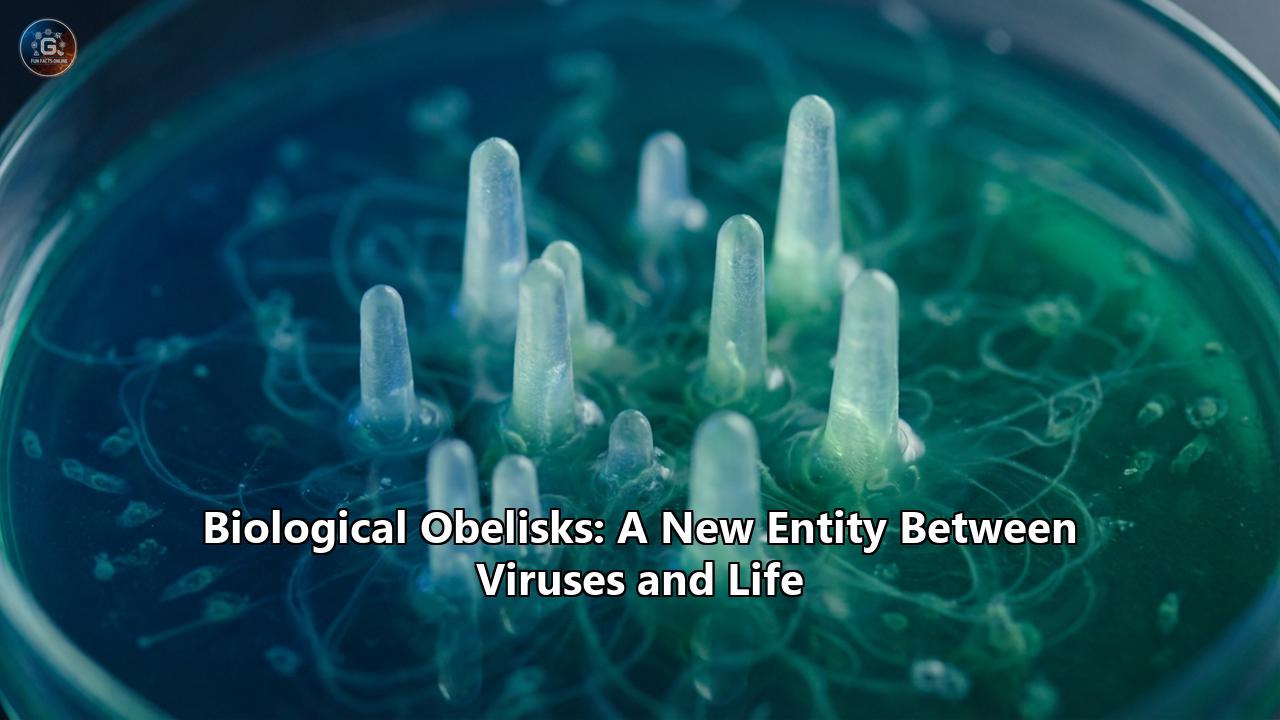
In the vast, microscopic universe that exists within our own bodies, we thought we had identified the major players. We knew the bacteria that digest our food, the viruses that hunt them, and the fungi that lurk in the shadows. We have spent decades cataloging the "Tree of Life," confident that while new species would undoubtedly be found, the categories of life were largely settled.
We were wrong.
In early 2024, a team of researchers from Stanford University shattered this assumption. Buried deep within the genetic data of the human microbiome, they discovered a completely new biological entity. They are not viruses. They are not bacteria. They are not quite viroids. They are something else entirely—a phantom lineage that has existed inside us for millennia, completely unnoticed until now.
They call them Obelisks.
This is the story of their discovery, their strange biology, and what their existence means for the definition of life itself.
Part I: The Discovery of the Invisible
The discovery of Obelisks is a testament to the changing nature of biology. Traditionally, new life forms were found in the mud of a rainforest or under the lens of a microscope. Obelisks, however, were found in the cloud.
Mining the Digital Microbiome
The human body is home to trillions of microorganisms, collectively known as the microbiome. For years, scientists have been sequencing the genetic material (RNA and DNA) of these communities to understand human health. This generates massive libraries of data—billions of strings of genetic letters (A, C, G, U)—that are stored in public databases.
Most researchers look at this data searching for things they know: segments of DNA that match known bacteria like E. coli or viruses like Influenza. But the Stanford team, led by Nobel Laureate Andrew Fire and doctoral student Ivan Zheludev, asked a different question: What is in the data that doesn't match anything we know?
They built a specialized computational tool called "VNom" (Viroid Nominator). Its purpose was to sift through 5.4 million datasets of genetic sequences looking for a specific pattern: circular loops of RNA that fold into themselves.
The "Rod" in the Haystack
When the algorithm finished its work, the results were staggering. It didn't find just a handful of anomalies; it found nearly 30,000 distinct types of a previously unknown biological agent.
These agents were composed of RNA, like many viruses, but they were incredibly small—only about 1,000 nucleotides long (a typical bacterium has millions). Even more striking was their shape. When these RNA strands exist in a cell, they twist and bond with themselves to form a tight, stiff, rod-like structure.
It was this distinct, monolithic shape that earned them their name: Obelisks.
Part II: What is an Obelisk?
To understand why Obelisks are so revolutionary, we must understand where they fit—or rather, where they don't fit—in the current hierarchy of biology. Until now, the borderlands of life were occupied by two main actors: Viruses and Viroids.
1. The Virus vs. Viroid Dichotomy
- Viruses are genetic material (DNA or RNA) wrapped in a protein shell (capsid). They infect a cell, hijack its machinery, and print copies of themselves. They are complex enough to encode instructions for building their own shells.
- Viroids are much simpler. Discovered in the 1970s, they are tiny, naked loops of RNA that infect plants (like the potato spindle tuber viroid). They have no protein shell and, crucially, they do not code for proteins. They are essentially "parasitic information" that disrupts the host cell just by existing.
2. The Obelisk Anomaly
Obelisks break the rules of both groups.
- Like Viroids, they are naked circular RNA loops with no protein shell.
- Like Viruses, they contain genes that code for proteins.
This "hybrid" nature is unprecedented. Obelisks appear to be a bridge between the lifeless simplicity of viroids and the complex machinery of viruses. They are small enough to be simple chemical replicators, yet sophisticated enough to manufacture their own tools.
The "Oblin" Proteins
The proteins encoded by Obelisks are a complete mystery. The researchers named them "Oblins" (specifically Oblin-1 and Oblin-2).
When scientists compared the genetic sequence of Oblins to every known protein database on Earth, they found... nothing. There is no homology (evolutionary similarity) to any known biological agent. This suggests that Obelisks are not just a mutated version of a known virus, but a distinct phylogenetic group that may have been evolving parallel to us for millions of years.
Initial structural analysis suggests that Oblin-1 might be able to bind to metal ions, potentially playing a role in cellular signaling or replication, but its true function remains one of the biggest unanswered questions in microbiology.
Part III: The Colonists Within Us
Perhaps the most unsettling aspect of the Obelisk discovery is not what they are, but where they are. These are not rare entities found in a deep-sea vent; they are in your mouth right now.
Mapping the Obelisk Population
The Stanford study found that Obelisks are surprisingly prevalent in humans:
- The Mouth: Obelisks were found in approximately 50% of the oral samples analyzed. If you are in a room with two people, statistically, one of you is hosting Obelisks in your saliva.
- The Gut: They were found in about 7% of stool samples, indicating they can survive the harsh journey through the digestive tract.
*The Host: Streptococcus sanguinis---
Because Obelisks are just RNA, they cannot survive on their own; they need a host cell to replicate. Through detective work, the researchers identified at least one definitive host: ---Streptococcus sanguinis---, a common bacterium found in dental plaque.
This is a crucial finding. It means Obelisks are "parasites of parasites" (or commensals of commensals). They live inside the bacteria that live inside us.
Interestingly, the presence of Obelisks does not seem to kill the bacteria. The S. sanguinis bacteria hosting Obelisks continued to grow and divide. This suggests a relationship that is more akin to a commensal (neutral) or even symbiotic (beneficial) relationship rather than a deadly viral infection. The Obelisks are quiet roommates, replicating silently without burning down the house.
Part IV: The "RNA World" and the Origins of Life
The discovery of Obelisks has set the world of evolutionary biology on fire because it reinvigorates the debate about the origins of life, specifically the RNA World Hypothesis.
The Missing Link?
The RNA World Hypothesis suggests that before DNA and proteins existed, life began as simple RNA molecules that could both store genetic information and catalyze chemical reactions.
- Viroids were long thought to be the "living fossils" of this ancient era—remnants of a time when life was just naked RNA.
- Viruses were seen as later, more complex evolutions.
Obelisks sit perfectly in the middle. They might represent a "transition state" in the evolution of life—a step where simple RNA replicators began to develop the ability to code for proteins, eventually leading to the complex cellular life we see today.
Are Obelisks ancient survivors from 4 billion years ago, protected inside bacteria through the eons? Or are they a newer evolutionary experiment, a "de-evolution" of viruses that ditched their shells to travel light? The distinctiveness of the "Oblin" proteins suggests the former: an ancient, separate lineage that has survived in the shadows of the microbial world.
Part V: Implications for Human Health
The million-dollar question for medical science is: Do Obelisks affect human health?
As of today, there is no evidence that Obelisks cause disease. However, "absence of evidence is not evidence of absence." The history of biology is full of "harmless" entities that turned out to be pivotal in health and disease.
1. Gene Regulation
Even if Obelisks don't kill cells, their presence involves producing RNA and proteins (Oblins) inside our gut and oral bacteria. This could alter the behavior of those bacteria. For example, an Obelisk might turn a harmless bacterium into a more aggressive one, or conversely, it might prevent a pathogenic bacterium from causing harm.
2. The Microbiome Balance
We know that our microbiome affects everything from our digestion to our mental health (the gut-brain axis). If 50% of people have Obelisks in their mouths, there may be a subtle but widespread difference in oral health between "carriers" and "non-carriers." Could Obelisks be a factor in tooth decay, gum disease, or even resistance to antibiotics?
3. A New Vector for Therapy?
If Obelisks are efficient at entering bacteria and producing proteins, they could theoretically be hijacked by scientists. We could engineer "designer Obelisks" to deliver therapeutic payloads into specific gut bacteria, effectively rewriting the microbiome to cure diseases—a concept known as "phage therapy," but with these new, smaller agents.
Part VI: The Future of Biology
The discovery of Obelisks is a humbling reminder of our ignorance. We have sequenced the human genome, split the atom, and looked back to the beginning of the universe, yet we missed an entire class of biological entities living in our own spit.
This discovery heralds a new era of Computational Microbiology. We are no longer limited by what we can grow in a petri dish. We are now exploring the "Dark Matter" of biology—the genetic sequences that don't match anything in our textbooks.
What Else is Out There?
If Obelisks went unnoticed for so long because they didn't look like viruses, what other shapes are hiding in the data? Are there "Triangles"? "Spheres"? Are there RNA agents that live inside our own human cells, not just our bacteria, regulating our genetics in ways we don't yet understand?
The Stanford team's use of the "VNom" tool is just the beginning. Researchers worldwide are now re-scanning their data, looking for other "cryptic" elements. We are likely on the verge of a gold rush of biological discovery, where the tree of life grows new branches not through expeditions to the Amazon, but through algorithms running on server farms.
Conclusion: A New Definition of Life
Biological Obelisks challenge our rigid definitions. They are not quite alive, yet they evolve and replicate. They are not quite viruses, yet they are infectious. They are a "third state" of biological matter—minimalist, efficient, and ancient.
As we stand on the precipice of this new frontier, one thing is certain: The microscopic world is far more crowded, complex, and mysterious than we ever imagined. The Obelisks have been watching us from the inside for millennia; now, finally, we are looking back.
Reference:
- https://compass.rauias.com/current-affairs/newfound-obelisks-join-viruses-viroids-third-unusual-life-form/
- https://www.sciencealert.com/obelisks-entirely-new-class-of-life-has-been-found-in-the-human-digestive-system
- https://interaksyon.philstar.com/trends-spotlights/2024/02/23/269906/a-new-virus-like-entity-has-just-been-discovered-obelisks-explained/
- https://newatlas.com/biology/obelisks-new-biological-entity-microbiome/
- https://www.darkdaily.com/2024/03/20/stanford-university-scientists-discover-new-lifeform-residing-in-human-microbiome/
- https://en.wikipedia.org/wiki/Viroid
- https://www.biocodexmicrobiotainstitute.com/en/pro/insane-discovery-obelisks-new-virus-entities-found-human-microbes
- https://www.sciencealert.com/Obelisks-entirely-new-class-of-life-has-been-found-in-the-human-digestive-system
- https://www.earth.com/news/new-life-forms-found-in-the-human-body-microbes-virus-like-rna-obelisks/
- https://www.observerbd.com/news/540631
- https://holisticprimarycare.net/topics/functional-medicine/viroid-obelisks-the-microbiomes-microbiome/
- https://en.wikipedia.org/wiki/Obelisk_(biology))
- https://www.discovermagazine.com/mysterious-microbial-obelisks-colonize-our-gut-mouth-and-stool-47048
- https://blog.lukmaanias.com/2024/02/08/obelisks-a-microscopic-discovery-in-human-microbiomes/
- https://pmc.ncbi.nlm.nih.gov/articles/PMC10827157/
- https://pmc.ncbi.nlm.nih.gov/articles/PMC12226432/
- https://www.civilsdaily.com/news/newfound-obelisks-join-viruses-viroids-as-third-unusual-life-form/
- https://www.medindia.net/news/healthinfocus/obelisks-what-are-these-tiny-rna-shapes-hiding-in-our-microbiome-221669-1.htm