
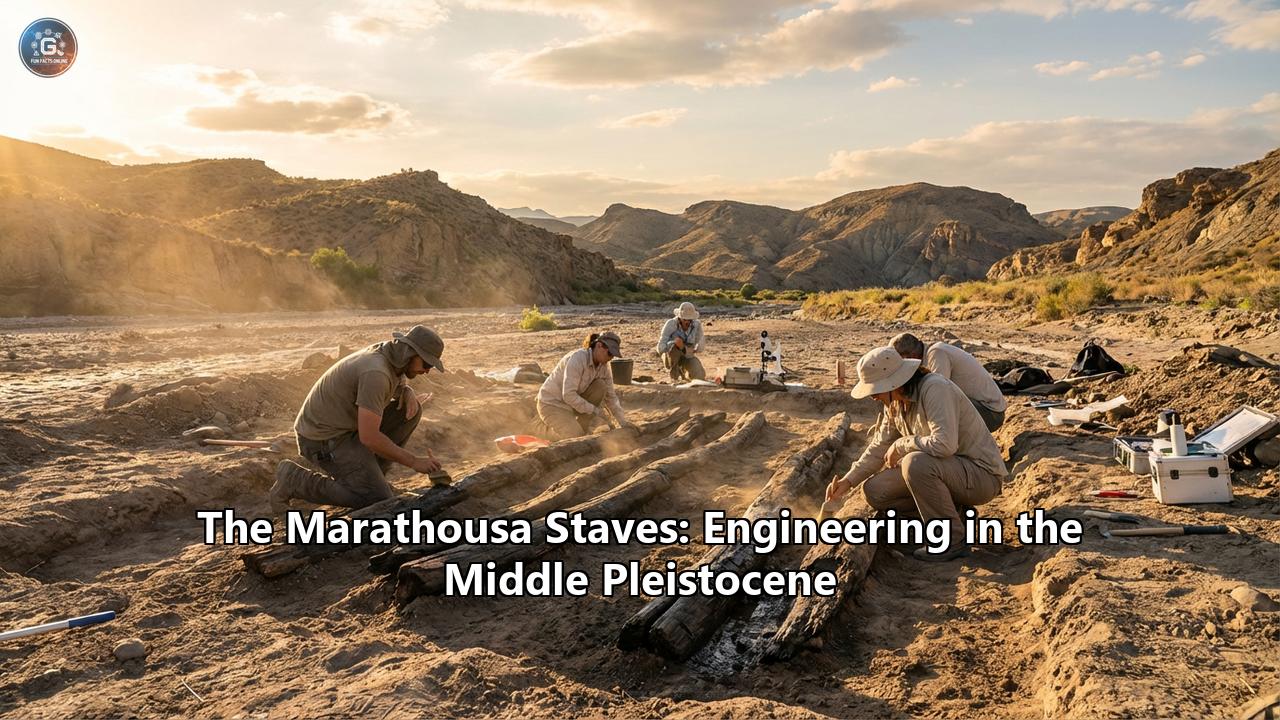
The wind howls across the Megalopolis Basin, not with the dry dust of the modern Greek summer, but with the biting chill of a glacial epoch. It is 430,000 years ago. The landscape is a mosaic of marshlands, shallow lakes, and dense, riparian forests—a refuge of life in a Europe slowly freezing under the grip of the Middle Pleistocene ice sheets. Here, on the muddy banks of a vanishied lake, a group of hominins is at work. They are not merely surviving; they are engineering their world. They are crafting the tools that will allow them to unlock the earth's hidden calories, stripping the bark from an alder branch to fashion an instrument of precision and power.
For nearly half a million years, these instruments lay entombed in the anaerobic embrace of the clay, protected from the rot that claims all living things. They waited in the dark as empires rose and fell, as the climate warmed and cooled, until the heavy machinery of a modern lignite mine exposed the ancient lakebed.
These are the Marathousa Staves.
Their discovery in early 2026 has sent shockwaves through the scientific community, rewriting the textbooks on early human cognition, technology, and survival. While the stone handaxes of the Acheulean industry have long dominated our understanding of the Paleolithic, the Marathousa Staves reveal a different truth: the Stone Age was, in reality, the Wood Age.
I. The Miracle of Megalopolis
To understand the Staves, one must first understand the miracle of their preservation. Wood is the ghost of the archaeological record. It is organic, transient, and biodegradable. In 99.9% of prehistoric sites, it has vanished without a trace, leaving only the imperishable stone tools behind. This survivorship bias has skewed our perception of our ancestors, painting them as people of stone, when they were likely people of organic fiber, leather, and wood.
The site of Marathousa 1 (MAR-1), located in the Peloponnese region of southern Greece, is a rare exception—a "black swan" event in archaeology. The site sits within the Megalopolis Basin, a geological depression that, during the Middle Pleistocene, hosted a large lake system. When the hominins of this era discarded their tools on the muddy shore, the artifacts were rapidly covered by fine-grained sediments. Crucially, the water level rose, sealing the layers in a waterlogged, oxygen-deprived (anaerobic) environment. Without oxygen, the bacteria and fungi that typically decompose vegetable matter could not function.
The result is a time capsule of unparalleled clarity. When archaeologists from the Ephorate of Paleoanthropology and Speleology, working alongside international partners, began excavating the area, they didn't just find stones; they found the landscape itself. Preserved leaves, seeds, insect remains, and wood fragments offered a high-definition picture of a lost world.
It was within this waterlogged treasure trove, situated stratigraphically between lignite seams, that the "Staves" were found. They were not mere driftwood. They bore the unmistakable signature of intention: the cut marks of stone blades, the smoothing of handles, and the wear patterns of heavy use.
II. Anatomy of the Staves
The term "Marathousa Staves" refers primarily to two extraordinary wooden artifacts described in the landmark 2026 study. While other wood fragments were found, these two pieces represent a cognitive leap in our understanding of Middle Pleistocene engineering.
1. The Alder Digging Stick (The Great Stave)
The centerpiece of the discovery is a substantial length of wood, measuring approximately 81 centimeters (roughly 32 inches) in length. Analysis of the wood anatomy identified it asAlder (Alnus sp.), a tree common to the wet, swampy environments of the ancient lake.
This was no random branch. The "Great Stave" exhibits a suite of modifications that required a multi-stage manufacturing process:
- Branch Removal: The side branches had been deliberately trimmed flush with the shaft, likely using a sharp stone flake or chopper.
- Bark Stripping: Portions of the bark were removed to create a smoother grip and to refine the shape of the tool.
- Shaping: The working end of the stick had been beveled and shaped. It wasn't just broken; it was engineered to penetrate soil.
But it is the use-wear analysis that brings the artifact to life. Microscopic examination of the surface revealed deep striations and compressive deformation consistent with being thrust into abrasive sediment. This was a digging stick—the veritable "Swiss Army Knife" of gatherer-hunters. It was likely used to pry up nutrient-dense tubers, roots, and rhizomes from the lake margins, or perhaps to dig for burrowing animals.
The choice of Alder is significant. Alder wood is relatively soft when green but hardens somewhat upon drying, and it is resistant to decay in wet conditions—a property that might have been appreciated by hominins living in a swamp.
2. The Willow Precision Tool
The second artifact is smaller but arguably more intriguing. Crafted from Willow (Salix sp.) or possibly Poplar, this fragment is much shorter, likely a finger-held tool. It has been deliberately shaped, with cut marks indicating the removal of wood to create a specific form.
Its function remains the subject of intense debate, but the leading hypothesis suggests it was a retoucher or a precision implement. In the production of stone tools, softer materials like wood or bone are often used to "pressure flake" the edges of flint, creating razor-sharp margins without shattering the core. If this interpretation holds, it represents a "tool to make tools"—a meta-tool that demonstrates a high level of recursive thinking.
III. Engineering in the Middle Pleistocene
We often reserve the word "engineering" for stone masonry or metalwork, but the Marathousa Staves represent a sophisticated form of organic engineering. The creation of a functional digging stick is not a simple task; it requires a deep understanding of material properties and physics.
The Selection Process
The engineering began before a single cut was made. The hominin maker had to select the right tree. They needed a straight limb of sufficient thickness to withstand the levering forces of digging. A branch that is too flexible would bend; one that is too brittle would snap. The choice of Alder for the digging stick suggests a specific knowledge of local flora. They weren't just grabbing any stick; they were selecting for tensile strength and durability.
The Manufacturing Chain
The "chaîne opératoire" (operational sequence) for these tools involves multiple steps, implying forward planning:
- Harvesting: Detaching the limb from the parent tree. This likely required heavy chopping tools, instances of which were found in the associated lithic assemblage.
- Roughing Out: Removal of lateral branches. This affects the balance and handling of the tool. A knot or protruding twig would blister the hand during heavy use.
- Debarking: Stripping the bark prevents the tool from becoming slippery when wet (crucial in a lakeside environment) and reduces friction when thrust into the soil.
- Tip Hardening/Shaping: While there is no definitive evidence of fire-hardening on the Marathousa Staves (unlike the spear tips found at other sites), the mechanical shaping of the tip to a wedge or point maximizes the pressure exerted on the ground, following the basic physical principle of Pressure = Force / Area.
The Physics of the Digging Stick
A digging stick is a lever. When a hominin drives the point into the ground and pulls back, the soil acts as the fulcrum. The engineering challenge is to ensure the shaft is thick enough to handle the shear stress at the fulcrum point. The Marathousa specimen is robust, indicating the maker understood the relationship between force and breakage. This is intuitive physics—a cognitive simulation of "what happens if I pull too hard?"—internalized and applied to tool design.
IV. The Context: Elephants and Ice
The Marathousa Staves did not exist in a vacuum. They were found in direct association with one of the most dramatic scenes of Middle Pleistocene life: the butchery of a straight-tusked elephant (Palaeoloxodon antiquus).
This species was a titan, significantly larger than modern African elephants, standing up to 4 meters tall at the shoulder. The site of Marathousa 1 contains the partial skeleton of a single elephant, along with remains of other fauna like hippopotamuses and deer.
Surrounding the elephant bones were lithic artifacts—stone tools. Interestingly, the stone tool industry at Marathousa is not the typical Acheulean handaxe industry often associated with this period. Instead, it is a microlithic industry, characterized by small, sharp flakes.
This context is vital for interpreting the wooden tools.
- The Meat and the Vegetable: The presence of both a butchered elephant and a digging stick suggests a broad-spectrum diet. These hominins were not obligate carnivores nor strict vegetarians. They were versatile opportunists. While the group butchered the elephant (a high-risk, high-reward event), others may have been using the digging sticks to harvest reliable plant foods from the lake mud. This implies a division of labor or at least a diversity of subsistence activities occurring simultaneously.
- The "Missing" Stone Tools: For years, archaeologists puzzled over why some sites lacked large stone cutting tools. The Marathousa Staves provide the answer. If you have robust wooden tools, you may not need large stone axes for every task. A sharpened wooden stave can be a weapon, a pry bar, or a digging implement, reducing the reliance on heavy stone portable kits.
V. The Makers: Who Were They?
The date of 430,000 years ago places Marathousa 1 squarely in the Middle Pleistocene, a murky and dynamic period in human evolution. The hominins living in Greece at this time were likely part of the lineage that would eventually evolve into the Neanderthals. They are often classified as Homo heidelbergensis, though recent taxonomy sometimes blurs the lines between late Heidelbergensis and early Neanderthals.
Whoever they were, the Staves prove they possessed:
- Complex Planning: They could envision a tool within a raw branch and execute a sequence of actions to reveal it.
- Environmental Knowledge: They knew which woods worked best for specific tasks.
- Social Cohesion: Butchering an elephant and maintaining a toolkit implies communication and cooperation.
The Staves also challenge the "dumb brute" stereotype. A digging stick is a tool of patience. It is used to extract resources that are not immediately visible (tubers underground). This requires object permanence and an understanding of subterranean ecology. "The food is not seen, but I know it is there, and I have made a tool to get it."
VI. Handheld vs. Projectile: Why "Staves" Matter
Prior to the Marathousa discovery, the most famous wooden artifacts from this period were the Schöningen spears from Germany (dated to roughly 300,000 years ago). The Schöningen finds were weapons—aerodynamically balanced javelins for hunting horses.
The Marathousa Staves are different. They are the earliest confirmed handheld domestic tools. They represent the "daily grind" of prehistoric life rather than the glory of the hunt. While spears capture the imagination with images of heroic confrontation, the digging stick is arguably the tool that fed the world. It allowed access to high-quality carbohydrates (USOs - Underground Storage Organs) which are essential for fueling the energy-hungry hominin brain.
The existence of the Staves proves that wood technology was not limited to hunting. It was ubiquitous. The "stave" form—a simple, modified shaft—was likely the foundational template for a myriad of tools: walking sticks, carrying poles, tent supports, clubbing weapons, and digging implements.
VII. The "Invisible" Revolution
The discovery of the Marathousa Staves forces us to confront the "Missing Majority." If these complex wooden tools were present 430,000 years ago, what else was made of wood?
- Containers? Bark trays or carved bowls?
- Hafting? Wooden handles for the small stone flakes found at the site?
- Shelter? Structural supports for windbreaks?
The small willow tool hints at fine manipulation, perhaps even the working of fibers or skins. We are looking at a culture that was likely rich in organic material culture—baskets, nets, furs, wood—none of which survives except in miraculous windows like Marathousa.
The "Stone Age" is a misnomer. It was the Organic Age, but only the stones survived to tell the tale—until now.
Conclusion: The Legacy of the Staves
The Marathousa Staves are more than just old sticks. They are a testament to the ingenuity of our ancestors in the face of a changing world. In the glacial chill of the Megalopolis Basin, these early humans looked at an Alder tree and saw a solution to their hunger. They applied engineering principles, manual dexterity, and ecological knowledge to craft tools that allowed them to thrive.
As we stare at these preserved pieces of wood, 430,000 years later, we are not looking at primitive detritus. We are looking at the roots of human engineering. The Marathousa Staves remind us that technology is not defined by the durability of the material, but by the sophistication of the mind that shaped it. In the mud of Greece, the ghost of the Middle Pleistocene has finally spoken, and it speaks of a people who were masters of their environment, long before the first city was built or the first word was written.
Reference:
- https://www.sci.news/archaeology/earliest-handheld-wooden-tools-14512.html
- https://earthsky.org/human-world/oldest-wooden-tools-yet-unearthed-found-in-southern-greece/
- https://www.heritagedaily.com/2026/01/archaeologists-find-earliest-evidence-of-wooden-tools-used-by-humans/156841
- https://pubmed.ncbi.nlm.nih.gov/41587331/
- https://www.discovermagazine.com/ancient-humans-carved-up-elephant-meat-with-small-yet-sophisticated-stone-47767
- https://www.smithsonianmag.com/smart-news/archaeologists-unearthed-a-430000-year-old-stick-after-careful-analysis-they-say-it-could-be-the-oldest-wooden-tool-ever-discovered-180988073/
- https://www.pnas.org/doi/10.1073/pnas.2515479123
- https://www.reading.ac.uk/news/2026/Research-News/Earliest-evidence-of-wooden-tools-used-by-humans