
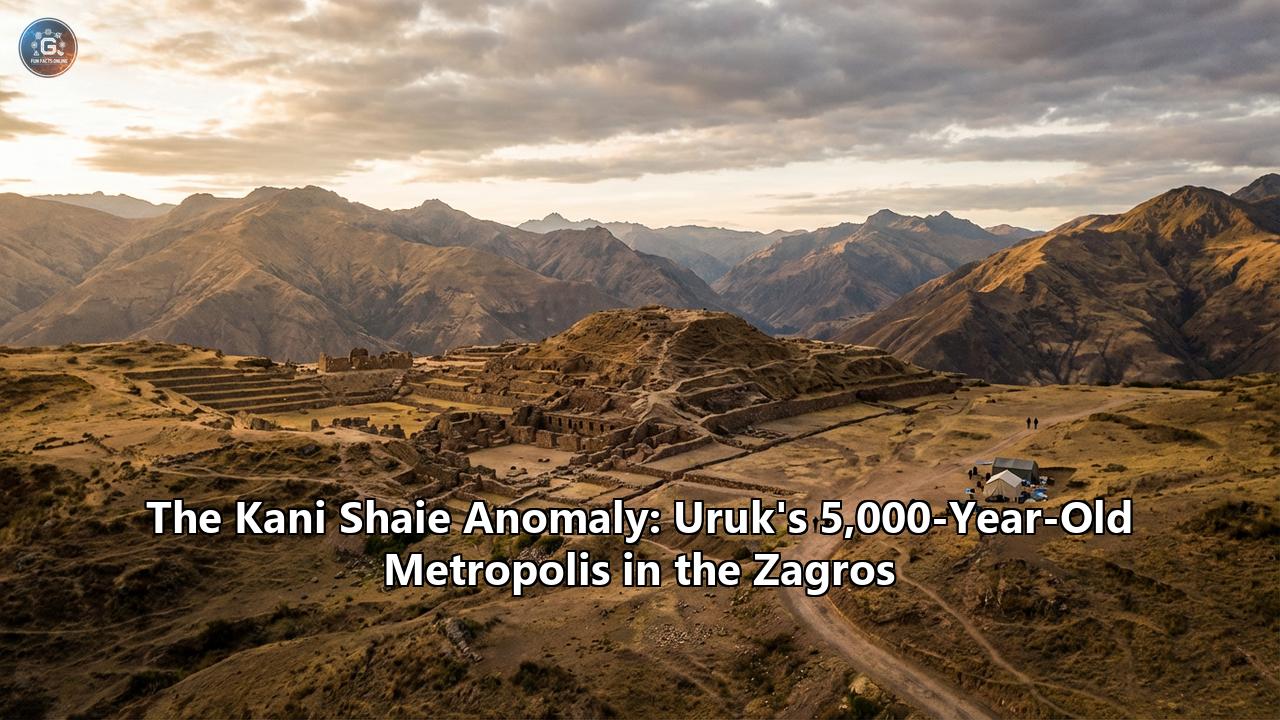
Nestled within the rugged, wind-swept foothills of the Zagros Mountains in the Sulaymaniyah Governorate of Iraqi Kurdistan lies a modest earthen mound. Rising just 15 meters above the surrounding Bazyan Valley and spanning a mere two hectares, the site of Kani Shaie might easily be overlooked by the untrained eye. Yet, beneath its sun-baked surface, archaeologists have unearthed a 7,000-year-old tapestry of human history that is fundamentally rewriting our understanding of the ancient world.
For decades, historians and archaeologists have painted the dawn of civilization as a phenomenon strictly confined to the fertile, flat alluvial plains of southern Mesopotamia. It was there, between the Tigris and Euphrates rivers, that Uruk—often heralded as the world’s first metropolis—rose to prominence during the fourth millennium BCE. But recent groundbreaking discoveries at Kani Shaie, culminating in a spectacular find in late 2025, have revealed an architectural and cultural anomaly that defies traditional historical narratives. Far from being a peripheral backwater, this small highland settlement was home to a monumental, richly decorated cultic building directly tied to the urban explosion of Uruk nearly 300 miles to the south.
The Kani Shaie anomaly forces us to ask: How did the architectural grandeur, complex bureaucracy, and immense wealth of the world’s first super-city find its way into a remote mountain valley? And more importantly, what role did these resilient highland communities play in the grand theater of the world's first urban revolution?
The Uruk Phenomenon and the Core-Periphery Paradigm
To understand the sheer magnitude of the discoveries at Kani Shaie, one must first understand the shadow cast by Uruk. Flourishing between 3300 and 3100 BCE during the Late Chalcolithic period, Uruk was a leviathan of the ancient world. At its height, the city boasted a population of up to 80,000 people—an unfathomable concentration of humanity for the era. It was in Uruk that some of the most critical milestones of human progress were achieved: the invention of precursor cuneiform writing, the birth of complex state administration, the mass production of pottery (such as the ubiquitous beveled-rim bowl), and the construction of colossal temple precincts dedicated to deities like Inanna and Anu.
As Uruk grew, its demand for resources—timber, precious metals, and exotic stones—skyrocketed. Southern Mesopotamia was rich in mud and reeds but destitute of these vital raw materials. This resource disparity birthed the "Uruk Expansion," a period when southern city-states established a vast network of colonies, enclaves, and outposts stretching across modern-day Syria, Turkey, and Iran. The traditional archaeological consensus, known as the core-periphery model, posited that Uruk (the core) dictated terms to the surrounding highlands (the periphery), establishing outposts solely to extract wealth and funnel it back to the metropolis.
For a long time, the famous site of Godin Tepe in Iran was considered the quintessential Zagros outpost of this expansion. But Kani Shaie presents a baffling contradiction. Geographically, the Bazyan Valley is situated off the major ancient trade routes that connected southern Mesopotamia to the Iranian plateau. Furthermore, the immediate vicinity of Kani Shaie lacks the highly coveted raw materials that typically attracted Uruk’s mercantile expansionists. By all conventional logic, a sophisticated Uruk-style administrative and religious center had no business being there. Yet, there it is—a metropolis in miniature, thriving in the highlands.
The Kani Shaie Archaeological Project: Unearthing the Anomaly
Though first noted by antiquarians over a century ago, Kani Shaie remained largely untouched until 2012, when the Kani Shaie Archaeological Project (KSAP) was formed. Systematic excavations began in September 2013. Directed by researchers André Tomé and Ricardo Cabral from the University of Coimbra’s Centre for Studies in Archaeology, Arts and Heritage Sciences (CEAACP), alongside Dr. Steve Renette of the University of Cambridge and the University of Pennsylvania, the project operates in close collaboration with the Slemani Directorate of Antiquities and Heritage.
The project was born out of a desire to correct a massive blind spot in Mesopotamian archaeology. Because of decades of geopolitical instability, the eastern Tigris region and the Zagros foothills had been critically under-researched. From the outset, the KSAP team deployed cutting-edge archaeological methodologies, including deep stratigraphic trenching, radiocarbon dating, and 3D scanning of artifacts, to piece together the region's obscured past.
What they found was staggering. The team identified 15 distinct occupational layers, tracing a continuous line of human habitation from the Chalcolithic era (circa 6500 BCE) through the Bronze and Iron Ages, into the Hellenistic-Parthian and Neo-Assyrian periods, and all the way to a medieval Kurdish cemetery from the Ottoman era. However, it was the Late Chalcolithic layers—corresponding to the Uruk period—that yielded the most paradigm-shifting evidence.
The 2025 Breakthrough: A Monument to the Mountain Gods
During the autumn 2025 excavation campaign, funded heavily by the Portuguese Foundation for Science and Technology (FCT), the KSAP team made a discovery that sent shockwaves through the archaeological community. Perched on the upper part of the artificial mound, the team uncovered the foundations and remnants of a massive, officially constructed monumental building.
This was not a simple village dwelling. The scale, layout, and construction techniques heavily implied a public, ceremonial, or cultic space—a temple or shrine where ritualistic and administrative activities converged. While the exact deities worshipped there remain veiled by time, the architectural DNA of the building was unmistakable: it was a direct reflection of southern Mesopotamian grandeur.
The most striking piece of evidence confirming this connection was the discovery of "wall cones" scattered throughout the structure. In the great temples of Uruk, architects decorated massive mud-brick walls by pressing thousands of baked clay or stone cones into the wet plaster. The flat, exposed heads of these cones were painted in vibrant reds, blacks, and whites, creating dazzling geometric mosaics that covered the temple facades. Finding these distinctive architectural elements at Kani Shaie—a small settlement hundreds of miles to the north—was akin to finding a piece of the Roman Colosseum hidden in a remote Scottish glen. It proved unequivocally that the building served a high-status ceremonial function and that the local builders were intimately fluent in the architectural language of the world's first metropolis.
Gold, Clay, and the Administration of Power
The monumental building did not just yield architectural marvels; it also housed artifacts that paint a vivid picture of Kani Shaie’s socio-economic status. Among the debris, archaeologists recovered a fragment of a delicately crafted gold pendant. In the ancient world, gold was the ultimate symbol of social prestige and elite status. Its presence in the Bazyan Valley shatters the illusion that highland communities of the fourth millennium BCE were impoverished or marginal. Instead, it indicates that the elites of Kani Shaie had the wealth, connections, and power to acquire luxury goods from distant trade networks.
Equally significant are the administrative artifacts recovered from the site. The KSAP team has unearthed multiple cylinder seals and clay seal impressions. Invented during the Uruk period, cylinder seals were intricately carved stone cylinders that, when rolled across wet clay, left a continuous frieze of images. They functioned as ancient signatures, used to seal storage jars, secure doors, and authenticate records. The seals found at Kani Shaie feature classic Uruk motifs, linking the highland site directly to the bureaucratic machinery of the southern plains.
One particularly remarkable find from earlier excavations at the site was a numerical clay tablet bearing a seal impression and an early numerical sign. These numerical tablets are widely regarded as the immediate precursors to the invention of full cuneiform writing. The fact that administrative tools of this sophistication were being utilized at Kani Shaie proves that the settlement was a vibrant, functioning node of bureaucracy and economic management, not just a passive recipient of southern culture.
Interestingly, while some seal impressions are distinctly Uruk in style, others reflect a localized Zagros Piedmont tradition. This hybridization is crucial. It suggests that Kani Shaie was not merely colonized and stripped of its local identity; rather, its inhabitants actively engaged with, adapted, and integrated southern Mesopotamian technologies into their own indigenous cultural frameworks.
The Strategic Geography of a Borderland
If Kani Shaie lacked raw materials and sat off the primary ancient highways, why did it become such a vital center? The answer lies in the complex topography and military history of the Zagros Mountains.
The Bazyan Valley serves as a critical borderland—a transitional zone between the flat, sprawling Mesopotamian alluvium and the rugged, impenetrable mountain corridors of Iran. Kani Shaie is centrally located within this valley, offering unparalleled visibility and control over the surrounding landscape.
History has repeatedly proven the strategic importance of this exact location. The valley features the infamous Bazyan Pass, known in antiquity as Babite. This narrow chokepoint has been the site of fierce historical contests for millennia. During the Bronze Age, the valley was part of the land of Lullubum, a mountain kingdom whose conflicts with Mesopotamian empires were immortalized on the famous Victory Stele of the Akkadian king Naram-Sin (circa 2150 BCE), a monument whose imagery is echoed on nearby rock reliefs at Darband-i Gawr.
Centuries later, in 881 BCE, the formidable Neo-Assyrian king Assurnasirpal II was forced to march his armies through a blockade at this very pass, constructed by a defiant local ruler named Nur-Adad. The strategic bottleneck proved so effective that the tactic was repeated nearly three millennia later, in 1805 CE, when Kurdish resistance leader 'Abd al-Rahman built a wall across the pass to halt the advance of Ottoman imperial troops.
Viewed through this lens of long-term geographical strategy, the anomaly of Kani Shaie begins to make sense. During the Uruk expansion, controlling the Bazyan Valley meant controlling a vital geopolitical buffer. Even if the valley didn't overflow with copper or lapis lazuli, it offered security, agricultural stability, and a watchful eye over the highland passes. Kani Shaie, with its monumental shrine and fortified mound, likely served as a diplomatic and administrative hinge connecting the lowland urbanites with the mountain tribes.
Cycles of Destruction and Rebirth
The story of Kani Shaie is not a simple upward trajectory of growth; it is a story of resilience marked by cycles of settlement, destruction, and adaptation.
Following the collapse of the Uruk expansion network at the end of the fourth millennium BCE—a period marked by the sudden abandonment of many southern outposts—Kani Shaie did not disappear. Stratigraphic evidence reveals that while the monumental center may have been destroyed or abandoned, the site quickly transitioned into a prosperous agricultural village. The grand architecture was replaced by smaller, continuously rebuilt domestic structures, but the site retained its role as a local administrative hub, as evidenced by the continued use of local cylinder seals on large storage jars.
As the millennia turned, the mound continued to attract settlers. Excavations in the flatter, lower town area of the site have revealed extensive occupation layers from the Hellenistic-Parthian period (247 BCE – 224 CE) and the Neo-Assyrian period (c. 911 – 609 BCE). The discovery of a Neo-Assyrian cylinder seal further underscores that even thousands of years after the fall of Uruk, Kani Shaie retained its regional importance within the imperial networks of the Iron Age.
Redefining the Cradle of Civilization
The ongoing revelations from the Kani Shaie Archaeological Project represent a monumental shift in Near Eastern archaeology. For generations, the narrative of human progress has been decidedly unipolar, focusing obsessively on the great southern cities like Uruk, Ur, and Eridu, while treating the Zagros Mountains as a wild, untamed frontier populated by passive or antagonistic barbarians.
Kani Shaie dismantles this antiquated view. The 2025 discovery of the monumental Uruk-period building, complete with metropolitan architectural flourishes like wall cones, elite gold adornments, and advanced bureaucratic tools, proves that the "Cradle of Civilization" was vastly more expansive and interconnected than previously imagined.
The highland communities of the Zagros were not just spectators to the urban revolution; they were active, vital participants. They engaged in the exchange of complex religious ideologies, administrative practices, and luxury goods. They built monumental structures that rivaled the provincial temples of the southern plains. They adapted the world's first writing systems to manage their local economies.
As the researchers at the University of Coimbra and Cambridge carefully analyze the latest findings, utilizing 3D printing and digital reconstruction to bring the ancient stones back to life, the true significance of Kani Shaie is coming into focus. It serves as a powerful reminder that history is rarely as simple as a core dictating to a periphery. Civilization is forged in the borderlands, in the spaces where different topographies, cultures, and ideas collide.
Today, the 15-meter mound of Kani Shaie stands quietly in the Bazyan Valley, baking under the same sun that saw the world's first bureaucrats roll their seals across wet clay 5,000 years ago. It is no longer just a hill of dirt and fragmented pottery. It is a testament to the enduring complexity of the ancient mountain peoples—a metropolis in miniature that forever changed our understanding of how the human story was written.
Reference:
- https://wildhunt.org/2025/11/ancient-cultic-space-discovered-in-the-shadow-of-the-worlds-first-metropolis.html
- https://www.biblicalarchaeology.org/daily/ancient-cultures/ancient-near-eastern-world/kani-shaie-archaeological-project/
- https://kanishaie.org/research/
- https://archaeologymag.com/2025/11/5000-year-old-monumental-building-in-kani-shaie/
- https://www.uc.pt/en/uc-news/articles/university-of-coimbra-team-discovers-monumental-building-shedding-new-light-on-the-origins-of-civilisation/
- https://whitelevy.fas.harvard.edu/archaeological-excavations-kani-shaie-iraqi-kurdistan-2013%E2%80%932016-campaigns
- https://allthathistory.com/archaeology-discoveries/uruk-period-building-kani-shaie-iraq/3996/
- https://arkeonews.net/archaeologists-discover-monumental-uruk-period-building-in-kani-shaie-northern-iraq/
- https://archaeology.org/news/2025/11/04/5000-year-old-monumental-building-excavated-in-iraq/