
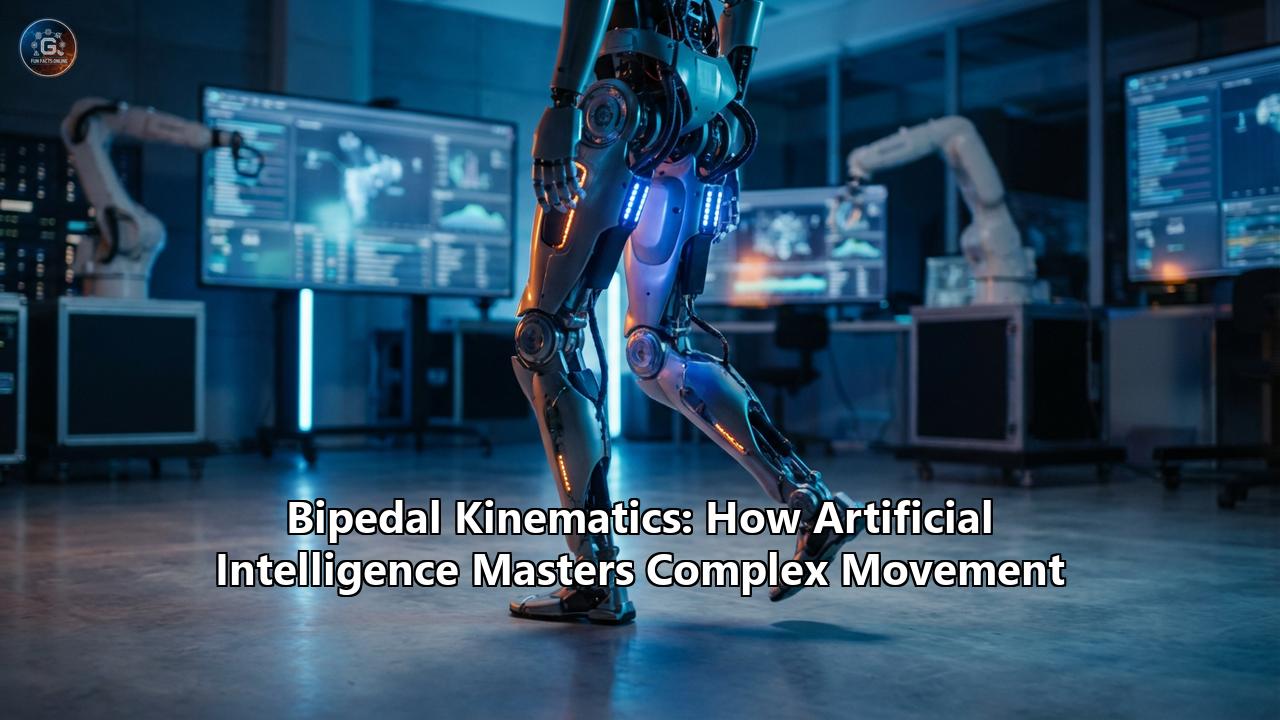
For a human, walking is an afterthought. You lean forward, gravity takes hold, and your legs instinctively swing out to catch you. It is a continuous, rhythmic symphony of controlled falling. Yet, translating this subconscious miracle into lines of code and mechanical actuators has been one of the most agonizing challenges in the history of robotics. For decades, getting a machine to walk on two legs without spectacularly crashing to the floor required supercomputers and excruciatingly precise mathematical models.
Today, that paradigm has been entirely upended. We are no longer just coding robots to walk; we are teaching them to learn.
At the intersection of biomechanics and artificial intelligence lies the fascinating field of AI-driven bipedal kinematics. By fusing deep reinforcement learning with advanced sensor suites, today’s humanoid robots are moving out of pristine laboratory environments and into real-world factories, rough terrains, and our daily lives. From machines that can adapt their gait to slippery surfaces in milliseconds, to humanoids that can jog across a room, AI has finally unlocked the secret to complex bipedal movement.
The Physics of Two Legs: Bipedal Kinematics 101
To appreciate what AI has accomplished, we first have to understand the physical nightmare that is bipedal locomotion.
In robotics, kinematics is the study of motion without considering the forces that cause it. It deals with joint angles, velocities, accelerations, and the spatial positioning of the robot's limbs. When a roboticist wants a humanoid's foot to land on a specific stair, they use inverse kinematics—a mathematical process that works backward from the desired foot placement to calculate the exact angles required at the hip, knee, and ankle joints.
But humans are top-heavy. Our Center of Mass (CoM) sits high up near our chest, supported by a tiny base of contact (our feet). In classical robotics, engineers relied on the Linear Inverted Pendulum Model (LIPM). This model treats the robot as a mass balanced on a telescopic leg, swinging back and forth. To keep the robot from falling, traditional control systems rely on calculating the Zero Moment Point (ZMP). The ZMP is the point on the ground where the total sum of horizontal inertia and gravity forces equals zero. As long as the ZMP stays within the polygon of the robot's feet, the robot stays upright.
For years, this ZMP-based control theory was the gold standard. It gave us the famous early humanoids, like Honda’s ASIMO, which walked with a distinctive, crouched, bent-knee gait. Keeping the knees bent kept the Center of Mass at a constant height, simplifying the math. But it was incredibly energy inefficient and rigid. If an ASIMO-era robot stepped on an unexpected pebble or encountered a slight incline, the pre-calculated math broke down, and the million-dollar machine would face-plant.
Classical model-based methods hit a ceiling. The real world is not flat, rigid, or predictable. To master true, dynamic, human-like movement, robots needed a brain that could react, adapt, and improvise. They needed Artificial Intelligence.
The Paradigm Shift: When Control Theory Met Neural Networks
The modern era of bipedal kinematics is defined by a massive pivot from purely analytical model-based control to Deep Reinforcement Learning (DRL).
Instead of engineers writing millions of lines of code to anticipate every possible physical disturbance, they now create a neural network and drop it into a physics simulator. In this virtual world, the AI is given a simple objective: move forward. It is given control of the robot's virtual joints and a reward function. If the robot falls, it receives a negative penalty. If it maintains its balance and moves forward efficiently, it receives a positive reward.
At first, the virtual robot flails wildly, collapsing instantly. But over millions of iterations—a process that takes days in simulation but equates to decades of human trial and error—the AI discovers the optimal way to move. It learns that swinging its arms counteracts the rotational momentum of its legs. It learns to lock its knees to save energy, unlocking the fluid, straight-legged, heel-to-toe gait that humans use.
However, mastering walking in a simulator (where physics are perfect) is very different from walking in the real world (where gears have friction, sensors have noise, and metal bends). This gap is known as the Sim-to-Real problem. To cross it, AI engineers use Domain Randomization. During training, the simulator constantly throws invisible curveballs at the AI. It randomly changes the gravity, alters the friction of the floor, adds virtual weights to the robot's limbs, and simulates sudden shoves. By the time the neural network is downloaded into the physical robot, it has already experienced—and learned to recover from—every physical anomaly imaginable.
Sensor Fusion: How AI "Feels" the World
An AI brain is useless without a nervous system. For a bipedal robot to master complex movement, it relies on high-speed "Sensor Fusion," a process where AI instantaneously stitches together data from various hardware streams to understand its body and its environment.
- Proprioception: Just as you can close your eyes and still know where your arms are, robots use joint encoders to track the exact angle and velocity of their limbs. Advanced AI policies allow robots to walk entirely "blind" across uneven terrain using only proprioceptive feedback—feeling the ground through the resistance in their actuators.
- The Vestibular System: Inertial Measurement Units (IMUs) act like the human inner ear, providing high-frequency data on the robot's acceleration and orientation. If a robot is pushed, the IMU detects the tilt in milliseconds, prompting the AI to instantly command a backward "catch" step to prevent a fall.
- Spatial Vision: Modern humanoids are equipped with 360-degree LiDAR and RGB-D depth cameras (like Intel RealSense). These sensors build a 3D topographic map of the environment.
Recently, the integration of Vision-Language-Action (VLA) models has revolutionized this space. Instead of vision and walking being separate systems, they are now intimately linked. The AI can look at a flight of stairs, understand them semantically, calculate the kinematic requirements, and adjust its Center of Mass before its foot even leaves the ground. Because latency is the enemy of balance, these massive AI models are increasingly run "on the edge" (locally on the robot's internal computers, like NVIDIA Jetson Orin modules) rather than in the cloud, ensuring split-second kinematic reactions.
Modern Marvels: The Titans of Bipedal AI
The sheer velocity of advancement in the mid-2020s has been staggering, moving humanoid robots out of viral lab videos and into commercial viability.
Tesla Optimus: From Static Display to High-Speed Runner
When Tesla originally announced the Optimus program in 2021, the display featured a human in a robot suit. By late 2025, Optimus Gen 2 and Gen 3 iterations were demonstrating astonishing kinematic feats. Transitioning away from motion-capture scripts, Tesla leaned heavily into Reinforcement Learning. This resulted in an entirely organic, straight-kneed, heel-to-toe walking gait.
But the true breakthrough came when Optimus achieved a running gait. Walking requires kinematic closure—one foot must always be touching the ground. Running is vastly more complex because it introduces a "flight phase" where both feet leave the ground, causing temporary dynamic instability. Tesla's neural networks managed to calculate the explosive vertical impulses and rapid control loops necessary to stabilize the robot mid-air, allowing Optimus to achieve running speeds estimated at 8.5 mph (3.8 m/s) in laboratory settings.
Boston Dynamics' Electric Atlas
Boston Dynamics' original Atlas was an internet legend, famous for performing backflips and parkour. But the older Atlas relied on heavy, high-maintenance hydraulic actuators and heavily scripted Model Predictive Control (MPC). Recognizing the power of modern AI, Boston Dynamics retired the hydraulic model and unveiled the fully Electric Atlas.
This new Atlas is built for commercial deployment and fleet learning. Its kinematics are bizarrely alien yet perfectly optimized; because its electric joints possess a wider range of motion than human joints, Electric Atlas can rotate its torso 180 degrees and stand up from the floor by folding its legs backward. Powered by machine learning, if one Electric Atlas figures out how to dynamically navigate a complex factory floor, that kinematic policy can be updated across the entire fleet.
Figure AI and the Industrial Deployment
While others focus on lab records, startups like Figure AI have pushed bipedal kinematics directly into the human workforce. Their Figure 02 and Figure 03 models have undergone rigorous real-world testing, including an 11-month deployment at BMW's Spartanburg manufacturing plant.
In a factory, a robot cannot simply walk; it must perform Whole-Body Loco-Manipulation. If Figure 02 picks up a heavy car part, its Center of Mass instantly shifts. The AI must dynamically recalculate its walking gait in real-time to compensate for the asymmetrical load, all while navigating around human workers. Figure's system, powered by their "Helix" AI, coordinates foot placement and arm manipulation as a single, unified neural problem rather than isolated tasks, allowing for highly dynamic and energy-efficient locomotion.
The Next Frontier: Cognitive-Kinematic Integration
Despite these monumental leaps, mastering complex movement remains an active frontier. AI researchers are currently solving the next wave of kinematic challenges.
Mixture-of-Experts (MoE) Architectures:When navigating highly unstructured terrain—like transitioning from flat concrete to a rocky hill—a single neural network can become overwhelmed. Researchers are now deploying MoE architectures in deep reinforcement learning. In this setup, the AI has a "gating network" that dynamically switches between different expert sub-networks. One expert network handles smooth walking, another specializes in stair climbing, and another activates instantly for recovery maneuvers if the robot slips. This divide-and-conquer strategy dramatically improves the robot's stability and agility.
Contact-Triggered Blind Climbing:Visual sensors can be blinded by glare, smoke, or physical obstructions. Next-generation bipedal robots are learning to navigate purely by touch. Using contact-triggered reinforcement learning, robots can detect when their foot hits an unseen obstacle and immediately trigger a highly agile, feedforward leg-lifting trajectory to clear the hazard. This allows humanoids to hike through dense brush or cluttered disaster zones where cameras are effectively useless.
Energy Efficiency and Artificial Muscles:While AI has optimized how robots move, hardware must keep pace. The human body is remarkably efficient; our tendons act as elastic springs that store and release kinetic energy with every step. Roboticists are deeply studying the Spring-Loaded Inverted Pendulum (SLIP) model to emulate this. By combining AI control with advanced elastic actuators, future humanoids will be able to run for hours on a single battery charge by recycling the kinetic shock of their own footsteps.
Stepping Into Tomorrow
The mastery of bipedal kinematics through Artificial Intelligence represents one of the crowning achievements of modern engineering. We have taken the chaotic, non-linear mathematics of falling and balancing, and handed it over to neural networks that can learn, adapt, and refine movement with superhuman precision.
The implications are profound. Because our entire world—our stairs, our doors, our factories, and our homes—was built for a bipedal footprint, the perfection of humanoid movement is the key to universal automation. The robots of tomorrow will not be confined to rails or flat warehouse floors. Thanks to the seamless fusion of artificial intelligence and kinematic design, they will walk beside us, matching our stride step for step into the future.
Reference:
- https://arxiv.org/abs/2509.09106
- https://www.researchgate.net/publication/394765955_Advancements_in_humanoid_robot_dynamics_and_learning-based_locomotion_control_methods
- https://pmc.ncbi.nlm.nih.gov/articles/PMC12783740/
- https://www.researchgate.net/publication/396607322_Reinforcement_Learning-Based_Footstep_Control_for_Humanoid_Robots_on_Complex_Terrain
- https://arxiv.org/html/2501.02116v2
- https://www.teslarati.com/tesla-optimus-improved-walk-update-video/
- https://arxiv.org/abs/2509.02986
- https://xpert.digital/en/humanoid-robots-with-a-load-capacity-of-10-kg-or-more/
- https://www.rdworldonline.com/beyond-manual-control-the-next-generation-of-surgical-robots-is-emerging/
- https://e1ventures.substack.com/p/beyond-the-hype-humanoid-robot-revolution-f18
- https://www.humanoidsdaily.com/news/analysis-tesla-optimus-pr-video-suggests-robot-has-reached-competitive-running-speeds
- https://bostondynamics.com/products/atlas/
- https://www.reddit.com/r/robotics/comments/5jpndu/is_anyone_know_whats_inside_atlas_from_boston/
- https://steelindustry.news/robotics-transforming-steel-manufacturing-and-the-automotive-industry/
- https://public-pages-files-2025.frontiersin.org/journals/robotics-and-ai/articles/10.3389/frobt.2026.1788395/pdf