
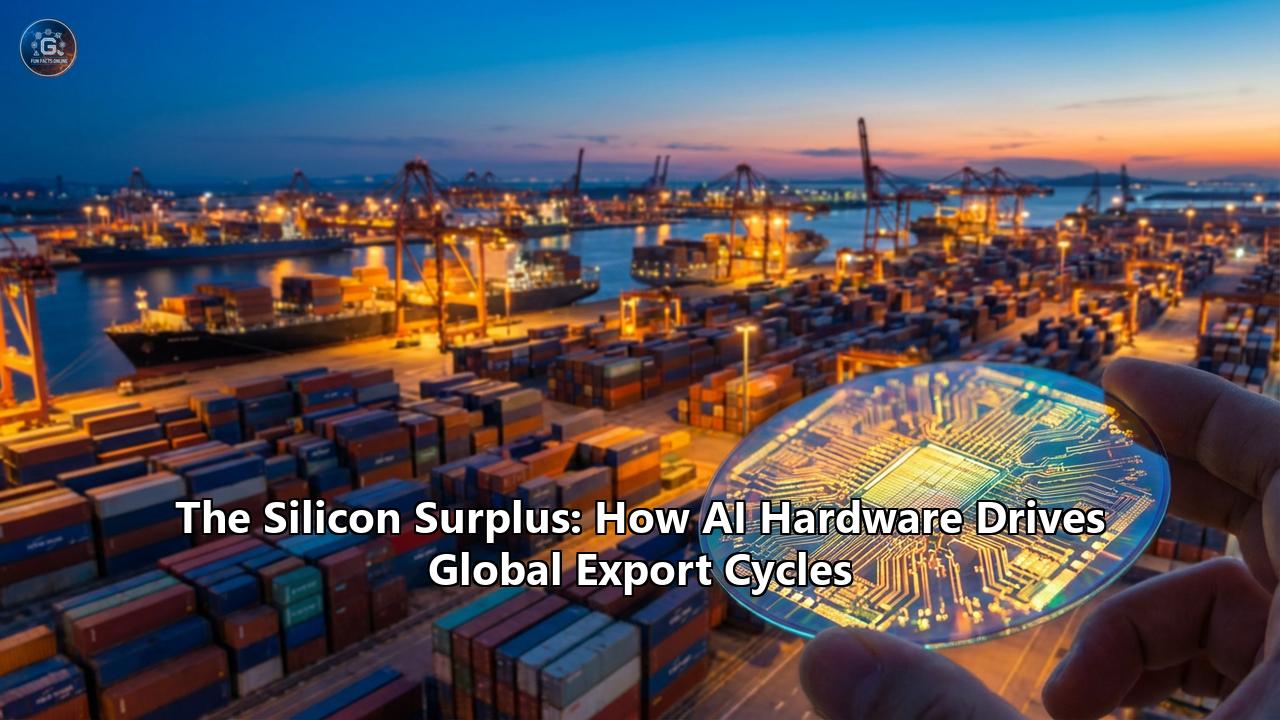
The hum of the global economy in 2026 is no longer the chugging of diesel engines or the roar of blast furnaces; it is the silent, high-frequency vibration of accelerated computing. We are living in the age of the "Silicon Surplus"—a period defined not just by an abundance of intelligence generated by machines, but by the massive, destabilizing trade surpluses accumulating in the handful of nations that build the brains of the new world.
As we stand in February 2026, the global trade map has been redrawn. Oil, once the undisputed king of commodities, has ceded its throne to the H100s, Blackwells, and HBM4 memory stacks that power the Artificial Intelligence revolution. This shift has unleashed a semiconductor supercycle of unprecedented magnitude, fundamentally altering the balance of power between East and West, creating new "petrostates" of silicon, and forcing the world’s superpowers into a high-stakes game of tariff-and-trade poker that culminated in the historic—and controversial—agreements of last month.
This is the story of the Silicon Surplus: how a shortage of sand-based logic created a surplus of wealth, leverage, and geopolitical tension that defines our time.
I. The New Wealth of Nations
To understand the scale of the current cycle, one must look at the harbor of Kaohsiung and the air freight terminals of Incheon. In late 2025, a quiet milestone was passed, one that future economic historians will mark as the start of a new era. For the first time in history, Taiwan’s monthly export value overtook that of South Korea.
For decades, the two "Asian Tigers" ran parallel races. South Korea, with its massive conglomerates (chaebols) like Samsung and SK, dominated memory chips, displays, and automobiles. Taiwan, with its army of specialized SMEs and the colossus TSMC, ruled contract manufacturing. But the AI boom has decoupled their fates.
In 2025, Taiwan’s exports surged 34% year-over-year, shattering records month after month. The driver was not smartphones or laptops, demand for which remains tepid, but "Accelerated Processing Units"—the GPUs and AI accelerators that every data center from Ashburn, Virginia, to Frankfurt, Germany, is desperate to acquire. The trade surplus generated by this island nation hit $157 billion in 2025, a figure so large it has begun to distort the local currency and force the central bank into aggressive maneuvering to prevent "Dutch Disease"—where a booming sector makes the rest of the economy uncompetitive.
"We are seeing a transfer of wealth from energy-consuming nations to intelligence-producing nations," notes Dr. Chang Hsin-yi of the Chung-Hua Institution for Economic Research. "Just as the world once sent dollars to Riyadh for oil, they now send dollars to Hsinchu for compute. The difference is, oil is burned once. A GPU prints value for five years."
This "Silicon Surplus" is not merely financial; it is diplomatic. The world’s dependence on the 5-nanometer and 2-nanometer nodes produced in Tainan and Taichung has given Taiwan a "Silicon Shield" more potent than any missile defense system, though it has also painted a larger target on its back.
II. The Tale of Two Chips: Logic vs. Memory
While Taiwan celebrates its ascension, South Korea faces a complex paradox. The nation is exporting more than ever—$173 billion in semiconductors alone in 2025—yet it feels like it is losing the race.
The reason lies in the architecture of the AI revolution. The current phase of AI investment is capex-heavy on logic—the brains (GPUs) that do the training. This is Taiwan's turf. TSMC holds a near-monopoly on the advanced packaging (CoWoS) required to stitch these massive chips together.
South Korea’s dominance is in memory. But not just any memory. The AI boom has bifurcated the memory market. On one side is "Commodity DRAM," the chips used in PCs and phones, where prices are volatile and competition from Chinese rivals like CXMT is fierce. On the other side is High Bandwidth Memory (HBM), the specialized, vertically stacked DRAM that sits next to the GPU.
Here, SK Hynix has emerged as the kingmaker. By betting the farm on HBM early, they captured the lion's share of the Nvidia supply chain, leaving even Samsung scrambling to catch up. In 2026, HBM acts as the "bottleneck of the bottleneck." You cannot ship an AI server without it. This has allowed South Korean firms to command profit margins on HBM that rival the logic makers, creating a bifurcated economy where the AI sector booms while the traditional industrial base stagnates.
"The surplus is real, but it is uneven," says Park Sung-hoon, a strategist at the Korea International Trade Association. "We are selling the pickaxes for the gold rush, but Taiwan is selling the maps and the dynamite. Both are profitable, but one commands the strategic high ground."
III. The January Shift: The Trump Tariffs and the "25% Kickback"
The economic purity of this export cycle crashed into the hard wall of politics in January 2026. With the return of Donald Trump to the White House, the "America First" trade policy underwent a radical, high-tech mutation.
For years, the U.S. strategy was simple: Denial. Block China from getting chips. Block the tools. Block the capital.
By late 2025, it was clear this strategy had leaks. China’s Huawei had managed to mass-produce 7nm and 5nm chips using older equipment, and the "Gray Market"—smuggling routes via Singapore, Dubai, and Vietnam—was thriving.
On January 15, 2026, the U.S. Administration unveiled a stunning policy pivot: The Conditional Export Regime.
Instead of a blanket ban, the U.S. would allow Nvidia and AMD to sell high-end chips (like the H200 and the new B200 simplified variants) to China, subject to a case-by-case review. The catch? A massive 25% "Security Tariff" or "Export Tax" levied on the revenue, payable directly to the U.S. Treasury.
"If they are going to build the future with our technology, they will pay for our national debt while doing it," President Trump declared.
This "Kickback Policy" fundamentally altered the export cycle overnight.
- Revenue Shift: It turned a national security issue into a revenue stream. Analysts estimate this could funnel $10-15 billion annually into the U.S. budget.
- Market Relief: For Nvidia, it reopened a market that was once 25% of its revenue, sending its stock soaring.
- The "Taxed" vs. "Smuggled" Spread: Chinese tech giants like Alibaba and ByteDance now face a choice: buy "clean" U.S. chips at a 25% premium plus tariff, or rely on the risky, warranty-void gray market. Most are choosing the former to secure stable supply chains for their training clusters.
Simultaneously, the U.S. signed the US-Taiwan Semiconductor Partnership Act on the same day. In exchange for a commitment of $500 billion in investment into the U.S. (half private, half state-backed credit), Taiwanese exports to the U.S. would see tariffs capped at 15%, avoiding the threatened 20-60% hikes.
"It was a masterclass in leverage," notes geopolitical analyst Sarah Chen. "The U.S. realized it couldn't reshore everything fast enough. So, it decided to tax the flow instead of damming it."
IV. The HBM Crunch and the $2,000 iPhone
While governments tussle over billions, the average consumer in 2026 is feeling the "Silicon Surplus" in a different way: inflation.
The "Cannibalization of Capacity" is in full swing. Because HBM requires three times the wafer capacity of standard memory and yields are lower, manufacturers like Samsung and Micron have aggressively converted their production lines from standard DDR5 (for PCs) and LPDDR (for phones) to HBM (for AI).
The result is a massive shortage of "normal" memory.
- The PC Squeeze: The price of a 32GB RAM stick has doubled since 2024.
- The Smartphone Hike: The newly released flagship phones in early 2026 are seeing price hikes of 15-20%, largely attributed to memory costs.
- The "AI Tax": Consumers are effectively subsidizing the data center build-out. Every time you buy a laptop with expensive RAM, you are paying for the lost capacity that went into an H200 server.
IDC reports warn that this "Memory Crunch" could last until 2027. "The world wants AI," the report states, "but the world also needs to check email. Right now, the fabs are prioritizing the AI."
V. The Red Silicon Curtain: China’s $1 Trillion Surplus
Across the strait, China is running its own "Silicon Surplus," but of a different flavor. While it imports high-end AI brains, it is flooding the world with "Legacy Chips"—the 28nm, 40nm, and 65nm microcontrollers that run cars, washing machines, and solar inverters.
In 2025, China’s trade surplus hit a staggering $1 trillion. A significant chunk of this is high-tech manufacturing powered by domestic chips. The U.S. and EU have erected tariff walls against Chinese EVs and solar panels, but the chips inside them are harder to police.
Furthermore, China’s domestic AI chip industry is not dead; it is merely bifurcated. Huawei’s Ascend series has captured 30% of the domestic market, creating a "Red AI Ecosystem" that is entirely distinct from the CUDA-dominated West. The new U.S. policy to allow taxed Nvidia sales is partly a move to slow this indigenous growth—if Chinese firms can buy superior Nvidia chips (even with a tax), they might stop buying inferior domestic ones. It is a cynical, calculated gamble to addict China to U.S. silicon again.
VI. The Green Dilemma: Energy as the Ultimate Export
The export of AI hardware is, effectively, the export of future energy consumption. A rack of Blackwell servers shipped from Taiwan to a data center in Ireland is a commitment to consume megawatts of power for years.
In 2026, we are seeing the rise of "Energy Protectionism." Countries are realizing that hosting AI data centers brings little employment but consumes vast grid resources.
- Singapore and Ireland have put moratoriums or strict caps on new data center builds.
- The US is seeing a "Nuclear Renaissance," with tech giants signing PPAs (Power Purchase Agreements) to restart decommissioned nuclear plants.
This changes the export cycle. Hardware is now flowing not just to where the money is, but to where the power is. We are seeing a surge in chip shipments to the Nordics (hydro), Quebec (hydro), and parts of the US Midwest (nuclear/wind). The "Silicon Surplus" is hunting for an "Energy Surplus."
VII. The Horizon: The Glut of 2027?
As we navigate the boom of 2026, the whispers of the next bust are already audible. The semiconductor industry is notoriously cyclical.
- Over-ordering: Just as in 2021-2022, companies are double-booking orders to ensure supply.
- Capacity Overshoot: The massive fab investments in Arizona, Germany, Japan, and Texas initiated in 2022-2024 are set to come online between 2026 and 2027.
- Efficiency Gains: New algorithmic breakthroughs are making AI training more efficient, potentially reducing the need for brute-force hardware scaling.
Some economists predict a "Silicon Crash" in late 2027, where the market is flooded with chips just as the initial AI capex frenzy cools. If that happens, the "Silicon Surplus" will turn into a literal surplus of inventory—warehouses full of depreciating processors.
But for now, in the spring of 2026, the music is playing faster than ever. The ships leaving Kaohsiung are heavy with the most valuable cargo in human history. The "Silicon Surplus" is driving the global economy, rewriting trade deals, and reshaping alliances. We are no longer just trading goods; we are trading the physical capacity to think. And right now, business is booming.
Reference:
- https://www.taipeitimes.com/News/biz/archives/2025/09/10/2003843507
- https://www.ajupress.com/view/20251013151008375
- https://sourceability.com/post/us-semiconductor-reshoring-efforts-collide-with-the-ai-boom
- https://www.idc.com/resource-center/blog/global-memory-shortage-crisis-market-analysis-and-the-potential-impact-on-the-smartphone-and-pc-markets-in-2026/
- https://www.tomshardware.com/tech-industry/semiconductors/ongoing-trade-war-has-tsmc-and-taiwan-stuck-between-a-rock-and-a-hard-place-concerns-mount-surrounding-u-s-deals-cracking-the-nations-silicon-shield
- https://internationalbanker.com/finance/how-chinas-trade-surplus-recently-hit-the-1-trillion-mark-for-the-first-time/
- https://www.ainvest.com/news/assessing-strategic-fallout-ai-chip-export-policy-shifts-2601/