
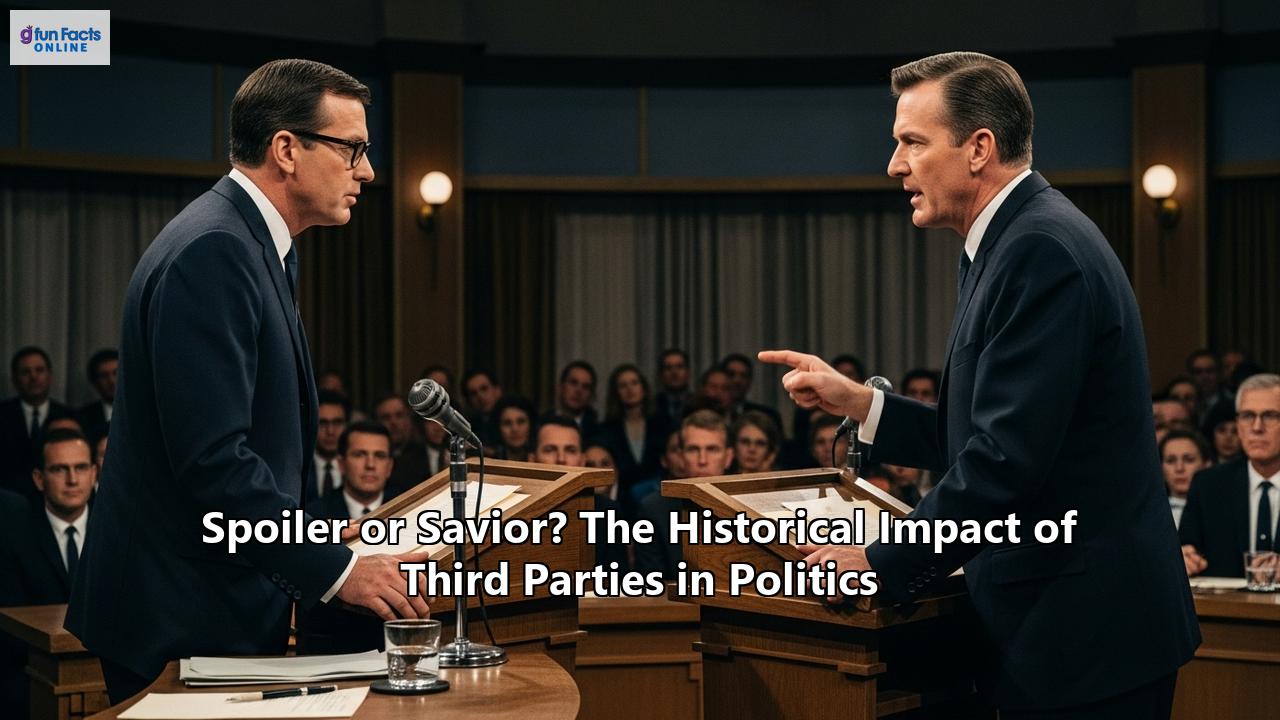
Spoiler or Savior? The Historical Impact of Third Parties in Politics
In the grand theater of American politics, the stage is typically set for a dramatic duel between two titans: the Democratic and Republican parties. Yet, history is replete with intriguing, often controversial, third-act entrances by smaller, yet significant, political forces. These third parties, emerging from the wings of the political stage, have been cast in two perpetually conflicting roles: the spoiler, a disruptive force that upends the delicate balance of an election, and the savior, a visionary catalyst that introduces crucial new ideas into the national discourse. Their legacies are a complex tapestry of thwarted ambitions, surprising victories, and enduring influence that has profoundly shaped the course of American history.
The narrative of the "spoiler" is a familiar one, a cautionary tale whispered every four years. It speaks of a charismatic or ideologically fervent candidate who, while having no realistic chance of winning, peels away just enough votes from a major-party contender to tip the election to the other side. Conversely, the "savior" narrative paints a picture of third parties as the conscience of the nation, bravely championing issues the two major parties are too timid or too entrenched to address. From advocating for the abolition of slavery to demanding women's suffrage and environmental protection, third parties have often been the initial champions of what later become mainstream American values.
This dual identity—spoiler and savior—is not a contradiction but rather two sides of the same coin, reflecting the inherent tensions within a two-party system. An exploration of pivotal moments in American history reveals the profound and often-underestimated impact these political outliers have had, forcing us to question whether they are a bug in the system or a feature essential for its evolution.
The Spoilers: Tipping the Scales of Power
The "spoiler effect" is a term that evokes strong emotions and heated debate, particularly in the aftermath of a close election. It describes a scenario where a third-party candidate draws votes from a major party candidate with a similar ideology, thereby "spoiling" their chances and handing victory to the opposing major party. Several presidential elections have been scrutinized under this lens, with the outcomes forever debated and the third-party candidates immortalized, or demonized, as spoilers.
The Election of 2000: The Nader Factor
Perhaps the most cited and contentious example of the spoiler effect is the 2000 presidential election. In a race that came down to a razor-thin margin in Florida, Green Party candidate Ralph Nader received 97,421 votes in the Sunshine State. Republican George W. Bush ultimately won Florida by a mere 537 votes, and with it, the presidency. Democrats have long argued that had Nader not been on the ballot, the vast majority of his supporters—sharing a more liberal ideology—would have voted for their nominee, Vice President Al Gore, securing him the presidency.
Studies and analyses have lent credence to this claim. A 2004 study found that Nader voters' profiles strongly aligned with those of likely Democratic voters, suggesting a preference for Gore over Bush in a two-man race. While Nader himself has consistently rejected the "spoiler" label, arguing that both major parties failed to address critical issues and that no party owns a citizen's vote, the perception of his candidacy as a spoiler has persisted. The Nader campaign of 2000 serves as a stark reminder of how a relatively small number of votes can have monumental consequences in a tightly contested election.
The Election of 1992: The Perot Phenomenon
The 1992 presidential election saw the emergence of a formidable third-party challenger in the form of Texas billionaire H. Ross Perot. Running on a platform of fiscal conservatism, a balanced budget, and an end to the national debt, Perot captivated a significant portion of the electorate disillusioned with both major parties. He ultimately garnered an impressive 18.9% of the popular vote, the highest for a non-major party candidate since 1912.
For years, a narrative has persisted that Perot's candidacy cost incumbent Republican President George H.W. Bush his re-election, handing the victory to Democrat Bill Clinton. Bush himself reportedly held this belief, feeling that Perot's anti-establishment message resonated more with potential Republican voters. However, the reality is more complex and contested.
Exit polls from the 1992 election indicated that Perot's voters would have split their votes roughly evenly between Bush and Clinton in a two-person race. Some political scientists argue that Perot's voters were demographically more similar to Clinton's, while others contend that Perot's relentless critique of the Bush administration's economic policies "departisanized the critique of Bush," damaging the incumbent in a way Clinton alone might not have been able to. While the debate over whether Perot was a true "spoiler" continues, his campaign undeniably reshaped the dynamics of the 1992 election and highlighted a deep-seated voter dissatisfaction that the major parties had failed to address.
The Election of 1968: Wallace and the Fracturing of the Democratic South
The 1968 presidential election was a tumultuous affair, set against a backdrop of the Vietnam War, civil rights struggles, and widespread social unrest. The candidacy of former Alabama Governor George Wallace, running on the American Independent Party ticket, added another layer of complexity. Wallace, a staunch segregationist, appealed to a significant number of white voters in the South and blue-collar workers in the North who were disenchanted with the Democratic Party's embrace of civil rights.
Wallace's campaign was not designed to win the presidency outright. Instead, he hoped to secure enough electoral votes to deny either major party candidate a majority, thereby throwing the election to the House of Representatives where he could act as a kingmaker. While this did not come to pass, Wallace's impact was profound. He won five Southern states, a clear sign of the fracturing of the "Solid South," which had been a reliable Democratic voting bloc.
Wallace's success demonstrated the potency of a racially charged "law and order" message, which Republican candidate Richard Nixon would later adopt in his "Southern Strategy." This strategy aimed to attract white Southern Democrats who felt alienated by the national Democratic Party's progressive stance on race. In this sense, Wallace was not just a spoiler who took votes away from the Democrats; he was a harbinger of a major political realignment that would see the South shift from solidly Democratic to reliably Republican.
The Saviors: Catalysts for Change and Progress
While the "spoiler" narrative often dominates the conversation about third parties, their role as "saviors" or innovators is equally, if not more, significant in the long arc of American history. Third parties have repeatedly served as incubators for ideas and policies that were initially deemed too radical or too niche for the major parties, only to be adopted into the mainstream years later.
The Populist Party: A Platform for the People
In the late 19th century, farmers in the South and West found themselves in a precarious economic position, plagued by debt, falling crop prices, and monopolistic railroad rates. Out of this discontent emerged the People's Party, more commonly known as the Populists. In 1892, they held their first national convention in Omaha, Nebraska, and drafted a platform that was revolutionary for its time.
The Omaha Platform called for a series of radical reforms, including the direct election of senators, a graduated income tax, government ownership of railroads, and a more flexible national currency. In the 1892 presidential election, the Populist candidate, James B. Weaver, won over a million votes and carried four states, a remarkable achievement for a new party.
Although the Populist Party itself was short-lived, its ideas were not. The Democratic Party, under the leadership of William Jennings Bryan, co-opted the Populist call for the free coinage of silver in 1896. Over the next two decades, many of the Populists' core tenets were enacted into law: the 16th Amendment established a federal income tax, and the 17th Amendment mandated the direct election of senators. These were once radical ideas, championed by a third party, that are now fundamental components of American governance.
The Socialist Party: Seeds of the New Deal
In the early 20th century, the Socialist Party of America emerged as a voice for the working class, advocating for a wide range of social and economic reforms. Led by charismatic figures like Eugene V. Debs, the Socialists championed policies such as an eight-hour workday, an end to child labor, social security, and unemployment insurance. At its peak, the party had a significant following, with Debs garnering nearly a million votes for president in 1920, even while imprisoned for his opposition to World War I.
The Socialist Party's influence far outstripped its electoral success. During the Progressive Era, their calls for reform resonated with a broader movement for social justice. However, it was during the Great Depression that the seeds they had planted truly began to bear fruit. Many of the key programs of President Franklin D. Roosevelt's New Deal, which fundamentally reshaped the role of the federal government in American life, mirrored proposals that the Socialist Party had been advocating for years. While the Socialist Party itself saw its support wane as the Democratic Party adopted its more popular policies, its ideological legacy is undeniable.
The Progressive Party of 1912: A "Bull Moose" Charge for Reform
When former President Theodore Roosevelt failed to secure the Republican presidential nomination in 1912, he did not go quietly. Instead, he launched a third-party bid under the banner of the Progressive Party, famously nicknamed the "Bull Moose Party." Roosevelt's platform was a bold and comprehensive vision for a more progressive America.
The Progressive Party platform of 1912 advocated for a host of reforms that would become central to American politics in the decades to come. It called for women's suffrage, an eight-hour workday, a ban on child labor, and a system of social insurance. Roosevelt's campaign was a direct challenge to the more conservative wing of the Republican Party and to the established political order.
While Roosevelt did not win the election, his candidacy had a significant impact. By splitting the Republican vote, he ensured the victory of Democrat Woodrow Wilson. More importantly, his campaign gave a national platform to a wide range of progressive ideas. Many of the reforms championed by the "Bull Moose" party would later be enacted, including the 19th Amendment, which granted women the right to vote. Roosevelt's 1912 campaign demonstrated how a powerful third-party movement could shift the national conversation and lay the groundwork for future social and political change.
Barriers to the Ballot Box: Why Third Parties Struggle
Despite their historical impact, third parties in the United States face a steep, often insurmountable, climb to electoral success. This is not by accident but is the result of a political system that is, by design, tilted in favor of the two major parties.
One of the most significant barriers is the "winner-take-all" electoral system used in most American elections. In this system, the candidate who receives the most votes in a given district or state wins all of the representation, leaving no room for second or third-place finishers. This stands in contrast to proportional representation systems used in many other democracies, where legislative seats are awarded based on the percentage of the vote a party receives. The winner-take-all system encourages strategic voting, where voters may abandon their preferred third-party candidate for the "lesser of two evils" among the major party contenders to avoid "wasting" their vote.
Ballot access laws also pose a significant hurdle. These laws, which vary from state to state, often require third parties to gather a large number of signatures or pay hefty fees to get their candidates on the ballot. The major parties, with their established infrastructure and financial resources, are largely exempt from these requirements.
Furthermore, third parties struggle with a lack of media coverage and are often excluded from presidential debates, which are a crucial platform for reaching a national audience. The rules for debate participation are often set by the major parties themselves, creating a classic catch-22: a third-party candidate needs to poll at a certain level to get into the debates, but it is difficult to reach that level without the exposure the debates provide.
The combination of these structural barriers creates a self-perpetuating cycle that reinforces the dominance of the two-party system and relegates third parties to the margins of American politics, at least in terms of winning elections.
The Enduring Legacy: A Necessary Disruption
The history of third parties in American politics is a testament to their complex and often contradictory role. They are the perennial underdogs, the gadflies of the political system, who rarely win the ultimate prize but often change the rules of the game.
The "spoiler" narrative, while often rooted in the bitter disappointment of a close election, highlights a fundamental reality of the American electoral system. In a winner-take-all contest, third parties can and do alter the outcome, sometimes with profound consequences. The elections of 2000, 1992, and 1968 serve as powerful case studies of this disruptive potential.
Yet, to focus solely on the "spoiler" effect is to miss the broader and arguably more important story of third parties as agents of change. From the Populists and Socialists to the Progressives, third parties have been at the forefront of some of the most significant social and political movements in American history. They have been the first to champion ideas that were once considered radical but are now accepted as fundamental rights and responsibilities of a modern democracy.
In this sense, third parties are more than just spoilers or saviors; they are an essential part of the American political ecosystem. They provide an outlet for voters who feel unrepresented by the two major parties, and they force the dominant parties to confront issues they would rather ignore. They are the bees of the political world, as historian Richard Hofstadter famously said: "once they have stung, they die." The sting may be painful for the major party that gets it, but the honey they leave behind—the new ideas, the expanded discourse, the push for progress—enriches the entire political landscape. The enduring legacy of third parties is not in the elections they have won, but in the a more perfect union they have consistently, and often thanklessly, pushed America to become.
Reference:
- https://millercenter.org/president/roosevelt/impact-and-legacy
- https://www.thirdway.org/memo/the-data-how-third-parties-could-be-spoilers-that-elect-trump
- https://dp.la/exhibitions/outsiders-president-elections/third-party-reform/roosevelt-progressive-party
- https://billofrightsinstitute.org/essays/the-election-of-1968
- https://en.wikipedia.org/wiki/Spoiler_effect
- https://archive.fairvote.org/spoiler/index.html
- https://en.wikipedia.org/wiki/Ralph_Nader
- https://www.cbsnews.com/news/the-nader-effect/
- https://www.brookings.edu/articles/reflections-on-the-2000-u-s-presidential-election/
- https://www.tandfonline.com/doi/abs/10.1016/j.soscij.2011.03.006
- https://en.wikipedia.org/wiki/1992_United_States_presidential_election
- https://spectrumlocalnews.com/tx/austin/news/2019/07/09/ross-perot-often-credited-for-costing-bush--92-election
- https://www.foxnews.com/politics/chris-wallace-bush-41-felt-ross-perot-cost-him-re-election-against-bill-clinton
- https://www.aei.org/articles/dont-know-whether-perot-cost-bush/
- https://split-ticket.org/2023/04/01/examining-ross-perots-impact-on-the-1992-presidential-election/
- https://en.wikipedia.org/wiki/George_Wallace_1968_presidential_campaign
- https://www.history.com/articles/how-the-party-of-lincoln-won-over-the-once-democratic-south
- https://teachingamericanhistory.org/document/platform-of-the-states-rights-democratic-party/
- https://www.khanacademy.org/humanities/us-history/postwarera/1960s-america/a/the-election-of-1968
- https://en.wikipedia.org/wiki/Southern_strategy
- https://www.britannica.com/topic/Southern-strategy
- https://www.britannica.com/event/Populist-Movement
- https://en.wikipedia.org/wiki/People%27s_Party_(United_States))
- https://digital.lib.niu.edu/illinois/gildedage/populism
- https://www.gilderlehrman.org/history-resources/spotlight-primary-source/peoples-party-campaign-poster-1892
- https://library.fiveable.me/key-terms/apush/socialist-party-of-america
- https://oxfordre.com/americanhistory/display/10.1093/acrefore/9780199329175.001.0001/acrefore-9780199329175-e-413?d=%2F10.1093%2Facrefore%2F9780199329175.001.0001%2Facrefore-9780199329175-e-413&p=emailASLajHFhwrz7c
- https://blogs.messiah.edu/politicsinternationalrelations/2024/11/13/the-promise-but-inevitable-difficulty-within-the-socialist-party-of-america/
- https://pq-static-content.proquest.com/collateral/media2/documents/resourceguide-socialistparty.pdf
- https://isreview.org/issue/108/new-deal-and-popular-front/index.html
- https://en.wikipedia.org/wiki/Bull_Moose_Party
- https://teachingamericanhistory.org/document/progressive-party-platform-1912/