
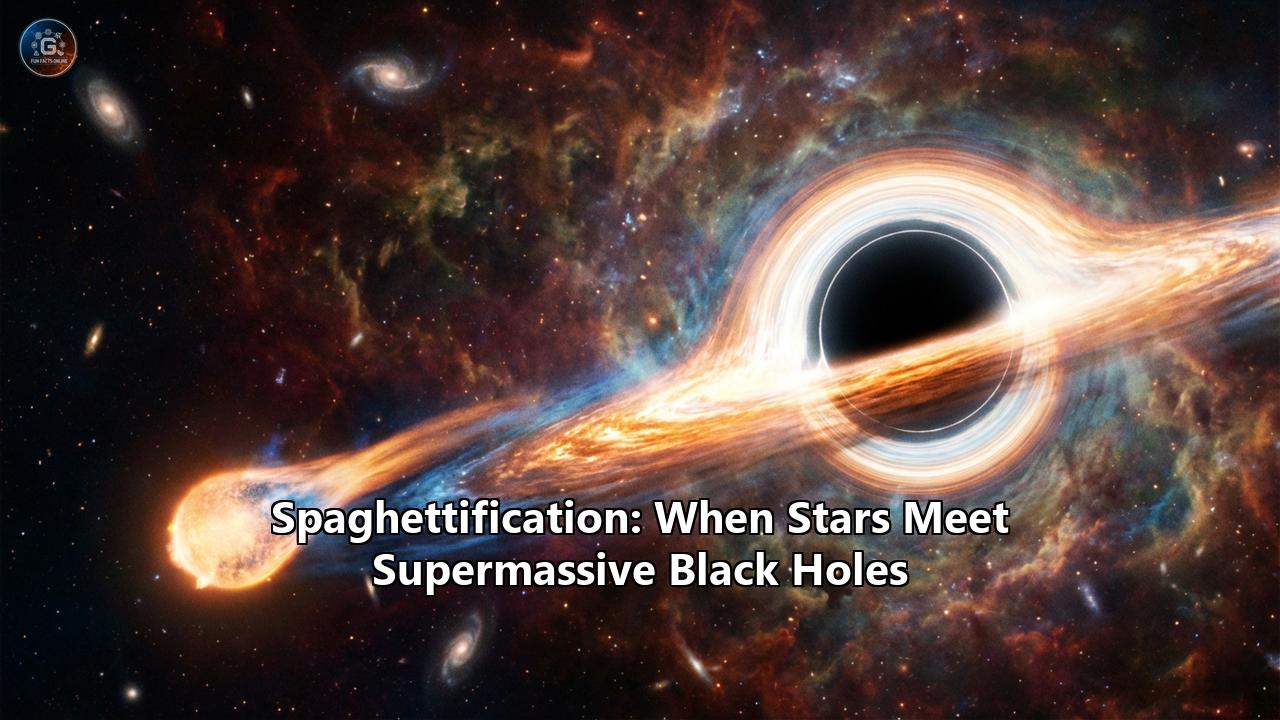
In the vast, silent cathedral of the cosmos, a drama of violence and transformation plays out that defies the human imagination. It is a celestial ballet where the dancers are stars—immense, fusing spheres of plasma—and the stage is the event horizon of a supermassive black hole, a gravitational tyrant millions or billions of times the mass of our Sun. The climax of this performance is a phenomenon with a name that sounds deceptively whimsical: spaghettification.
This is not merely a quirky footnote in an astrophysics textbook. Spaghettification, or the tidal disruption event (TDE), is one of the most energetic and revelatory processes in the universe. It is the mechanism by which the invisible becomes visible, lighting up the dark hearts of galaxies and offering astronomers a fleeting window into the extreme physics of gravity, accretion, and relativistic jets.
As we stand in late 2025, we are currently living through a golden age of TDE discovery. Thanks to advanced survey telescopes like the Zwicky Transient Facility (ZTF) and the newly operational Vera C. Rubin Observatory, we are no longer finding these events by luck, but by the hundreds. We are witnessing stars being shredded in real-time, observing "wandering" black holes in the outskirts of galaxies, and solving decades-old mysteries about where the energy from these cataclysms goes.
This article will take you on a journey into the abyss. We will explore the terrifying physics of tidal forces, the intricate anatomy of a star’s destruction, the puzzling absence (and occasional presence) of relativistic jets, and the groundbreaking discoveries of the last few years—including the enigmatic "wandering" black hole revealed by the event AT 2024tvd.
Part I: The Physics of the Stretch
To understand spaghettification, one must first abandon the intuition of gravity as a simple force that pulls things down. In the vicinity of a black hole, gravity is a gradient—a slope so steep that it tears reality apart.
The Tidal Force
Gravity weakens with distance. According to Newton’s law of universal gravitation, the force is inversely proportional to the square of the distance between two objects. On Earth, this gradient is negligible. The gravity pulling on your feet is infinitesimally stronger than the gravity pulling on your head, but your body’s structural integrity (your bones and muscles) easily resists this tiny difference.
Now, imagine replacing Earth with a singularity. As an object approaches a black hole, the gravitational field intensifies exponentially. If you were to fall feet-first toward a stellar-mass black hole, the difference in gravitational pull between your feet and your head would become enormous. Your feet would be pulled down with thousands of g-forces more than your head. Simultaneously, because all paths toward the center of a black hole converge, your sides would be squeezed inward.
The result is a vertical stretching and horizontal compression. You would be drawn out into a long, thin strand of biological matter. You would be spaghettified.
The Roche Limit
For a star, the process is governed by the Roche limit—the distance at which the tidal forces of the black hole exceed the self-gravity holding the star together. A star is essentially a delicate balance: the inward pull of its own gravity versus the outward pressure of nuclear fusion. When it crosses the tidal radius ($r_t$), the black hole wins.
The formula for the tidal radius is roughly:
$$ r_t \approx R_ (M_{BH} / M_)^{1/3} $$
Where $R_$ is the radius of the star, $M_{BH}$ is the mass of the black hole, and $M_$ is the mass of the star.
Crucially, the "danger zone" depends on the mass of the black hole. For a black hole with the mass of our Sun (a stellar-mass black hole), the tidal radius is often outside the event horizon. A star (or a human) approaching it would be ripped apart before ever crossing the point of no return.
However, for supermassive black holes (SMBHs)—those giants with masses exceeding 100 million Suns—the event horizon is huge. In fact, for the largest SMBHs, the tidal radius lies inside the event horizon. A star approaching such a monster would be swallowed whole, crossing the horizon intact and only undergoing spaghettification deep inside, hidden from the universe forever.
This creates a "sweet spot" for astronomers: black holes with masses between roughly 1 million and 100 million solar masses. These are the "Goldilocks" monsters. They are large enough to exist at the centers of galaxies but compact enough that they shred stars outside the event horizon, creating a visible fireworks display that we can observe from Earth.
Part II: The Anatomy of a Destruction
What exactly happens when a star wanders into this zone? It is not an instantaneous explosion, but a protracted, multi-stage process that can last for months or years.
1. The Approach and Disruption
Most stars in a galactic nucleus are on safe orbits, far from the maw of the central black hole. But occasionally, gravitational interactions with other stars or massive gas clouds can perturb a star's orbit, sending it on a parabolic trajectory that grazes the tidal radius.
As the star reaches the point of closest approach (pericenter), the tidal forces overcome its gravity. In a matter of hours, the star is unsealed. It does not just break into pieces; it is fluidly deformed. Approximately half of the star's mass is given a kick of energy and flung out into the galaxy on a hyperbolic trajectory—the "unbound" debris. The other half is gravitationally captured, bound to the black hole in highly eccentric, elliptical orbits.
2. The Stream and "Nozzle" Shock
The bound debris does not immediately fall in. Instead, it stretches into a long, thin stream of gas, often likened to a "cosmic hose" spraying plasma. As this stream swings around the black hole, it experiences extreme relativistic effects. The gas at the "head" of the stream (closest to the hole) orbits faster than the gas at the "tail."
This leads to a phenomenon known as apsidal precession. The elliptical orbits of the gas streams don't stay closed; they rotate over time. Eventually, the head of the stream wraps all the way around the black hole and smashes into the tail of the stream that is still falling in.
3. The Self-Intersection Shock
This collision is the moment of truth. The "self-intersection shock" is where the kinetic energy of the gas is converted into heat and light. For years, theorists debated whether the optical and ultraviolet light we see from TDEs comes from this shock or from the accretion disk that forms later.
Recent simulations and observations, particularly of the event AT2019qiz, suggest that for many TDEs, the bright flare we see is powered by these shocks. The collision circularizes the gas, robbing it of angular momentum and allowing it to settle into a disk.
4. The Accretion Disk
Once the gas circularizes, it forms a hot, swirling accretion disk. Friction within the disk heats the gas to millions of degrees, causing it to emit X-rays. This is the "engine" of the TDE.
However, a longstanding puzzle has been the "Missing Energy Problem." Theoretical models predicted that TDEs should be blazingly bright in X-rays, yet many observed events were dominated by cooler optical and UV light. Where were the X-rays?
The answer, solidified by discoveries in the early 2020s, lies in reprocessing. In many events, the initial debris cloud is so thick and turbulent that it shrouds the inner X-ray machine. The high-energy X-rays are absorbed by this envelope of gas and re-emitted as lower-energy optical and UV light. It is only later, as the debris clears, that the X-rays "break out."
Part III: The Jetted Few
While most TDEs are messy, thermal events, a rare subset—about 1%—are truly relativistic monsters. These are the "jetted" TDEs.
In these events, the black hole doesn't just eat; it burps. A significant fraction of the accreted material is funneled by intense magnetic fields toward the poles of the black hole and blasted out at 99.9% the speed of light.
The most famous of these was Swift J1644+57, discovered in 2011. It was initially thought to be a Gamma-Ray Burst, but its persistence revealed its true nature: a star had been consumed by a black hole, and the resulting jet was pointed directly at Earth. We were looking down the barrel of a cosmic gun.
More recently, the event AT2022cmc (discovered by the Zwicky Transient Facility) provided a masterclass in jetted physics. It was the farthest TDE ever detected, located 8.5 billion light-years away. The jet was so bright it outshone its entire host galaxy.
Why do some have jets and others don't?The leading theory involves the magnetic state of the black hole. To launch a powerful jet, you need a "Magnetically Arrested Disk" (MAD). This occurs when the magnetic field lines threading the accretion disk become so strong that they actually pile up against the black hole, disrupting the inflow of gas and channeling energy into the jet. It also requires the black hole to be spinning rapidly. If a star falls onto a non-spinning black hole, or one with weak magnetic fields, you get a "quiet" indigestion rather than a relativistic beam.
Part IV: The Era of "Wandering" Black Holes
Perhaps the most exciting development in the mid-2020s is the use of TDEs to find black holes where they "shouldn't" be.
Standard astronomy tells us that supermassive black holes reside in the exact centers of galaxies. But nature is rarely so tidy. When galaxies merge, their central black holes can interact. Sometimes they merge; other times, gravitational recoil (a "kick" from the emission of gravitational waves) can eject a black hole from the center, sending it wandering through the galactic suburbs.
These wandering black holes are invisible—unless they eat a star.
In late 2024/early 2025, astronomers confirmed the nature of AT 2024tvd. This event appeared to be a standard TDE, but high-precision astrometry from the Hubble Space Telescope and the Chandra X-ray Observatory placed it 2,600 light-years away from the center of its host galaxy.
This was the "smoking gun" for a wandering supermassive black hole. It proved that there is a hidden population of monsters lurking in the dark halos of galaxies, detectable only when they commit a stellar murder. This has profound implications for our understanding of galaxy evolution and the merger history of the universe.
Part V: The "Impostors" and the Detective Work
One of the biggest challenges in TDE science is distinguishing them from other cosmic flashes. A supernova (an exploding star) can look very similar to a TDE in a distant galaxy. An Active Galactic Nucleus (AGN)—a black hole that is constantly feeding—can flare up and mimic a TDE.
Astronomers have developed a forensic toolkit to tell them apart:
- Location: TDEs (usually) happen in the absolute center of a galaxy. Supernovae can happen anywhere. (The "wandering" black holes are the exception that proves the rule!)
- Color Temperature: TDEs are incredibly hot and remain blue for a long time. Supernovae tend to cool down and turn red faster.
- Light Curve: The brightness of a TDE often decays following a very specific mathematical power law ($t^{-5/3}$), representing the rate at which the debris falls back onto the hole.
- Spectral Lines: TDEs show very broad emission lines of hydrogen and helium (due to the high speeds of the orbiting gas) but lack the narrow absorption lines typical of AGN.
Recently, the use of infrared data has added a new layer to this. Events like WTP14adbjsh were invisible in optical light but bright in infrared. Why? Because they occurred in "dusty" star-forming galaxies. The dust absorbed the visible light and re-radiated it as heat (infrared). This discovery solved a major discrepancy: astronomers previously thought TDEs avoided star-forming galaxies. They didn't avoid them; they were just hiding behind the dust curtains.
Part VI: The Future is Bright (and Periodic)
As we look toward the late 2020s, the field is shifting from discovery to understanding.
Quasi-Periodic Eruptions (QPEs)A bizarre sequel to the TDE story has recently emerged. Years after the main event, some black holes start "hiccuping" in X-rays. The event AT2019qiz, years after its initial discovery, began showing X-ray bursts every 48 hours. The leading theory? A stellar survivor.
It is possible that the star was not fully destroyed. The dense core survived the initial pass, and now it is on a tight, elliptical orbit, punching through the accretion disk formed from its own stripped atmosphere every 48 hours. Each punch creates a shockwave—a heartbeat of X-rays.
The Rubin EraThe Vera C. Rubin Observatory is now coming online. Its Legacy Survey of Space and Time (LSST) will scan the entire southern sky every few nights. It is predicted to find thousands of TDEs per year. We are moving from studying individual "specimens" to studying "populations."
We will soon know if our theories about black hole mass, spin, and wandering populations hold up against the weight of big data. We might even find "micro-TDEs"—stars disrupted by Intermediate-Mass Black Holes (IMBHs), the elusive missing link between stellar and supermassive black holes.
Conclusion: The Ultimate Recycling
Spaghettification is violent, but it is also generative. The gas that does not fall into the black hole—the unbound half—is flung out into the galaxy, enriched with heavy elements from the star's interior. This material may eventually cool, collapse, and form new stars, or even planets.
When we look at a TDE, we are seeing the cycle of the cosmos in its most extreme form: destruction and creation, gravity and light, silence and fury. The star dies, but in its dying scream, it illuminates the darkest corners of the universe, allowing us, the observers on a small rock 25,000 light-years from our own galactic monster, to understand the monsters in the dark.
Reference:
- https://arxiv.org/pdf/2505.07061
- https://www.sci.news/astronomy/wandering-supermassive-black-hole-13891.html
- https://dash.harvard.edu/server/api/core/bitstreams/231201ce-d3c2-4281-92e3-a2215a1d8e34/content
- https://ideas.repec.org/a/nat/nature/v634y2024i8035d10.1038_s41586-024-08023-6.html
- https://academic.oup.com/mnras/article/528/2/2568/7571557
- https://arxiv.org/abs/2502.19495
- https://www.bohrium.com/paper-details/strong-lensing-of-tidal-disruption-events-detection-rates-in-imaging-surveys/1037568319554584583-527