
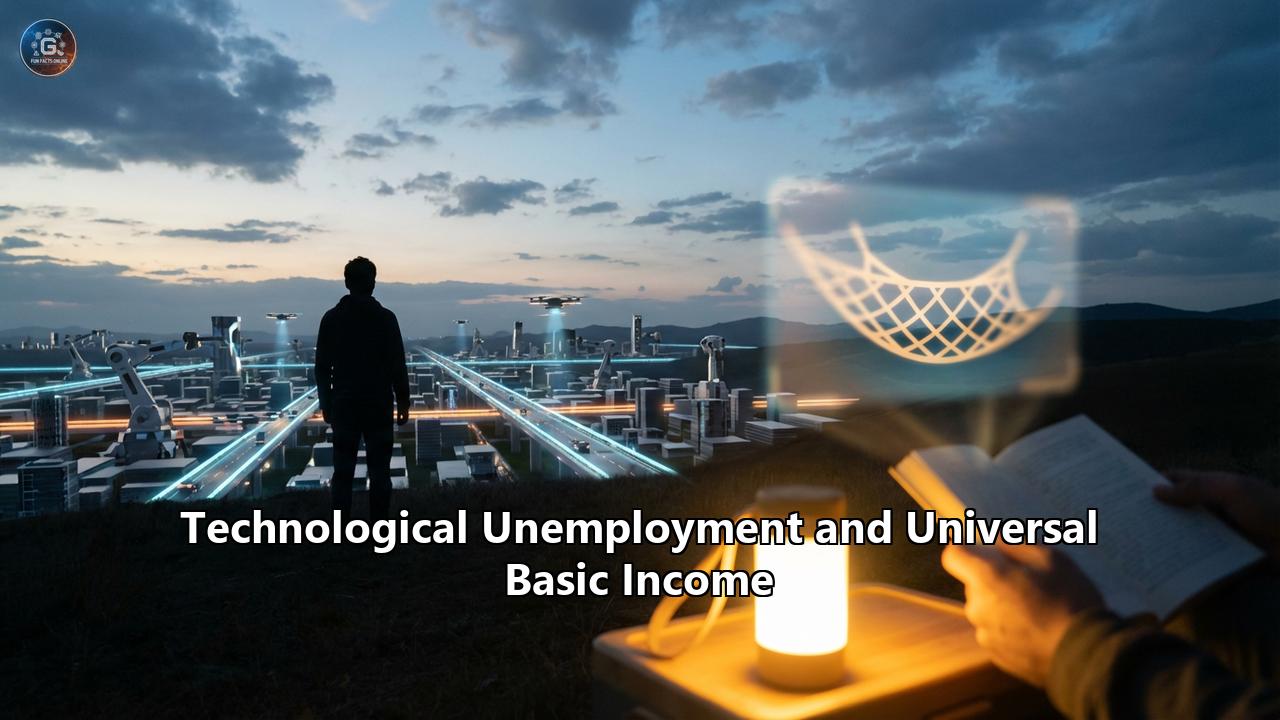
Part I: The Age of Acceleration
We stand on the precipice of a transformation so profound that it makes the Industrial Revolution look like a minor adjustment in human affairs. For two centuries, the social contract of civilization has been predicated on a simple exchange: labor for survival. You work, you get paid, you eat. It is a system that has built skyscrapers, cured diseases, and lifted billions out of poverty. But that system is breaking. It is cracking under the pressure of a new kind of intelligence—one that does not sweat, does not sleep, and is evolving at a pace that biology cannot match.
The convergence of technological unemployment and Universal Basic Income (UBI) is no longer a fringe topic discussed in the dusty corners of academic economics departments or the speculative forums of futurists. It has moved to the center stage of global policy debate. The catalyst is Artificial Intelligence, specifically the rise of Generative AI and advanced robotics, which threatens to uncouple economic productivity from human labor permanently.
This is the story of the "Great Decoupling"—the moment when the line on the graph tracking GDP continues to soar while the line tracking median human income flattens or falls. It is an exploration of the existential crisis facing the workforce and the radical economic intervention that might be our only bridge to a stable future.
Part II: The Nature of the Beast – Why "This Time Is Different"
To understand the urgency of UBI, one must first confront the reality of the technological threat. Economists have long cited the "Luddite Fallacy"—the mistaken belief that technological progress creates structural unemployment. When the steam engine arrived, weavers lost their jobs, but the textile industry exploded, creating more jobs than it destroyed. When the tractor arrived, farmhands were displaced, but they moved to cities to man the assembly lines of Ford and GM. The standard economic dogma holds that technology destroys tasks, not jobs, and that human ingenuity will always find new, higher-value uses for human time.
But Artificial Intelligence presents a fundamentally different challenge. Previous industrial revolutions replaced human muscle. Machines were stronger, faster, and more tireless than biological bodies, but they were dumb. They needed humans to guide them, repair them, and make decisions.
The AI revolution is replacing human cognition.
Generative AI models, such as the GPT series and their successors, have demonstrated an ability to perform tasks that were previously thought to be the exclusive domain of the human spirit: writing poetry, debugging code, diagnosing illnesses, drafting legal contracts, and creating art. We are moving from an era of "blue-collar" automation (robots in factories) to "white-collar" obliteration.
The "Comparative Advantage" of humans is shrinking. If a machine can write a marketing brief faster, cheaper, and better than a junior associate, what happens to the associate? If an algorithm can analyze an X-ray with greater accuracy than a radiologist, what is the future of medical diagnostics? The argument that humans will simply "move up the value chain" assumes that there is an infinite ladder of higher cognitive tasks that machines cannot reach. That assumption is looking increasingly fragile. As AI systems achieve parity with human reasoning, the "safe harbor" jobs are disappearing.
Part III: The Economics of Displacement
The economic impact of this shift is visible in the phenomenon of polarization. The labor market is hollowing out. We are seeing a boom in high-skill, high-pay jobs for those who can build and control AI, and a persistence of low-skill, low-pay service jobs (like elder care) that require physical dexterity and emotional intelligence—things robots still struggle with. But the massive middle—the accountants, the truckers, the paralegals, the middle managers, the coders—is under siege.
This creates a crisis of effective demand. In a capitalist economy, workers are also consumers. If automation drives wages down or eliminates jobs entirely, who will buy the goods and services the machines are producing? Henry Ford famously doubled his workers' wages so they could afford to buy his Model T cars. If the "workers" are algorithms running on server farms, they do not buy cars, they do not go on vacation, and they do not pay mortgages. Without a mechanism to recirculate wealth, an automated economy risks a deflationary death spiral—massive supply, zero demand.
This is where the logic of Universal Basic Income enters the equation. It is not merely a charitable safety net; in an age of extreme automation, it becomes the necessary lubricant to keep the engine of capitalism from seizing up.
Part IV: Universal Basic Income – A Primer
Universal Basic Income is a deceptively simple idea: a periodic cash payment delivered to all on an individual basis, without means test or work requirement.
It is "Universal" because everyone gets it, from the homeless person on the street corner to the CEO in the penthouse. This universality removes the stigma associated with welfare and eliminates the "welfare trap"—the disincentive to work caused by the fear of losing benefits if one earns too much.
It is "Basic" because it is meant to cover the floor of existence—food, shelter, basic dignity. It is not meant to fund a life of luxury, but to ensure survival.
It is "Income" because it is cash, not vouchers. It respects the agency of the recipient to decide what they need most.
The concept has a diverse lineage. It was hinted at by Thomas More in Utopia (1516), advocated by revolutionary pamphleteer Thomas Paine, supported by libertarians like Milton Friedman (in the form of a Negative Income Tax), and championed by civil rights leader Martin Luther King Jr., who wrote in 1967, "I am now convinced that the simplest approach will prove to be the most effective—the solution to poverty is to abolish it directly by a now widely discussed measure: the guaranteed income."
In the 21st century, the torch was picked up by tech leaders and political figures like Andrew Yang, who brought UBI to the mainstream during the 2020 US Presidential election. Their argument was specific: the robots are coming, and we need a "Freedom Dividend" to survive the transition.
Part V: The Evidence – What Happens When You Give People Free Money?
For decades, the debate over UBI was theoretical. Critics argued it would make people lazy, explode the deficit, and lead to vice. Proponents argued it would unleash creativity and end poverty. In recent years, however, we have moved from theory to data.
The Sam Altman / OpenResearch Study (2024)Perhaps the most significant piece of recent evidence comes from the long-awaited study funded by Sam Altman, CEO of OpenAI. The study gave \$1,000 a month to low-income participants for three years. The results, published in mid-2024, provided a nuanced rebuttal to both utopian and dystopian predictions.
- Labor Supply: Did people stop working? Slightly. Recipients worked, on average, 1.3 hours less per week than the control group. But they didn't drop out of the workforce to play video games. They used that time to find better jobs, wait for roles that matched their skills, or care for family members.
- Agency: The money purchased "agency." Recipients were more likely to refuse low-quality, exploitative jobs. This shift in bargaining power is a crucial feature of UBI; it transforms the labor market from a coerced necessity to a voluntary exchange.
- Health: While the study did not find massive short-term improvements in physical health markers (like blood pressure), it found significant increases in the utilization of dental care and mental health services. People fixed the teeth they had been ignoring for years because they finally had the cash.
In Stockton, California, a pilot program gave \$500 a month to randomly selected residents. The results showed that employment actually increased among recipients. The financial stability allowed them to fix their cars to get to interviews, buy uniforms, and take the risk of applying for new work. It debunked the myth of laziness.
The Finnish ExperimentFinland ran a nationwide randomized control trial of UBI. The primary finding was not an employment boom, but a happiness boom. Recipients reported significantly lower stress, higher trust in social institutions, and better cognitive functioning. In a world where mental health crises are endemic, the psychological ROI of UBI is a factor that purely economic metrics often miss.
Part VI: The Funding Puzzle – Who Pays for It?
The most formidable barrier to UBI is the price tag. Providing \$1,000 a month to every adult in the United States would cost roughly \$3 trillion a year—a massive chunk of GDP. However, in the context of an AI-driven economy, the funding models shift from taxing labor to taxing capital and automation.
1. The Robot TaxBill Gates has famously suggested that if a robot takes a human's job, the robot (or its owner) should pay taxes at a similar level to the human it replaced. This slows down the pace of automation to a manageable speed and generates revenue. However, defining a "robot" is difficult. Is a spreadsheet a robot? Is a self-checkout kiosk? The complexity of implementation makes this challenging, but the principle—taxing automation—is sound.
2. The Data DividendAI models are trained on the collective data of humanity—our books, our articles, our photos, our code. Currently, tech giants harvest this data for free and sell the intelligence back to us. A "Data Dividend" proposes that companies pay a tax on the data they use, which flows directly into a UBI fund. We are the raw material for AI; we should own a share of the output.
3. Sovereign Wealth FundsWe can look to the Alaska Permanent Fund as a model. Alaska taxes its oil revenue and distributes a yearly dividend to every resident. In an AI future, a nation could create a Sovereign Wealth Fund that owns equity in the major AI infrastructure and automation corporations. As these companies grow and become the primary drivers of GDP, their dividends would fund the UBI. This is a transition from taxing income to socializing a portion of the profits of automation.
4. Value Added Tax (VAT)A consumption tax on non-essential goods, specifically targeting the luxury consumption of the winners of the AI economy, could raise trillions. By harvesting a slice of every Amazon transaction, every Google ad click, and every algorithmic trade, a VAT acts as a broad-based funnel to capture the velocity of money in a high-tech economy.
Part VII: The Psychological and Societal Shift
Implementing UBI is not just an economic challenge; it is a philosophical one. For centuries, our culture has conflated "work" with "worth." We ask children, "What do you want to be when you grow up?" implying that their job is their identity.
Technological unemployment forces us to sever this link. If AI can do the "work" of society better than us, we must redefine the meaning of human life. UBI provides the material floor to do this. It allows for the "Aristotelian realization" of leisure—not idleness, but the freedom to pursue education, art, community service, caregiving, and philosophy.
This transition will be painful. The "crisis of meaning" is real. Without the structure of the 9-to-5, many may struggle to find purpose. However, it also opens the door to a Renaissance of human connection. The jobs that are safest from AI are those rooted in empathy, creativity, and human touch. UBI allows people to pursue these "unprofitable" but socially vital roles—the stay-at-home parent, the community organizer, the local artist.
Part VIII: The Alternative Scenarios
If we do not implement UBI or a similar mechanism in the face of rapid automation, we risk two dark timelines:
1. Neo-Feudalism: A tiny elite of trillionaires who own the AI infrastructure live in fortified compounds, while the vast majority of humanity survives on scraps in a gig economy of servitude, competing for the few tasks machines cannot yet do. Inequality reaches breaking points, leading to civil unrest and political extremism. 2. The Luddite Reaction: Society, terrified of obsolescence, bans or heavily restricts AI technology. This preserves jobs in the short term but causes the nation to fall behind globally, as other countries embrace the efficiency of automation. It is a path of stagnation and lost potential.UBI represents the "Star Trek" path (albeit in its infancy). It embraces the technology but distributes the abundance. It acknowledges that if machines can produce the wealth, the role of humans shifts from production to distribution and enjoyment.
Part IX: The Path Forward
The journey to Universal Basic Income will likely happen in stages.
- Stage 1: The Pilots. We are here now. Cities and NGOs run small-scale experiments to gather data and normalize the concept.
- Stage 2: The Crisis Response. A major recession or a rapid displacement event (e.g., millions of trucking jobs vanishing in a few years) forces the government to issue "emergency stimulus checks" that morph into a temporary guaranteed income.
- Stage 3: The Tax Shift. Governments begin to overhaul their tax codes, moving away from income tax (which is shrinking as labor shrinks) toward VAT, land value taxes, and carbon taxes to build the war chest for UBI.
- Stage 4: Institutionalization. UBI is codified as a right of citizenship, pegged to GDP or automation productivity metrics.
Conclusion
The question of Technological Unemployment and Universal Basic Income is not ultimately about robots or money. It is a question about what kind of civilization we wish to build.
We are inventing a new species of intelligence that will eventually outpace us in every economically productive metric. This can be our greatest catastrophe or our greatest liberation. If we cling to the 20th-century model of "labor for survival," we are doomed to irrelevance and poverty amidst plenty. But if we have the courage to rewrite the social contract—to recognize that the fruits of automation belong to the humanity that made them possible—we can enter an era of unprecedented freedom.
The robots are coming. The only question is whether they will work for the few, or for us all. Universal Basic Income is the share certificate of the future. It is the acknowledgement that in a world of artificial intelligence, being human is a job in itself, and it deserves a paycheck.
Reference:
- https://www.bls.gov/opub/mlr/2025/article/incorporating-ai-impacts-in-bls-employment-projections.htm
- https://medium.com/@human-paradox3/how-to-find-ways-to-finance-universal-basic-income-using-a-tax-on-production-robots-and-ai-a3faf8f72d87
- https://tcf.org/content/report/mounting-response-technological-unemployment/
- https://www.cold-takes.com/technological-unemployment-ai-vs-most-important-century-ai-how-far-apart/
- https://www.youtube.com/watch?v=1yxjmLVkh28
- https://firstmovers.ai/universal-basic-income-automation/
- https://19thnews.org/2024/07/study-guaranteed-income-program-results/
- https://www.cbsnews.com/news/sam-altman-universal-basic-income-study-open-research/
- https://www.cfo.com/news/sam-altman-backed-study-releases-data-on-universal-basic-income-trial-bala/721816/
- https://www.scottsantens.com/did-sam-altman-basic-income-experiment-succeed-or-fail-ubi/
- https://www.theregister.com/2024/07/23/sam_altman_basic_income/
- https://observer.com/2024/07/sam-altman-vision-universal-basic-income-taking-shape/
- https://www.weforum.org/stories/2024/08/why-ai-will-not-lead-to-a-world-without-work/
- https://www.minneapolisfed.org/article/2024/one-year-of-basic-income-in-minneapolis
- https://www.forbes.com/sites/lbsbusinessstrategyreview/2026/01/16/beyond-robot-taxes-building-a-sustainable-fiscal-model-for-the-ai-economy/