
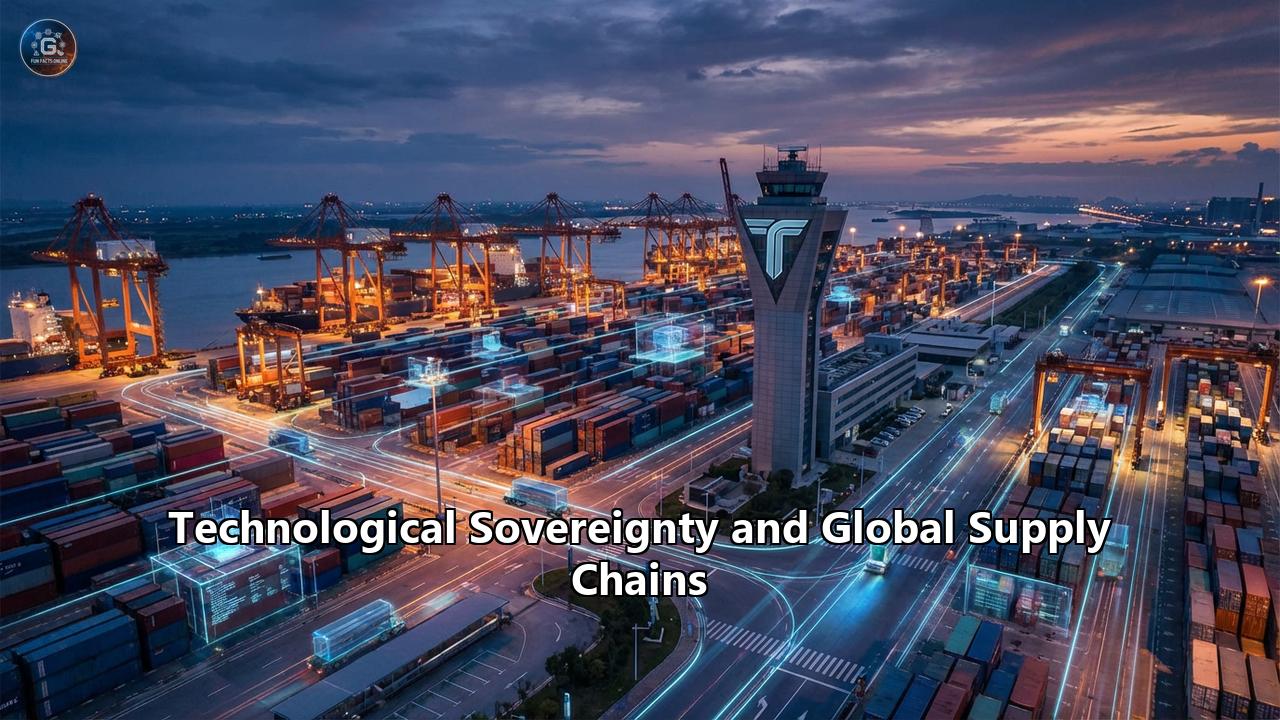
The Great Reordering: How Technological Sovereignty is Rewriting the Map of Global Trade
For thirty years, the world operated on a single, seductive premise: efficiency is king. From the fall of the Berlin Wall to the onset of the COVID-19 pandemic, the global economy was designed as a frictionless machine. Supply chains were stretched taut across oceans to capture the lowest labor costs, the cheapest raw materials, and the most efficient just-in-time delivery schedules. A microchip might be designed in California, etched in Taiwan, packaged in Malaysia, and assembled into a phone in China before being sold in Germany. Borders were viewed as inconveniences to be minimized, not barriers to be fortified.
That era is over.
We have entered a new age defined not by efficiency, but by resilience and technological sovereignty. The frictionless world has been replaced by a landscape of choke points, trade wars, and strategic decoupling. Governments no longer ask, "Where can this be made cheapest?" They now ask, "If the world falls apart, can we still make this at all?"
This shift is not merely a tweak in trade policy; it is a fundamental reordering of the global operating system. The pursuit of technological sovereignty—the capacity of a state to provide for its own critical technological needs without reliance on potentially hostile foreign actors—is now the primary driver of industrial strategy in Washington, Brussels, Beijing, and beyond. This article explores the anatomy of this transformation, dissecting how the quest for control over silicon, critical minerals, digital infrastructure, and biotechnology is dismantling the old globalization and building something entirely new in its place.
Part I: The Anatomy of Technological Sovereignty
To understand the current upheaval, we must first define the term that is reshaping the world. Technological Sovereignty is not autarky. No modern nation, not even a superpower like the United States or China, can be 100% self-sufficient in every technology. The complexity of a modern semiconductor supply chain, which involves thousands of specialized steps across dozens of countries, makes total isolation impossible.
Instead, technological sovereignty is about agency and asymmetric interdependence. It is the ability to control the most critical nodes of a supply chain so that no foreign power can hold your economy hostage. It is about ensuring that if a geopolitical rival turns off the tap, your factories do not stop running, your hospitals do not run out of medicine, and your grid does not go dark.
The Three Pillars of Sovereignty
- Defensive Resilience: The ability to withstand shocks. This means having domestic capacity or "friend-shored" supply lines for essential goods like semiconductors, APIs (active pharmaceutical ingredients), and rare earth minerals.
- Offensive Leverage: The ability to impose costs. This is the "weaponization of interdependence." By controlling key technologies—like the US control over semiconductor design software or China’s dominance in gallium processing—nations gain leverage over their rivals.
- Standard Setting: The power to write the rules. Whether it’s the protocols for 5G, the ethics of Artificial Intelligence, or the standards for green hydrogen, sovereignty means your values are baked into the technology itself.
The Geopolitical Catalysts
Three specific events dismantled the old consensus of "efficiency first."
- The US-China Trade War: Beginning in 2018, tariffs and entity lists shattered the illusion that economic integration would inevitably lead to political convergence. The realization that the US and China were "strategic competitors" forced companies to rethink their exposure to a single dominant supplier.
- The COVID-19 Pandemic: When borders closed in 2020, nations realized that their "efficient" supply chains were terrifyingly fragile. Europe found itself unable to produce basic paracetamol; the US scrambled for ventilators. The lesson was brutal: you cannot buy sovereignty on the spot market during a crisis.
- The War in Ukraine: The energy crisis in Europe following the Russian invasion served as a grim warning for the tech sector. Just as Germany had over-relied on Russian gas, the world realized it had over-relied on Taiwanese chips and Chinese battery minerals. "De-risking" became the phrase of the decade.
Part II: Silicon Shields – The Semiconductor Wars
If oil was the resource that defined the geopolitics of the 20th century, semiconductors are the resource of the 21st. They are the "brains" of the modern economy, powering everything from F-35 fighter jets to toaster ovens. And nowhere is the battle for technological sovereignty more ferocious.
The Choke Points
The semiconductor supply chain is a marvel of specialization, but this specialization creates extreme vulnerability.
- Design: The US dominates the Electronic Design Automation (EDA) software required to design complex chips. This is a key "choke point" Washington uses to limit China’s access to advanced AI capabilities.
- Lithography: A single Dutch company, ASML, produces the Extreme Ultraviolet (EUV) lithography machines necessary to print the most advanced chips (below 7nm). Without ASML’s machines, you cannot make a modern iPhone processor. This monopoly has made the Netherlands a surprising geopolitical heavyweight.
- Manufacturing: Taiwan, specifically TSMC (Taiwan Semiconductor Manufacturing Company), produces over 90% of the world’s most advanced chips. This concentration is the "Silicon Shield"—a deterrent against invasion, but also a terrifying single point of failure for the global economy.
The Policy Response: Subsidies and Fences
Governments are now spending hundreds of billions to buy their way out of this vulnerability.
- The US CHIPS and Science Act: A $52 billion massive injection of federal funds to lure manufacturing back to American soil. The goal is not to make all chips in the US, but to ensure that the US has domestic capacity for the most sensitive military and AI applications. Intel, TSMC, and Samsung are currently building massive "fabs" in Arizona, Ohio, and Texas—projects that are as much national security assets as they are factories.
- The EU Chips Act: Europe, realizing its share of global production had fallen to under 10%, launched a €43 billion initiative to double its market share by 2030. The focus here is on "strategic autonomy"—ensuring Europe isn't squeezed between US unilateralism and Chinese dominance.
- China’s "Big Fund": In response to US export controls that cut off access to advanced chips, China has poured unrivaled capital into its domestic industry. While they struggle with the bleeding edge (due to the lack of ASML machines), they are rapidly dominating the market for "legacy chips"—the older but essential semiconductors used in cars, appliances, and industrial machinery.
The result is a bifurcated market. We are moving toward a world with two distinct technology stacks: a Western stack and a Chinese stack, with little interoperability between them.
Part III: The Raw Material of Sovereignty – Critical Minerals
You cannot build a digital future without physical stuff. The "Green Paradox" of the 21st century is that the transition to clean energy and digital sovereignty requires a massive increase in mining. Electric vehicles, wind turbines, and defense systems are hungry for lithium, cobalt, nickel, and rare earth elements (REEs).
Here, the sovereignty map looks bleak for the West.
The Processing Monopoly
While raw ores are distributed globally—lithium in Australia and Chile, cobalt in the DRC—the processing of these minerals is overwhelmingly concentrated in China.
- Rare Earths: China controls roughly 90% of the processing capacity for rare earth elements. These are the "vitamins" of modern tech, essential for the permanent magnets in EV motors and wind turbines.
- Lithium & Cobalt: China refines over 60% of the world’s lithium and 70% of its cobalt.
This dominance gives Beijing a potent lever. In 2010, China briefly restricted rare earth exports to Japan over a territorial dispute. In 2023, it placed restrictions on gallium and germanium (used in chips) and graphite (used in batteries). These were warning shots.
The Race for Diversification
To achieve sovereignty, Western nations are attempting to build an entire mine-to-magnet supply chain from scratch.
- The Minerals Security Partnership (MSP): A coalition of US-led nations aiming to finance mining projects in "friendly" nations. This is the operationalization of "friend-shoring."
- The "China Plus One" Strategy: Companies are not abandoning China entirely but are aggressively hedging. We are seeing a boom in processing facilities in Australia, Canada, and the US.
- Innovation as an Escape Route: Japan, terrified of its vulnerability, has invested heavily in technologies that reduce the need for rare earths in magnets. Similarly, Tesla has experimented with motors that use no rare earths at all. This is technological sovereignty through innovation—inventing your way out of dependence.
Part IV: The Nervous System – 5G, 6G, and Connectivity
If chips are the brain and minerals are the body, then 5G networks are the nervous system. The controversy over Huawei was the opening salvo of the tech sovereignty era, illustrating that infrastructure is no longer neutral.
The Huawei Moment
For years, Huawei offered the best telecommunications gear at the lowest price. In the old efficiency paradigm, buying Huawei was a no-brainer. But in the sovereignty paradigm, it was a Trojan horse. The fear was not just espionage, but the "kill switch"—the theoretical ability of a foreign power to shut down critical infrastructure during a conflict.
The US-led campaign to rip and replace Huawei gear from Western networks was expensive and disruptive, but it established a new precedent: National security trumps cost.
Open RAN: Sovereignty via Software
One of the most interesting responses to the telecom dilemma is Open RAN (Radio Access Network). Traditionally, telecom gear is a "black box"—you buy the hardware and software as a proprietary bundle from a vendor like Nokia, Ericsson, or Huawei.
Open RAN seeks to break this open, standardizing the interfaces so that carriers can mix and match hardware and software from different vendors. This is a technological solution to a geopolitical problem. By commoditizing the hardware, the West hopes to lower the barrier to entry, allowing US software companies to compete against Chinese hardware giants. It is an attempt to rewrite the rules of the game to favor Western strengths (software) over Eastern strengths (integrated hardware manufacturing).
The Race for 6G
The battle for 5G is largely decided; the world is split. The focus has now shifted to 6G. Sovereignty here is about standards. Who decides how the next generation of networks will function? Who owns the essential patents?
China is currently leading in 6G patent applications, a fact that rings alarm bells in Western capitals. The standard-setting bodies (like the ITU and 3GPP), once obscure technical committees, have become geopolitical battlegrounds. A vote on a technical protocol is now a vote on whose industrial base will dominate the next decade.
Part V: Biological Sovereignty – Pharmaceuticals
The COVID-19 pandemic exposed a terrifying reality: the West had outsourced its biological survival. For decades, the production of Active Pharmaceutical Ingredients (APIs)—the actual medicinal part of a pill—had quietly migrated to India and China due to lower costs and looser environmental regulations.
By 2020, it was estimated that a vast percentage of the generic drugs used in US hospitals depended on Chinese supply chains. This included everything from antibiotics to sedatives used for intubation.
From "Just-in-Time" to "Just-in-Case"
Pharmaceutical sovereignty is distinct because it is literally a matter of life and death. The response has been a shift toward "Health Security."
- Reshoring API Production: The US and Europe are using public funds to build domestic capacity for "essential medicines." The goal is not to make every drug at home, but to have a strategic reserve of manufacturing capacity for critical antibiotics and generic injectables.
- Advanced Manufacturing: Reshoring old-fashioned batch manufacturing is economically unfeasible due to labor costs. The solution is Continuous Manufacturing—a new technology that allows drugs to be made in a continuous flow in smaller, highly automated facilities. This technology shrinks the footprint of a factory and reduces labor needs, making it possible to produce drugs in high-cost countries like the US or Switzerland competitively.
This is a key theme of technological sovereignty: Automation is the enabler of reshoring. You cannot bring jobs back to the West if you rely on low-cost labor. You can only bring production back if you rely on robots.
Part VI: The Technologist’s Toolkit – AI, Blockchain, and Digital Twins
So far, we have discussed sovereignty over technology. But we must also look at sovereignty via technology. How do nations and corporations manage these complex, fragmented, and resilient supply chains? They turn to the "ABCD" of Industry 4.0: AI, Blockchain, Cloud, and Data.
The Transparency Problem
In a globalized supply chain, you often don't know who your supplier's supplier is. A car manufacturer might know who makes their seats, but not who tanned the leather or where the cow was raised. In an era of sanctions and sovereignty, ignorance is a liability. You need to prove that your cobalt didn't come from a mine using child labor and that your chips didn't violate export controls.
Blockchain for Provenance
Blockchain technology is moving beyond the crypto-hype to become a tool for sovereign provenance. By creating an immutable ledger of a product's journey, companies can mathematically prove the origin of their materials.
- Battery Passports: The EU is implementing a "Battery Passport" regulation that requires a digital record of a battery’s entire life cycle—from the mine to the car. This effectively creates a digital border: if you cannot digitally prove your supply chain's sovereignty and sustainability, you cannot sell in Europe.
Digital Twins for Wargaming
If the new world is defined by shocks, you need to predict them. Companies are building Digital Twins of their entire supply chain—virtual replicas that simulate every node, route, and factory.
- Scenario Planning: Executives can now run simulations: "What happens to our production if the Straits of Malacca are closed?" "What if a new tariff hits our Malaysian facility?" This allows for "stress testing" the supply chain, similar to how banks stress-test their balance sheets. It transforms resilience from a vague goal into a quantifiable metric.
Agentic AI and Supply Chain Autonomy
The bleeding edge of this field is the "SDRT-Agentic AI" framework. This involves using autonomous AI agents that don't just predict disruptions but actively manage them. An AI agent, noticing a delay in a port in Shanghai, could automatically book alternative freight capacity out of Vietnam and update the production schedule in Germany, all without human intervention. This is the ultimate form of supply chain sovereignty: a self-healing network that reacts faster than any geopolitical crisis can unfold.
Part VII: The Risks of a Fragmented World
The drive for technological sovereignty is logical, perhaps even inevitable. But it comes with profound risks that are often glossed over in patriotic speeches.
The Inflationary Pressure
Resilience is expensive. Building redundant factories, stockpiling inventory, and moving production from low-cost to high-cost jurisdictions is inflationary. The "peace dividend"—the deflationary pressure of cheap global goods that the world enjoyed for 30 years—is gone. Consumers will pay the price for sovereignty at the checkout counter.
The Innovation Tax
Science thrives on openness. The "Splinternet"—where the US and China have separate internets, separate chip standards, and separate AI research ecosystems—will slow down global innovation. If scientists cannot collaborate across borders, and if companies have to design two versions of every product (one for the West, one for the East), global R&D efficiency plummets.
The "Rest of the World" Dilemma
For the "Global South"—nations in Africa, Latin America, and Southeast Asia—this new era is fraught with danger. They risk being forced to choose sides. Will they adopt Chinese 5G and get locked out of Western markets? Or adopt Western standards and lose Chinese investment? We are seeing a new Non-Aligned Movement emerge, where countries like India, Saudi Arabia, and Brazil attempt to play both sides, demanding technology transfers from everyone while refusing to become vassal states of either tech ecosystem.
Conclusion: The Balance Between Independence and Interdependence
We are witnessing the pendulum of history swing violently back from hyper-globalization toward the nation-state. Technological sovereignty is the new organizing principle of the global economy. It is rewriting trade deals, redirecting capital flows, and redefining national security.
However, total sovereignty is a mirage. The modern world is too complex for any one nation to go it alone. The goal, therefore, should not be autarky, but strategic interdependence. Nations should strive to be sovereign enough to say "no" to coercion, but open enough to say "yes" to cooperation.
The winners of this new era will not be the ones who build the highest walls, but the ones who build the most resilient bridges. They will be the nations that can secure their critical needs—their chips, their minerals, their data—while still remaining hubs of global innovation. The era of "Just-in-Time" is dead. Long live the era of "Just-in-Case."
Reference:
- https://www.almendron.com/tribuna/china-is-still-winning-the-battle-for-5g-and-6g/
- https://digitaltwinhub.co.uk/unlocking-the-future-of-supply-chain-with-digital-twins-insights-from-scnode/
- https://egyptoil-gas.com/features/critical-minerals-a-political-race-for-supply-chain-dominance/
- https://www.diplomacyandlaw.com/post/the-geopolitics-of-critical-minerals
- https://www.irena.org/Digital-Report/Geopolitics-of-the-Energy-Transition-Critical-Materials
- https://www.diplomacy.edu/blog/the-geopolitics-of-critical-raw-materials-who-controls-the-future/
- https://www.biospace.com/business/2025-the-year-trump-pushed-manufacturing-into-the-spotlight
- https://www.healthofhealth.org/health-of-health-2024-securing-the-us-pharmaceutical-supply-chain/
- https://ondemandpharma.com/a-revolutionary-approach-to-reshoring-pharmaceutical-manufacturing-not-just-made-in-america-made-to-work-for-america/
- https://kpmg.com/xx/en/our-insights/operations/ai-blockchain-transform-supply-chain-performance.html
- https://www.preprints.org/manuscript/202512.0845