
Part I: The Ballistic Paradigm – A New Era of Atomic Warfare
The Magic Bullet ReimaginedIn the history of medicine, few concepts have captured the imagination quite like the "magic bullet"—a hypothetical therapeutic agent that strikes only the disease target without harming the host. First proposed by Nobel laureate Paul Ehrlich in the early 20th century, this ideal has driven pharmacology and oncology for over a hundred years. In the realm of radiation oncology, this dream has arguably found its closest physical manifestation in the proton.
To understand Proton Arc Therapy (PAT), one must first discard the intuitive physics of light (photons) that governs our daily vision and traditional X-rays. Instead, we must embrace the physics of ballistics—the science of projectiles, momentum, and stopping power. While traditional radiation therapy bathes a tumor in light that passes through the patient like a flashlight beam through a semi-transparent gel, proton therapy acts more like a depth charge or a precision-guided missile. It has a specific range; it travels a set distance and then detonates.
Proton Arc Therapy represents the evolution of this ballistic capability from a static sniper shot to a dynamic, multi-angle barrage. By rotating the delivery source around the patient while simultaneously modulating the energy and intensity of the beam, PAT achieves a level of dose conformity that borders on the sculptural. It carves the radiation dose around critical structures—optic nerves, the brainstem, the heart—with sub-millimeter precision, creating a "dose-free valley" where healthy tissue remains virtually untouched.
The Physics of Attenuation vs. The Physics of StoppingThe fundamental limitation of conventional X-ray radiation (photon therapy) is the exponential nature of attenuation. When a photon beam enters the human body, it begins depositing energy immediately at the skin surface. As it travels deeper, it loses energy gradually. By the time it reaches a deep-seated tumor, it has already deposited a significant portion of its payload in healthy tissue. Crucially, it continues to travel through the tumor, exiting the back of the patient and irradiating everything in its path. This is the "exit dose," an unavoidable collateral damage of photon physics.
Protons behave differently. As heavy, charged particles (approximately 2,000 times heavier than electrons), they enter the body with a specific momentum determined by their acceleration energy. Initially, they travel fast, depositing very little energy as they zip past atomic electrons in the patient's superficial tissues. This is the "plateau" region of the dose curve.
However, as the proton slows down due to electromagnetic drag, it spends more time in the vicinity of atoms, increasing the probability of interaction. Suddenly, just as it runs out of kinetic energy, the proton dumps its entire remaining payload in a catastrophic burst of ionization. This phenomenon is known as the Bragg Peak.
The Bragg Peak is the "detonation" of the depth charge. Immediately after this peak, the dose drops to practically zero. There is no exit dose. The proton stops.
From Static Beams to the Dynamic ArcTraditional proton therapy, known as Intensity Modulated Proton Therapy (IMPT), utilizes this Bragg peak by firing beams from a few fixed angles. A patient might receive a beam from the left, one from the right, and perhaps one from the front. Each beam is optimized to cover the tumor.
Proton Arc Therapy takes this ballistic advantage and multiplies it by the geometry of the circle. Instead of three or four static angles, the gantry (the massive machine housing the nozzle) rotates continuously or in fine steps around the patient. This "arc" delivery has two profound effects:
- Dose Dilution: The entrance dose—that small amount of energy deposited before the Bragg peak—is spread out over a 360-degree path. Instead of one patch of skin receiving a moderate dose, the entire circumference receives a negligible dose. The "integral dose" to the patient is lowered, and the biological impact on healthy tissue is minimized.
- Angular Freedom: For complex tumors that wrap around critical organs (like a C-shape tumor around the spinal cord), fixed beams are often limited. They might be forced to pass through a rib or a sensitive organ to reach the target. An arc has infinite angles to choose from, allowing the treatment planning software to "see" the tumor from every possible vantage point and paint the dose with unprecedented conformity.
Part II: The Machine – Engineering the Leviathan
The Accelerator: Cyclotrons and SynchrotronsThe heart of any proton facility is the particle accelerator. To treat a deep-seated tumor, protons must be accelerated to approximately 60% of the speed of light—energies reaching 230 to 250 Mega-electron Volts (MeV). Two primary types of engines drive this ballistic warfare: the Cyclotron and the Synchrotron.
- The Cyclotron: Imagine a massive electromagnetic spiral. Protons are injected into the center and spun outward by a high-frequency alternating voltage. A static magnetic field holds them in a spiral path. As they gain speed, they move to the outer edge until they are stripped off and shot down the beamline. Cyclotrons produce a continuous stream of protons, which is excellent for the speed required in arc therapy. However, they output a fixed maximum energy. To hit a shallower tumor, the beam must be physically slowed down by passing it through "degraders" (essentially blocks of graphite or plastic), a process that creates secondary neutrons and requires careful shielding.
- The Synchrotron: This is a ring of magnets where the magnetic field strength increases (synchronizes) as the particles gain speed. Synchrotrons accelerate protons in "spills" or pulses. They can dial in the exact energy required for a specific depth, eliminating the need for degraders. This makes the beam "cleaner" but traditionally slower to change energies.
For Proton Arc Therapy, the speed of energy switching is critical. As the gantry rotates, the tumor's depth relative to the skin changes constantly. The beam must adjust its "range" (energy) dozens of times per second. Modern synchrotrons and rapid-switching cyclotrons have evolved specifically to meet this "energy layer switching" challenge, reducing the dead time between layers to mere milliseconds.
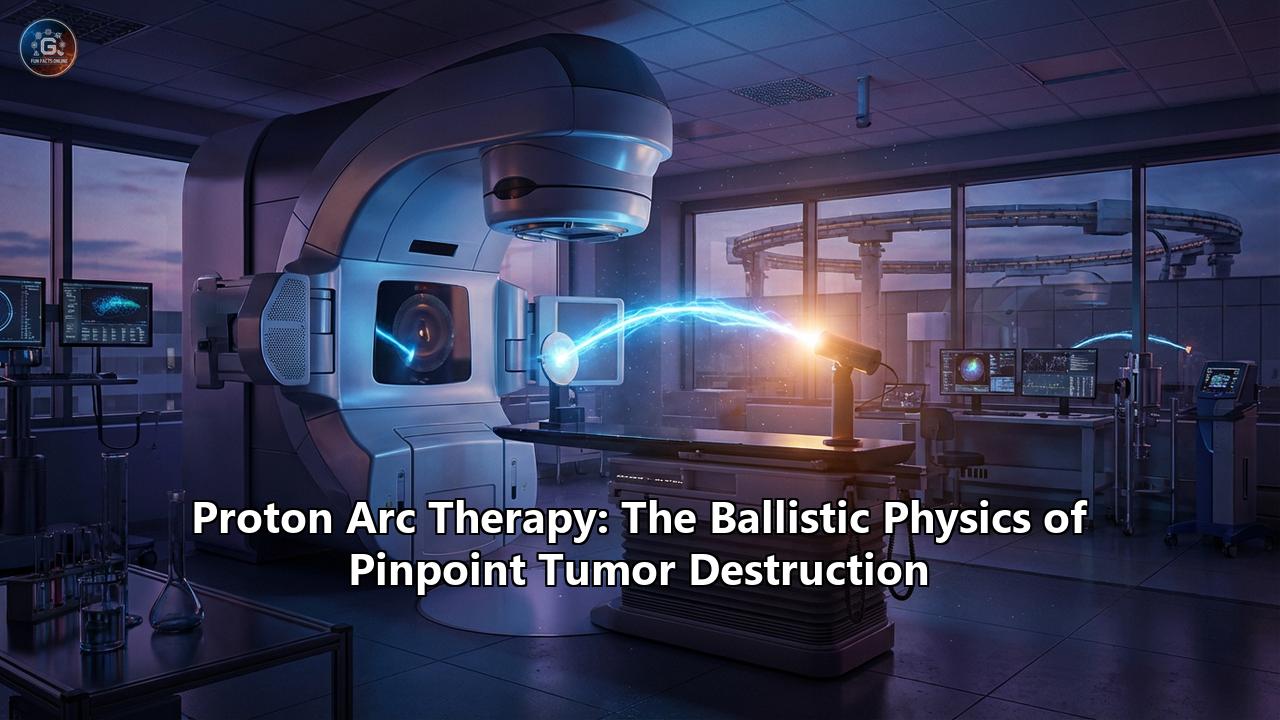
The Gantry: A 200-Ton Rotational PrecisionThe most visually arresting component of a proton center is the gantry. In photon therapy (VMAT), the linear accelerator is relatively small and can rotate around a patient easily. In proton therapy, the "nozzle" that aims the protons is merely the end of a massive magnetic optical system that must bend a beam of near-light-speed particles 90 degrees and point them at a sub-millimeter target.
Standard proton gantries are three stories tall and weigh as much as a jumbo jet (100–200 tons). To perform arc therapy, this leviathan must rotate with absolute smoothness and precision. It cannot wobble greater than a fraction of a millimeter.
The engineering challenge of PAT was not just rotating the gantry—that had been done. The challenge was rotating it while shooting. In the past, the gantry would move, stop, shoot, move, stop, and shoot. This "step-and-shoot" method was too slow for a true arc. True PAT (or SPArc - Spot-scanning Proton Arc) requires the gantry to move continuously while the beam "paints" the tumor. This demands a synchronization of mechanical heavy industry with quantum-level beam steering.
The Nozzle and the Spot ScanAt the end of the gantry lies the nozzle, the "barrel" of our ballistic weapon. Inside, two sets of fast-scanning magnets deflect the proton beam in the X and Y directions. This technology, called Pencil Beam Scanning (PBS), is analogous to a 3D printer.
The tumor is divided into thousands of "voxels" (3D pixels). The scanner places a "spot" of protons in one voxel, delivers the exact dose, and then magnetically steers to the next. It paints a layer, then the accelerator changes energy (depth), and it paints the next layer.
In Proton Arc Therapy, this 3D printing happens on a moving canvas. As the gantry rotates, the beam angle changes. The planning system must calculate where to place a spot, knowing that by the time the protons arrive, the gantry will have rotated 0.5 degrees. It is a four-dimensional problem (3D space + time), requiring computational power that was unavailable just a decade ago.
Part III: The Software Brain – Algorithms and Optimization
The "Thousands of Spots" ProblemA single static proton field might contain 2,000 to 5,000 individual spots. An arc treatment, covering 360 degrees, could theoretically require hundreds of thousands of spots. If the machine tried to deliver all of them, the treatment would take an hour. The patient would twitch, the tumor would move, and the biological advantage would be lost.
This is the central algorithmic challenge of PAT: Spot Sparsity Optimization.
We do not need to shoot from every angle to hit every part of the tumor. The "SPArc" algorithms (Spot-scanning Proton Arc) developed by researchers at institutions like Beaumont Health and effectively implemented in commercial planning systems (like RayStation) use "iterative optimization."
The software begins by assuming a full arc. It then ruthlessly culls the herd. It asks, "Does this specific spot from this specific angle contribute significantly to the tumor dose? Does it help spare the organ at risk?" If the answer is weak, the spot is deleted.
This process, often using "coarse-to-fine" sampling or "greedy algorithms," reduces the millions of potential spots down to a manageable, efficient set. The result is a plan where the beam might fire intensely from 45 degrees, skip 10 degrees, fire a few spots from 60 degrees, and then unleash a barrage from 90 degrees. It is a "smart arc," delivering the dose only from the most advantageous ballistic trajectories.
Robustness and The Moving TargetPhotons are forgiving. If a patient breathes and the tumor moves 5mm, the photon beam (which passes all the way through) still hits it, albeit with some blurring. Protons are unforgiving. If the tumor moves 5mm deeper, the Bragg peak might stop short of the tumor, delivering zero dose to the distal edge. Or, if the tumor moves shallower, the peak might overshoot into the brainstem.
This sensitivity to density changes is the "Achilles' heel" of proton therapy. PAT turns this weakness into a managed risk through Robust Optimization.
The AI-driven planning software runs thousands of simulations before the first treatment. It simulates "What if the patient is set up 3mm to the left?" "What if they inhale deeply?" "What if their sinus cavity fills with fluid?"
The software generates a plan that is "robust"—meaning it remains effective even under these error scenarios. Because PAT comes from so many angles, it is inherently more robust than fixed-beam IMPT. If one beam angle is blocked by a density change (like a gas bubble in the bowel), the other 100 degrees of the arc compensate for the loss. This "angular diversity" makes PAT the gold standard for robust delivery.
Monte Carlo Simulations: Rolling the DiceTo calculate the dose accurately, modern PAT systems use Monte Carlo algorithms. Instead of using approximations, the computer simulates the path of millions of individual virtual protons. It tracks their interactions with the atomic electron clouds of the patient's CT scan data.
It calculates the scattering, the nuclear halo (secondary neutrons), and the precise stopping point of the protons. For arc therapy, this calculation is immense. It requires GPU-accelerated computing clusters to render a treatment plan in a reasonable time. The result is a heat map of radiation dose that is accurate to within a single percentage point.
Part IV: The Clinical Battlefield
Head and Neck Cancers: The Ultimate TestThe neck is a crowded highway of critical structures: the spinal cord, the salivary glands, the voice box, the jawbone, and the taste buds. Standard radiation (VMAT) cures many head and neck cancers but often at a terrible price: the loss of taste (dysgeusia), dry mouth (xerostomia), and difficulty swallowing (dysphagia).
PAT has shown its most dramatic early promise here. By pulling the dose off the parotid (salivary) glands and the constrictor muscles of the throat, PAT can preserve the patient's ability to eat and speak normally.
In nasopharyngeal carcinoma (cancer behind the nose), the tumor sits at the base of the skull, millimeters from the brainstem and optic chiasm. Fixed-beam protons (IMPT) are excellent here, but they often require shooting through the jaw or face, causing side effects in the oral cavity. PAT can arc under the jaw and over the eyes, entering through the "path of least resistance" to paint the tumor while sparing the oral mucosa. Recent clinical data (2024-2025) suggests a significant reduction in the need for feeding tubes in PAT patients compared to VMAT.
Brain Tumors: Cognitive PreservationFor pediatric brain tumors (medulloblastoma, ependymoma), the stakes are the highest. The developing brain is exquisitely sensitive to radiation. Even low doses of "exit radiation" from photons can cause IQ loss, hormonal deficits, and secondary cancers decades later.
The "ballistic stop" of protons is crucial here. PAT enhances this by reducing the dose to the hippocampus—the memory center of the brain. By arcing around the cranium, PAT ensures that the temporal lobes receive minimal fallout. This "cognitive sparing" is the frontier of modern neuro-oncology, aiming not just to survival, but for a high-functioning life after cancer.
Prostate and HypofractionationProstate cancer treatment is moving toward "hypofractionation"—giving the entire course of radiation in just 5 days (SBRT) rather than 40 days. This requires massive daily doses that must be delivered with extreme accuracy.
PAT allows for a workflow that is both fast and precise. A prostate arc can be delivered in under 2 minutes. This speed is vital because the prostate can move (due to bladder filling or rectal gas) during a longer treatment. By finishing the "shot" before the target moves, PAT ensures the high dose stays within the capsule.
Part V: The Biological Advantage – LET and RBE
The "Kill Probability"Not all radiation is created equal. The biological damage caused by radiation is measured by RBE (Relative Biological Effectiveness). Photons have an RBE of 1. Protons are generally assigned an RBE of 1.1, meaning they are 10% more effective at killing cells for the same physical dose.
However, this is an average. The physics of the Bragg peak reveals a hidden weapon: Linear Energy Transfer (LET).
LET is a measure of how dense the ionization track is. As the proton slows down at the very end of its range (the distal edge of the Bragg peak), the LET skyrockets. The proton is moving slowly, ripping electrons off DNA strands with brutal efficiency. This causes "complex double-strand breaks" in the DNA helix—damage that cancer cells find almost impossible to repair.
LET Painting with ArcsIn fixed-beam proton therapy, this high-LET region might accidentally land in a critical organ just behind the tumor. This is a known risk.
PAT allows for "LET Optimization." Because the software has so many angles to choose from, it can deliberately place the high-LET "stopping point" of the protons inside the tumor core, specifically targeting the hypoxic (oxygen-starved) regions of the tumor which are usually resistant to radiation.
Simultaneously, it ensures that the beam does not stop in the brainstem or optic nerve, keeping the high-LET spikes away from healthy tissue. This "biological dose painting" is the next evolution of oncology—treating not just the anatomy of the tumor, but its biological vulnerability.
Part VI: The Patient Experience – Inside the Gantry
The Walk to the MachineFor a patient entering a Proton Arc Therapy suite, the experience is a mix of high-tech industrial design and calming medical care. They enter a "treatment room" that looks spacious, but hidden behind the walls is the massive gantry structure.
They lie on a robotic couch, often immobilized with a custom-molded mesh mask (for head and neck) or a body mold. The alignment system—often using X-rays or surface-guided vision cameras—adjusts their position with robotic precision, moving them by fractions of a millimeter to match the planning CT scan.
The Invisible BarrageWhen the beam turns on, there is no sensation. No heat, no light, no sound from the beam itself. The only noise is the hum of the magnets and the whir of the gantry as it rotates.
In a VMAT (photon) treatment, the gantry rotates quickly, often in less than a minute. In early proton treatments, the gantry was static. In the new PAT workflow, the gantry moves smoothly around them.
The actual "beam on" time for a PAT treatment is surprisingly short. Thanks to the "spot sparsity" optimization, the machine might only fire for 2 to 3 minutes total. The efficiency of the arc means the patient spends less time on the table, reducing anxiety and the likelihood of movement.
Side Effects and RecoveryThe true difference is felt weeks later. In head and neck cancer, a PAT patient might avoid the severe mouth sores (mucositis) that plague VMAT patients. They might retain their taste. In brain tumor patients, the lack of nausea and fatigue is often notable, a result of the "integral dose" reduction—the body isn't working overtime to repair low-level damage to widespread healthy tissue.
Part VII: The Future Horizon
FLASH Therapy: The Blink of an EyeThe most exciting frontier in radiation oncology is FLASH therapy—delivering the entire radiation dose in a fraction of a second (ultra-high dose rates). For reasons not yet fully understood, FLASH radiation kills the tumor but spares healthy tissue and blood vessels almost completely. It triggers a different immune and inflammatory response.
Proton Arc Therapy is the perfect delivery vehicle for FLASH. The high beam current of protons can achieve the necessary dose rates. "Proton FLASH-Arc" is a concept currently in research (and early trials as of 2025/2026). It combines the ballistic conformity of the Bragg peak with the biological "magic" of FLASH dose rates.
Compact Systems and DemocratizationHistorically, proton centers cost $100-$200 million to build, limiting them to major academic centers. The future of PAT lies in compact, single-room systems. Companies are developing superconducting cyclotrons that can be mounted directly on the gantry (removing the massive beamline).
These "room-temperature" or "high-temperature" superconducting magnets reduce the size and weight of the gantry, making PAT affordable for smaller regional hospitals. The goal is to make the "ballistic precision" of protons the standard of care, not just a luxury for the few.
AI and Adaptive TherapyBy 2030, we expect "Online Adaptive PAT." A patient will lie down, a CT scan will be taken right on the table, and AI will re-plan the entire arc treatment in seconds to account for the fact that the patient's bladder is slightly fuller today or they have lost weight. This real-time adaptation will close the final gap in accuracy, ensuring that the ballistic strike is perfect, every single day.
Conclusion
Proton Arc Therapy is not merely an incremental improvement in cancer treatment; it is a fundamental shift in the physics of interaction. It moves us from the era of "illuminating" tumors to the era of "terminating" them with ballistic precision.
By harnessing the stopping power of the Bragg peak, the rotational freedom of the arc, and the computational power of AI, PAT offers a glimpse of the ultimate goal of oncology: a cure without cost to the patient's quality of life. It is the physics of destruction, refined into an instrument of healing. The "magic bullet" is no longer a metaphor; it is a proton, traveling at 100,000 miles per second, stopping exactly where we tell it to.
Reference:
- https://www.aapm.org/meetings/09PRS/documents/Palta.pdf
- https://pmc.ncbi.nlm.nih.gov/articles/PMC4013396/
- https://openmedscience.com/proton-therapy-an-examination-of-challenges-and-future-directions/
- https://arxiv.org/abs/2510.19213
- https://www.youtube.com/watch?v=7EFTHl87KcQ
- https://actaorthop.org/actaoncologica/article/download/34921/39858
- https://newsnetwork.mayoclinic.org/discussion/10-years-10000-lives-mayo-experts-highlight-the-journey-and-future-of-proton-beam-and-particle-therapy-at-mayo-clinic/
- https://www.researchgate.net/publication/396790127_AI_in_Proton_Therapy_Treatment_Planning_A_Review