
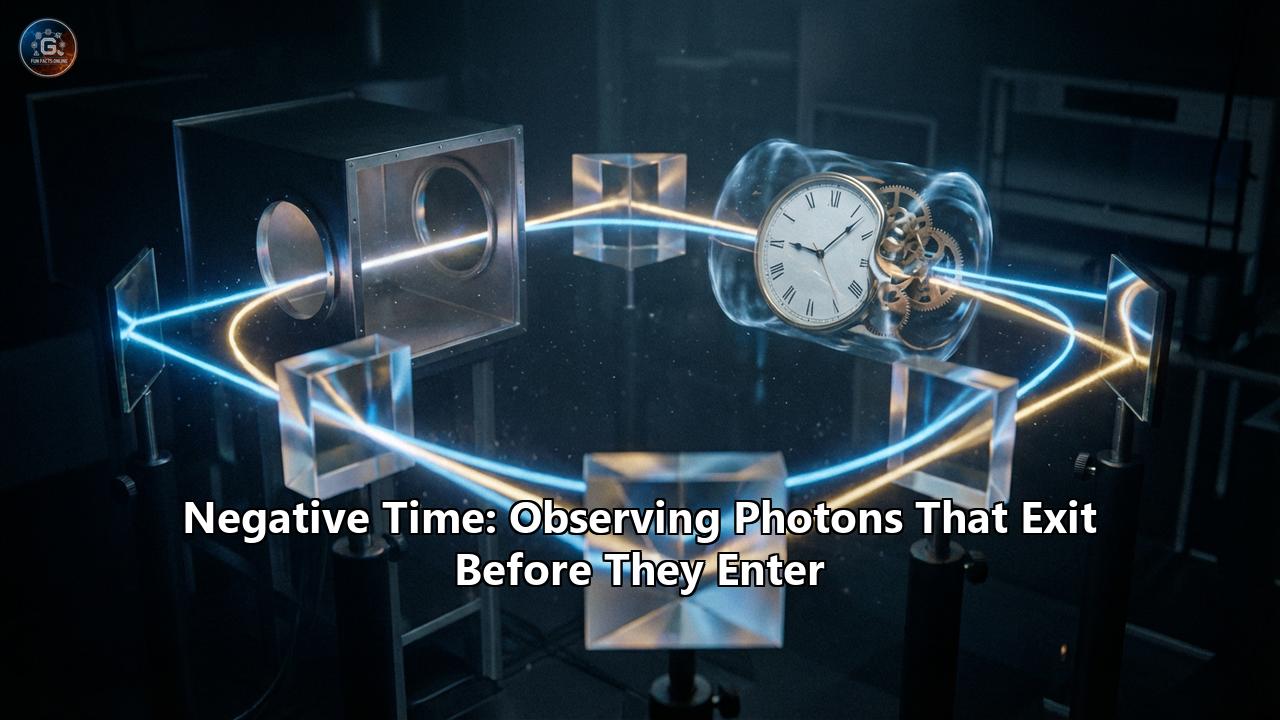
How a groundbreaking experiment at the University of Toronto is rewriting the rules of quantum reality, one "negative" millisecond at a time.
Time is money. Time is of the essence. Time waits for no one.We live our lives shackled to the arrow of time, a relentless march from cause to effect, from past to future. In our classical world, you cannot leave a room before you enter it. You cannot eat a meal before you cook it. And light—the fastest thing in the universe—cannot exit a material before it has finished crossing it.
Or can it?
In a basement laboratory at the University of Toronto, a team of quantum physicists has just shattered our intuitive understanding of the clock. Led by Professor Aephraim Steinberg and doctoral student Daniela Angulo, these researchers have provided the first experimental evidence that photons can spend a negative amount of time interacting with a cloud of atoms.
They didn't break the speed of light. They didn't build a DeLorean. They did something far stranger: they proved that in the quantum realm, "interaction time" can differ fundamentally from "propagation time," allowing a particle to effectively finish a task before it has even started.
This is the story of how they did it, why it doesn’t violate the laws of physics, and what it means for the future of quantum technology.
Part 1: The "Impossible" Observation
To understand why this discovery is making waves, we first have to understand the classical expectation. Imagine a tunnel. If you drive a car into a tunnel at 60 mph, and the tunnel is 60 miles long, you will emerge exactly one hour later. If you encounter traffic (resistance), you emerge later.
In the world of optics, when a photon (a particle of light) travels through a medium like glass or water, it typically interacts with the atoms inside. It gets absorbed, excites an electron to a higher energy state, and is then re-emitted. This process takes time. Physicists call this Group Delay. Because of this "traffic," light usually travels slower through materials than it does through a vacuum. The group delay is positive.
But quantum mechanics loves a paradox.
The Toronto Setup
For years, physicists have theoretically predicted that under very specific conditions, this "group delay" could become negative. However, observing it directly—and distinguishing it from a mere measurement artifact—was a monumental challenge.
The Toronto team, including researchers Daniela Angulo, Kyle Thompson, Vida-Michelle Nixon, and others, devised an ingenious trap. They didn't use glass or water; they used ultracold Rubidium-85 atoms.
- The Medium: They cooled a cloud of rubidium atoms to within a hair's breadth of absolute zero. At these temperatures, the atoms are nearly motionless, allowing for precise control.
- The Signal: They fired "signal" photons tuned to a frequency very close to the resonance of the rubidium atoms. This is the "car" entering the tunnel.
- The Probe: Here is the stroke of genius. How do you measure how much time a photon spends inside an atom? You can't just use a stopwatch. Instead, they used a second laser beam, called the "probe."
Through a quantum phenomenon known as the Cross-Kerr Nonlinearity, the "probe" beam would experience a tiny phase shift (a change in its wave pattern) whenever the "signal" photon was exciting the atoms. It’s like a security camera that records a blip every time the car is inside the tunnel.
The Result
When they ran the experiment, the data was undeniable. The probe beam measured a phase shift that corresponded to a negative interaction time.
In plain English: The photons were traversing the atomic cloud and exiting it faster than if the atoms hadn't been there at all. In fact, the data showed the atoms spending a negative amount of time in the excited state. It was as if the photons had exited the medium before the atomic excitation process had even finished.
"It took a positive amount of time," Steinberg noted with a physicist's dry wit, "but our experiment observing that photons can make atoms seem to spend a negative amount of time in the excited state is up!"
Part 2: Breaking Down the Paradox (Why Einstein Isn't Rolling in His Grave)
Whenever the words "negative time" or "faster than light" appear, the ghost of Einstein appears to wag a finger. Special Relativity forbids information from traveling faster than the speed of light ($c$). If you could send a signal faster than light, you could theoretically send a message to the past, violating causality.
So, did the Toronto team break the universe?
No. And the reason why is one of the most subtle concepts in physics: the difference between Group Velocity and Information Velocity.The Pulse and the Peak
A pulse of light is not a single particle; it's a wave packet—a collection of many different frequencies bunched together, shaped like a bell curve.
- The Front: The very leading edge of the pulse (the "front") travels at the speed of light ($c$). It cannot go faster.
- The Peak: The highest point of the bell curve (the "peak") is what we usually measure to determine when the pulse arrives.
In "anomalous dispersion" media (like the ultracold rubidium cloud), the different frequencies that make up the pulse interfere with each other in a strange way. The back of the pulse is absorbed more than the front, or the phases shift such that the peak of the wave packet gets reconstructed forward.
The result? The peak of the pulse exits the material before the peak of the pulse enters it.
The "Dwell Time" Mystery
For decades, physicists argued that this "negative group delay" was just a mathematical trick—a reshaping of the pulse that didn't represent physical reality. They argued that the photon didn't actually spend negative time in the atoms; it just looked like it did.
This is where the Toronto experiment changes the game.
By using the "probe" beam to measure the atomic excitation directly, they asked the atoms: "How long did you feel the photon?"
The atoms replied: "Negative milliseconds."
This confirmed a theoretical prediction made by quantum physicist Howard Wiseman (a collaborator on the paper). The experiment proved that the dwell time (the time the particle spends interacting with the barrier) is physically equal to the group delay, even when that delay is negative.
It is not just a reshaping of the pulse; the physical interaction itself carries this negative value. It implies that in the quantum world, the "history" of a particle is not a simple stopwatch duration.
Part 3: The Quantum Clock and Weak Values
To understand how a clock can run backward, we have to abandon the idea of time as a rigid, linear ruler. In this experiment, "time" is a quantum observable.
The Logic of the Quantum Clock
Imagine a stopwatch that runs only when a photon is inside an atom.
- In a classical world, the hand moves clockwise: 1ms, 2ms, 3ms.
- In the quantum world, the photon is in a superposition. It is simultaneously "transmitted," "reflected," and "absorbed."
When these different probabilities interfere, the "average" position of the clock hand can end up behind where it started.
This relies on a concept called Weak Measurement, a field pioneered by Yakir Aharonov and also a specialty of Aephraim Steinberg. In a "strong" measurement (like clicking a Geiger counter), you collapse the wavefunction and get a definite "yes/no." In a "weak" measurement, you gently probe the system without disturbing it, allowing you to measure the average behavior of a large group of particles.
The Toronto experiment used this weak measurement (via the Cross-Kerr effect) to look at the "history" of only the photons that were successfully transmitted. They found that for these specific survivors, the interaction time was indeed negative.
The Tunneling Analogy
Steinberg often uses a specific analogy to explain this. Imagine you are watching people enter a store.
- Most people spend 10 minutes shopping.
- Some people get confused, spend 1 minute, and leave.
- In the quantum store, you can have a situation where the people who leave are the ones who, on average, "un-shopped."
It implies that the photons that made it through the cloud were the ones that arrived at the exit too early, borrowing energy and time from the vacuum in a way that the mathematical average of their interaction became negative.
Part 4: A Century-Old Debate Resolved
This experiment is not an isolated curiosity; it is the climax of a controversy that has raged since the 1930s: The Tunneling Time Problem.
The Hartman Effect
In 1962, Thomas Hartman calculated how long it takes for a particle to "tunnel" through a barrier it shouldn't be able to cross (a quantum wall). He found something shocking: as the wall gets thicker, the time it takes to tunnel doesn't increase. It saturates.
This implied that for a thick enough wall, the particle would cross instantaneously—or even faster than light. This became known as the Hartman Effect.
For 60 years, physicists argued over how to define "time" in this context.
- Is it Phase Time? (Group delay)
- Is it Dwell Time? (How long the probability cloud stays in the barrier)
- Is it Larmor Time? (Precession of a spin in a magnetic field)
The Toronto experiment has effectively connected these dots. By showing that the atomic excitation time (Dwell Time) is equal to the Group Delay (even when negative), they have solidified the link between the pulse's arrival and the particle's interaction. They have proven that these "impossible" negative numbers are not errors; they are the correct physical description of the event.
Part 5: Why This Matters (The Future)
Why should we care if a photon exits an atom before it enters? Beyond the philosophical thrill, this discovery has tangible implications for the future of technology.
1. Quantum Memory and Information
We are currently trying to build the Quantum Internet. To do this, we need to send photons through optical fibers and store them in "quantum memories" (clouds of atoms) without destroying their delicate quantum states.
Understanding that interaction times can be negative allows engineers to better model the noise and loss in these systems. If we don't account for these negative delays, our error-correction algorithms for quantum computers might fail.
2. Precision Sensing
The technique used—Weak Value Amplification—is incredibly sensitive. The fact that the researchers could measure such a minute phase shift (resulting from a single photon's interaction!) paves the way for sensors that can detect the presence of single atoms or faint chemical signatures with unprecedented accuracy.
3. All-Optical Switching
If we can manipulate light to traverse a medium with "negative delay," we can theoretically create optical switches that operate faster than the transit time of the material itself. While we can't send information back in time, we can minimize the "lag" in optical circuits to zero (or seemingly less than zero), pushing the speed of optical computing closer to its fundamental limits.
Conclusion: The Reality of the Absurd
The observation of negative time is a reminder that the universe does not run on human common sense. It runs on quantum mechanics.
In our macroscopic world, cause always precedes effect. But zoom in to the level of a single photon, and those rigid rules soften into a haze of probabilities. A photon can be in two places at once; it can traverse two paths simultaneously; and now, we know it can finish an interaction before it starts.
The work by Steinberg, Angulo, and their team is a triumph of experimental physics. It transforms a "mathematical quirk" into a measurable, physical reality. It tells us that negative time is not just a sci-fi trope or a calculator error—it is a legitimate coordinate on the map of the quantum world.
As we peer deeper into these anomalies, we aren't just learning about light and atoms; we are learning about the fundamental texture of reality itself. And sometimes, to move forward in our understanding, we apparently have to move backward in time.
Reference:
- https://www.thebrighterside.news/post/scientists-observe-negative-time-for-the-first-time-ever/
- https://www.sciencealert.com/quantum-physicists-just-found-evidence-of-negative-time
- https://magazine.mindplex.ai/post/photons-that-seem-to-travel-in-negative-time
- https://www.researchgate.net/publication/346408871_On_the_status_of_quantum_tunneling_times
- https://www.google.com/search?q=time+in+Toronto,+CA
- https://watchers.news/2024/10/08/researchers-discover-negative-time-in-quantum-physics-challenging-traditional-concepts-of-time/
- https://www.researchgate.net/publication/383792235_Experimental_evidence_that_a_photon_can_spend_a_negative_amount_of_time_in_an_atom_cloud
- https://www.researchgate.net/publication/363895222_On_the_status_of_quantum_tunnelling_time/download
- https://www.earth.com/news/evidence-of-negative-time-observed-measured-in-new-quantum-physics-experiments/
- https://arxiv.org/pdf/2409.03680
- https://physicsworld.com/a/negative-time-observed-in-photon-atom-interaction/
- https://thequantuminsider.com/2024/10/07/accentuate-the-negative-scientists-show-photons-can-spend-negative-time-as-atomic-excitations/
- https://cqiqc.physics.utoronto.ca/news/recent-news/understanding-negative-time-delay-quantum-research-by-aephraim-steinbergs-lab-goes-global/
- https://physics.stackexchange.com/questions/855726/tunneling-time-controversy-recent-experiments
- https://dig.watch/updates/scientists-explore-quantum-concept-of-negative-time
- https://archive.aps.org/smt/2025/mar-s56/5/
- https://physicstoday.aip.org/features/the-early-history-of-quantum-tunneling