
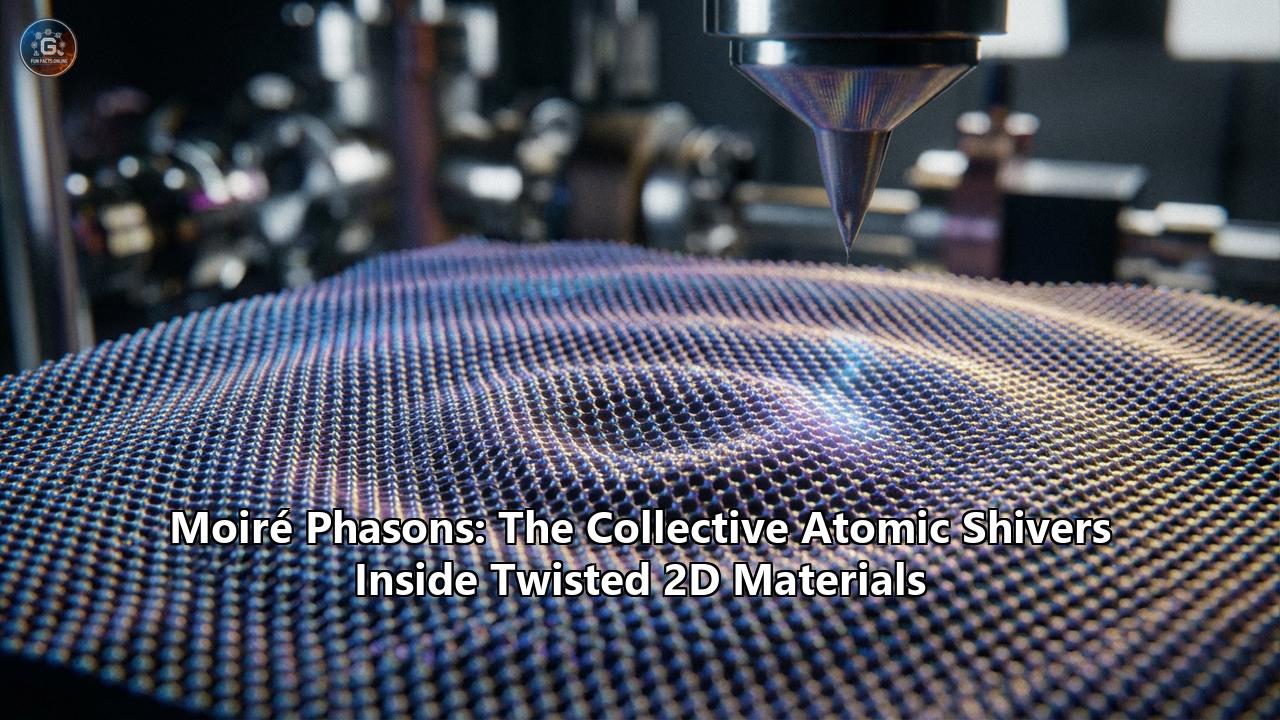
For nearly a decade, physicists have been obsessed with "twistronics"—the art of stacking and rotating atomically thin sheets of material like graphene to summon exotic quantum states. We knew these twisted cathedrals of atoms held magic: superconductivity, strange magnetism, and light that behaves like matter. But until recently, we thought the stage itself—the moiré pattern formed by these crossed lattices—was rigid. We assumed the atoms were locked in a static, geometric dance.
We were wrong.
Recent breakthroughs in 2024 and 2025 have shattered that static image. We have discovered that the moiré pattern itself is alive. It breathes. It shivers. Inside these twisted materials, a collective, phantom-like vibration called the Moiré Phason is constantly rippling through the atomic structure. These are not simple sound waves; they are "atomic shivers," collective excitations that allow layers to slide and undulate like a superfluid, even at temperatures near absolute zero.
This is the story of the Moiré Phason—the ghost in the quantum machine that might just hold the key to the next generation of heat-proof electronics, superfluid computing, and quantum sensors.
Part 1: The Phantom in the Lattice
To understand a phason, you must first unlearn what you know about solids. In a standard crystal, like a diamond or a grain of salt, atoms vibrate around fixed points. We call these vibrations phonons—the quantum particles of sound and heat. They are the "music" of a rigid lattice.
But twisted 2D materials are not standard crystals. When you stack two layers of graphene or tungsten diselenide (WSe2) and twist them by a tiny angle (say, 1.1 degrees), you create a Moiré Superlattice. This is a larger, interference-pattern periodicity that emerges from the misalignment, much like the shimmering patterns you see when looking through two offset window screens.
For years, this superlattice was treated as a mathematical abstraction—a fixed potential energy landscape that electrons had to navigate. But the atoms in these layers are not glued together; they are held by weak van der Waals forces. This means they can slide.
The "Soft" Mode
A phason is the collective motion associated with this sliding. Imagine the moiré pattern not as a fixed painting, but as a projected image. If you shift the top atomic layer by a fraction of a nanometer, the "projected" moiré pattern shifts by a massive amount—sometimes nanometers or more. This immense amplification means that the moiré pattern is incredibly sensitive.
In physics terms, phasons are "massless" or "ultrasoft" modes. Unlike a stiff guitar string that requires energy to pluck (a phonon), a phason is like a loose, floating silk ribbon. It takes almost zero energy to excite these waves. This "softness" means that even at temperatures close to absolute zero, where all other thermal motion should freeze, phasons are still alive. The atoms are still shivering.
The Soliton Network
Theoretical models, specifically the Frenkel-Kontorova model, describe this behavior as a "soliton network." At small twist angles, the material tries to relax. It wants to snap into perfect alignment (commensurate stacking) wherever it can. To do this, it forms large islands of perfect alignment separated by thin, stressed boundaries called domain walls or solitons.
The phason is the vibration of this web. It is the domain walls breathing, flexing, and sliding. It is a "structural fluid" existing inside a solid material.
Part 2: The Breakthrough — Seeing the Invisible (2025)
For decades, phasons were largely theoretical entities, discussed in the context of quasicrystals (materials with order but no periodicity). In moiré systems, they were a mathematical prediction—a nuisance term in an equation that suggested the lattice wasn't quite stable.
That changed in 2025.
A team of researchers, including Yichao Zhang at the University of Maryland and collaborators at Lawrence Berkeley National Laboratory, achieved the impossible: they photographed the shiver.
Electron Ptychography
The problem with seeing a phason is that it is too fast and too small for normal microscopes. It is a blur on a blur. To catch it, the team used a cutting-edge technique called electron ptychography. Unlike traditional electron microscopy, which just blasts a sample with electrons to make a shadow, ptychography shoots a focused beam and records the complex interference pattern of the scattered electrons. A supercomputer then reconstructs the image, correcting for lens aberrations computationally.
This allowed them to reach sub-picometer resolution—seeing details smaller than the vibration of a single atom.
The "Blur" that Wasn't Random
When they looked at twisted WSe2, they didn't see sharp atoms. They saw atoms that looked smeared. But this wasn't bad focus; it was the phason. The atoms were physically surfing on the moiré waves.
Crucially, the blurring wasn't random (which would be heat). It was collective. The atoms in the domain walls were vibrating more intensely than those in the aligned regions. The researchers had captured the first direct visual evidence of the "moiré phason" dominating the thermal behavior of a material. They proved that at low angles, the "solid" material behaves mechanically more like a viscous fluid or a glass.
Part 3: Surfing the Quantum Wave
Why does this matter? Because in the quantum world, everything is connected. The discovery of phasons has solved several lingering mysteries about twisted materials, specifically regarding excitons and strange metals.
Exciton Surfing
Excitons are quasiparticles formed when an electron binds to a hole (a missing electron). They are critical for LEDs, solar cells, and lasers. In twisted TMDs (Transition Metal Dichalcogenides), excitons were expected to get trapped in the deep "valleys" of the moiré potential, frozen in place like marbles in an egg carton.
But experiments showed they were moving. How?
The answer is the phason. The moiré potential isn't a static egg carton; it's a rolling ocean surface. The phasons create "waves" in the potential landscape. The excitons, rather than getting stuck, surf these phason waves. This phason-assisted transport allows quantum information and energy to flow through the material even when it "should" be trapped.
The Strange Metal Mystery
Twisted bilayer graphene is famous for becoming a superconductor (conducting electricity with zero resistance) at magic angles. But just above that superconducting temperature, it behaves as a "strange metal," where resistance scales linearly with temperature. Standard theory says this shouldn't happen.
Phasons provide the missing link. Because phasons are "ultrasoft" (low energy) and their coupling strength increases with wavelength (a counterintuitive trait known as "mismatch symmetry"), they can scatter electrons efficiently even at tiny energies. The electrons are colliding with the "shivers" of the lattice itself, creating that mysterious linear resistance.
Part 4: The Future — Phason Engineering
We are now entering the era of Phason Engineering. If we can control these atomic shivers, we can unlock technologies that were previously science fiction.
1. Nano-Optomechanics & Quantum Sensing
Phasons effectively couple mechanical motion to light. This is the basis of optomechanics. By designing twisted cavities that trap both light and phasons, we could create sensors of unprecedented sensitivity.
- The Concept: A "phason sensor" would detect changes in gravity, acceleration, or electric fields by measuring how they disturb the collective atomic shiver. Because the moiré pattern amplifies atomic displacements by 100x or 1000x, these sensors could theoretically be orders of magnitude more sensitive than current MEMS (Micro-Electro-Mechanical Systems).
2. Superfluid Electronics (Heat Management)
Heat is the enemy of computing. In normal chips, heat is carried by random, incoherent phonons (noise). Phasons are coherent.
- The Breakthrough: The 2025 studies suggest that because phasons dominate thermal transport in twisted layers, we could "tune" the heat conductivity of a material just by twisting it. We could create a "thermal transistor"—a material that conducts heat efficiently in one state (aligned) and blocks it in another (twisted/phason-dominated). This could lead to self-cooling quantum processors.
3. Qubit Protection
Quantum computers suffer from decoherence—the loss of quantum information due to environmental noise.
- The Shield: Phasons might be the ultimate shield. By engineering the moiré spectrum, we could create "quiet zones" or "bandgaps" in the vibrational spectrum where no heat waves can exist. Placing a qubit inside such a "phason bandgap" would isolate it from the mechanical environment, potentially extending coherence times significantly.
Conclusion: The Universe in a Twist
The discovery of Moiré Phasons teaches us a humbling lesson: even in the hardest, coldest crystals, there is motion. Matter is never truly still.
By twisting two sheets of atoms, we didn't just create a new pattern; we summoned a new fundamental behavior of matter. We created a solid that shivers like a liquid. We found a ghost in the machine that can carry electrons, scatter heat, and maybe one day, carry the calculations of a quantum computer.
The static picture of the atomic world is dead. Long live the shivering, sliding, surfing world of the Moiré Phason.
Reference:
- https://www.jos.ac.cn/article/doi/10.1088/1674-4926/44/1/011902
- https://sites.google.com/site/hector8aromillo/home/phasons-of-moir%C3%A9-superlattices
- https://analyticalscience.wiley.com/content/news-do/first-direct-observation-moir%C3%A9-phasons-marks-major-step-quantum-materials-research
- https://mrsec.org/highlights/collective-excitations-twisted-bilayers
- https://physicsworld.com/a/top-10-breakthroughs-of-the-year-in-physics-for-2025-revealed/
- https://www.arxiv.org/pdf/2511.01338