
In the summer of 1979, a device emerged from Japan that would forever alter the soundtrack of our lives and, in doing so, subtly and profoundly rewire our social interactions. The Sony Walkman, a portable cassette player, was a revelation. For the first time, you could curate a personal, high-fidelity soundscape and take it with you, transforming the mundane commute, the city street, and the public park into a private motion picture starring you. This phenomenon, dubbed "The Walkman Effect" by cultural musicologist Shuhei Hosokawa, described how personal audio technology allowed individuals to control their environment and create a bubble of personal space in public. The iconic orange-foamed headphones became a symbol of both personal freedom and a new form of social disengagement.
Today, the Walkman has been relegated to a retro curiosity, but its legacy reverberates in the ubiquitous glow of the smartphone. We are living in the age of the "Walkman Effect 2.0," a supercharged and multifaceted evolution of the original phenomenon. Where the Walkman offered a one-way ticket to a private audio world, today's devices are interactive portals to a universe of content, connection, and distraction. This new iteration is not just about personalizing our auditory environment; it’s about constantly mediating our entire reality, blurring the lines between the physical and digital, and fundamentally redefining our social fabric in ways that make the original Walkman’s impact seem quaint by comparison.
The Original Disconnect: A Soundtrack for a Generation
Before the Walkman, music was largely a shared experience. It was broadcast over the radio, played on a home stereo for the family, or performed live in concert halls and clubs. The Walkman shattered this communal model. It was a device built for the individual. In fact, Sony's then-chairman Akio Morita was so concerned about the potential for social isolation that he initially insisted on a second headphone jack and a "hotline" button that would mute the music for conversation. These features were quickly abandoned; people wanted their own private worlds.
This newfound ability to curate one's own reality was both empowering and unsettling. Users reported feeling more confident and calm, turning boring daily activities into cinematic experiences. Life, as one inventor noted, "became a film." But critics were quick to point out the social cost. The Walkman was accused of promoting narcissism, detachment, and rudeness. To be plugged in was to send a clear "do not disturb" sign to the outside world, creating a barrier against the spontaneous, unscripted interactions that form the basis of community. It was a technology, as one German magazine put it, "for a generation with nothing left to say."
However, the Walkman also fostered a new kind of social connection. The "mixtape," a carefully curated collection of songs recorded onto a cassette, became a powerful form of personal expression and a way to communicate feelings and forge bonds. Sharing earbuds with a friend was an act of intimacy, a temporary merging of two private worlds. These practices showed that even a technology of isolation could be co-opted for social purposes.
The Walkman Effect 2.0: From Private Soundscape to Public Stage
The leap from the Walkman to the smartphone is not just a matter of technological advancement; it represents a fundamental shift in the nature of our digital isolation. The Walkman was a device of consumption. The smartphone, on the other hand, is a device of both consumption and constant production. This distinction is at the heart of the Walkman Effect 2.0.
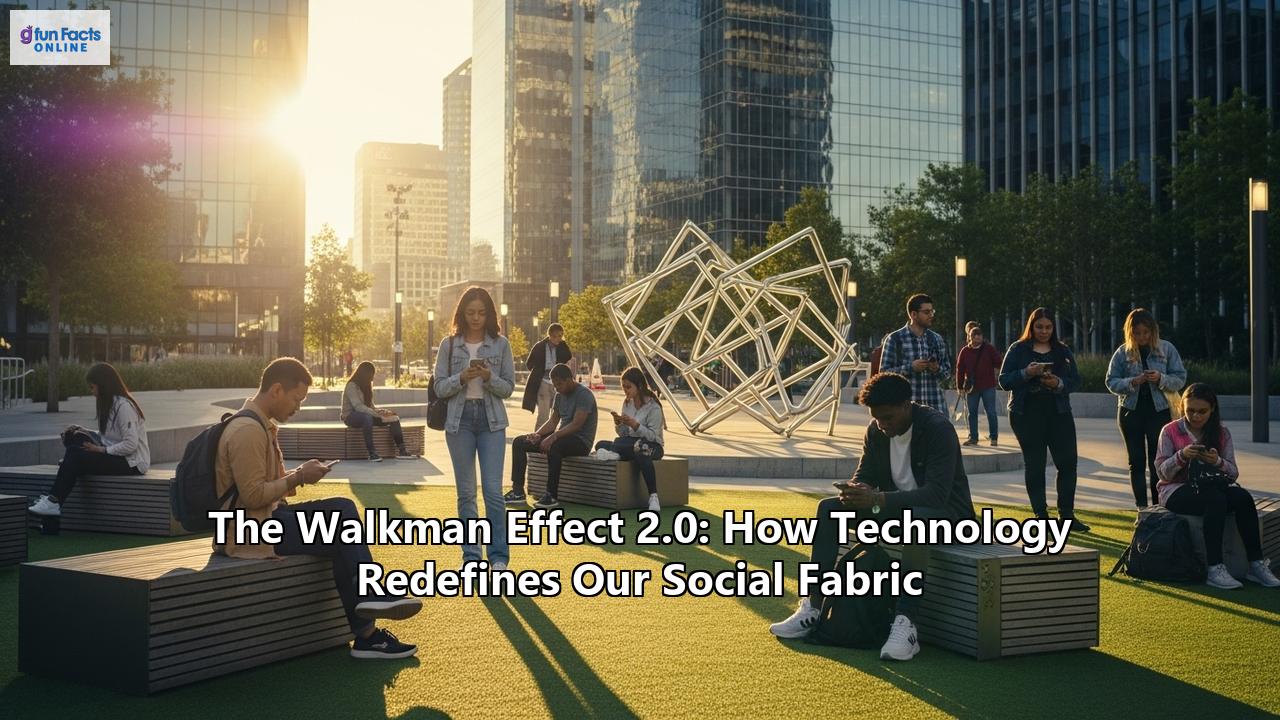
The modern "bubble" is no longer just filled with music. It’s a dynamic, interactive space where we are simultaneously listeners, viewers, broadcasters, and performers. We are not just escaping the physical world; we are actively curating and performing our lives for a digital audience. This has intensified the original Walkman effect in several key ways:
- The Intensification of the Private Bubble: With a smartphone, you can retreat into a world of social media feeds, streaming videos, podcasts, and endless news updates. This bubble is far more immersive and demanding of our attention than a simple album. The result is a more profound disengagement from our immediate surroundings.
- The Performance of Self: The Walkman allowed you to be the audience of your own life's movie. The smartphone turns you into the director, star, and publicist. We are constantly capturing, editing, and sharing our experiences, often with the goal of presenting an idealized version of ourselves. This performance can lead to a state of being "alone together," a term coined by MIT sociologist Sherry Turkle. We can be physically present with others, yet our minds and emotional energies are focused on our digital audience.
- The Erosion of Shared Experience: When a group of people are together, but each is engrossed in their own device, the potential for shared experience and spontaneous interaction diminishes. This phenomenon, often referred to as "phubbing" (phone snubbing), has been shown to decrease the enjoyment of social interactions and make people feel excluded.
The Psychological and Sociological Fallout of Constant Connection
The Walkman Effect 2.0 is having a profound impact on our psychological well-being and the structure of our communities. The constant stream of notifications and the pressure to be always "on" can lead to increased anxiety, stress, and a fear of missing out (FOMO). Studies have shown a correlation between heavy social media use and increased rates of depression, anxiety, and loneliness.
This paradox—that a device designed for connection can make us feel more isolated—is a defining feature of our time. The curated perfection of social media feeds can lead to feelings of inadequacy and low self-esteem as we compare our messy realities to the highlight reels of others. The validation sought through "likes" and comments can create a fragile sense of self-worth that is dependent on external approval.
On a societal level, the Walkman Effect 2.0 is contributing to the fragmentation of our shared reality. The algorithms that power our social media feeds and search engines create "filter bubbles" and "echo chambers." These personalized information ecosystems show us more of what we already like and agree with, limiting our exposure to diverse perspectives and reinforcing our existing biases. This can lead to increased polarization and a decline in civil discourse, as we become less able to understand and empathize with those who hold different views.
The very nature of our public spaces is also changing. The serendipitous encounters that were once a hallmark of urban life are becoming less frequent as we navigate our cities with our heads down, eyes glued to our screens. We are less likely to make eye contact with strangers, strike up a conversation with the person next to us on the bus, or simply observe the world around us.
Navigating the New Social Fabric: A Call for Digital Mindfulness
To say that the smartphone is simply a "new Walkman" would be a gross oversimplification. While the Walkman offered a temporary escape, the smartphone offers a parallel existence. It has become an extension of our minds, our memories, and our social lives. Its influence is more pervasive and its consequences more complex.
However, just as the Walkman was both a tool of isolation and connection, the smartphone holds the same dual potential. It allows us to maintain relationships across vast distances, to organize social movements, and to access a world of information. The challenge lies in using this powerful tool with intention and awareness.
Finding a healthy balance in the age of the Walkman Effect 2.0 requires a new kind of literacy—a digital mindfulness. This includes:
- Setting Boundaries: Consciously deciding when and where to use our devices is crucial. Creating tech-free zones or times, such as during meals or before bed, can help to preserve the sanctity of face-to-face interaction and protect our mental health.
- Cultivating Presence: Making a conscious effort to be fully present in our physical surroundings and with the people we are with is a powerful antidote to the pull of the digital world. This can be as simple as putting the phone away during conversations or taking a walk without headphones.
- Seeking Diverse Perspectives: Actively seeking out information and opinions that challenge our own can help to break out of our filter bubbles. Following people with different viewpoints on social media or reading a wider range of news sources can foster empathy and critical thinking.
The Walkman Effect, in its first and second iterations, is not simply about technology; it's about our relationship with it. It reflects a timeless human desire for both connection and autonomy, for both a shared world and a private one. The Walkman taught us how to walk through the world with our own personal soundtrack. The smartphone has given us the power to rewrite the entire score. The question now is whether we can learn to conduct this symphony without losing the rhythm of our shared humanity.
Reference:
- https://www.darden.virginia.edu/sites/default/files/inline-files/05_16371_RA_KitchensJohnsonGray%20Final_0.pdf
- https://university.taylors.edu.my/en/student-life/news/2023/the-bubble-wrapped-web-filter-bubbles-and-echo-chambers.html
- https://medium.com/@hadia7299207/the-impact-of-social-media-on-real-life-relationships-687672531723
- http://essay.utwente.nl/95556/1/Pasca_BA_BMS.pdf
- https://www.blinkist.com/en/books/alone-together-en
- https://www.supersummary.com/alone-together-why-we-expect-more-from-technology-and-less-from-each-other/summary/
- https://5minutebooksummary.com/alone-together-summary/
- https://fourminutebooks.com/alone-together-summary/
- https://nhws.us/2024/09/23/how-does-social-media-affect-social-skills/
- https://sobrief.com/books/alone-together
- https://www.medicalnewstoday.com/articles/negative-effects-of-technology
- https://misq.umn.edu/understanding-echo-chambers-and-filter-bubbles-the-impact-of-social-media-on-diversificationi-and-partisan-shifts-in-news-consumption.html
- https://pmc.ncbi.nlm.nih.gov/articles/PMC8923337/
- https://medium.com/@craigrourke/the-walkman-revolution-the-retro-80s-portable-music-phenomenon-that-redefined-a-generation-1e8496db9156
- https://is.muni.cz/th/d1s3y/The_Walkman_Effect_Private_Listening_Culture_and_its_Impact_on_the_Individual_and_the_Society.docx
- https://imotions.com/blog/learning/research-fundamentals/technological-influences-on-behavior-insights-and-implications/
- https://www.smithsonianmag.com/innovation/walkman-invention-40-years-ago-launched-cultural-revolution-180972552/
- https://www.aei.org/society-and-culture/a-positive-consequence-of-smartphones/
- https://www.frontiersin.org/journals/psychology/articles/10.3389/fpsyg.2024.1391415/full
- https://aithor.com/essay-examples/the-impact-of-mobile-apps-on-modern-communication-and-social-interaction
- https://www.tandfonline.com/doi/pdf/10.1179/0308018814Z.000000000103