
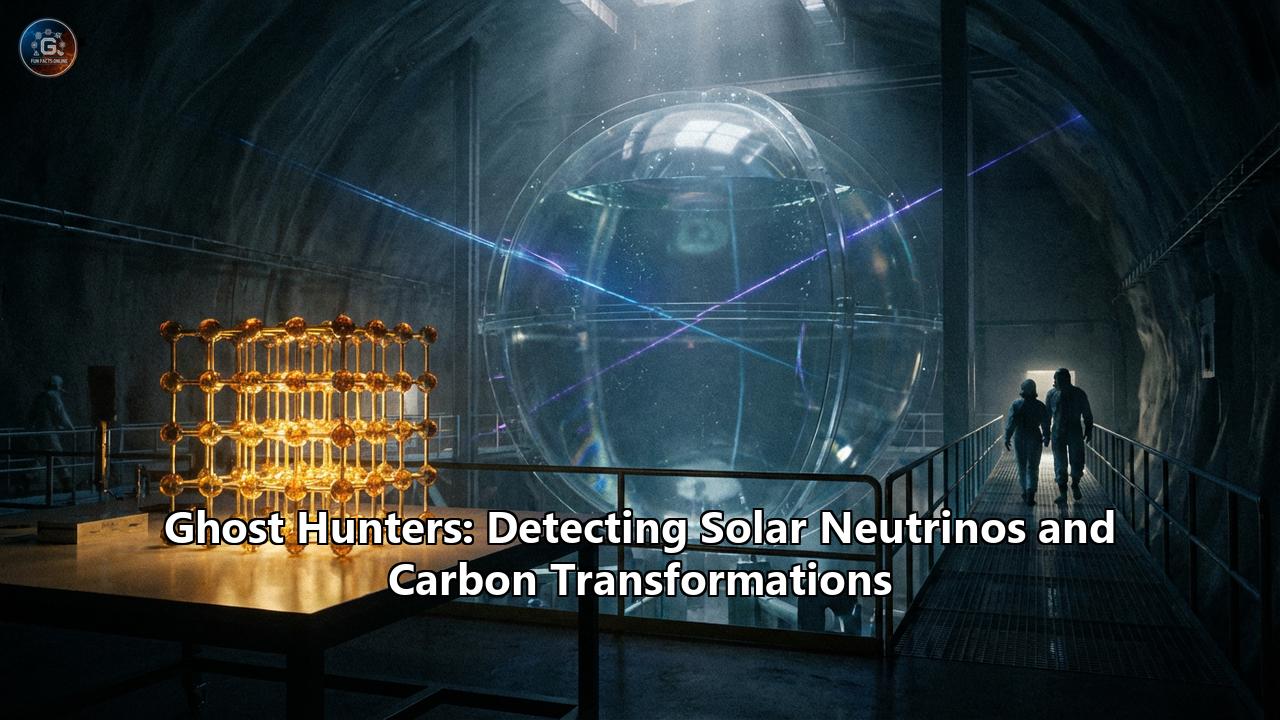
The universe is not merely the silent, glittering expanse of darkness and light that meets the naked eye. It is a cacophony of invisible forces, a turbulent ocean of subatomic particles streaming through the void at the speed of light. Among these, the neutrino stands as the most enigmatic, a "ghost particle" that has haunted physicists for nearly a century. They are the whispers of the cosmos, passing through planets, stars, and our own bodies by the trillions every second, leaving no trace, no ripple, and no sign of their passing.
For decades, humanity has built cathedral-like observatories deep underground, shielding sensitive eyes from the noise of the surface world, waiting for a single ghost to speak. And now, in a monumental convergence of astrophysics and nuclear science, we have not only heard them but decoded their message. We have peered directly into the fusion engine of our nearest star and witnessed the alchemical dance of carbon transformations that powers the giants of the universe.
Part I: The Solar Enigma
To understand the magnitude of recent discoveries, we must first look to the source: the Sun. For most of human history, the mechanism that powered the Sun was a mystery. It wasn't until the 20th century that physicists deduced that the Sun is a massive fusion reactor, crushing hydrogen atoms together to form helium, releasing energy in the process.
This fusion occurs primarily through two distinct pathways. The first, and most dominant in our Sun, is the proton-proton (pp) chain. This process accounts for roughly 99% of the Sun's energy output. It is a direct mashing of protons (hydrogen nuclei) to create deuterium, then helium-3, and finally stable helium-4.
But there is a second, more elusive pathway: the CNO Cycle (Carbon-Nitrogen-Oxygen cycle). Proposed independently by Hans Bethe and Carl Friedrich von Weizsäcker in the late 1930s, this cycle uses heavier elements—carbon, nitrogen, and oxygen—not as fuel, but as catalysts. A carbon-12 nucleus captures a proton to become nitrogen-13, which decays to carbon-13, which captures another proton, and so on. The carbon atom is transmuted, shifting identities through nitrogen and oxygen isotopes, only to be reborn as carbon-12 at the end of the cycle, having successfully fused four protons into a helium nucleus.
In our Sun, this "catalytic converter" of fusion is a minor player, contributing only about 1% of the solar energy. However, its significance is cosmic. In stars more massive than our Sun—the hot, blue giants that illuminate the galaxy—the CNO cycle is the dominant engine. It is the primary method by which the universe creates energy. Confirming its existence in our own Sun was not just about understanding our local star; it was about validating our understanding of stellar evolution across the entire cosmos.
Part II: The Whispering Ghosts
The proof of these fusion processes lies in the byproducts. Fusion creates energy (gamma rays) and neutrinos. The gamma rays are trapped in the Sun's dense core, bouncing around for up to 100,000 years before emerging as sunlight. They are "old news" by the time they reach Earth. Neutrinos, however, interact with almost nothing. They flee the solar core instantly, reaching Earth in just eight minutes. They are the only direct probe we have of the Sun's current internal state.
But catching them is a task of Sisyphean difficulty.
The first victory in this hunt came in the mid-20th century with the Homestake Experiment, where a tank of cleaning fluid buried in a gold mine captured the first solar neutrinos. This experiment, led by Ray Davis Jr. and John Bahcall, revealed a discrepancy—the "Solar Neutrino Problem"—where only a third of the predicted neutrinos were detected. This mystery was solved decades later with the discovery of neutrino oscillation: neutrinos change "flavors" (electron, muon, tau) as they travel.
With the oscillation mystery solved, the stage was set for the next great challenge: distinguishing the faint signal of CNO neutrinos from the overwhelming roar of the pp-chain neutrinos and background radiation.
Part III: The Borexino Breakthrough
Enter Borexino, an experiment located at the Laboratori Nazionali del Gran Sasso in Italy. Buried under kilometers of rock in the Apennine Mountains, Borexino is often described as the most radio-pure place in the universe. Its heart is a nylon sphere filled with 300 tons of liquid scintillator—a fluid that flashes with light when a neutrino interacts with an electron inside it.
The challenge for Borexino was not just detecting neutrinos, but identifying which neutrinos they were. CNO neutrinos have a specific energy signature, but this signature is frustratingly similar to the background noise caused by the decay of bismuth-210, a radioactive contaminant found in minute traces in the detector's materials.
To isolate the CNO signal, the Borexino team had to achieve thermal stability on an unprecedented scale. They wrapped the detector in a thermal blanket and stabilized the temperature so precisely that convective currents in the liquid—which could move radioactive contaminants around—were effectively frozen.
In 2020, the Borexino collaboration announced a historic victory: the first statistically significant detection of neutrinos from the solar CNO cycle.
This was the "smoking gun." For the first time, humanity had direct experimental proof that the Sun burns hydrogen using carbon as a catalyst. We were watching the CNO cycle turn the gears of the solar engine in real-time. This discovery confirmed that our models of stellar physics were correct and provided a crucial anchor for understanding the composition of the Sun, specifically its "metallicity" (the abundance of elements heavier than helium).
Part IV: The "Carbon Transformation" on Earth
While Borexino was observing carbon transformations inside the Sun, a new chapter was being written inside the detectors themselves on Earth.
Fast forward to December 2025. The scientific community was electrified by a new announcement from the SNO+ experiment (the successor to the Sudbury Neutrino Observatory) in Canada.
Deep within a nickel mine in Ontario, SNO+ had been hunting for rare interactions. The detector, filled with a liquid scintillator loaded with Tellurium, was primarily designed to look for "neutrinoless double beta decay." However, its extreme sensitivity allowed it to perform another groundbreaking measurement.
On December 10, 2025, researchers announced the first evidence of solar neutrino interactions on Carbon-13.
This is a subtle but profound distinction from the Borexino result. Borexino detected neutrinos born from carbon cycling in the Sun. SNO+ detected neutrinos colliding with carbon atoms in the detector fluid itself, transforming them.
The reaction observed was:
ν_e + ¹³C → ¹³N + e⁻In this interaction, a high-energy solar neutrino strikes a Carbon-13 atom (a rare isotope naturally present in the scintillator fluid). The collision transforms the carbon atom into Nitrogen-13 and ejects an electron. The Nitrogen-13 is unstable and subsequently decays, emitting a positron.
This creates a unique "coincidence signal" in the detector:
- The Prompt Flash: The initial impact creates a flash of light from the ejected electron.
- The Delayed Flash: The resulting Nitrogen-13 decays minutes later, creating a second flash.
This specific "double flash" signature allowed SNO+ scientists to pick these rare events out of the background noise with incredible precision.
Part V: Why This Matters
The synergy between the Borexino (2020) and SNO+ (2025) discoveries paints a complete picture of the role of Carbon in neutrino physics.
- Stellar Archaeology: The Borexino result (CNO neutrinos) acts as a probe for the Sun's core temperature and composition. The rate of CNO fusion is highly sensitive to the amount of carbon and nitrogen in the Sun's center. By measuring this flux, we are essentially taking a biopsy of the solar core, helping to resolve the "Metallicity Problem"—a conflict between spectroscopic measurements of the Sun's surface and helioseismic models of its interior.
- Standard Model Testing: The SNO+ result (Carbon-13 interaction) turns solar neutrinos into a "test beam." We are using the Sun as a particle accelerator to bombard Earth with neutrinos, allowing us to study how they interact with matter (specifically Carbon-13) at energies that are difficult to replicate in man-made reactors. This helps refine our knowledge of nuclear cross-sections—the probability of specific atomic interactions—which is vital for everything from nuclear reactor safety to medical physics.
- The Universal Engine: Confirming the CNO cycle's mechanics validates our understanding of massive stars. When we look at a blue supergiant like Rigel, we now know for certain that its brilliance is powered by the same carbon-cycling engine we have detected whispering in our own Sun.
Conclusion: The Age of Neutrino Astronomy
We have entered a golden age of "Ghost Hunting." We are no longer just counting neutrinos; we are using them to perform spectroscopy of the Sun's deep interior and to study the fundamental properties of matter itself.
From the CNO cycle churning in the solar inferno to the transmutation of carbon atoms in a tank of fluid two kilometers underground, we are witnessing the universe's most subtle mechanics. These ghost particles, once thought undetectable, have become our most powerful eyes, allowing us to see through the opaque layers of stars and into the very heart of creation.
As detectors become larger and more sensitive—like the upcoming Hyper-Kamiokande in Japan and DUNE in the United States—we stand on the precipice of even greater discoveries. But for now, the dual triumphs of Borexino and SNO+ stand as a testament to human ingenuity: catching ghosts to understand the stars.
Reference:
- https://www.inverse.com/science/scientists-detect-elusive-particle-in-sun
- https://collaborate.princeton.edu/en/publications/solar-neutrinos-from-the-cno-fusion-cycle-borexino-discovery-and-/
- https://physicstoday.aip.org/news/borexino-experiment-detects-neutrinos-from-the-suns-carbon-nitrogen-oxygen-cycle
- https://www.zmescience.com/science/physics/historic-neutrino-detection-shines-new-light-on-the-sun/
- https://medium.com/the-cosmic-companion/neutrinos-from-the-sun-cno-something-weird-bdd5c9c51c45
- https://physicstoday.aip.org/news/borexino-detector-catches-neutrinos-from-the-suns-cno-cycle
- https://physicsworld.com/a/borexino-spots-solar-neutrinos-from-elusive-fusion-cycle/
- https://en.wikipedia.org/wiki/Solar_neutrino
- https://borex.lngs.infn.it/papers/articles/experimental-evidence-of-neutrinos-produced-in-the-cno-fusion-cycle-in-the-sun/
- https://mcdonaldinstitute.ca/astroparticle-physics-news/borexino-cno-neutrinos/
- https://scitechdaily.com/scientists-catch-ghost-particles-changing-an-atom-deep-underground/
- https://collaborate.princeton.edu/en/publications/observation-of-cno-cycle-solar-neutrinos-in-borexino/
- https://kids.frontiersin.org/articles/10.3389/frym.2022.1034181
- https://scitechdaily.com/tiny-ghost-particles-could-explain-why-the-universe-exists/
- https://www.researchgate.net/publication/388883598_Neutrinos_from_Carbon-Burning_Red_Supergiants_and_Their_Detectability
- https://www.independent.co.uk/space/sun-solar-ghost-particles-b2882099.html