
Introduction: The Ultimate Energy Frontier
For decades, humanity has looked to the stars for the secrets of the universe, yet the solution to our most pressing terrestrial crisis—the need for limitless, clean energy—may lie not above our heads, but miles beneath our feet. We stand on the precipice of a new era in renewable power, one that reads like the pages of a science fiction novel: drilling directly into the molten heart of volcanoes to harness the raw power of the Earth itself.
This is not a theoretical exercise. In the frozen, volcanic landscapes of Iceland, an international team of scientists and engineers is preparing to do what was once thought impossible: deliberately drill into a magma chamber. Their goal is to unlock the potential of supercritical geothermal energy, a resource so potent that it could render fossil fuels obsolete and provide a baseload power source capable of fueling civilization for millions of years.
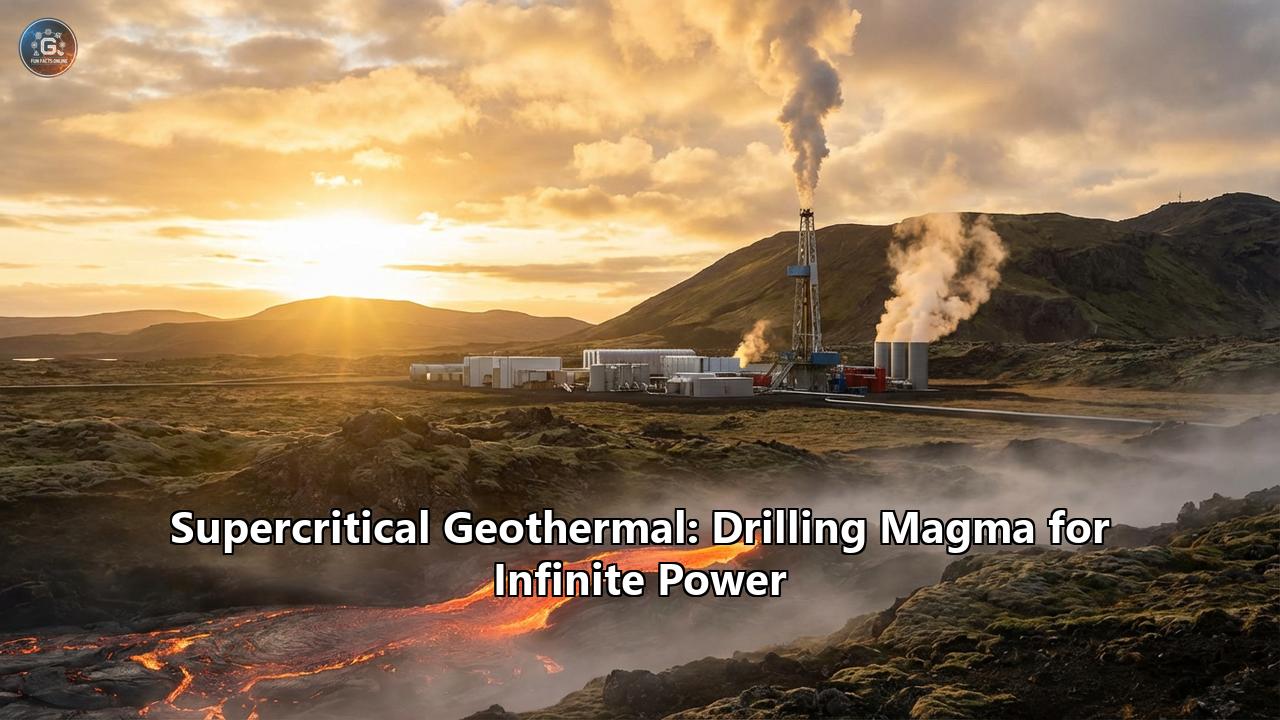
The project, known as the Krafla Magma Testbed (KMT), is the "moonshot" of the geothermal world. If successful, it will prove that we can safely tap into the most extreme environments on the planet—where temperatures soar towards 1,000°C and pressures crush conventional steel like soda cans—to access a power source that is, for all human intents and purposes, infinite.
Part I: The Physics of the "Fourth State"
To understand why drilling into magma is such a revolutionary idea, one must first understand the physics of water under extreme conditions. Traditional geothermal power plants operate by tapping into reservoirs of hot water or steam trapped in porous rock, typically at temperatures between 150°C and 300°C. This steam drives turbines to generate electricity. It is a reliable, clean technology, but it is limited by the energy density of the fluid.
The game changes entirely when we push water beyond its "critical point."
Defining Supercritical Water
Water is familiar to us in three states: solid (ice), liquid (water), and gas (steam). However, when water is subjected to temperatures above 374°C (705°F) and pressures higher than 22.1 MPa (221 bar), it enters a supercritical state. In this phase, the distinction between liquid and gas vanishes. The fluid creates a "super-state" that possesses the low viscosity of a gas (allowing it to flow easily through rock fractures) but the high density of a liquid (allowing it to carry immense amounts of thermal energy).
The Energy Multiplier
The thermodynamic advantage of supercritical water is staggering. A standard geothermal well might produce 3 to 5 megawatts (MW) of electricity—enough to power a few thousand homes. In contrast, a single supercritical well, tapping into fluids at 400°C to 600°C, has the potential to generate 30 to 50 MW of electricity.
This is an order-of-magnitude leap. It means that instead of drilling a sprawling field of 50 wells to power a city, energy providers could achieve the same output with just three or four supercritical wells. This massive increase in energy density drastically lowers the physical footprint of power plants and has the potential to crash the "levelized cost of energy" (LCOE), making geothermal cheaper than coal, gas, and even wind or solar in many applications.
Part II: The Icelandic Saga – Accidental Discoveries
The journey to the center of the Earth began, as many great scientific breakthroughs do, with an accident.
IDDP-1: The Happy Mistake
In 2009, the Iceland Deep Drilling Project (IDDP) began drilling a well known as IDDP-1 in the Krafla caldera, a volcanic region in northeast Iceland. The plan was to drill down to 4.5 kilometers to find deep, hot bedrock. However, at just 2.1 kilometers depth, the drill bit suddenly seized. The engineers were baffled. They had hit something soft.
When they analyzed the cuttings coming back up the borehole, they realized the impossible had happened: they had drilled directly into a pocket of rhyolitic magma—molten rock at over 900°C.
In most drilling scenarios, this would be a catastrophic failure. The equipment should have melted, and the well should have been abandoned. Instead, the IDDP team made a bold decision. They cemented a steel casing into the well just above the magma and decided to flow-test it.
Water from the rocks above the magma was heated by the molten intrusion to 450°C at extremely high pressures. When this superheated steam roared to the surface, it was unlike anything the geothermal industry had ever seen. The well produced enough high-pressure steam to generate 36 MW of electricity from that single hole. It became the world's hottest productive geothermal well, proving that magma-enhanced geothermal systems were not just theoretical—they were possible.
IDDP-2: Pushing Deeper
Emboldened by the success of IDDP-1, the consortium moved to the Reykjanes Peninsula for IDDP-2. In 2017, they drilled to a depth of 4,659 meters (nearly 3 miles). At the bottom, they encountered rocks at 427°C and pressures of 340 bar. They had successfully reached the realm of supercritical water in a seawater-recharged system.
While IDDP-2 faced technical challenges with casing integrity (the steel pipes struggled to survive the thermal shock of cold water injection), it provided invaluable data. It confirmed that supercritical conditions exist at reachable depths and that the Earth's crust is permeable enough to allow fluid flow even at these crushing pressures.
Part III: The Krafla Magma Testbed (KMT)
Building on these "accidental" successes, the scientific community formally established the Krafla Magma Testbed (KMT). This is the first international facility dedicated to drilling into magma on purpose.
The Mission
Scheduled to begin drilling its first major wells around 2026-2027, KMT has a dual purpose:
- The Magma Observatory: Just as we have telescopes to study the stars, KMT will be a microscope for the Earth's crust. It will allow scientists to place sensors directly into the magma-rock interface, providing unprecedented data on volcanic eruptions, magma chamber dynamics, and the formation of the Earth's crust.
- The Energy Testbed: The ultimate goal is to perfect the technology for "Magma-Enhanced Geothermal Systems" (MEGS). KMT aims to develop the "hardware"—valves, casings, and wellheads—that can survive 1,000°C for decades.
The KMT project is positioning itself as the CERN of geophysics. Just as the Large Hadron Collider revealed the secrets of particle physics, KMT aims to reveal the secrets of the planetary subsurface.
Part IV: The Global Race for Deep Heat
While Iceland is the poster child for this technology due to its unique geology (where magma sits shallowly near the surface), the race for supercritical geothermal is global. The prize is a universal, baseload, carbon-free energy source that can work even when the sun isn't shining and the wind isn't blowing.
Japan: The Supercritical Geothermal Project
Japan, situated on the Ring of Fire, sits atop a massive potential energy reserve. The Japan Supercritical Geothermal Project (an evolution of the "Beyond Brittle" project) is investigating deep resources in the Tohoku volcanic arc. Japanese researchers have identified that at depths of 3 to 5 kilometers, they can access resources at 500°C.
The challenge in Japan is the "Brittle-Ductile Transition Zone" (BDTZ). As you go deeper and rocks get hotter, they stop breaking (brittle) and start bending (ductile). Conventional geothermal relies on fractures in brittle rock for water to flow. In ductile rock, these fractures can seal shut under the immense pressure, cutting off the water flow. Japanese scientists are pioneering methods to artificially fracture these ductile rocks and keep them open, turning the hot, impermeable basement rock into a massive radiator.
New Zealand: Geothermal The Next Generation
GNS Science in New Zealand is leading a program called "Geothermal: The Next Generation." They are targeting the Taupō Volcanic Zone, aiming to drill to depths of 4 to 6 kilometers to find supercritical fluids. Estimates suggest that New Zealand's deep supercritical resources could provide enough energy to meet the country’s entire electricity demand, potentially yielding 2,000 MW or more of new capacity.Italy: Project DESCRAMBLE
In Tuscany, the DESCRAMBLE project (Drilling in Deep, Super-Critical Ambient of Continental Europe) successfully drilled a test well in Larderello to a depth of 2.9 km, reaching temperatures of 517°C. While they faced challenges with aggressive fluids and gas control, DESCRAMBLE demonstrated that we can control wells at these extreme conditions using modified oil and gas technologies.
Part V: Engineering the Impossible
Drilling into magma sounds suicidal for machinery. Steel melts at around 1,370°C, but it loses its structural integrity long before that (around 600°C). Electronics fry at 200°C. How do we build a machine to survive hell?
1. The Drill That Doesn't Touch the Rock: Millimeter Waves
The most revolutionary advancement in deep drilling comes from an MIT spin-off called Quaise Energy. Traditional mechanical drill bits wear out quickly in hot, hard granite. They require constant "tripping"—pulling the entire drill string out of the hole to replace the bit—which takes days and costs millions.
Quaise is commercializing gyrotron-powered millimeter-wave drilling. This technology was originally developed for nuclear fusion experiments. A gyrotron on the surface shoots a high-energy beam of millimeter waves (similar to microwaves) down a waveguide tube. When the beam hits the rock, it doesn't just chip it—it vaporizes it.
The beam melts the rock into a glass-like slag, which is then blown out of the hole by purge gas. Because there is no mechanical contact with the rock, the "drill bit" never gets dull. Quaise claims this technology can drill down to 20 kilometers, accessing supercritical temperatures anywhere on Earth, not just in volcanic zones. They have already successfully demonstrated this in lab tests and are moving to field trials, aiming to repower existing coal plants with geothermal steam by 2028.
2. Indestructible Cement
A well is only as good as the cement that holds it in place. Standard Portland cement disintegrates at high temperatures and in the acidic environment of volcanic gases. To solve this, researchers at Brookhaven National Laboratory and other institutions have developed Calcium-Aluminate Cements (CAC) and phosphate-based cements. These advanced materials actually get stronger in high-temperature, hydrothermal environments. They are self-healing and resistant to the corrosive "cocktail" of hydrochloric and sulfuric acids found near magma.
3. Flexible Wells
Thermal expansion is a well-killer. When a cold well is suddenly heated to 500°C, the steel casing expands, buckling and crushing itself. The solution, pioneered in IDDP-2 and KMT designs, involves flexible couplings—essentially accordion-like joints in the steel casing that allow the pipe to expand and contract without breaking. These "breathing" wells can tolerate the thermal shock of startup and shutdown cycles.
Part VI: Is It Truly Infinite?
The headline promises "Infinite Power," but is that scientific fact or marketing hype?
From a human perspective, it is effectively infinite. A magma chamber is a colossal thermal battery, constantly recharged by heat rising from the Earth's mantle and core. The heat content of a single cubic kilometer of magma is immense.
However, thermodynamics dictates that if you extract heat faster than it is replenished by the mantle, the local rock will cool down. This is actually a safety feature; cooling the magma margin creates a thicker crust, reducing the risk of eruption. But compared to a coal mine that runs out of coal, a magma chamber's "recharge rate" is geological.
Japanese researchers studying the "magma replenishment rate" suggest that for sustainable, long-term production, we would manage the extraction rate to match the conductive heat flow from the magma body. Even with these limits, the energy available dwarfs our current consumption. A 2006 MIT report estimated that the U.S. alone has enough deep geothermal resource to power the entire country for thousands of years.
Part VII: Risks and Reality Checks
We must address the elephant in the room: Could we accidentally trigger a volcanic eruption?
This is the most common fear, but geologists assure us the risk is negligible. The IDDP-1 incident proved that poking a magma chamber doesn't cause it to explode. The high pressure of the magma is actually contained by the weight of the rock above it. When a drill bit penetrates, the hole is so small (a few inches wide) compared to the volume of the chamber that the change in pressure is insignificant. Furthermore, the drilling fluid (cold water) instantly freezes the magma it touches, creating a protective "glass plug" that seals the hole if necessary.
The greater risks are:
- Induced Seismicity: Injecting water into deep faults can lubricate them, causing earthquakes. This happened in Basel, Switzerland, and Pohang, South Korea. Supercritical projects must carefully map stress fields to avoid triggering large slips.
- Corrosion: The fluids at these depths are often "super-acidic." They can eat through titanium and high-grade alloys in weeks. Developing materials that can survive this chemistry for 20 years is the primary engineering hurdle remaining.
Conclusion: The Baseload Future
Supercritical geothermal represents the "Holy Grail" of the energy transition. Solar and wind are vital, but they are intermittent. Batteries are expensive. Nuclear is politically fraught. But the heat of the Earth is always there, beneath our feet, waiting.
If projects like KMT in Iceland and companies like Quaise Energy succeed, we could see a transformation of the global energy grid within the next two decades. We could retrofit old coal power plants, replacing their dirty furnaces with deep boreholes that draw clean, steam power directly from the planet's core.
We are no longer just scratching the surface of our planet's potential. We are drilling into the fire that forged the world, ready to light the future with the infinite power of the Earth itself.
Reference:
- https://www.youtube.com/watch?v=2BE_AFLbrVU
- https://www.thinkgeoenergy.com/geothermal/advanced-geothermal-technologies/
- https://www.u-tokyo.ac.jp/focus/en/press/z0508_00423.html
- https://www.geothermalnextgeneration.com/supercritical-advantage
- https://en.wikipedia.org/wiki/Fervo_Energy
- https://cdn.catf.us/wp-content/uploads/2022/10/25212950/CATF_SHRProjectFactsheet_SCGPJapan.pdf
- https://www.gns.cri.nz/research-projects/geothermal-the-next-generation/
- https://www.thinkgeoenergy.com/new-zealand-holds-2000-mw-of-supercritical-geothermal-potential/
- https://www.gns.cri.nz/news/new-zealand-government-has-announced-that-up-to-60-million-for-supercritical-geothermal/
- https://en.wikipedia.org/wiki/Quaise
- https://www.thinkgeoenergy.com/superhot-rock-geothermal-the-holy-grail-for-geothermal/