
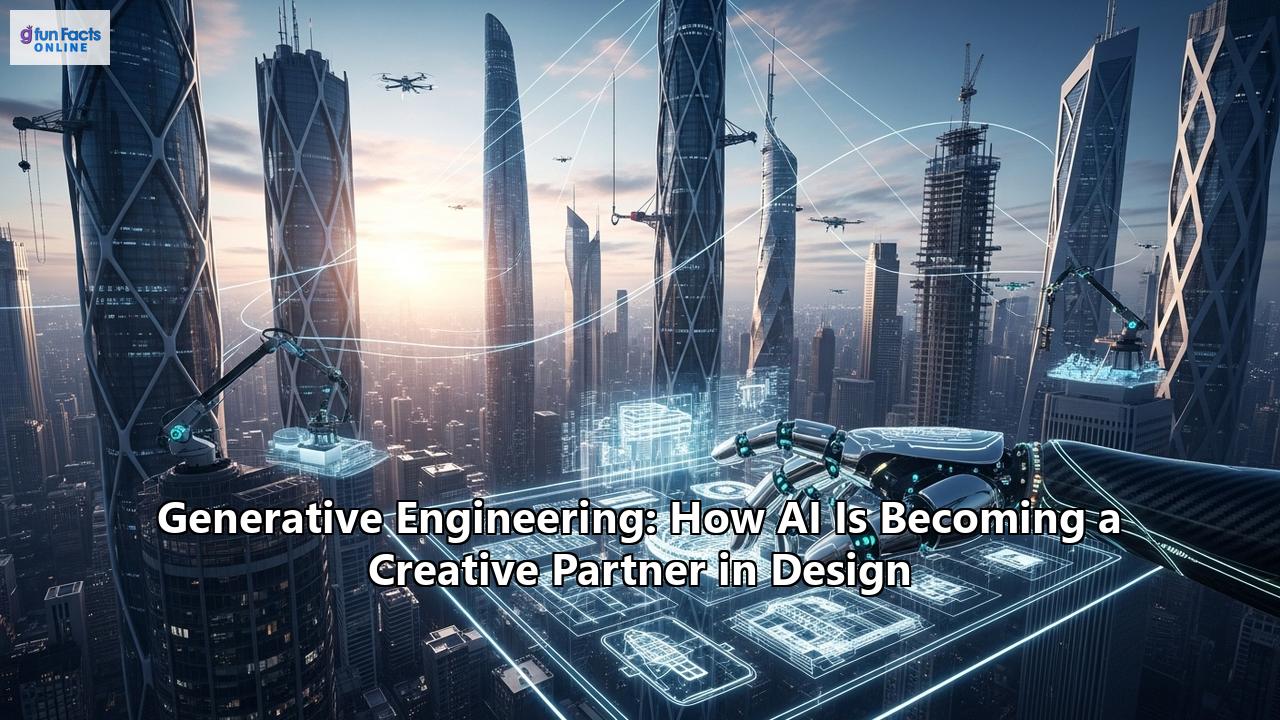
The Dawn of a New Design Era: How Generative Engineering and AI are Forging a Creative Partnership
The world of design and engineering is in the midst of a profound transformation. A new paradigm, known as Generative Engineering, is emerging, fueled by the relentless advancement of artificial intelligence. This is not just another incremental improvement in computer-aided design (CAD) software; it represents a fundamental shift in the very nature of creation, where AI transcends its role as a mere tool to become a true creative partner. This article delves into the world of Generative Engineering, exploring its historical roots, the powerful AI technologies that drive it, its real-world applications across diverse industries, the challenges and ethical considerations it presents, and its transformative potential for the future of design and engineering.
From Automation to Co-Creation: The Evolution of Design
The journey to Generative Engineering has been a long and fascinating one, marked by key milestones that have progressively intertwined the worlds of design and computation.
The Seeds of Automation: Early CAD and Computational Design
The origins of Generative Engineering can be traced back to the middle of the 20th century, with the advent of computer science and the pioneering work of visionaries like Alan Turing and John McCarthy. Their foundational theories on computation and artificial intelligence laid the groundwork for a future where machines could not only calculate but also "think" in a rudimentary sense.
The 1960s witnessed the birth of computer-aided design (CAD), with Ivan Sutherland's groundbreaking Sketchpad system being a pivotal moment. For the first time, designers could interact with a computer graphically, a revolutionary concept that marked the beginning of the end for purely manual design processes. This era also saw the rise of computational design, where architects and engineers began to explore the use of algorithms to generate complex forms and structures.
The 1970s and 1980s saw further advancements, with the development of expert systems and the emergence of early neural networks. These technologies, though primitive by today's standards, began to hint at the potential for AI to play a more active role in the design process. The development of genetic algorithms during this period also introduced the concept of "evolving" designs to find optimal solutions, a key precursor to modern generative techniques.
The Rise of Generative Design: A New Approach to Form-Finding
The 1990s marked a significant turning point with the development of the first true generative design algorithms. This new approach was a departure from traditional CAD, where the designer creates a model based on their own knowledge and experience. With generative design, the designer sets the parameters and constraints, and the computer, powered by AI, generates a multitude of design possibilities.
Initially, generative design found a fertile ground in architecture, where pioneers like Zaha Hadid, Frank Gehry, and Greg Lynn began to use computational tools to create buildings with fluid, organic forms that would have been impossible to design using traditional methods. These early explorations showcased the potential of generative design to push the boundaries of creativity and challenge conventional notions of form and space.
The Convergence of Technologies: Paving the Way for Generative Engineering
The early 2000s and 2010s saw a convergence of several key technologies that propelled generative design into the mainstream. The exponential growth of computing power, coupled with the rise of cloud computing, made it possible to run the complex simulations and optimizations required for generative design on a massive scale. The development of advanced manufacturing techniques, particularly additive manufacturing (3D printing), provided a way to physically realize the intricate and often unconventional geometries produced by generative algorithms.
During this period, sophisticated software tools like Autodesk's Fusion 360 and Rhino with its Grasshopper plugin emerged, making generative design more accessible to a wider range of designers and engineers. These tools integrated generative capabilities directly into the CAD environment, allowing for a more seamless and collaborative workflow between the human designer and the AI.
The AI Powerhouse: Technologies Fueling Generative Engineering
At the heart of Generative Engineering lies a suite of powerful AI technologies that enable machines to not only analyze and optimize but also to create and innovate. These technologies are the engines that drive the generative process, exploring vast design spaces and uncovering novel solutions that might otherwise remain undiscovered.
Generative Adversarial Networks (GANs): The Creative Forgers
Generative Adversarial Networks, or GANs, are a class of AI models that have proven to be exceptionally adept at generating realistic and novel designs. A GAN consists of two neural networks, a "generator" and a "discriminator," that are locked in a competitive, or adversarial, relationship.
The generator's role is to create new data, such as images or 3D models, that are as realistic as possible. It starts with a random input, often called a "noise vector," and through a process of learning, it refines its ability to produce outputs that mimic the training data it has been fed.
The discriminator, on the other hand, acts as a discerning critic. It is trained to distinguish between real data from the training set and the "fake" data created by the generator. The discriminator's feedback is then used to improve the generator's performance, pushing it to create even more convincing forgeries.
This adversarial process continues, with both networks getting progressively better at their respective tasks, until the generator is able to produce outputs that are so realistic that the discriminator can no longer tell them apart from the real thing. This is the point at which the GAN has learned the underlying patterns and structures of the training data and can be used to generate new, original designs.
In the context of Generative Engineering, GANs are particularly useful for:
- Concept Generation: GANs can be trained on vast datasets of existing designs to generate a wide range of new and inspiring concepts. This can help designers to break free from their own creative biases and explore a much broader design space.
- Style Transfer: GANs can be used to apply the stylistic elements of one design to another. For example, an engineer could use a GAN to apply the aerodynamic principles of a high-performance aircraft to the design of a new car.
- Data Augmentation: In situations where there is a limited amount of training data, GANs can be used to generate synthetic data to augment the existing dataset. This can help to improve the performance of other machine learning models used in the design process.
Variational Autoencoders (VAEs): The Structured Innovators
Variational Autoencoders, or VAEs, are another powerful class of generative models that are widely used in Generative Engineering. Like GANs, VAEs are capable of generating new data, but they do so in a more structured and controlled manner.
A VAE consists of two main components: an "encoder" and a "decoder." The encoder takes an input, such as a 3D model, and compresses it into a lower-dimensional "latent space." This latent space is a probabilistic representation of the input data, meaning that it captures the underlying patterns and variations in the data in a continuous and structured way.
The decoder then takes a point from this latent space and reconstructs it back into the original data format. By sampling different points from the latent space, the VAE can generate a wide range of new and diverse designs that are similar to the original input data but with subtle variations.
The key advantage of VAEs is their ability to create a smooth and continuous latent space, which allows for a more controlled and intuitive exploration of the design space. This makes them particularly well-suited for tasks such as:
- Design Optimization: By exploring the latent space, designers can identify areas that correspond to desirable design characteristics, such as high performance or low weight.
- Design Interpolation: VAEs can be used to interpolate between two different designs, creating a smooth transition from one to the other. This can be useful for exploring a range of design possibilities between two known good solutions.
- Anomaly Detection: VAEs can be trained on a dataset of "normal" designs to identify anomalies or defects in new designs.
Reinforcement Learning: The Performance-Driven Optimizer
Reinforcement learning is a type of machine learning where an AI agent learns to make decisions by interacting with an environment and receiving rewards or penalties for its actions. In the context of Generative Engineering, reinforcement learning can be used to optimize designs for specific performance criteria.
The process typically involves the following steps:
- Define the Environment: The environment is the design space, which can be represented by a set of parameters or a 3D model.
- Define the Agent: The agent is the AI model that makes changes to the design.
- Define the Actions: The actions are the modifications that the agent can make to the design, such as changing a parameter or adding or removing material.
- Define the Rewards: The rewards are the feedback that the agent receives for its actions. This feedback is typically based on the performance of the design, which can be measured through simulations or physical tests.
The agent's goal is to learn a "policy," which is a strategy for choosing actions that will maximize its total reward over time. Through a process of trial and error, the agent learns which actions lead to better designs and which ones lead to worse designs.
Reinforcement learning is particularly useful for optimizing designs in complex and dynamic environments where the relationship between design parameters and performance is not well understood. It has been successfully applied to a wide range of engineering problems, including:
- Structural Optimization: Reinforcement learning can be used to optimize the topology of a structure to maximize its strength and stiffness while minimizing its weight.
- Aerodynamic Design: Reinforcement learning can be used to optimize the shape of an airfoil or a car body to minimize drag and maximize lift.
- Robotics: Reinforcement learning can be used to design robots that can perform complex tasks in unstructured environments.
Transformers: The Language of Design
Transformers are a relatively new type of neural network architecture that has revolutionized the field of natural language processing. They have proven to be exceptionally good at understanding the context and relationships between words in a sentence, which has made them the go-to technology for tasks such as machine translation and text generation.
More recently, transformers are also finding applications in the world of design and engineering. By treating a design as a sequence of data points, transformers can be used to:
- Generate Design Concepts: Transformers can be trained on a dataset of existing designs to generate new and creative design concepts.
- Predict Design Performance: Transformers can be used to predict the performance of a design without the need for expensive simulations.
- Automate the Design Process: Transformers can be used to automate repetitive and time-consuming tasks in the design process, such as creating detailed drawings or generating manufacturing instructions.
The ability of transformers to understand and process sequential data makes them a powerful tool for Generative Engineering, and we are likely to see many more applications of this technology in the years to come.
Generative Engineering in Action: Real-World Applications
The transformative potential of Generative Engineering is not just a theoretical concept; it is already being realized in a wide range of industries, from automotive and aerospace to architecture and product design. Here are some compelling examples of how AI is being used as a creative partner to solve complex design challenges and drive innovation.
Automotive: Lighter, Stronger, and More Efficient Vehicles
The automotive industry has been an early adopter of Generative Engineering, driven by the constant pressure to reduce vehicle weight, improve fuel efficiency, and enhance performance.
- Volkswagen's Generative Wheels: In a bid to reduce the weight of its electric vehicles, Volkswagen used generative design to reimagine the wheels of its classic Microbus. The result was a set of lightweight, yet strong, wheels with an organic, almost twig-like appearance. The generative design process allowed Volkswagen to reduce the weight of the wheels by 18%, a significant saving that contributes to improved range and performance.
- General Motors' Seatbelt Bracket: General Motors partnered with Autodesk to redesign a seatbelt bracket using generative design. The AI-powered software generated a single-part design that was 40% lighter and 20% stronger than the original multi-part assembly. This not only improved the vehicle's efficiency but also reduced production costs.
- Ford's AI-Driven Quality Control: Ford is using generative AI to automate quality assurance processes and optimize its supply chain. By analyzing data from production lines, AI can identify potential defects and predict maintenance needs, leading to improved efficiency and reduced costs.
- Briggs Automotive Company (BAC) Mono's Wheels: The Briggs Automotive Company utilized generative design to create innovative wheels for its street-legal race car, the BAC Mono. The technology helped produce wheels that are more lightweight, durable, and stronger, significantly improving the car's acceleration and handling.
Aerospace: Pushing the Boundaries of Performance and Sustainability
In the aerospace industry, where every gram of weight has a significant impact on fuel consumption and performance, Generative Engineering is playing a crucial role in creating lighter, stronger, and more efficient aircraft.
- Airbus's Bionic Partition: In a landmark project, Airbus collaborated with Autodesk to create a "bionic partition" for its A320 aircraft. This partition, which separates the passenger cabin from the galley, was designed using generative algorithms that mimic the cellular structure and bone growth found in nature. The resulting design was 45% lighter than the traditional partition, leading to significant fuel savings and a reduction in CO2 emissions. This project showcased the potential of combining generative design with advanced manufacturing techniques like 3D printing to create highly optimized and lightweight structures.
- Optimizing Aircraft Wings: Students at Autodesk University used Fusion 360's generative design tools to reduce the weight of an aircraft wing for a Cessna Grand Caravan. By simulating load paths and optimizing the internal structure, they were able to achieve significant weight savings while maintaining the wing's strength and stiffness.
- Jacobs Engineering's Life Support Backpack: To improve NASA's life support backpack for astronauts, Jacobs Engineering turned to generative design. The technology allowed them to create optimized designs for various structural components, resulting in a part mass reduction of up to 50%. This not only reduced the launch weight and fuel consumption but also improved astronaut mobility. The company also anticipates a 20% reduction in design time.
- Evolved Structures for Spaceflight: A process known as "Evolved Structures" is leveraging generative design and digital manufacturing to create optical instrument structures for spaceflight. This approach has demonstrated a more than 10x reduction in development time and cost, along with a greater than 3x improvement in structural performance.
Architecture: Designing the Buildings of the Future
In the world of architecture, Generative Engineering is being used to create buildings that are not only aesthetically stunning but also more sustainable, efficient, and responsive to the needs of their occupants.
- Autodesk's Toronto Office: Autodesk's own office in Toronto is a living testament to the power of generative design in architecture. The company used its own software to generate thousands of design options for the office layout, optimizing for factors such as natural light, views, and employee work styles. The result is a high-performing and innovative work environment that would have been impossible to create using traditional methods.
- MX3D's 3D-Printed Steel Bridge: In a remarkable feat of engineering and artistry, Dutch technology startup MX3D, in collaboration with Joris Laarman Lab and Arup, created the world's first 3D-printed stainless steel bridge. The bridge, which spans a canal in Amsterdam, was designed using generative algorithms and topology optimization, resulting in a complex and organic form that is both beautiful and structurally sound. The bridge is also a "living laboratory," equipped with a network of sensors that collect data on its performance, which is then used to create a "digital twin" for ongoing research and analysis.
- The Daedalus Pavilion: This intricate, 5-meter-high lattice structure, created by AI Build and ARUP Engineers, was designed using generative algorithms and fabricated by a robotic arm. The AI optimized the design for material efficiency and utilized biodegradable materials, demonstrating the potential for sustainable construction. The entire structure was completed in just three weeks.
- The Shanghai Tower: This towering skyscraper is a beacon of AI-driven architecture. AI was used to optimize the building's aerodynamics, minimize wind loads, and enhance its structural integrity and sustainability.
Product Design: From Innovative Footwear to Safer Sports Equipment
Generative Engineering is also making its mark on the world of product design, enabling the creation of innovative products that are not only more performant but also more personalized and sustainable.
- Under Armour's Architech Shoe: Under Armour partnered with Autodesk to create the UA Architech, the first commercially available 3D-printed performance trainer. The shoe's midsole was generatively designed to provide a unique combination of stability and cushioning, resulting in a lightweight and high-performing shoe that is ideal for intense workouts. The complex lattice structure of the midsole could only be produced using 3D printing, highlighting the synergistic relationship between generative design and additive manufacturing. The company has since released updated versions, such as the ArchiTech Futurist Sneaker, which also leverage generative design and 3D printing.
- Edera Safety's Sports Brace: Edera Safety utilized generative design to create a sports safety brace that adapts to the body's movements, offering enhanced protection for athletes. This demonstrates how the technology can be used to create products that are not only more effective but also more comfortable and personalized.
- Philippe Starck's AI-Generated Furniture: In a collaboration with Autodesk and Kartell, renowned designer Philippe Starck used generative design to create a collection of innovative furniture pieces. This project showcased the ability of generative design to bridge the gap between artistic vision and manufacturing feasibility, resulting in beautiful and functional products that push the boundaries of design.
The Challenges and Ethical Considerations of Generative Engineering
While the potential of Generative Engineering is immense, it is not without its challenges and ethical considerations. As with any powerful technology, it is crucial to approach its development and implementation with a critical and responsible mindset.
The High Cost of Innovation
One of the most significant barriers to the widespread adoption of Generative Engineering is the high cost of the software and computational resources required. The powerful algorithms that drive generative design require significant computing power, which can be expensive to acquire and maintain. While cloud-based solutions have made these tools more accessible, the costs can still be prohibitive for smaller companies and individual designers.
The Skills Gap: A Need for New Expertise
The rise of Generative Engineering is also creating a demand for new skills and expertise. Designers and engineers who want to work with these tools need to have a strong understanding of AI, machine learning, and data science. They also need to be able to think critically about the outputs of generative algorithms and to guide the AI towards desirable solutions. This has led to a "skills gap" in the industry, with many companies struggling to find qualified professionals who can effectively leverage the power of Generative Engineering.
The Perils of Bias: When AI Inherits Our Flaws
One of the most pressing ethical concerns with Generative Engineering is the potential for bias in the AI models. Generative algorithms are trained on vast datasets of existing designs, and if these datasets reflect existing societal biases, the AI will learn and perpetuate those biases in its own creations. For example, an AI trained on a dataset of designs created predominantly by male engineers might generate designs that are less suitable for female users.
Addressing this challenge requires a concerted effort to create more diverse and representative datasets, as well as to develop techniques for identifying and mitigating bias in AI models.
Intellectual Property in the Age of AI
The rise of AI-generated designs also raises complex questions about intellectual property. Who owns the copyright to a design that was created by an AI? Is it the person who developed the AI, the person who used the AI to generate the design, or the AI itself?
Current copyright law is not well-equipped to handle these questions, as it is based on the concept of human authorship. As AI becomes more autonomous and creative, we will need to develop new legal frameworks to address the ownership and protection of AI-generated works.
The Evolving Role of the Designer: From Creator to Curator
The emergence of Generative Engineering is also changing the role of the designer. In a world where AI can generate thousands of design options in a matter of minutes, the designer's role is shifting from that of a sole creator to that of a collaborator, curator, and guide.
Designers will need to become adept at:
- Defining the problem: Clearly articulating the goals, constraints, and performance criteria that will guide the generative process.
- Curating the results: Evaluating the vast number of design options generated by the AI and selecting the most promising ones for further development.
- Guiding the AI: Providing feedback to the AI to help it learn and improve its performance over time.
This new role will require a different set of skills, with a greater emphasis on critical thinking, problem-solving, and collaboration.
The Future is Generative: A New Era of Co-Creation
The journey of Generative Engineering is still in its early stages, but its trajectory is clear. As AI technology continues to advance, we can expect to see even more sophisticated and powerful generative tools that will further transform the world of design and engineering.
The Rise of AI-Native Software Engineering
We are moving towards an era of "AI-native" software engineering, where the majority of code is generated by AI rather than being written by humans. This will free up engineers to focus on higher-level tasks, such as system architecture and design, and will enable the creation of more complex and sophisticated software systems.
The Democratization of Design
Generative tools will become increasingly accessible and intuitive, empowering a wider range of people to participate in the design process. This could lead to a "democratization of design," where individuals and small businesses can create their own custom products and solutions without the need for expensive software or specialized expertise.
A New Partnership Between Humans and Machines
Ultimately, the future of design and engineering will be defined by a new partnership between humans and machines. AI will not replace human creativity, but rather augment and amplify it. By working together, humans and AI will be able to solve some of the world's most pressing challenges and to create a future that is more sustainable, efficient, and beautiful than we can currently imagine.
The age of Generative Engineering is upon us, and it promises to be a time of unprecedented innovation and creativity. As we continue to explore the possibilities of this new technology, it is essential that we do so with a sense of responsibility and a commitment to using it for the betterment of humanity. The creative partnership between humans and AI is just beginning, and the future it will forge is limited only by our imagination.
Reference:
- https://www.numberanalytics.com/blog/ethics-ai-driven-design
- https://news.bloomberglaw.com/us-law-week/ai-generated-logos-require-careful-steps-to-protect-ip-rights
- https://www.autodesk.com/design-make/articles/generative-design-and-generative-ai
- https://www.numberanalytics.com/blog/future-of-design-generative-design
- https://portal.research.lu.se/en/publications/challenges-in-the-industrial-implementation-of-generative-design-
- https://startgenerativeai.com/future-of-design-with-generative-ai/
- https://www.arcweb.com/industry-best-practices/understanding-role-ai-generative-engineering-design
- https://bernardmarr.com/how-generative-ai-will-change-the-jobs-of-architects-and-civil-engineers/
- https://www.forbes.com/sites/bernardmarr/2024/03/15/how-generative-ai-will-change-the-jobs-of-architects-and-civil-engineers/
- https://parachutedesign.ca/blog/ethics-of-ai-in-design/
- https://rescale.com/blog/ai-in-engineering-the-impact-of-ai-on-product-design-and-development/
- https://rewrite.technology/en/systematic-biases-in-generative-ai-models-the-hidden-influence-of-design-decisions-and-training-data/
- https://www.toptal.com/designers/artificial-intelligence/ai-ethics-in-design
- https://www.forbes.com/councils/forbestechcouncil/2020/04/30/closing-the-engineering-skills-gap-with-generative-design/
- https://bernardmarr.com/the-rise-of-generative-ai-in-design-innovations-and-challenges/
- https://allendyer.com/design-protection-and-ai-generated-works/
- https://medium.com/@geetanjali8487/bias-by-design-the-hidden-risks-of-building-on-generative-ai-ced7562e35d4
- https://adasci.org/the-generative-ai-talent-gap-how-businesses-can-cultivate-their-own-experts/
- https://www.computerweekly.com/feature/Could-generative-AI-help-to-fill-the-skills-gap-in-engineering
- https://itrexgroup.com/blog/calculating-the-cost-of-generative-ai/
- https://www.mckinsey.com/capabilities/mckinsey-digital/our-insights/the-economic-potential-of-generative-ai-the-next-productivity-frontier
- https://kanerika.com/blogs/limitations-of-generative-ai/
- https://www.syansoft.com/decoding-the-cost-of-creation-building-generative-ai-in-2025/
- https://www.marks-clerk.com/insights/latest-insights/102jvso-ip-ownership-of-ai-generated-designs/
- https://arthirajendran.medium.com/ai-driven-creativity-how-generative-models-are-redefining-intellectual-property-369da7f65f6f
- https://www.cognizant.com/nl/en/insights/blog/articles/primary-challenges-when-implementing-gen-ai-and-how-to-address-them
- https://mostly.ai/blog/data-bias-types
- https://medium.com/ai-simplified-in-plain-english/exploring-the-limitations-of-generative-ai-913e316de3ee
- https://www.capgemini.com/dk-en/insights/expert-perspectives/from-pilots-to-production-overcoming-challenges-to-generative-ai-adoption-across-the-software-engineering-lifecycle/
- https://adobe.design/stories/leading-design/reducing-biased-and-harmful-outcomes-in-generative-ai
- https://www.pmi.org/blog/top-10-ethical-considerations-for-ai-projects
- https://grupo-giga.com/blog/the-role-of-ai-in-engineering-design/
- https://waterfront.law/ai-generated-designs-innovation-or-infringement/
- https://fractory.com/generative-design/
- https://www.aalpha.net/blog/cost-to-build-a-generative-ai/
- https://develop3d.com/cad/fusion-360-changes-pricing-access-for-generative-design-tools/
- https://www.wire19.com/80-of-engineers-will-need-to-upskill-for-generative-ai/
- https://generativeaidatascientist.ai/ai-engineering-bridging-the-skills-gap/
- https://community.nasscom.in/communities/cloud-computing/bias-generative-ai-challenges-and-solutions-ethical-ai