
In the grand catalog of universal constants, the speed of light is the ultimate speed limit: 299,792,458 meters per second. It is the cosmic metronome, the defining characteristic of the photon. To a photon, existence is motion; to stop is to cease to exist. Yet, for the physicists and engineers racing to build the next generation of computing, this unyielding velocity is a problem.
Imagine trying to build a complex railway network where the trains travel at varying speeds but must arrive at a junction at the exact same femtosecond to exchange passengers. Now imagine those trains cannot slow down, cannot wait, and explode if they touch anything. This is the challenge of the quantum internet. To build a network that connects quantum computers, we need a way to catch the fastest thing in the universe, hold it gently without destroying its fragile quantum state, and release it on command.
We need a cage for light.
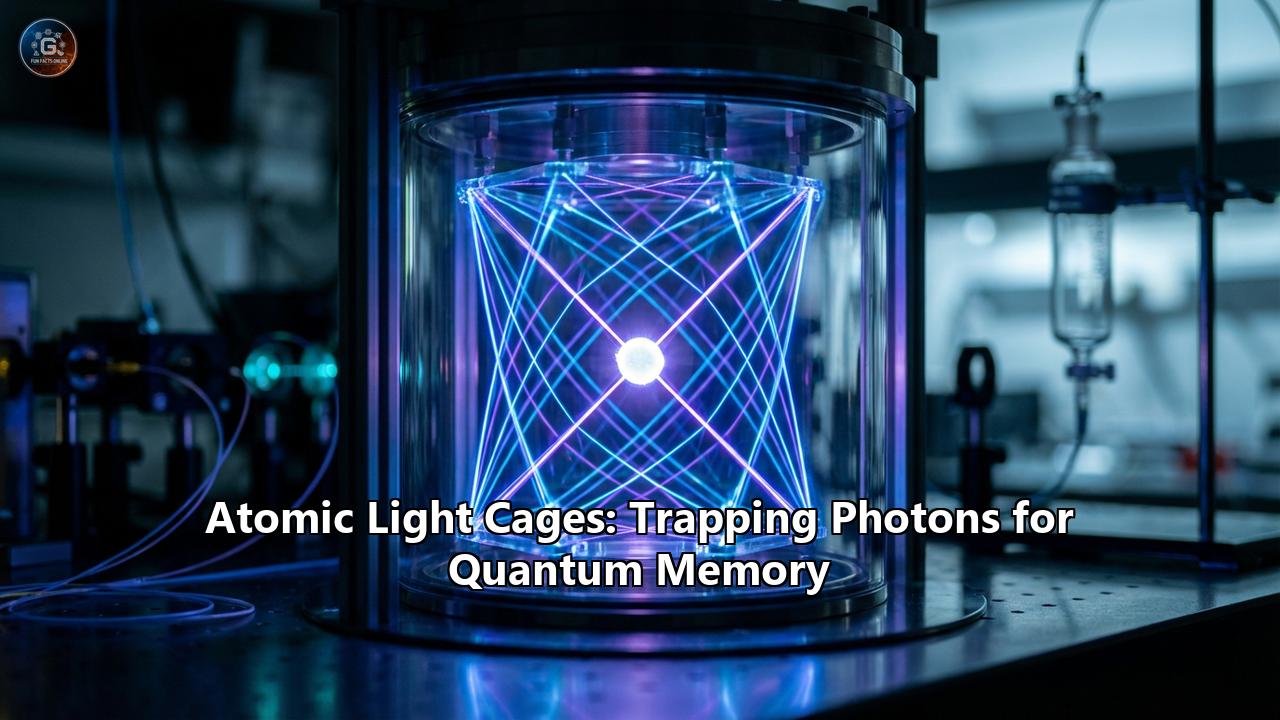
Enter the "Atomic Light Cage"—a revolutionary technology that merges the precision of 3D nanoprinting with the spooky physics of atomic vapors. These microscopic structures, smaller than a human hair, are not just trapping light; they are taming it, turning the fleeting flash of a photon into a stationary piece of information that can be stored, processed, and retrieved. This is the story of how humanity learned to bottle lightning, and why it might just be the key to the ultimate internet.
Part I: The Quantum Memory BottleneckTo understand why we need to trap photons, we must first understand the architecture of the future. The "Quantum Internet" is not merely a faster version of the web we use today; it is a fundamentally different system. Current networks transmit bits (0s and 1s) as pulses of light through fiber-optic cables. If a signal fades over a long distance, a "repeater" simply measures the pulse and blasts a fresh, strong copy down the line.
Quantum networks, however, transmit qubits—superpositions of 0 and 1 simultaneously. These qubits are carried by single photons. The laws of quantum mechanics (specifically the No-Cloning Theorem) forbid us from copying a qubit. If you try to measure it to copy it, you destroy the information instantly. This means standard repeaters are useless. If a photon carrying a quantum message dies after 100 kilometers of fiber, that message is gone forever.
The solution is the "Quantum Repeater," a device that doesn't copy the photon but instead uses a phenomenon called entanglement swapping to teleport the information to the next node. But for this to work, the repeater needs to wait. It has to catch a photon from Node A, hold it, wait for a photon from Node B to arrive, and then perform a joint measurement.
"You can't synchronize events if you can't hold onto the participants," says Dr. Elena Rossi, a leading theorist in quantum optics. "Without quantum memory—a waiting room for light—a global quantum internet is impossible. We’d be limited to city-sized networks."
For decades, this "waiting room" required laboratories the size of squash courts, filled with supercooled magnets and high-power lasers. But recent breakthroughs have shrunk this technology onto a chip the size of a fingernail.
Part II: From Supercooled Clouds to Nanoprinted CagesThe dream of stopping light isn't new. In 1999, Danish physicist Lene Hau shocked the world when she successfully slowed a pulse of light to 17 meters per second—cycling speed—by passing it through a cloud of sodium atoms cooled to near absolute zero. By 2001, her team had stopped it completely.
While scientifically monumental, Hau's experiment required a Bose-Einstein Condensate (BEC), a state of matter that exists only at temperatures colder than deep space. It was a triumph of physics, but you couldn't put it inside a server rack, let alone a laptop.
The community then turned to "warm" atomic vapors—rubidium or cesium gases kept at room temperature or slightly heated. These atoms are naturally interactive with light, but containing them is tricky. If you put them in a glass tube, they bounce off the walls, losing their quantum coherence (the "memory") in micro-seconds.
This is where the Atomic Light Cage enters the narrative.
Developed through a collaboration of researchers including teams from the University of Stuttgart and Humboldt-Universität zu Berlin, the Light Cage is a marvel of hybrid engineering. Instead of a simple glass tube, they use a technique called "two-photon polymerization"—essentially high-resolution 3D printing with lasers—to build a microscopic scaffold directly onto a silicon chip.
The Cage Anatomy:Imagine a hexagonal tunnel. The walls of this tunnel are not solid glass but are made of delicate, longitudinal struts, like the bars of a prison cell, but thinner than a wavelength of light.
- The Core: The hollow center of the cage is where the magic happens. This is the "flyway" for the photons.
- The Atmosphere: This hollow core is filled with a vapor of alkali atoms (typically cesium).
- The Access: Unlike traditional hollow-core fibers, which are long tubes that take months to fill with gas from the ends, the Light Cage’s "barred" design allows gas to diffuse in from the sides almost instantly.
"The structure allows us to confine light tightly in the core, forcing it to interact with the atoms, while simultaneously letting the atoms refresh themselves by diffusing in and out through the bars," explains a lead author of a seminal 2026 study on the technology. "It’s a perfect Goldilocks zone: tight confinement for the light, open freedom for the atoms."
Part III: How to Stop a Photon (The Physics of EIT)So, you have a nanoprinted cage filled with cesium atoms. How does this actually stop light? You can’t just close a door; the photon would smash into it. You have to turn the medium transparent and sticky at the same time.
The mechanism is known as Electromagnetically Induced Transparency (EIT). It is a quantum magic trick involving three ingredients:
- The Signal Photon: The carrier of information (the "passenger").
- The Control Laser: A strong, constant beam that acts as the "traffic controller."
- The Three-Level Atom: The cesium atoms in the cage are tuned to have three specific energy levels (Ground, Excited, and Storage).
- Transparency: Normally, if you shine the Signal Photon at the cesium gas, the atoms would absorb it, destroying the data. However, when the Control Laser is on, it creates a quantum interference pattern that prevents the atoms from absorbing the Signal Photon. The gas, usually opaque, becomes transparent.
- Slowing Down: As the Signal Photon enters this "transparent" gas, it drastically slows down. It is no longer a pure photon; it becomes a "Dark-State Polariton." Think of this as the photon turning into a ghost. It is a hybrid wave, part light and part atomic spin. As it moves through the cage, it is constantly mapping its information onto the atoms and back again.
- The Trap: To stop the light, the physicists simply turn off the Control Laser while the pulse is inside the cage.
Click. The Control beam vanishes.
The transparency window closes.
But the photon doesn't get absorbed and lost. Because of the quantum state it was in, the energy and information of the photon are fully transferred into the spin coherence of the atomic gas.
The light is gone. The cage is dark. But the information is imprinted on the stationary atoms, frozen in the "Storage" energy level.
- The Retrieval: A microsecond, or even a millisecond later—an eternity in computer time—the physicists switch the Control Laser back on.
Click.
The atomic spins re-emit their energy.
The Dark-State Polariton re-materializes as a photon.
The light pulse exits the cage, continuing its journey as if nothing had happened, retaining its original phase and quantum information.
Part IV: The "Light Cage" AdvantageWhy is the "Atomic Light Cage" specifically generating such excitement in the 2024-2026 timeline compared to other methods?
1. Integration and Scalability:Previous memories were discrete components. You had a laser table, a vacuum cell, and optics. The Light Cage is chip-integrated. You can print dozens of these cages on a single silicon wafer. This allows for "multiplexing"—storing multiple photons in parallel lines, drastically increasing the bandwidth of a quantum network.
2. The "Wall" Problem:In standard hollow fibers, atoms crash into the inner walls of the fiber constantly. When a spin-polarized atom hits a glass wall, it usually flips its spin, erasing the memory (decoherence).
The Light Cage uses a "negative curvature" design. The shape of the bars is mathematically designed to minimize the optical mode's overlap with the solid material. Furthermore, researchers coat the cage struts with anti-relaxation coatings (like paraffin) or use specific "buffer gases" that allow atoms to bounce off walls without losing their quantum state.
3. Filling Speed:Hollow-core fibers are notoriously difficult to fill with atomic vapor; it can take weeks for cesium atoms to diffuse down a hair-thin tube. The Light Cage’s porous side-walls allow the chip to be placed in a vacuum chamber and filled with cesium vapor in seconds. This makes manufacturing practical, not just theoretical.
Part V: The Competition (Crystals and Sound)Atomic Light Cages are not the only contender for quantum memory.
- Rare-Earth Crystals: Teams have had great success using crystals doped with ions like Praseodymium or Europium. These are solid-state and stable. However, they often require cryogenics (liquid helium cooling) to work, making them expensive and bulky to deploy in remote repeater stations.
- Acoustic Memory: A recent breakthrough (notably from Caltech) involves converting quantum information from superconducting qubits into sound waves (phonons) to store them. This is brilliant for superconducting quantum computers but less ideal for the quantum internet, which runs on light. Converting light to sound and back is lossy.
The Atomic Light Cage sits in a "sweet spot": it operates at or near room temperature (warm vapor), it interacts directly with the optical photons used in communication networks, and it is compact enough to be mass-produced.
Part VI: The Future of the Trapped PhotonThe implications of robust Atomic Light Cages extend far beyond just a "better internet."
Synchronization of Quantum Processors:Future quantum computers will likely be modular—clusters of smaller chips linked together. To calculate a joint problem, Chip A and Chip B need to share entanglement. Light Cages can act as the buffers that align these interactions, correcting for the time-of-flight delays between chips.
Blind Quantum Computing:With functional memory, we can enable "blind" computing, where a user sends a task to a cloud quantum server. The server processes the qubits without ever knowing what the data is, because the state is manipulated while stored in memory.
Fundamental Physics:These cages also allow us to study light-matter interaction in unprecedented detail. By trapping light in such confined geometries, we can induce "nonlinear" interactions where individual photons bounce off each other—something impossible in free space. This could lead to "photonic logic gates," where light controls light, removing the need for electronics entirely in some processing steps.
The Road AheadChallenges remain. The storage time in these cages (currently in the range of microseconds to milliseconds) needs to be extended to seconds for long-distance repeaters. The efficiency (how many photons you get out vs. how many you put in) hovers around 20-50% in experimental setups and needs to push toward 90%+.
However, the trajectory is clear. The transition from massive optical tables to 3D-printed nanostructures marks the maturation of quantum technology. We are moving from the era of "discovery" to the era of "engineering."
ConclusionFor centuries, light was the symbol of the ephemeral—here and gone in an instant. To catch a sunbeam was a poetic impossibility. Today, inside the microscopic, barred halls of Atomic Light Cages, that poetry has become engineering. By building prisons for photons, we are unlocking the freedom to communicate instantaneously, securely, and powerfully across the globe. The light is no longer just running; it is waiting for our command.
Reference:
- https://cmns.umd.edu/news-events/news/two-light-trapping-techniques-combine-best-both-worlds
- https://www.cnet.com/tech/tech-industry/stopping-light-could-lead-to-quantum-advance-in-computing/
- https://medium.com/@samt68432/pause-play-repeat-the-wild-science-of-stopping-light-9c1e931d092b
- https://scitechdaily.com/3d-printed-light-cages-could-solve-one-of-quantum-networkings-biggest-problems/
- https://www.sciencedaily.com/releases/2026/01/260106001907.htm
- https://arxiv.org/html/2503.22423v1
- https://pmc.ncbi.nlm.nih.gov/articles/PMC5562294/
- https://validate.perfdrive.com/?ssa=fe68ee55-9433-be19-369d-1ef38cb3697d&ssb=85369223884&ssc=https%3A%2F%2Fopg.optica.org&ssi=7644af09-d3hy-5322-7528-97a5cf7febf5&ssk=botmanager_support@radware.com&ssm=77517075844682400133048091603084&ssn=eb3974dcda97dafabf9338b805ddeeae682d1ce5fb0e-c80f-b637-31d437&sso=d366337-39c8-aaa9683d16257435e211ba40b5d5449ca4cc96a3b869447e&ssp=63538027971767866181176786492617283&ssq=87920903343366346735433431136074666395778&ssr=MTI0LjIxNy4xODkuMTE5&sst=python-requests%2F2.32.3&ssv=&ssw=
- https://arxiv.org/abs/1605.08519
- https://serious-science.org/slow-and-stopped-light-436
- https://projects.research-and-innovation.ec.europa.eu/en/horizon-magazine/scientists-stop-light-minute-breaking-records
- https://bioengineer.org/storing-light-in-cages-enables-scalable-quantum-memories/
- https://www.sciencedaily.com/releases/2025/08/250827234137.htm
- https://quantumcomputingreport.com/news/