
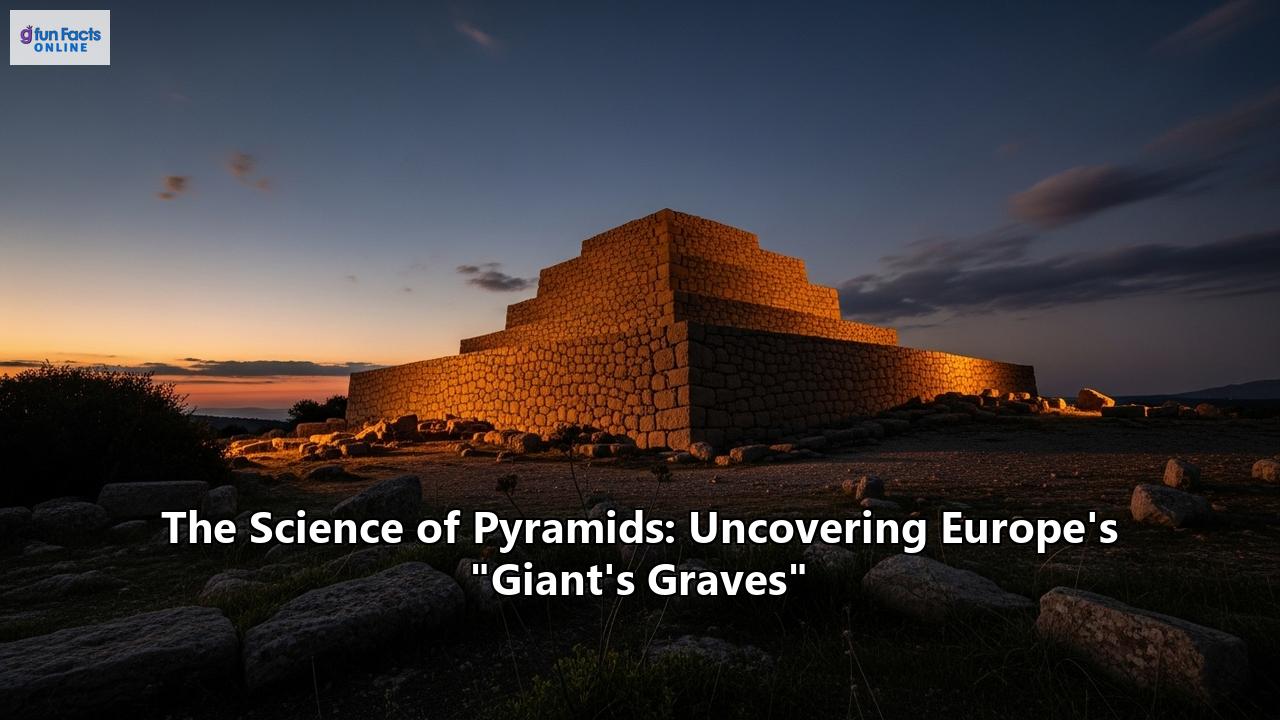
The Science of Pyramids: Uncovering Europe's "Giant's Graves"
Nestled within the captivating landscapes of Europe, from the sun-drenched shores of the Mediterranean to the rugged northern isles, lie ancient and enigmatic structures that have long stirred the human imagination. These are not the towering, smooth-sided pyramids of Egypt, but a different kind of monumental architecture, one that has earned the evocative moniker of "Giant's Graves." This name, a legacy of folklore, hints at a time when local populations, awestruck by the sheer scale of these constructions, attributed them to a mythical race of giants. Today, science offers a more grounded, yet no less fascinating, narrative. Through the meticulous work of archaeologists, the precision of modern dating techniques, and the insights of archaeo-astronomers, we are peeling back the layers of myth to reveal the true story of Europe's ancient builders and their monumental tombs.
Sardinia: The Land of the Giants' Tombs
The heartland of the "Giant's Graves" phenomenon is undoubtedly the Mediterranean island of Sardinia. Here, over 800 of these megalithic gallery graves, known locally as Tombe dei Giganti, are scattered across the landscape. These structures are the enduring legacy of the Nuragic civilization, a culture that flourished on Sardinia during the Bronze Age, from approximately 1800 BCE to the 2nd century BCE.
The Nuragic people were master builders, and their tombs are a testament to their architectural prowess and their profound reverence for the dead. These were not tombs for individuals, but collective burial sites, intended to house the remains of entire communities. This practice suggests a society that valued unity and collective identity, both in life and in death.
The name "Giant's Graves" stems from the colossal size of the stones used in their construction and the sheer scale of the tombs themselves, which can reach up to 30 meters in length. Local folklore, unable to comprehend how their ancestors could have erected such monuments, wove tales of giants. However, archaeological excavations have found no evidence of giant skeletons, only the remains of regular-sized people. The "giant" aspect of these tombs refers to their function as massive public burial chambers.
Architectural Marvels of the Nuragic CivilizationThe Tombe dei Giganti exhibit a remarkable and consistent architectural style. They typically consist of a long, rectangular burial chamber, often with an apse at the end, built with large stone slabs. This chamber, which could be up to 15 meters long and 2 meters high, was originally covered by a mound of earth and smaller stones, creating a tumulus that resembled an overturned ship.
The most distinctive feature of these tombs is the semi-circular ceremonial area, or exedra, at the entrance. This space, which symbolized the horns of a bull, a sacred figure in Nuragic culture, was used for rituals in honor of the deceased. In the older "slab type" tombs, a towering central stele, sometimes reaching up to 4 meters in height, stands at the center of the exedra. A small doorway carved into the base of the stele provided access to the burial chamber. Later tombs, known as the "block type," feature a more refined construction with rectangular-cut blocks arranged in regular rows.
The construction techniques employed by the Nuragic people were sophisticated. They used two primary methods for building the burial chambers: the orthostat technique, where large stones were placed upright in the ground with slabs laid on top to form a roof, and the isodomic structure, which involved arranging stones in regular horizontal rows that narrowed towards the top to create a triangular cross-section.
A Glimpse into Nuragic BeliefsThe Tombe dei Giganti offer invaluable insights into the spiritual world of the Nuragic people. These were not simply places to dispose of the dead; they were sacred spaces that connected the world of the living with the realm of the ancestors. The collective nature of the burials suggests a belief in a shared afterlife and a deep respect for ancestral lines.
It is believed that the Nuragic people performed complex funerary rites at these tombs. Evidence suggests that bodies were likely left to decompose before the bones were placed inside the tomb, a practice known as scarnification. The presence of funerary objects, such as pottery and tools, indicates a belief that the deceased would need these items in the afterlife.
Some researchers have proposed that the design of the tombs holds a deeper symbolic meaning. The shape of the tomb, when viewed from above, is thought to represent a bull's head or a birthing mother, linking the concepts of death and rebirth. This suggests a cyclical view of life and death, where the tomb was seen as a place of regeneration.
Furthermore, there is compelling evidence to suggest that the Nuragic people had a sophisticated understanding of astronomy and that this knowledge was integrated into the design of their tombs. Many Tombe dei Giganti are oriented towards specific celestial events, such as the sunrise during the solstices and equinoxes. The tomb of S'Ena e Thomes, for example, is aligned with the sunset during the summer solstice. Some researchers have even proposed that certain tombs are aligned with specific stars, such as Aldebaran in the Taurus constellation. This suggests that the Nuragic people saw a connection between the cosmos and the journey of the soul after death.
There are also intriguing, though less scientifically proven, theories about the placement of these tombs. Some researchers claim that the Tombe dei Giganti were built on specific locations with high levels of natural magnetic energy, and that the granite used in their construction has therapeutic properties. While these ideas are not universally accepted, they speak to the enduring mystery and allure of these ancient sites.
Beyond Sardinia: Megalithic Tombs Across Europe
While Sardinia is the epicenter of the "Giant's Graves" phenomenon, similar megalithic tombs can be found throughout Europe, from the British Isles to the Iberian Peninsula and beyond. These structures, which predate the Sardinian tombs in many cases, share some common characteristics, suggesting a shared tradition of monumental tomb building in prehistoric Europe.
In the British Isles, for example, we find a rich variety of megalithic tombs, including the dolmens of Wales and the chambered tombs of Ireland and Scotland. These structures, like their Sardinian counterparts, were used for collective burials and were often covered by a mound of earth or stone. One of the most famous examples is Newgrange in Ireland, a massive passage tomb that is older than the Egyptian pyramids. Its central chamber is illuminated by the rising sun on the winter solstice, a testament to the astronomical knowledge of its builders.
In France, the Carnac stones, a dense collection of megalithic sites, include several types of tombs. The Tumulus of Saint-Michel, for example, is a massive burial mound that contains a central chamber. The allées couvertes, or covered alleys, found throughout France, are long, narrow tombs that are similar in form to the burial chambers of the Sardinian Tombe dei Giganti.
The Iberian Peninsula is also home to a wealth of megalithic tombs. The Cromeleque dos Almendres in Portugal, a large stone circle, is associated with several nearby tombs. In Spain, the Dolmen of Menga, a massive passage grave, is one of the largest megalithic structures in Europe.
These examples demonstrate that the practice of building monumental tombs was widespread in prehistoric Europe. While each region developed its own unique architectural styles, the underlying purpose of these structures was the same: to create a lasting memorial for the dead and to connect the world of the living with the realm of the ancestors.
The "Pyramid" Controversy: Separating Fact from Fiction
The allure of ancient mysteries has also given rise to more controversial claims about European "pyramids." The most famous of these is the so-called "Bosnian pyramid" complex, located near the town of Visoko in Bosnia and Herzegovina. In 2005, author and businessman Semir Osmanagić claimed that a group of hills in the area were actually man-made pyramids, the largest and oldest in the world.
This claim has been widely debunked by the scientific community. Geologists have concluded that the hills are natural formations known as "flatirons," and archaeologists have found no evidence of human construction on the scale proposed by Osmanagić. The European Association of Archaeologists has condemned the "Bosnian pyramid" project as a "cruel hoax" that is damaging legitimate archaeological sites in the area.
Despite the lack of scientific evidence, the "Bosnian pyramid" theory has gained a popular following, attracting tourists and volunteers to the site. This phenomenon highlights the public's fascination with ancient monuments and the enduring appeal of fringe theories. However, it is crucial to distinguish between evidence-based archaeology and pseudoscientific claims.
The Science of Uncovering the Past
The study of Europe's "Giant's Graves" and other megalithic tombs is a multidisciplinary endeavor that relies on a wide range of scientific techniques. Archaeologists use excavation and survey methods to uncover the physical remains of these structures and the artifacts they contain. Ground-penetrating radar and other remote sensing technologies allow researchers to "see" beneath the surface of the earth without disturbing the site.
Dating techniques are essential for establishing the age of these monuments. Radiocarbon dating of organic materials found in the tombs, such as bones and charcoal, provides a timeline for their construction and use. Optically stimulated luminescence (OSL) dating can be used to determine when sediments were last exposed to sunlight, which can help to date the construction of the tomb itself.
Archaeo-astronomy, the study of how ancient peoples understood and used the sky, has provided fascinating insights into the alignment of these tombs. By mapping the orientation of the tombs and comparing it to the positions of celestial bodies in the past, researchers can uncover the astronomical knowledge of their builders.
Conclusion: A Legacy in Stone
Europe's "Giant's Graves" are more than just ancient piles of stones. They are a testament to the ingenuity, creativity, and spiritual beliefs of the continent's prehistoric inhabitants. Through the lens of science, we can begin to understand the complex societies that built these monuments and the profound meaning they held for them.
From the sun-drenched shores of Sardinia to the misty landscapes of the British Isles, these megalithic tombs stand as a silent and enduring legacy of a shared European heritage. They remind us that the desire to commemorate the dead, to connect with the cosmos, and to build for eternity is a fundamental part of the human story. As scientific research continues to unlock their secrets, these "Giant's Graves" will undoubtedly continue to captivate and inspire for generations to come.
Reference:
- https://en.wikipedia.org/wiki/Giants%27_grave
- https://archaeologymag.com/encyclopedia/giants-tomb/
- https://www.sopranovillas.com/attractions/giants-tomb-nuragic-civilization/
- https://www.ancient-origins.net/news-ancient-places-europe/mysteries-coddu-vecchiu-tombs-giants-002487
- https://archaeology-travel.com/thematic-guides/nuragic-civilisation/giants-tombs-of-sardinia/
- https://it.wikipedia.org/wiki/Tomba_dei_giganti
- https://meandsardinia.it/le-tombe-dei-giganti-case-di-orchi-e-sepolture-ciclopiche/
- https://vcorner.medium.com/the-enigma-of-sardinias-giants-graves-a-glimpse-into-ancient-mysteries-df7492545879
- https://www.ancient-origins.net/history-ancient-traditions/nuragic-sardinia-004841
- https://www.hotelgabbianoazzurro.com/en/Blog/Tombs-of-the-Giants
- https://www.youtube.com/watch?v=e4lyiPekntg