
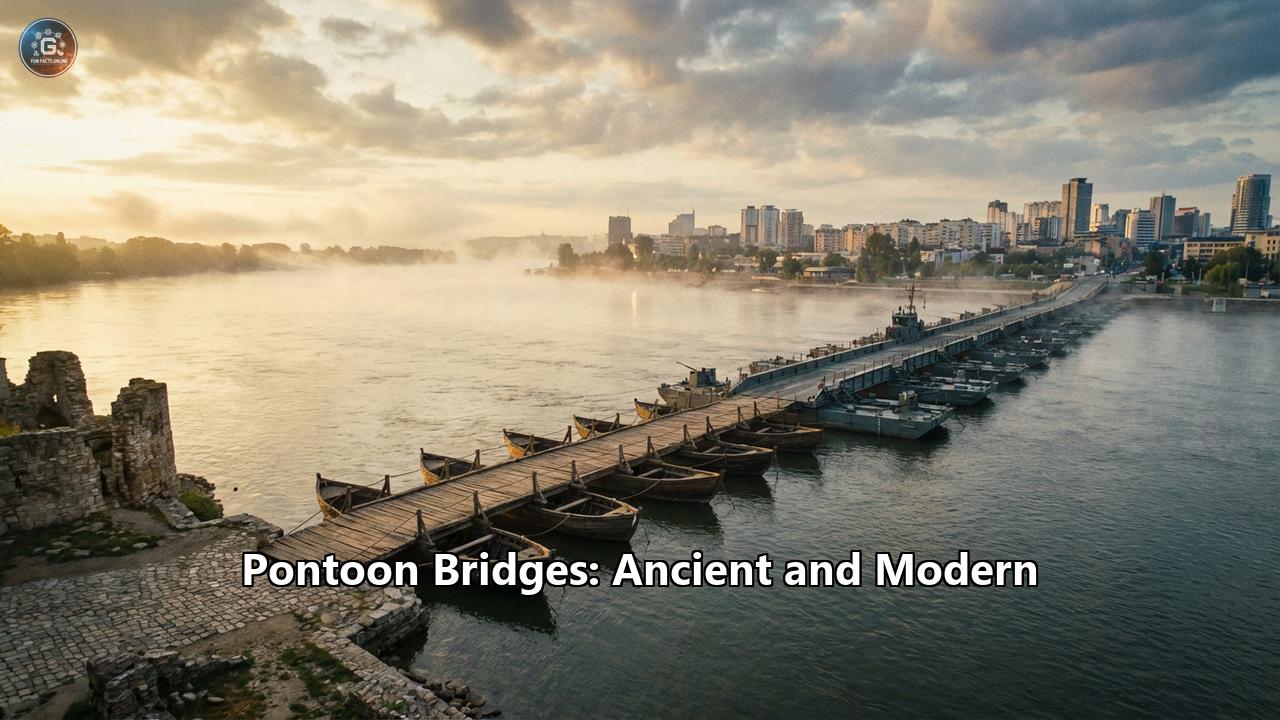
One of the most primal challenges humanity has faced since the dawn of migration is the barrier of water. Rivers, lakes, and straits have dictated the movement of tribes, the borders of empires, and the flow of trade for millennia. While the dugout canoe and the raft offered a way to travel on the water, the desire to walk across it—to march armies, drive caravans, and connect lands without the delay of ferrying—birthed one of the most ingenious and resilient forms of engineering: the pontoon bridge.
From the audacity of ancient kings who lashed ships together to defy the gods, to the concrete leviathans that carry thousands of commuters across deep lakes today, the story of the pontoon bridge is a testament to human adaptability. It is a narrative of skins stuffed with straw, of steel ribbons unfolding under fire, and of floating highways that rise and fall with the tides.
Part I: The Ancient World – Defying the Water Gods
The concept of the pontoon bridge is deceptively simple: if you cannot sink a pile into the deep mud or build an arch wide enough to span the flood, you must float your road. This idea likely emerged independently in various cultures, born of the necessity of war and migration.
The Chinese Origins
While Western history often focuses on the exploits of Greeks and Persians, the earliest recorded use of pontoon bridges comes from ancient China. Historical texts from the Zhou Dynasty (c. 11th century BC) mention the floating bridge as a critical military tool. The Chinese character for "pontoon" appears in the Shi Jing (Book of Odes), referencing King Wen of Zhou’s use of boats lashed together to cross the Wei River.
Unlike the temporary military bridges of the West, China was a pioneer in creating permanent floating structures. The Yellow River, with its shifting silt beds and violent floods, made permanent stone piers nearly impossible to construct with ancient technology. The solution was the Pujin Bridge, a floating masterpiece anchored by massive iron oxen on the banks. These iron figures, cast during the Tang Dynasty, were not mere decoration; they served as heavy, immovable anchors to hold the bamboo cables that secured the line of boats against the river's fury.
Xerxes and the Whipping of the Hellespont
Perhaps the most famous—and dramatic—story of a pontoon bridge comes from the Greco-Persian Wars. In 480 BC, the Persian King Xerxes I sought to invade Greece with an army of unprecedented size. Standing in his way was the Hellespont (the modern Dardanelles), a strait separating Asia from Europe, roughly a mile wide with strong, treacherous currents.
Xerxes ordered his engineers, likely Egyptians and Phoenicians, to bridge the strait. They constructed two massive bridges using penteconters and triremes—ships of war and transport—lashed together by the hundreds. However, just as the work was completed, a violent storm shattered the structures.
In a display of hubris that has echoed through history, Xerxes was enraged. He ordered the Hellespont itself to be punished. He commanded his men to give the water 300 lashes with whips, to throw shackles into the depths, and to brand the sea with hot irons. "You salt and bitter stream," his executioners chanted, "your master lays this punishment upon you for injuring him, who never injured you."
After the "execution" of the water (and the very real execution of the unfortunate engineers), a second attempt was made. This time, the engineering was flawless. Two bridges were constructed, one consisting of 360 ships and the other of 314. They were anchored with heavy stones to resist the current and the winds. Huge cables of flax and papyrus, weighing tons, were stretched across the ships. Planks were laid, covered with brush and earth to create a road, and high screens were erected on the sides so the horses and camels would not be spooked by the sight of the rushing water.
For seven days and seven nights, the Great Army of Persia marched across the floating spine of ships, a dry road on the open sea. It was a logistical miracle that terrified the Greeks, symbolizing an empire that could bend nature to its will.
Rome: The Bridge of Madness?
The Romans, the master builders of antiquity, usually preferred the permanence of stone and timber piles. Julius Caesar’s pile bridge across the Rhine is a legendary feat of rapid construction. However, they too utilized the pontoon. The most notorious Roman example was built by Emperor Caligula in 39 AD.
According to the historian Suetonius, Caligula built a floating bridge stretching over two miles across the Bay of Baiae, from Baiae to Puteoli. The purpose was not strategic, but spiteful. A soothsayer had once prophesied that Caligula had "no more chance of becoming emperor than of riding a horse across the Gulf of Baiae."
To prove the prophecy wrong, Caligula impounded a massive portion of the Roman merchant fleet, disrupting grain imports and threatening famine. He lashed the ships together, covered them with earth, and built a road. Dressed in the breastplate of Alexander the Great, he rode his horse across the bridge, leading a procession of soldiers and staging a mock triumph. For two days, he partied on the water, lighting the bridge with torches so it shone like a second sun. While often dismissed as the act of a madman, modern historians also view it as a demonstration of absolute power and engineering capability—a message to the world that Rome could walk on the sea whenever it chose.
Part II: The Evolution of Military Bridging
As the ancient world gave way to the medieval, the art of the pontoon bridge was preserved primarily by military engineers. A river was the ultimate defensive line; the ability to cross it swiftly was the key to offensive warfare.
The Middle Ages to Napoleon
During the Middle Ages, armies often relied on seizing local barges to construct ad-hoc bridges. However, the lack of standardization meant that a bridge could only be built as fast as boats could be stolen.
It was in the 17th and 18th centuries that the pontoon train became a standard unit of European armies. The French and the Dutch, dealing with the waterlogged terrain of the Low Countries, refined the design. They moved away from heavy wooden boats to purpose-built pontoons made of copper or tin. These were lighter, could be stacked on wagons, and were uniform in size.
Napoleon Bonaparte, a former artillery officer, understood the value of speed. His pontonniers were elite troops. During the disastrous retreat from Russia in 1812, the survival of the remnants of the Grande Armée hinged on a pontoon bridge. At the Berezina River, facing freezing waters and Russian encirclement, Dutch pontonniers under General Éblé worked in the icy water, building trestle and pontoon bridges. Many of the engineers died of hypothermia, but their sacrifice allowed the Emperor and the core of his army to escape.
The American Civil War: The Rubber Experiment
The American Civil War saw the industrialization of the pontoon bridge. The Union Army, needing to invade the South across the numerous rivers of Virginia, developed highly efficient pontoon trains.
Interestingly, the U.S. Army experimented with pneumatic technology long before it became common. They utilized "india-rubber" pontoons—inflatable rubber torpedoes that were lightweight and easy to transport. However, they proved less durable than the wooden and canvas boats. The wooden boats were heavy but reliable.
The Battle of Fredericksburg in 1862 highlighted the critical—and dangerous—nature of this work. Union engineers attempted to bridge the Rappahannock River under direct fire from Confederate sharpshooters. It was a suicide mission. The bridge builders would row out, lash a boat, and be picked off. Eventually, the Union infantry had to conduct an amphibious assault in the pontoons themselves to clear the opposite bank, marking one of the first contested river crossings in modern history.
The World Wars: Steel and Speed
By the 20th century, the pace of war had accelerated. Tanks and heavy trucks required bridges that could support massive loads.
The Bailey Bridge: While often used as a fixed truss bridge, the genius of the British Bailey Bridge design was its modularity. It could be supported by pontoons to span wide rivers. It was the "Lego set" of the war, enabling Allied advances across the rivers of Italy and France. The Treadway and M4 Bridges: The US Army developed steel treadway bridges, where two steel tracks were laid over pneumatic floats. This allowed tanks to cross without a full deck, saving weight and assembly time. The Rhine Crossings: In the closing months of World War II, the Rhine River was the last barrier to the heart of Germany. When the Ludendorff Bridge at Remagen collapsed, the Allies deployed massive floating bridges. The sheer speed was staggering; entire divisions could cross a major European river in hours, supported by a line of steel and rubber floating on the current.Part III: The Science of Floating
To understand how a bridge can carry a 70-ton tank or a rush-hour traffic jam while floating on water, one must delve into the physics of buoyancy and structural dynamics.
Archimedes and the Concrete Boat
The fundamental principle is simple: Archimedes’ Principle. An object submerged in a fluid is buoyed up by a force equal to the weight of the fluid it displaces. A pontoon bridge does not "rest" on the water; it displaces it.
The most counterintuitive material used in modern floating bridges is concrete. To the layperson, concrete sinks. But a hollow concrete box, if large enough, displaces a volume of water that weighs far more than the concrete itself. This reserve buoyancy allows it to float high in the water. Concrete is preferred for permanent floating bridges because it is durable, resistant to saltwater corrosion (unlike steel), and its immense mass provides inertia, dampening the movement of the waves.
The Anchor System
A floating bridge is essentially a giant ship that must never sail. The biggest enemy is not the weight of the cars, but the wind and the waves.
- The Fetch: Engineers calculate the "fetch"—the distance wind travels across open water to hit the bridge. A long fetch generates high waves.
- The Cables: Modern floating bridges are held in place by massive steel cables roughly 3 inches thick. These are attached to anchors buried deep in the lakebed. These anchors can be gravity anchors (giant concrete blocks) or fluke anchors that dig into the mud.
- Tension: The bridge is in a constant tug-of-war. The cables are tightened to hundreds of thousands of pounds of tension to keep the bridge straight. If the water level of the lake rises or falls, the cables must be adjusted, or the bridge must have hydraulic systems to compensate.
The Dynamic Spine
A fixed bridge is rigid. A floating bridge is a living thing. It "breathes" with the lake. It creates a continuous elastic beam. When a heavy truck drives over a pontoon, that pontoon sinks slightly, and the load is shared by the neighboring pontoons. The joints between the pontoons are critical; they must be strong enough to transfer the load but flexible enough (in some designs) or rigid enough (in others) to maintain the road surface. In severe storms, a floating bridge can snake and twist. If the frequency of the waves matches the natural frequency of the bridge structure, the resonance can be catastrophic (similar to the Tacoma Narrows Bridge, but on water).
Part IV: The Seattle Phenomenon – Capital of the Floating Bridge
If you want to see the pinnacle of floating bridge technology, you go to Seattle, Washington. The geography of the region created a perfect storm for this specific type of engineering. Lake Washington separates the city of Seattle from its eastern suburbs (Bellevue, Redmond). The lake is deep—over 200 feet in places—and the bottom is a thick slurry of soft silt that makes driving piles prohibitively expensive and difficult.
Faced with a need to move commuters and a geography that rejected suspension bridges (due to the cost of the towers and anchorages), engineer Homer Hadley proposed a radical idea in the 1930s: a bridge made of concrete barges.
The Lacey V. Murrow Bridge
Opened in 1940, this was the first concrete floating bridge. It was a marvel. It consisted of a series of concrete pontoons bolted together. It proved that a floating highway could be stable, safe, and durable. However, it also taught a hard lesson in maintenance. In 1990, during a renovation, water accumulated in the pontoons due to a series of errors (hatches left open during a storm). The bridge slowly filled with water, flipped over, and sank to the bottom of the lake in slow motion. It was a stark reminder that buoyancy is a finite resource.
The SR 520 (Evergreen Point) Bridge
The successor to the original spans is the new SR 520 bridge, the longest floating bridge in the world at 7,710 feet. Opened in 2016 to replace an aging 1963 structure, it is a beast of engineering.
- The Pontoons: It sits on 77 massive concrete pontoons. The largest are 360 feet long, 75 feet wide, and nearly 30 feet tall.
- The Elevated Deck: Unlike the old bridges, where the road sat directly on the pontoons (leaving drivers staring at waves splashing their windshields), the new bridge features a deck elevated 20 feet above the water. This allows waves to pass harmlessly underneath the roadway during storms.
- Earthquake Proofing: Despite floating, the bridge is vulnerable to earthquakes, which can cause "seiches" (standing waves in an enclosed body of water) and liquefy the lakebed anchors. The new bridge is designed to withstand a 1,000-year seismic event.
The Homer Hadley Bridge
Parallel to the replaced Lacey V. Murrow, this bridge carries the I-90 freeway. It is currently the site of another world-first: Light Rail on a Floating Bridge.
Putting a train on a floating bridge is an engineering nightmare. Trains require rigid, perfectly aligned tracks. Floating bridges move with the wind, waves, and traffic weight. The Sound Transit engineers had to invent a "track bridge"—a complex system of bearings and plates that allows the rails to curve and flex as the bridge moves between the fixed land and the floating section, all while keeping the steel rails safe for a train moving at 55 mph.
Part V: Modern Military Dominance – The Ribbon Bridge
While civilians build concrete giants, the military has perfected the art of the temporary. The modern gold standard is the Improved Ribbon Bridge (IRB) used by the US Army and NATO allies.
Gone are the days of rowing wooden boats. The IRB system is carried on heavy trucks (HEMTTs). When the truck backs up to the water, it releases a folded bay. The bay hits the water and automatically unfolds like a massive accordion, popping open into a flat section of bridge.
- Speed: A team of engineers can assemble a 100-meter bridge in under 30 minutes.
- Propulsion: Tiny, powerful boats called Bridge Erection Boats (BEBs) zip around, pushing the bays into place where they are latched together.
- Amphibious Rigs: Vehicles like the M3 Amphibious Rig are even more self-sufficient. They are essentially large trucks that drive into the water, inflate side pontoons, and turn into ferries. Multiple M3s can drive into a river, link up side-by-side, and form a bridge in minutes without a single soldier touching the ground.
This technology allows modern armored divisions to treat rivers as speed bumps rather than walls. It was used extensively in the Iraq War to cross the Tigris and Euphrates, maintaining the momentum of the invasion.
Part VI: Global Giants and Unique Designs
Seattle doesn't have a monopoly on floating bridges. The specific problem of "deep water + soft bottom" exists elsewhere, leading to unique solutions.
The Nordhordland Bridge (Norway)
Norway's coastline is fractured by deep fjords. The Nordhordland Bridge is a hybrid. It combines a cable-stayed section for ship navigation with a long floating section. Because the fjord is 500 meters deep, the floating section is not anchored to the bottom along its length. Instead, it curves in an arch. The geometry of the arch transfers the wind and current forces to the shore abutments, functioning like a horizontal arch bridge.
The Yumemai Bridge (Japan)
Located in Osaka, this is a floating swing bridge. It can pivot to allow large ships to pass. It is built on massive hollow steel pontoons. The engineering challenge here is the "swing." Moving a floating structure against the resistance of water requires immense power and precise control of the center of buoyancy.
The Demerara Harbour Bridge (Guyana)
One of the longest floating bridges in the world (over a mile long), it is vital for the country's infrastructure. Unlike the high-tech concrete of Seattle, this bridge uses steel pontoons and has a retractor span to let bauxite ships pass. It is a lifeline, but also a maintenance challenge, constantly battling the corrosive tropical river water and the heavy loads of industrial trucks.
Part VII: Challenges and Vulnerabilities
For all their ingenuity, floating bridges are high-maintenance beasts.
1. Corrosion: Water, especially saltwater, is the enemy of steel and concrete reinforcement. The pontoons must be constantly inspected for leaks. Modern bridges use cathodic protection systems (sending a small electrical current through the metal) to prevent rust. 2. The Sinking Risk: As seen with the Lacey V. Murrow, a floating bridge is one failure away from becoming a submarine. Watertight compartments are essential. Modern designs use cellular construction—honeycombs of hundreds of small watertight rooms. If one is breached, the others keep the bridge afloat. 3. Traffic Weight: On a normal bridge, the ground pushes back. On a floating bridge, the water pushes back. If you pack a floating bridge with bumper-to-bumper heavy trucks, it sinks lower. Engineers must strictly limit the "live load." 4. Environmental Impact: Floating bridges block sunlight from reaching the water below, which can affect fish migration (like Salmon in the Pacific Northwest). They also act as physical barriers to marine life. New designs incorporate "fish windows"—glass blocks or grates—or raise the structure higher to allow light penetration.Part VIII: The Future – Floating Cities and Submerged Tunnels
The evolution of the pontoon bridge is pointing toward a future where we live with the water, rather than just crossing it.
The Archimedes Bridge (Submerged Floating Tunnel)
Norway is currently researching the "Submerged Floating Tunnel" (SFT) to cross its widest, deepest fjords (like the Sognefjord, which is 4,000 feet deep). An SFT is essentially a pipeline for cars, floating 100 feet below the surface of the water, held up by buoyancy and held down by cables. It avoids surface storms and doesn't block ship traffic. It is the logical inversion of the pontoon bridge—using the same principles of buoyancy but submerged.
Climate Resilience
As sea levels rise, traditional fixed infrastructure in coastal cities is at risk. The technology of the pontoon bridge—concrete foundations that rise with the water—is being adapted for floating buildings, runways, and even entire neighborhoods. The "floating city" concepts proposed for places like the Maldives or South Korea rely on the engineering data gathered from decades of floating bridge maintenance.
Conclusion: The Bridge That Breathes
The pontoon bridge is more than just a piece of infrastructure; it is a paradox. It is heavy yet light, rigid yet flexible, permanent yet movable. It represents a specific kind of human genius: the ability to work with nature’s forces rather than just overpowering them.
From the lashed boats of Xerxes that groaned under the weight of Persian chariots to the high-tech concrete ribbons of Seattle that carry light rail trains over 200 feet of water, the lineage is unbroken. We are a species that refuses to stop at the water's edge. When the river is too wide, and the bottom is too deep, we do not turn back. We build a boat, and then another, and then another, until we have built a road to the other side.
Reference:
- https://www.aanavandi.com/blog/pontoon-bridge-one-of-the-great-military-engineering-trick/
- https://www.amusingplanet.com/2017/01/the-floating-bridges-of-seattle.html
- https://www.thortech.co.uk/bridges/pontoon-bridges-through-history/
- https://pontoon-depot.com/blogs/news/pontoon-boats-have-been-around-for-centuries-pontoon-depot
- https://www.designingbuildings.co.uk/wiki/Pontoon_bridge
- http://www.wadehamptoncamp.org/pontoon.html
- https://grokipedia.com/page/Xerxes'_pontoon_bridges
- https://en.wikipedia.org/wiki/Xerxes%27_pontoon_bridges
- https://www.ancient-origins.net/history/roman-emperor-caligula-and-floating-bridge-baiae-002452
- https://www.thortech.co.uk/bridges/history-of-the-pontoon-bridge/
- https://www.youtube.com/watch?v=SQK_yZWUySw
- https://edubilla.com/invention/pontoon-bridge/
- https://www.baileybridgesolution.com/how-does-floating-bridge-work.html
- https://www.youtube.com/watch?v=x0ZzrJuxm7E
- https://www.youtube.com/watch?v=nol0_4qxzb0
- https://www.hiseadock.com/how-do-floating-bridges-work/
- http://www.worldrecordacademy.org/2024/5/worlds-longest-floating-bridge-world-record-in-seattle-washington-424276
- https://www.youtube.com/watch?v=kIJC0QSt6fo
- http://freeit.free.fr/Bridge%20Engineering%20HandBook/ch22.pdf
- https://www.wsp.com/en-us/projects/sr520-evergreen-point-floating-bridge
- https://grokipedia.com/page/Pontoon_bridge
- https://en.wikipedia.org/wiki/Pontoon_bridge
- https://www.youtube.com/watch?v=qqYgzt-01pE
- https://www.ijraset.com/research-paper/floating-bridges-a-comprehensive-historical-review
- https://grokipedia.com/page/List_of_pontoon_bridges
- https://www.baileybridgesolution.com/what-is-a-floating-bridge.html
- https://www.youtube.com/watch?v=Eh_wcV8XBN4