
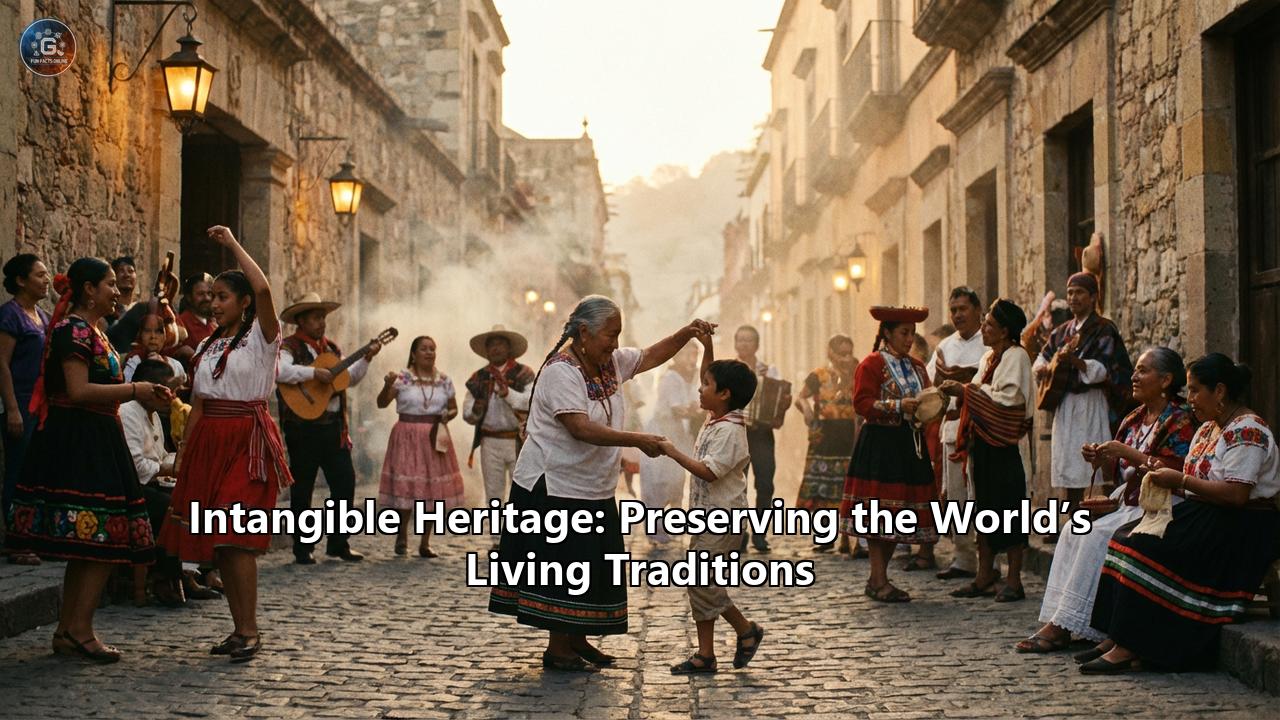
The aroma of a freshly baked French baguette, the rhythmic thrum of the Royal Drummers of Burundi, the haunting whistle of a shepherd across a Canary Island valley, and the communal warmth of a Singaporean hawker center. At first glance, these things seem unrelated. One is food, another music, the third a language, and the last a social space. Yet, they all share a profound commonality: they are Intangible Cultural Heritage (ICH).
While the Great Pyramids and the Taj Mahal stand as frozen testaments to human history, intangible heritage is the living soul of humanity. It is not built of stone or mortar; it is built of memory, practice, spirit, and breath. It is the wealth of knowledge and skills that is transmitted from one generation to the next.
This comprehensive guide explores the fascinating world of intangible heritage, taking you on a journey through its definition, its vibrant expressions across the globe, the existential threats it faces, and the heroic efforts being made to save these "living treasures" from extinction.
Part 1: Beyond Stones and Monuments—What is Intangible Heritage?
For decades, the world focused on preserving "Tangible Heritage"—the physical sites, monuments, and artifacts that we could touch. But in 2003, the United Nations Educational, Scientific and Cultural Organization (UNESCO) adopted a groundbreaking convention that changed how we view history. The Convention for the Safeguarding of the Intangible Cultural Heritage recognized that culture is not just what we build, but what we do.
The Five Domains of Living TraditionUNESCO categorizes ICH into five broad domains, each representing a different facet of the human experience:
- Oral Traditions and Expressions: This includes proverbs, riddles, tales, nursery rhymes, legends, myths, epic songs and poems, charms, prayers, chants, songs, dramatic performances, and more. Language is the primary vehicle here.
- Performing Arts: Traditional music, dance, and theater. These are not just "shows" but often sacred rituals or integral parts of community bonding.
- Social Practices, Rituals, and Festive Events: These are the activities that structure the lives of communities—birth, wedding, and funeral rites, seasonal festivals, and harvest celebrations.
- Knowledge and Practices Concerning Nature and the Universe: This includes traditional ecological wisdom, indigenous knowledge of local flora and fauna, traditional healing systems, and cosmologies.
- Traditional Craftsmanship: The focus here is not on the craft object itself (which is tangible) but on the skills and knowledge required to create it. If the pot breaks, it is gone; but if the knowledge of how to make the pot dies, the tradition is lost forever.
Part 2: A Global Tour of Living Traditions
To truly understand the richness of intangible heritage, we must travel the world. Let us embark on a tour of some of the most unique and vibrant traditions currently recognized and protected.
Europe: The Language of the Birds
On the rugged island of La Gomera in the Canary Islands, Spain, the ravines are deep and the valleys are wide. Before cell phones, shouting was useless. The locals developed Silbo Gomero, a whistled language that replicates the Spanish language (and originally the Guanche language) phonetically. A "silbador" (whistler) can transmit messages over distances of up to 5 kilometers. It is the only fully developed whistled language in the world practiced by a large community. Once on the brink of extinction, it is now taught in schools, a triumph of revitalization.
Asia: The Human Treasures of Korea and Japan
In East Asia, the respect for intangible heritage is codified into law. South Korea and Japan have systems where master practitioners are designated as "Living Human Treasures."
- The Haenyeo of Jeju Island (South Korea): These are the legendary women divers, some in their 80s, who dive 10 meters deep without oxygen tanks to harvest seafood. Their culture is matriarchal, emphasizing community coherence and sustainability.
- Hahoe Mask Dance (South Korea): A satirical drama where commoners wore masks to mock the aristocracy and release social tensions, blending shamanistic ritual with village entertainment.
Africa: The Rhythm of Life
- The Royal Drummers of Burundi: In ancient times, these drums were the symbol of royal power. Today, the performance is a spectacle of athleticism and rhythm. The drummers leap, twist, and thunder on the wood, preserving a tradition that links the country to its ancestral kings.
- The Gelede (Nigeria): A spectacle of the Yoruba people, the Gelede pays tribute to the spiritual power of women, specifically the "mothers" (ancestors and elders). Men wear elaborate masks and costumes to dance, not to mock, but to soothe and honor the female spirit, ensuring peace and fertility for the community.
South America: The Carnival of Colors
- Carnival of Barranquilla (Colombia): This is more than a party; it is a melting pot of cultures. It fuses the European carnival tradition with African musical rhythms and Indigenous legends. For four days, the city stops, and the streets are filled with "Marimondas" (elephant-like figures) and "Congo" dancers, representing a living museum of Colombia's tri-ethnic history.
- Vallenato Music (Colombia): Originating from cowherders traveling with their cattle, this music tells stories. It was the "Twitter" of its time, carrying news from village to village through song, accompanied by the accordion (European), the caja drum (African), and the guacharaca scraper (Indigenous).
Oceania: Navigating the Great Blue
- Taputapuātea (French Polynesia): While a physical marae (sacred site) exists, its true power lies in the intangible. This was the center of the "Polynesian Triangle," where navigators shared knowledge of the stars, currents, and winds. It represents the ancestral knowledge that allowed humans to colonize the vast Pacific Ocean long before Western maps existed.
Part 3: The Existential Threats
If these traditions are so vital, why are they in danger? Intangible heritage is far more fragile than stone. A monument can be neglected for a century and still be restored; a tradition, once the chain of transmission is broken for a single generation, can vanish forever.
1. Globalization and "Cultural Homogenization"As the world becomes more connected, a dominant "global culture" (often Western and consumerist) can displace local traditions. Young people may view traditional music or dress as "backward" or "uncool," preferring pop culture and blue jeans. This leads to a loss of interest in learning the difficult skills of their ancestors.
2. Urbanization and MigrationWhen villagers move to cities for work, the communal context that sustains traditions often dissolves. A harvest festival makes no sense in a concrete apartment block. The "social glue" that held the tradition together is gone.
3. Commercialization and TourismTourism is a double-edged sword. It brings money and attention, which can help preserve a tradition. However, it can also "Disney-fy" culture. Sacred rituals may be shortened or altered to fit the attention spans of tourists. Authentic meaning is sacrificed for spectacle, turning a spiritual act into a mere commodity.
4. Climate ChangeThis is a newer, but potent, threat. Many traditions are linked to nature. If a specific tree used for carving masks goes extinct due to deforestation, the craft dies. If climate patterns shift, the agricultural festivals that mark the seasons lose their relevance and timing.
Part 4: The Guardians—"Living Human Treasures"
How do we fight back? One of the most effective strategies has been the "Living Human Treasures" system, pioneered by Japan in 1950 and adopted by UNESCO in 1993.
This system recognizes that the "heritage" is not the object, but the person.
- Japan: The government designates individuals as "Holders of Important Intangible Cultural Properties." They receive a special stipend (around 2 million yen per year) to ensure they don't have to abandon their craft for other work. In return, they are obligated to train apprentices.
- France: The "Maître d’art" (Master of Art) program similarly honors master craftspeople, from fan-makers to engravers, ensuring they pass their rare skills to a student over a three-year period.
By elevating these masters to the status of national heroes, countries signal to the youth that this path is honorable, valuable, and viable.
Part 5: The Lazarus Effect—Stories of Revitalization
Can a dead tradition rise again? Yes. The story of Silbo Gomero (mentioned earlier) is the gold standard. By the 1990s, the language was dying; roads and phones had made it obsolete. The local government took a bold step: they made it a compulsory subject in primary schools. Today, thousands of children whistle the language. It transitioned from a utilitarian tool to a badge of cultural identity.
Similarly, the Ainu people of Japan have seen a resurgence. Historically marginalized and forced to assimilate, their language was critically endangered. The opening of the Upopoy (National Ainu Museum and Park) in 2020 marked a turning point. It serves as a base for Ainu language revitalization, traditional dance, and crafts, creating a space where Indigenous pride is reclaimed and celebrated publicly.
Part 6: Future-Proofing—Technology and Innovation
The future of ancient traditions may lie in modern technology.
- Digitization: Projects are underway to record the motions of dance masters using Motion Capture technology, preserving the exact nuance of movement for future students.
- VR/AR: Virtual Reality allows users to "step inside" a festival or a workshop that might be halfway across the world, fostering empathy and understanding.
- Social Media: TikTok and YouTube have become unexpected archivists. Young people are using these platforms to remix folk songs, showcase traditional fashion, and teach indigenous languages, making heritage "viral" and relevant.
Conclusion: Why It Matters
Preserving intangible heritage is not about freezing the world in the past. It is about maintaining the diversity of human imagination. In a world that is increasingly uniform, these traditions offer alternative ways of seeing reality, healing our bodies, and relating to nature.
When we save a language, we save a library of knowledge about the universe. When we save a craft, we save a relationship with the material world. When we save a ritual, we save a way of bonding with one another.
Intangible Cultural Heritage is the mirror of our humanity. It is the story of where we came from, and if we listen closely to its wisdom, it might just guide us to where we need to go.
Reference:
- https://ainu-upopoy.jp/en/wp-content/uploads/sites/2/2022/03/31d6266340e7c9a71de295d07cbc3ed4-2.pdf
- https://ohtheplaceswesee.com/places-in-oceania/
- https://lagomera.travel/en/experiences/silbo-gomero/
- https://languagemuseum.org/language-of-the-month-august-2023-silbo-gomero/
- https://www.thevintagenews.com/2016/10/08/silbo-gomero-an-ancient-and-fascinating-whistle-language-still-survives-on-one-of-the-canary-islands-its-used-to-talk-across-the-islands-steep-ravines/
- https://ich.unesco.org/en/RL/whistled-language-of-the-island-of-la-gomera-canary-islands-the-silbo-gomero-00172
- https://www.jardin-tecina.com/en/blog/silbo-gomero-an-ancient-language/
- https://lingua-learn.com/blogs/revival-of-ancient-languages-success-stories/
- https://en.wikipedia.org/wiki/Living_Human_Treasure
- https://api.patrimoinevivant.qc.ca/content/uploads/2021/11/actes_thv_2020_en.pdf
- https://www.afar.com/magazine/9-cool-unesco-experiences-of-intangible-cultural-heritage
- https://www.cambridge.org/core/books/abs/safeguarding-intangible-cultural-heritage/africas-rich-intangible-heritage-managing-a-continents-diverse-resources/C3091A3EF518FC31617764D635AC836B
- https://en.wikipedia.org/wiki/Culture_of_Oceania
- https://docs.google.com/document/d/1jj-1KK_eW6jsQ7Ve9tdKEkzREDJqe77ZnzG1RRX7Prg/edit
- https://grokipedia.com/page/Living_Human_Treasure
- https://www.ijih.org/volumes/article/463
- https://www.okayafrica.com/eight-african-cultural-practices-from-unescos-2024-intangible-heritage-list/155632
- https://www.culturalsurvival.org/publications/cultural-survival-quarterly/ainu-people-reclaim-their-rights
- https://www.japantimes.co.jp/2022/02/21/special-supplements/efforts-underway-save-ainu-language-culture/