
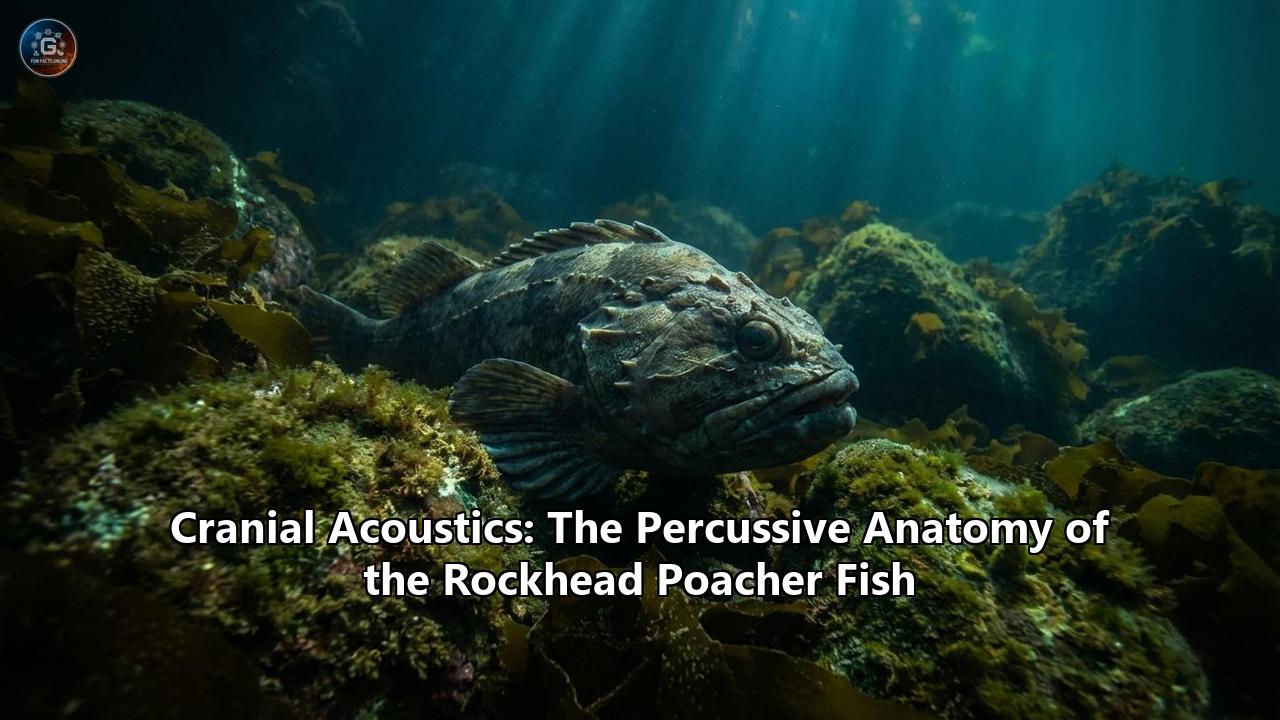
The crashing of waves, the grinding of coastal pebbles, and the relentless roar of the surf make the shallow intertidal zone one of the most acoustically chaotic environments on Earth. For marine animals attempting to communicate, trying to be heard in this watery din is akin to whispering in a crowded, heavy metal nightclub. Yet, evolution is a master problem-solver, often engineering bizarre and beautiful adaptations to overcome environmental hurdles. Enter a tiny, unassuming fish that has bypassed the problem of underwater noise entirely by evolving what scientists believe is a built-in percussion instrument right inside its skull,.
Meet Bothragonus swanii, commonly known as the rockhead poacher. Measuring a mere 3.5 inches (8.9 centimeters) in length, this teardrop-shaped, heavily armored bottom-dweller makes its home along the eastern Pacific coast, from the icy waters of Alaska down to Carmel Bay in California,. First described by Austrian ichthyologist Franz Steindachner in 1876, the fish is an undisputed master of camouflage,. Covered in rigid, bony plates, it spends most of its life resting motionless on the seafloor or hiding in tidepools, blending perfectly with the surrounding rocks and sponges while waiting to ambush passing benthic shrimp and crabs,,.
But the rockhead poacher harbors an anatomical secret that has baffled naturalists and marine biologists for more than a century: a massive, cavernous crater sitting squarely on top of its head,.
The Mystery of the Missing Skull
To look at a rockhead poacher from above is to look at a creature that appears to be missing a crucial piece of its anatomy. "It looks like the fish has a large chunk of its skull missing—as though somebody took a little ice cream scoop and took a piece of it away," explained Daniel Geldof, a functional morphologist and researcher whose master's thesis at Louisiana State University (LSU) brought this fish's bizarre anatomy to light,,.
This deep, bowl-shaped cavity—known scientifically as the cranial pit—is an extreme evolutionary oddity,. It is proportionately enormous, occupying a volume roughly equivalent to the fish's entire brain,. For over a hundred years, ichthyologists have stared at this hollow divot and proposed a myriad of theories to explain its existence,. Early naturalists suggested the pit was simply a structural adaptation to enhance the fish's rocky camouflage, breaking up its silhouette against the sea floor,. Others speculated it might be a sensory dish acting like a biological radar to gather sound, or a specialized organ for detecting minute changes in water pressure,,.
The difficulty in testing these theories lay in the fish's elusive nature and small size. Finding rockhead poachers requires painstakingly combing through treacherous, rocky intertidal zones. Researchers often have to form a "bucket brigade" during low tide, manually draining massive permanent tidepools until only a puddle remains, just on the off-chance of uncovering a few confused, perfectly camouflaged rockheads,. Even when specimens were acquired, dissecting such a tiny, heavily armored skull risked destroying the delicate, microscopic structures inside,.
The true function of the cranial pit remained locked away—until the advent of modern high-resolution imaging,.
Peering Inside: The Micro-CT Revolution
To solve the mystery without destroying the rare specimens, Geldof and his colleagues at LSU utilized a 5,000-pound Heliscan MKII X-ray microscope. By performing high-resolution micro-computed tomography (micro-CT) scans and contrast-agent enhanced soft-tissue scans, the research team was able to digitally reconstruct the rockhead poacher's anatomy in breathtaking three-dimensional detail,,.
The resulting digital models allowed the researchers to peel back the fish's biological layers virtually, tracing the intricate pathways of bones, muscles, tendons, and individual nerves,. When they zoomed in on the cranial pit, they found that it was not just empty space, nor was it a simple indentation for camouflage,. It was a highly specialized, complex biomechanical chamber,.
Cranial Acoustics: A Built-In Drum Kit
The most stunning revelation from the micro-CT scans was the discovery of what Geldof refers to as a "smoking gun" for sound production. Directly beneath the cranial pit, the rockhead poacher possesses a set of anatomical tools that look less like typical fish anatomy and more like a musical instrument,.
In most fish, the ribs are relatively uniform and attached firmly to the spine. However, the micro-CT models revealed that the rockhead poacher’s first set of anterior ribs are drastically modified,. They are unusually dense, greatly enlarged, and heavily flattened,,. More importantly, they are highly mobile, sitting completely free from direct attachment to the spine, yet moored tightly to the base of the cranial pit by incredibly powerful muscles and thick tendons,,.
The base of the cranial pit itself is uniquely mineralized, forming a hard, bony dish that is significantly denser than the surrounding skull walls,.
When these anatomical pieces are put together, the function becomes startlingly clear: the fish's modified, muscularly controlled ribs act exactly like drumsticks,,.
Geldof's research hypothesizes a mechanism known as stridulation—where an animal produces sound by rubbing or striking distinct body parts together,. By contracting its powerful specialized muscles, the rockhead poacher can rapidly strike its flattened ribs against the hardened underside of the cranial pit,. The pit acts as a resonating chamber, essentially turning the fish's head into a biological drum kit or a maraca,.
While direct underwater audio recordings of this drumming in the wild have yet to be captured due to the sheer difficulty of isolating sounds in the pounding surf, the physical evidence is palpable,. Anyone who has handled a live rockhead poacher can attest to its percussive power. "If you pick up a poacher underwater, it'll generally get annoyed and start 'talking'," Geldof noted. "It feels very similar to if you have a cell phone in your hand that's on vibrate mode",,. This vibration is the result of the ribs frantically beating against the skull, generating low-frequency pulses (estimated at around 20 Hz).
Substrate-Borne Communication: Why Drum?
Why would a fish need a drum built into its head? The answer lies in the harsh physics of its acoustic environment,.
In the turbulent, wave-battered shallows of the intertidal zone, attempting to communicate via traditional vocalizations (waterborne sound) is wildly inefficient,. The ambient noise of the crashing surf easily drowns out the subtle acoustic signals of a three-inch fish,. Furthermore, localizing the source of a sound underwater is notoriously difficult; the shallower the water, the more chaotic the acoustic reflections become as sound bounces unpredictably off rocks, the seafloor, and the water's surface,.
To bypass this aquatic static, the rockhead poacher likely uses its cranial drum to transmit signals through the ground,,. Sound waves travel much faster and with significantly less degradation through solid matter (like rocky substrates) than they do through churning water. Because the rockhead poacher is a benthic fish—spending nearly all its time resting directly on the rocky sea floor—it is perfectly positioned to utilize substrate-borne communication,,.
By vigorously drumming its ribs against its skull, the fish sends localized, seismic vibrations down through its body and directly into the rock it rests upon,. These subterranean pulses can be felt by other rockhead poachers resting on the same substrate, allowing them to communicate clearly without their signals being washed away by the roaring waves,.
This acoustic adaptation likely plays a vital role in the fish's social survival,. In an environment where visual cues are rendered useless by brilliant camouflage and murky waters, tactile and seismic acoustic signals are essential,. The rockhead's drumming is theorized to be used for territorial disputes, warning off rivals, or perhaps most importantly, transmitting courtship signals to potential mates during their January-to-May spawning season.
A Multitasking Marvel: The Sensory Function
While the discovery of the percussive anatomy is groundbreaking, the "hole truth" of the rockhead poacher is even more complex,. Nature rarely wastes space, and an anatomical feature the size of a fish's brain is unlikely to serve only one purpose. Geldof’s detailed scans provided strong evidence that the cranial pit is actually a multifunctional organ, serving as both a transmitter and a highly sensitive receiver,,.
When researchers traced the intricate wiring of the fish's nervous system, they discovered that a distinct branch of the posterior lateral line nerve routes directly into the cranial pit,,. In fish, the lateral line is a critical sensory system used to detect minute changes in water pressure and motion, alerting them to the presence of nearby predators or prey,.
Looking closer at the internal surface of the pit, the micro-CT scans revealed a complex micro-landscape,. "When you zoom in, it becomes clear that there are lots of tiny structures within the fish's bizarre head-hole," Geldof explained. "There are visually obvious rods... and extremely tiny spines of bone, all pointing inwards",.
These inward-pointing microstructures are believed to be heavily innervated mechanoreceptors,. As ocean currents and tidal surges flow over the top of the fish's head, water naturally swirls into and out of the deep cranial bowl,. The tiny bony spines likely bend and vibrate with the moving water, allowing the fish to precisely sense the direction and velocity of water currents, or detect the subtle hydrostatic pressure waves created by the movement of an approaching crab or a looming predator,,.
In this light, the cranial pit is a biological marvel of engineering: it is simultaneously a heavily armored shield, a percussive resonating chamber for seismic communication, and a highly tuned satellite dish for detecting microscopic shifts in the fluid environment,,.
Broader Implications: What a Fish Can Teach Us
The revelation of the rockhead poacher's cranial acoustics is more than just a fascinating piece of marine trivia; it represents a stunning example of convergent evolution and biological ingenuity.
The study of such fringe cases in vertebrate morphology opens new doors for scientific and technological advancement. Biomechanists and engineers are already taking note of the rockhead poacher's unique adaptations,. Understanding exactly how this tiny fish generates and propagates low-frequency seismic vibrations through complex, noisy environments could eventually inform the design of advanced underwater human communication systems,. Substrate-based acoustic transmission is an area of growing interest for marine engineers attempting to map the seafloor or communicate with deep-sea submersibles in turbulent coastal waters.
Furthermore, the discovery underscores the sheer volume of unexplored biodiversity lurking right off our coastlines,. "This is how spectacular, unexpected discoveries begin," Geldof noted,. The fact that a fish possessing a built-in skull drum has been hiding in plain sight in the tidepools of the Pacific Northwest for over a century serves as a humbling reminder of how much of the ocean’s inner workings remain entirely unknown to science.
The Symphony of the Tidepool
The next time you walk along a rocky Pacific beach at low tide, looking out over the crashing surf and the seemingly still tidepools, consider the invisible world vibrating just beneath the surface. In the acoustic chaos of the intertidal zone, life finds a way to speak,.
Hidden among the kelp and the sponges, wearing a suit of stone-like armor, the tiny rockhead poacher refuses to be silenced by the ocean's roar,. By turning its own skeleton into an instrument and the very seafloor into an amplifier, Bothragonus swanii beats its head to the rhythm of its own survival, proving that sometimes, you really do need a hole in the head to make your voice heard,.
Reference:
- https://www.zmescience.com/ecology/animals-ecology/scientists-finally-think-they-know-why-this-fish-has-a-hole-in-its-head/
- https://www.sci.news/biology/rockhead-poacher-fish-cranial-pit-14481.html
- https://www.discoverwildlife.com/animal-facts/marine-animals/rockhead-poacher
- https://en.wikipedia.org/wiki/Bothragonus_swanii
- https://www.iflscience.com/rockhead-poacher-fish-appear-to-communicate-by-using-their-ribs-to-play-their-heads-like-a-drum-82220
- https://nautil.us/this-fish-really-does-need-a-hole-in-its-head-1262497
- https://www.sciencenews.org/article/rockhead-poacher-fish-play-hole-drum
- https://repository.lsu.edu/gradschool_theses/6270/
- https://timesofindia.indiatimes.com/etimes/trending/meet-the-rockhead-poacher-the-fish-with-a-mysterious-hollow-in-its-skull/articleshow/126511147.cms
- https://tut.az/en/this-is-interesting/scientists-discovered-a-fish-that-uses-its-head-as-a-musical-drum
- https://www.reddit.com/r/ScienceUncensored/comments/1q9r3sz/why_the_rockhead_poacher_fish_actually_needs_a/