
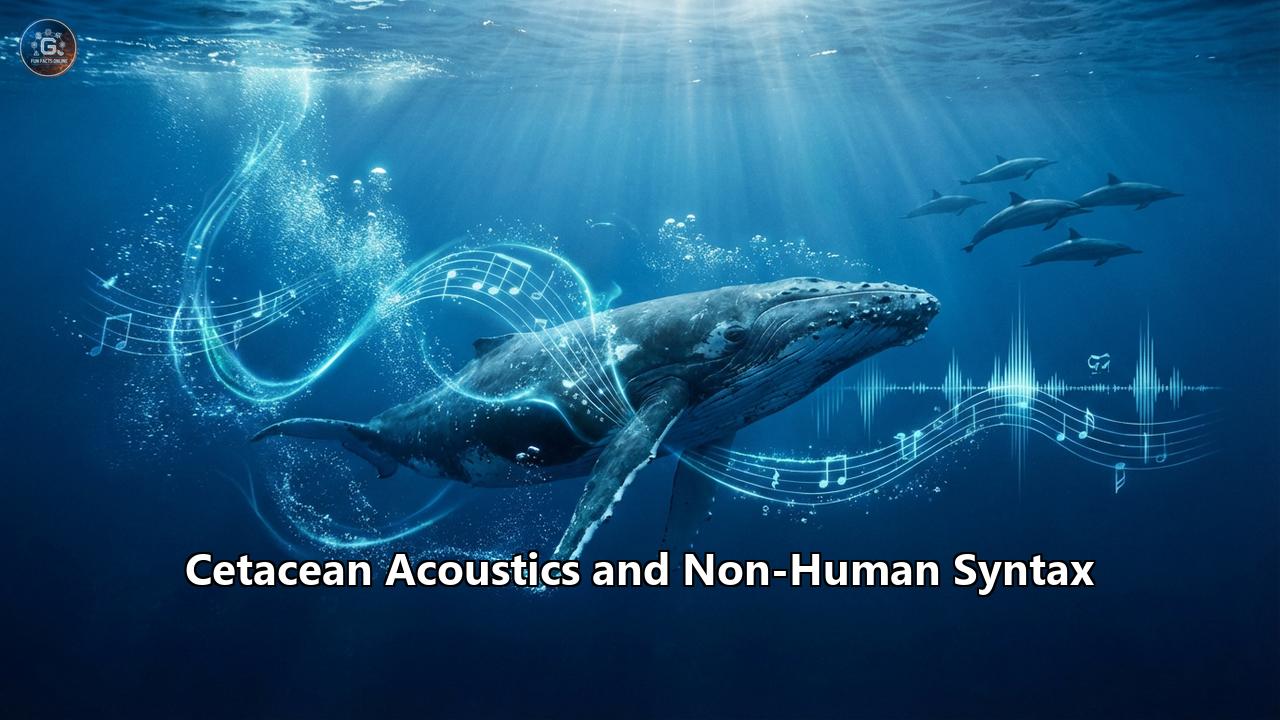
The ocean is not silent. Beneath the rolling waves, in the crushing darkness where sunlight fades to black, a cacophony of clicks, whistles, moans, and booms creates a soundscape as complex and vibrant as any rainforest. For centuries, humanity looked at the ocean and saw a void, a silent blue expanse. We were wrong. We share this planet with intelligences that have been communicating across vast distances for millions of years before the first word was spoken by a human.
We are standing on the precipice of a revolution in our understanding of life on Earth. Through the convergence of marine biology, linguistics, and artificial intelligence, we are finally beginning to parse the syntax of the sea. This is not just about recording "animal noises"; it is about decoding a non-human culture, a sophisticated system of communication that possesses grammar, dialects, names, and perhaps, a form of oral history passed down through generations.
This article explores the cutting-edge science of cetacean acoustics, from the biomechanical marvels that produce these sounds to the intricate syntax that structures them, and the recent AI-driven breakthroughs that suggest we may soon be able to "speak" to the whales.
Part I: The Instrument – The Biomechanics of Underwater Sound
To understand the language, one must first understand the instrument. Sound travels more than four times faster in water than in air, preserving its energy over thousands of kilometers. Cetaceans—whales, dolphins, and porpoises—have evolved not just to live in this medium, but to master it. Their bodies are biological subwoofers and synthesizers, capable of producing sounds ranging from the ultrasonic clicks of a harbor porpoise to the infrasonic rumble of a blue whale, which can circumnavigate the globe.
The Odontocetes: The Click and the Whistle
The toothed whales (Odontocetes), which include sperm whales, orcas, and all dolphin species, are the masters of high-frequency precision. Unlike humans, who produce sound by passing air over vocal cords in the larynx, toothed whales have evolved a mechanism that is far more alien.
They generate sound through phonic lips (also known as "monkey lips"), a set of muscular structures located in the nasal passage just below the blowhole. As air is forced past these lips, they snap together, creating a vibration. But the magic happens next. This vibration is not sent out into the water directly; it is transmitted through the melon, a fatty, oil-filled organ on the animal's forehead. The melon acts as an acoustic lens, focusing the sound into a tight, directional beam. This allows a dolphin to "flashlight" the dark ocean with sound, inspecting a fish’s swim bladder or a buried crab with surgical precision.
But they do not just click; they whistle. Dolphins possess a dual-source vocalization capability. They can produce echolocation clicks with one set of phonic lips while simultaneously producing tonal whistles with another, effectively allowing them to "talk" and "see" at the same time. This would be akin to a human holding a conversation while simultaneously screaming to map the room, without the two signals interfering.
The Mysticetes: The Deep Bass
The baleen whales (Mysticetes), such as the Humpback and Blue whale, operate on a different scale. Their world is one of low frequencies and massive wavelengths. They possess a larynx, but it lacks vocal cords. Instead, they have a U-shaped fold of tissue and a massive laryngeal sac.
When a humpback sings, it does not exhale. It recycles air between its lungs and this laryngeal sac, driving the U-fold to vibrate. This closed-loop system allows them to sing for 20 minutes or more without surfacing for a breath, resonating their massive chests to project songs that can be heard by other whales hundreds of miles away. The efficiency of this system is terrifyingly perfect; almost no energy is lost, allowing these leviathans to fill entire ocean basins with their songs.
Part II: The Code – Syntax, Structure, and Grammar
For decades, the assumption was that these sounds were emotional outbursts—simple signals for "food," "danger," or "mate." We now know this view is dangerously reductive. Cetacean communication exhibits syntax: a set of rules that governs how sound units are combined to create meaning.
The Humpback: Hierarchical Composers
The song of the male Humpback whale is perhaps the most famous piece of non-human music. But it is not just a melody; it is a rigid hierarchical structure.
In the 1970s, Roger Payne and Scott McVay discovered that these songs are not random. They are built like a language:
- Units: The fundamental building blocks—individual whoops, moans, or chirps.
- Phrases: A specific sequence of units repeated for 15-20 seconds.
- Themes: A set of identical phrases repeated several times.
- Song: A collection of 5 to 7 themes sung in a specific order.
A whale will sing this song, surface to breathe, and then pick up exactly where it left off, or restart the cycle. The complexity lies in the evolution. Over the course of a breeding season, the song changes. One unit might drop in pitch; a phrase might be truncated. Every male in the population makes these changes in lockstep. It is a cultural display of conformity, a choir that rewrites its sheet music as it sings.
However, a new theory, the Heterarchical Model, challenges the traditional linguistic view. Proposed by researchers like Eduardo Mercado III, this model suggests that the "grammar" of the song is driven by physiological constraints—the need to manage oxygen levels and air pressure during a dive—rather than an attempt to convey a specific message. In this view, the song is less like a sentence and more like a physical workout routine, where the "syntax" is determined by the limits of the whale's breath. The debate between these two models—Song as Language vs. Song as Physiology—is one of the most heated in bioacoustics.
The Sperm Whale: The Phonetic Alphabet
If Humpbacks are the opera singers, Sperm whales are the Morse code operators. Their communication consists almost entirely of codas—rhythmic patterns of clicks.
For years, these sounded like static to human ears. But in 2024 and 2025, the Project CETI (Cetacean Translation Initiative) team made a breakthrough that shook the foundations of linguistics. Using advanced AI to analyze thousands of hours of recordings from the Dominica Sperm Whale Project, they discovered that these clicks are not binary.
They found a Sperm Whale Phonetic Alphabet.
By removing the silence between the clicks and analyzing the spectral properties of the sound, they realized the whales were modulating the frequency of the clicks to create "vowel-like" structures. They identified an "a-vowel" and an "i-vowel," along with diphthongs (combinations of vowels).
Furthermore, they discovered Rubato and Ornamentation.
- Rubato: The whales subtly speed up or slow down the tempo of a coda, changing its "feel" or meaning.
- Ornamentation: They add extra "grace notes" or clicks at the end of a coda.
This means a standard "5R" coda (five regularly spaced clicks) isn't just one word. Depending on the vowel intonation, the tempo (rubato), and the ornamentation, that single rhythm could have dozens of different meanings. It is a combinatorial coding system, much like human phonemes combining into words.
The Dolphin: Names and Words
Bottlenose dolphins have arguably the most documented "language" of any cetacean. We have known for decades that they possess Signature Whistles. In the first few months of life, a dolphin invents a unique whistle that acts as its name. They use this whistle to broadcast their identity ("I am here") and, crucially, they address others by mimicking their whistles ("Hey, Bob!").
But the recent "Sarasota Bay Study" (2024/2025) has cracked the code on Non-Signature Whistles (NSWs). For years, these "other" whistles were dismissed as noise. But by analyzing the context of thousands of interactions, researchers found that specific NSWs are shared across the entire community and carry stable meanings. One specific whistle curve means "alarm/danger," while another functions as a "query" or check-in.
This is the holy grail of animal communication: referential signaling. These are not just names; they are common nouns or verbs, shared words that allow for a level of abstract communication we are only beginning to fathom.
Part III: Culture – Dialects and Revolutions
Language is the vessel of culture, and cetaceans have culture in spades. This is nowhere more evident than in the phenomenon of Song Revolutions and Tribal Dialects.
The Cultural Revolution of the Pacific
In the vast expanse of the Pacific Ocean, a cultural wave travels from west to east. Humpback whales in Western Australia sing a specific song. Over the course of a year, some of those males migrate to Eastern Australia, bringing their song with them.
The local males in Eastern Australia hear this new tune—the "latest hit"—and they abandon their old song entirely to adopt the new one. This "Song Revolution" then ripples across the Pacific to New Zealand, Tonga, the Cook Islands, and finally, French Polynesia and Ecuador.
It is a striking example of horizontal cultural transmission. It’s not genetic; it’s learned. And it’s fast. In one documented case, a completely new song replaced an old one across the entire South Pacific in just two years. The drive for novelty—to sing the "cool new song"—overrides the tradition, a behavior that feels startlingly human.
The Orca Clans: Dialects of the Residents
In the cold waters of the Pacific Northwest, the Killer Whales (Orcas) present a different kind of linguistic culture. Here, we see a stark divide between two sub-species: the Residents (fish-eaters) and the Transients (mammal-eaters).
The Southern Resident Orcas are divided into three pods: J, K, and L pods. Each pod has its own distinct dialect.
- J Pod is known for the "S01" call, a specific sequence of pulsed calls that is their acoustic badge of honor.
- K Pod favors the "S16" call.
- L Pod uses the "S19".
A whale from J pod can communicate with L pod—they speak the same "language"—but they speak it with a heavy "accent." This dialect is learned from the mother. An orca calf does not chirp random sounds; it mimics the specific pulsed calls of its matriline. If a calf is born into J pod, it learns J pod slang.
In contrast, the Transient (Bigg's) orcas are almost silent. Because their prey (seals, porpoises) have excellent hearing, Transients hunt in stealth. They only vocalize after a kill, during a "party" of celebration. Their dialect is entirely different from the Residents; the two groups have not shared a language—or a gene pool—for hundreds of thousands of years, despite swimming in the same waters. They are two alien cultures passing in the night.
Part IV: The Rosetta Stone – AI and the Future
We are currently living through the "Golden Age" of cetacean research, driven not by submersibles, but by Artificial Intelligence.
The sheer volume of data—millions of hours of hydrophone recordings—was previously impossible for humans to analyze. But Machine Learning (ML) thrives on patterns.
Generative Adversarial Networks (GANs), the same technology used to create Deepfakes, are now being used to hallucinate whale sounds. By training a GAN on sperm whale codas, researchers at Project CETI asked the AI to "complete the sentence." If the AI can accurately predict the next click in a sequence, it means it has "learned" the grammar.The results are staggering. The AI models picked up on the subtle "vowel" structures in sperm whale clicks that human ears had missed for 50 years. They are identifying the "syntax of context"—how a whale changes its grammar when it is diving versus when it is socializing.
We are building a Rosetta Stone. The goal is not just to translate "whale to English," but to understand the Umwelt—the worldview—of an aquatic intelligence.
The Dolphin Singularity
Futurists and biologists have begun to whisper about the "Dolphin Singularity." As our AI translation tools improve, we approach a threshold where two-way communication becomes possible. Imagine an underwater speaker playing back a synthesized sperm whale "vowel" sequence that asks a question, and receiving a coherent answer.
It sounds like science fiction, but the "conversation" recorded in 2016 between two Black Sea dolphins, Yasha and Yana, already hinted at this. They waited for each other to finish "speaking" before responding, exchanging pulses in packets of five "words." They were polite. They were structured. We just didn't know what they were saying.
Conclusion: The Mirror in the Water
Why does this matter? Why spend millions decoding the clicks of a sperm whale?
Because for our entire history, we have searched for intelligence in the stars. We built radio telescopes to listen for a signal from the cosmos, desperate for proof that we are not alone in the universe.
All the while, in the darkness of our own oceans, a complex, cultured, grammatical intelligence has been singing. They have names. They have dialects. They have songs that sweep across oceans like wildfire. They have vowels and grammar and etiquette.
Decoding cetacean syntax is more than a scientific pursuit; it is a humbling re-evaluation of humanity's place on Earth. We are not the only thinkers, the only speakers, or the only singers. We are simply the ones who finally learned to listen. As we peer into the blue abyss, we are finding that the "alien" intelligence we sought was swimming alongside us all along.
Reference:
- https://www.researchgate.net/publication/340438141_CHARACTERIZATION_OF_THE_HIERARCHICAL_LEVELS_THAT_COMPOSE_MEGAPTERA_NOVAEANGLIAE_SONG_IN_THE_ABROLHOS_BANK_BRAZIL_BETWEEN_2005_AND_2016
- https://www.universityofcalifornia.edu/news/uc-berkeley-and-project-ceti-study-shows-sperm-whales-communicate-ways-similar-humans
- https://www.popsci.com/environment/sperm-whale-language-vowels/
- https://www.discovermagazine.com/sperm-whale-clicks-may-be-more-complex-than-once-thought-and-similar-to-human-language-48359
- https://www.whoi.edu/press-room/news-release/dolphin-award/
- https://reddingtimes.com/sperm-whale-communication-like-human-vowels-say-uc-berkeley-project-ceti/